
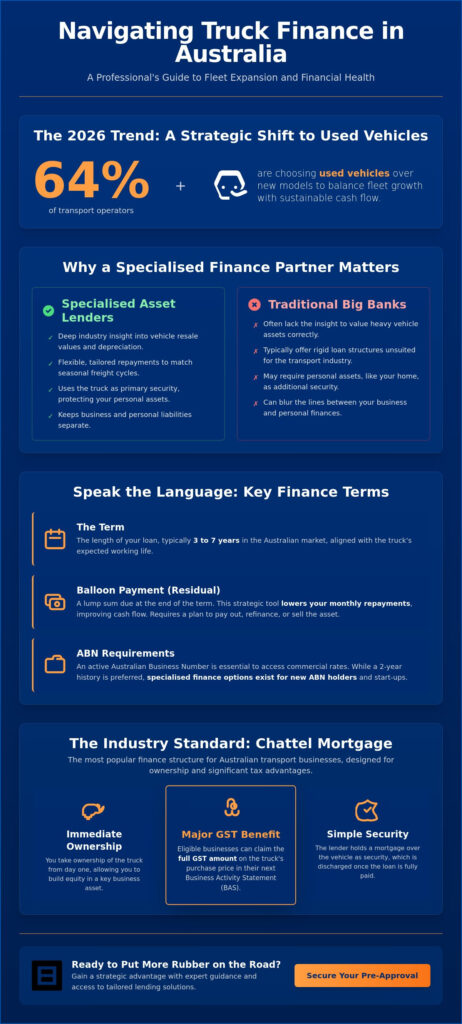
Did you know that nearly 64% of Australian transport operators securing financing for trucking in 2026 are choosing used vehicles over brand-new models? It is a strategic shift that reflects the current economic climate, where balancing fleet growth with sustainable cash flow has never been more critical. You likely recognise that adding a heavy vehicle to your business is the fastest way to scale, yet the high upfront costs and the confusing choice between chattel mortgages and leases can feel incredibly daunting.
We understand that the fear of a massive balloon payment or the struggle of proving income as a new ABN holder can stall your ambitions. This guide is designed to replace that uncertainty with a clear, professional roadmap to loan approval. You will learn how to structure your finance to maximise tax benefits and gain the insights needed to negotiate with lenders from a position of strength, ensuring you stay in control of your business’s financial health.
We will break down the essential loan types, explain how to navigate the application process seamlessly, and highlight how upcoming regulatory changes in August 2026 will impact your fleet’s operational costs. It is time to move from uncertainty to a place of streamlined confidence as you prepare to put more rubber on the road.
Key Takeaways
- Learn why specialised asset finance is superior to traditional bank loans for heavy vehicles and how to choose a structure that aligns with your ownership goals.
- Identify the 2026 eligibility requirements for financing for trucking, including how new business owners with a fresh ABN can still successfully secure approval.
- Master the documentation and pre-approval process to ensure you can walk into a dealership with the confidence and “inside access” of a seasoned fleet operator.
- Discover how to navigate the differences between chattel mortgages and leases to maximise your tax benefits and protect your cash flow.
- Understand the strategic advantage of using an expert guide to access wholesale rates and tailored lending solutions that aren’t available on the open market.
Table of Contents
- Understanding the Basics of Financing for Trucking in Australia
- Choosing the Right Finance Structure for Your Transport Business
- Navigating Eligibility: What Lenders Look for in 2026
- Step-by-Step: How to Apply for and Secure Truck Finance
- Why a Specialist Broker is Your Best Asset for Fleet Expansion
Understanding the Basics of Financing for Trucking in Australia
Financing for trucking is more than a simple debt; it’s a strategic method for putting a revenue-generating asset to work. This is a specific category of commercial finance that treats the vehicle as a business tool rather than a personal expense. You’ll likely find that traditional big-four banks are often ill-suited for the logistics sector. They frequently lack the industry insight to understand why a five-year-old prime mover is a sound investment, whereas specialised lenders see the immediate potential for profit and fleet growth.
A major benefit of this approach is using the truck itself as the primary security. This structure protects your personal assets, like the family home, and keeps your business debt distinct. It also ensures you don’t exhaust your working capital. Every operator knows that cash flow is the lifeblood of the business, especially when facing rising fuel levies or an unexpected gearbox failure. By financing the purchase, you keep your cash reserves available for these day-to-day operational needs, ensuring you aren’t “asset rich but cash poor.”
Why Specialised Truck Finance Matters
Specialist lenders provide a level of “inside access” that generalist banks can’t match. They possess a deep understanding of heavy vehicle resale values and depreciation cycles across different makes and models. This insight allows them to offer tailored repayments that can be organised to match seasonal freight cycles. If your revenue fluctuates during the harvest or the Christmas rush, your finance can be structured to reflect those changes. This flexibility is a hallmark of professional asset finance, ensuring your business remains resilient regardless of the month while keeping your personal and business liabilities separate.
Key Terms You Need to Know
To navigate the market with confidence, you need to speak the language of the lenders. Understanding these three pillars will help you secure a better deal:
- The Term: This refers to the length of your loan. In the Australian market, this typically ranges from three to seven years, allowing you to align the debt with the expected working life of the truck.
- Balloon Payments: Often called a residual, this is a lump sum due at the end of the term. It lowers your monthly commitment, which helps with cash flow, but you’ll need a plan to either pay it out, sell the asset, or refinance it when the time comes.
- ABN Requirements: To access commercial interest rates for financing for trucking, you must have an active Australian Business Number. While many lenders prefer a two-year history, there are options available for new start-ups with a fresh ABN.
Choosing the Right Finance Structure for Your Transport Business
Selecting the right finance structure is just as critical as choosing the right truck for the job. Many operators make the mistake of chasing the lowest interest rate without considering how the loan is organised. In reality, the “cheapest” headline rate could cost you more in lost tax benefits or restricted cash flow if the structure doesn’t suit your business model. When you’re looking at financing for trucking, you need a solution that aligns with your accounting practices and your long-term plans for fleet expansion.
The choice between owning the asset or leasing it impacts your balance sheet, your GST claims, and your ability to upgrade equipment. Every transport business has different needs. A solo driver-operator might prioritise ownership to build equity, while a growing company might prefer the flexibility of regular upgrades to stay competitive. Understanding these differences is a foundational part of learning how to get a business loan that strengthens your financial position rather than just adding another monthly bill.
Chattel Mortgage: The Industry Standard
This is the most popular choice for Australian transport businesses for a reason. Under a chattel mortgage, you take ownership of the truck at the start of the agreement, while the lender holds a mortgage over it as security. The primary drawcard here is the GST benefit. Most businesses can claim the full GST on the truck’s purchase price as an Input Tax Credit in their next Business Activity Statement. This provides an immediate cash flow injection that can be used to fund initial insurance costs or fuel reserves. It’s a straightforward, efficient option that works well for businesses on a cash accounting basis.
Finance Lease vs. Operating Lease
If you prefer a “rent-to-own” style, a finance lease might be more appropriate. The lender retains ownership during the term, and you make regular payments for the use of the vehicle. At the end of the term, you have the option to pay a residual amount to take ownership. If you’d rather upgrade your fleet every few years to keep your maintenance costs low and your technology current, an operating lease is a smart alternative. This functions like a long-term rental where the truck is returned at the end of the period. This can sometimes be kept “off-balance sheet,” which may improve your business’s financial ratios. If you’re ready to see which structure fits your goals, exploring tailored vehicle finance options can help you make an informed decision with confidence.
Navigating Eligibility: What Lenders Look for in 2026
Meeting lender criteria for financing for trucking in 2026 is less about ticking boxes and more about demonstrating a sustainable business model. While many competitors suggest that a “no financials” loan is the only path for transport operators, the reality is more nuanced. You essentially have two main routes: “Low Doc” and “Full Doc” applications. A Low Doc application is ideal for established operators who have an active ABN and a clean credit history but haven’t finalised their latest tax returns. In contrast, a Full Doc application requires comprehensive profit and loss statements. While it takes more effort to prepare, it often unlocks the most competitive rates for those with complex financial structures or those seeking the highest possible loan amounts.
The truck itself acts as a silent partner in your application. Lenders scrutinise the age and condition of the vehicle because it serves as the loan’s security. If you’re looking at a truck over ten years old, expect the lender to apply a small “loading” to the interest rate, often between 0.5% and 1.5%. They prefer assets with high resale value. This is why a well-maintained, late-model vehicle from a reputable dealer often secures faster approval and better terms than a private sale on an older rig. Lenders want to know that if things go wrong, the asset still holds significant value on the secondary market.
The Power of a Clean Credit Profile
Your personal credit score is often the first thing a lender reviews, even for a commercial loan. It acts as a barometer for how you’ll handle business debt. Before you apply, take the time to organise your finances by clearing any small, outstanding defaults or credit card balances. If you’re “asset-backed”—meaning you own or are paying off a home—lenders view you as a significantly lower risk. This status can often be the deciding factor in securing a “best-in-class” rate because it signals long-term financial stability and shows you have “skin in the game.”
New Entrants and Start-up Financing
Starting a transport business with a fresh ABN doesn’t mean you’re locked out of the market. Lenders are increasingly willing to support new entrants who can prove their industry expertise. If you have several years of experience as an employee driver or a signed contract with a major freight provider, you’re in a much stronger position. The Owner-Driver Truck Finance Guide from the ATA highlights that showing a clear business plan is essential for startups. Additionally, offering a larger deposit can mitigate the lender’s risk and move your application from a state of uncertainty toward streamlined confidence and approval.
Step-by-Step: How to Apply for and Secure Truck Finance
Securing financing for trucking shouldn’t feel like a high-stakes gamble. By following a structured sequence, you move from a state of uncertainty to one of streamlined confidence. The process begins long before you set foot on a dealership lot. It starts with establishing your financial boundaries. When you approach the market with a clear roadmap, the entire experience becomes stress-free, allowing you to focus on what matters most: getting your new asset on the road and generating revenue.
The journey from application to settlement typically follows four distinct stages. First, you prepare your documentation, including your ABN, identification, and relevant financial statements. Second, you secure a pre-approval. Third, you identify the specific vehicle and obtain a formal tax invoice. Finally, the lender conducts a valuation of the asset before settling the funds directly with the supplier. This professional approach ensures that every stakeholder is protected and that your business is positioned for sustainable fleet growth.
Phase 1: Preparation and Pre-Approval
Before you start browsing listings, it’s vital to understand your “repayment ceiling.” You should use a truck loan calculator to test your cash flow against different scenarios. This tool allows you to see how different interest rates and terms impact your monthly bottom line. By doing this early, you avoid the trap of over-leveraging your business. Having a pre-approval in your pocket provides a significant advantage. It acts as “inside access” when negotiating with dealers, as it proves you’re a serious buyer with the backing of a professional lender. It simplifies the conversation and often leads to a more efficient purchase process.
Phase 2: Finalising the Deal
Once you’ve found the right rig, the focus shifts to the asset’s quality. For used trucks, a thorough mechanical inspection is essential. Lenders need to be certain the vehicle is in good working order before they finalise the loan. You’ll also need to ensure your comprehensive insurance policy is “noted” with the lender’s interest before settlement can occur. This is a standard requirement that protects both you and the financier. On “Settlement Day,” the process is remarkably seamless. The lender pays the supplier directly, and you’re cleared for delivery. Just be sure to review your loan offer one last time, ensuring the balloon payment at the end of the term is manageable and fits your future refinancing or replacement strategy. If you’re ready to take the first step, you can explore our tailored finance solutions to find a structure that fits your specific business dream.
Why a Specialist Broker is Your Best Asset for Fleet Expansion
Securing financing for trucking shouldn’t be a solitary burden that keeps you off the road and away from your core business. While a local bank branch offers a limited menu of generic products, a specialist broker provides a gateway to the broader Australian lending market. We act as your high-level fixer, leveraging our deep relationships to secure wholesale rates that are generally unavailable to the public. Our goal is to ensure you stay in the driver’s seat while we manage the complexities of the banks, transforming a potentially stressful process into a seamless transition for your business. We believe you should be in good hands, with a partner who prioritises your specific fleet goals over a simple transaction.
A professional broker doesn’t just look for the next loan; we structure your finance for long-term scalability. Every truck you add to your fleet impacts your overall borrowing capacity and tax position. By taking a holistic view of your operation, we ensure that the way you finance your second or third vehicle doesn’t limit your ability to add the tenth. This strategic approach provides the “inside access” you need to navigate the lending landscape with confidence, ensuring your business remains agile and ready to capitalise on new freight opportunities as they arise.
Accessing a Panel of 2026 Lenders
One bank’s “no” is just a starting point, not a dead end. Our panel of 2026 lenders includes specialised financiers who understand the transport industry’s unique demands and the resale value of heavy assets. Our team doesn’t just submit forms; we curate your financial story. We utilise advanced matching technology to align your specific business profile with the lender most likely to offer a tailored approval. By carefully organising your application to highlight your strengths, we present the lowest possible risk to financiers. This proactive approach turns an impersonal digital portal into a human-led advisory experience that moves you from uncertainty toward a state of streamlined confidence.
Beyond the First Truck: Strategic Fleet Advisory
True fleet growth often requires more than just adding one prime mover at a time. It demands a seasoned partner who looks at the big picture. Perhaps your dream involves scaling through business acquisition funding to buy out a local competitor and instantly double your capacity. Or maybe you need working capital finance to cover the upfront costs of fuel and wages for a major new contract. Whatever your path, we provide the local insights and technical expertise to guide you. We’re here to be your expert guide for the life of your business, providing the “can-do attitude” required for situations that fall outside of the norm and ensuring your fleet is always positioned for success.
Drive Your Business Forward Today
Securing the right financing for trucking is the foundation of a successful transport operation. You’ve seen that choosing between a chattel mortgage and a lease is a strategic choice that impacts your GST claims and long-term fleet flexibility. By organising your documentation early and securing a pre-approval, you move from a state of uncertainty to one of streamlined confidence. Whether you’re a new ABN holder or an established fleet owner, the path to growth is clearer when you have a professional roadmap to follow.
As an award-winning business loan broker, we provide inside access to 2026’s best rates and use proprietary AI for faster, stress-free approvals. You don’t have to manage the complexities of the Australian lending landscape alone. We’re here to act as your expert guide, ensuring your business is in good hands every step of the way.
I’m interested in tailored truck finance solutions
Your dream of a larger, more efficient fleet is within reach. We look forward to helping you get those wheels turning.
Frequently Asked Questions
Can I get financing for trucking with a new ABN?
Yes, you can certainly secure approval even with a fresh ABN. While traditional banks often require two years of trading history, specialised lenders offer “new start” programs for operators who can demonstrate industry experience. If you’ve held a heavy vehicle licence for several years or have a signed work contract from a reputable freight company, you’re in a strong position to get started.
What is the difference between a chattel mortgage and a truck lease?
The primary difference lies in ownership and tax treatment. With a chattel mortgage, you own the vehicle from day one, which typically allows you to claim the full GST amount on your next Business Activity Statement. In a lease, the lender owns the truck and “rents” it to you for a set period. You’ll generally have the option to buy the asset at the end of the term by paying a residual amount.
Do I need a deposit for a commercial truck loan in Australia?
Not necessarily. Many established transport businesses and property owners can access 100% financing for trucking without an upfront deposit. If you’re a new entrant to the industry, providing a 10% or 20% deposit can be a smart move. It reduces the lender’s risk and can often help you negotiate a more competitive interest rate for your first vehicle.
How much does a balloon payment affect my monthly truck loan repayments?
A balloon payment significantly lowers your monthly outgoings by deferring a portion of the loan principal until the end of the term. For instance, setting a 30% balloon on a five-year loan can reduce your monthly bill by several hundred dollars. This improves your daily cash flow, though you’ll need a plan to pay the lump sum, sell the asset, or refinance when the term concludes.
Can I finance a used truck from a private seller?
You can finance a private sale, but the process involves a few extra safety checks. Lenders will usually require a professional mechanical inspection and a PPSR search to ensure the truck isn’t stolen or encumbered by another debt. Because of the extra administrative work involved, some lenders might apply a slightly higher interest rate compared to a dealership purchase.
How long does the truck finance approval process typically take?
Approval is often quite fast, usually taking between 24 and 48 hours once your documents are submitted. If you’re applying for a “Low Doc” loan for a late-model truck, you might even receive a response on the same day. More complex applications involving older vehicles or intricate company structures may take three to five business days to reach a final decision.
Will financing a truck affect my ability to get a home loan later?
It will be included in your total liabilities, which affects your debt-to-income ratio. However, because the truck is a revenue-generating tool, the income it produces is also factored into your future home loan application. Keeping your business and personal finances clearly separated through a professional loan structure makes it much easier for mortgage lenders to assess your true borrowing power.
What documents do I need to provide for a low-doc truck loan?
For a Low-Doc application, you’ll typically only need to provide your active ABN, a copy of your driver’s licence, and recent bank statements to verify your business turnover. You won’t usually need to produce full tax returns or audited profit and loss statements. This streamlined approach is designed to be stress-free, getting you behind the wheel with minimal paperwork.