
Did you know that as of May 2026, cash flow confidence among Australian SMEs has dropped to just 60%? It’s a frustrating reality for many local business owners. Your books might show a healthy profit, but your bank account tells a different story while you wait 30, 60, or even 90 days for debtors to pay. This lumpiness in cash flow often prevents growth and makes meeting new obligations, like the July 2026 Payday Super requirements, feel like a high-stakes hurdle. You’ve done the work, yet your capital remains out of reach.
We believe you shouldn’t have to wait for a slow bank application to access your own money. This guide will show you exactly how to use invoice finance australia to turn those outstanding invoices into immediate working capital without taking on traditional debt. You’ll learn how to set up a tailored, scalable facility that expands as your sales do, ensuring you always have the liquidity needed for payroll or ATO obligations. We’ll explore the best ways to maintain professional relationships with your clients while gaining the financial freedom to focus on your next big project.
Key Takeaways
- Understand how to bypass the 30, 60, or 90-day waiting game by using your accounts receivable as a revolving capital source for immediate liquidity.
- Discover the seamless process of invoice finance australia that integrates with your accounting software to unlock cash shortly after you issue a tax invoice.
- Learn the critical differences between factoring and confidential discounting to choose the strategy that best protects your professional debtor relationships.
- Review the essential eligibility criteria, such as B2B trade and GST registration, to ensure your Australian business is positioned for a successful application.
- Gain inside access to a panel of over 50 lenders, including boutique non-bank specialists that provide tailored facilities traditional banks often overlook.
Table of Contents
- What is Invoice Finance and How Does it Support Australian SMEs?
- How Invoice Finance Works: A Step-by-Step Breakdown
- Factoring vs. Discounting: Choosing the Right Strategy
- How to Qualify and Apply for Invoice Finance in Australia
- Why Partnering with a Broker Maximises Your Results
What is Invoice Finance and How Does it Support Australian SMEs?
For many Australian business owners, the gap between finishing a job and actually seeing the funds in the bank can feel like an eternity. This delay is the core of the cash flow challenge in our local B2B landscape. Invoice finance australia serves as a sophisticated revolving facility that allows you to use your accounts receivable as collateral. Rather than waiting for a customer to settle their bill, you can access a significant portion of that invoice’s value almost immediately. It is a strategic way to ensure your hard work translates into usable capital without the typical month-long wait.
The Australian B2B market is notorious for its extended payment cycles, where 30, 60, or even 90-day terms are standard. This “waiting game” often leaves businesses in a precarious position, especially when trying to meet day-to-day operational costs or manage BAS cycles. It’s vital to understand that this is a form of asset finance; you aren’t taking on a traditional unsecured company loan. Instead, you’re simply accelerating the arrival of money you’ve already earned. By leveraging your sales ledger, you can keep your momentum high even when your debtors are slow to move.
The Difference Between Invoice Finance and Traditional Business Loans
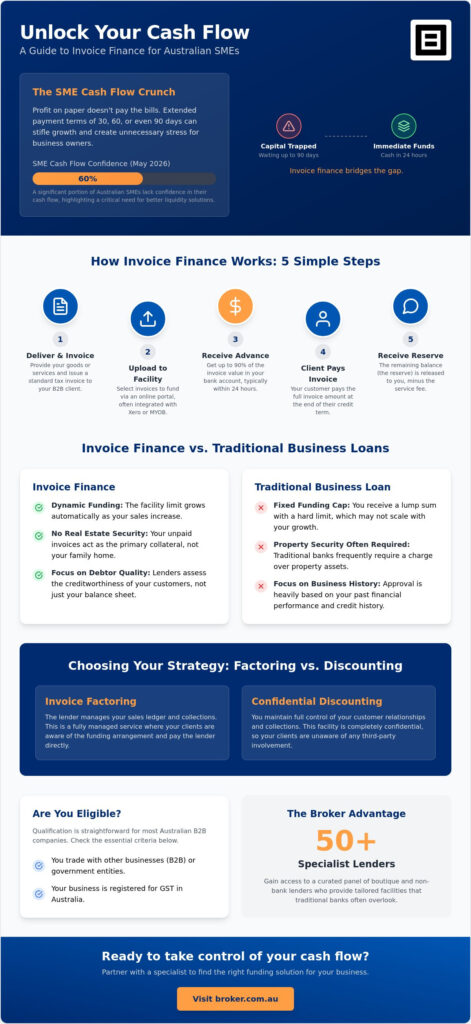
One of the most reassuring aspects of this facility is that it generally doesn’t require real estate security. Traditional bank loans often demand a charge over your family home, which adds a layer of personal anxiety to every business decision. With invoice finance, the security is the invoice itself. The funding limits are also dynamic. While a standard loan has a fixed cap, an invoice facility grows automatically as your sales increase. Furthermore, the lender focuses on the creditworthiness of your debtors rather than just your own balance sheet. If you’re interested in the technical mechanics, you can learn more about what is invoice factoring to see how these structures have evolved into the modern tools we use today.
Why Cash Flow is King in the 2026 Australian Economy
Navigating the 2026 economy requires a proactive approach to liquidity. With persistent inflationary pressures and occasional supply chain delays, having cash on hand is a massive competitive advantage. It allows you to negotiate early-settlement discounts with your own suppliers, which can often offset the cost of the finance facility itself. Maintaining this level of liquidity ensures you can handle unexpected hurdles without stress. Invoice finance is a liquidity tool that converts credit sales into immediate cash.
How Invoice Finance Works: A Step-by-Step Breakdown
Moving from a completed job to cash in hand should be a seamless experience. While traditional banks often wrap business funding in layers of red tape, the mechanics of invoice finance australia are built for speed and clarity. This facility acts as a bridge, ensuring your capital isn’t trapped in your sales ledger while you wait for customers to settle their accounts. The process is straightforward and designed to integrate quietly into your existing business rhythm.
- Step 1: Deliver and Invoice. You provide your goods or services as usual and issue a standard tax invoice to your B2B or government client.
- Step 2: Upload to the Facility. You select the invoices you wish to fund. Most modern platforms integrate directly with Xero or MYOB, making this step almost instantaneous.
- Step 3: Receive the Advance. The lender provides an upfront payment, typically between 80% and 90% of the invoice value. These funds usually land in your business bank account within 24 hours.
- Step 4: Debtor Settlement. Your client pays the invoice into a dedicated account at the end of their credit term. If you use a confidential facility, your client won’t even notice a change in your process.
- Step 5: Release of the Reserve. Once the client pays, the lender releases the remaining balance, known as the reserve, to you. This is the final portion of the invoice minus a small fee for the service.
The Role of Technology and AI in Modern Funding
The days of manual paper trails and phone tag with bank managers are over. Modern invoice finance australia providers use sophisticated cloud accounting integrations to make the entire workflow stress-free. By linking directly to your accounting software, these platforms offer real-time visibility of your available borrowing power. AI-driven credit assessments can now analyse the reliability of your debtors in seconds, which significantly speeds up approval times. This level of insight ensures you are always in control of your liquidity without the administrative burden.
Understanding the Cost Structure
The cost of an invoice facility is generally split into two parts: a discount rate and a service fee. The discount rate functions similarly to interest on the funds you’ve actually drawn, while the service fee covers the administration and maintenance of the facility. It’s helpful to view these costs through the lens of return on investment. If accessing cash 60 days early allows you to take on a larger contract or secure a bulk-buy discount from a supplier, the effective cost is often negligible compared to the growth it facilitates. If you’re curious about how this might look for your specific ledger, you can explore our tailored options to find the right fit. We always recommend looking for transparent structures that avoid hidden “unused facility” or “audit” fees to ensure your cash flow remains predictable.
Factoring vs. Discounting: Choosing the Right Strategy
While the core mechanics of invoice finance australia remain consistent, the specific structure you choose will define your daily relationship with your debtors. Choosing between factoring and discounting is a strategic decision that depends on your business’s maturity, the strength of your internal systems, and how much transparency you want with your clients. There is an outdated myth that using these facilities signals financial trouble. On the contrary, sophisticated lenders and tier-one clients now recognise that accelerating cash flow is a hallmark of a growth-ready, well-managed Australian enterprise.
The fundamental difference lies in who manages the sales ledger. In a factoring arrangement, the lender takes over the collections process, which means your customers are aware of the facility. In contrast, invoice discounting is confidential. You continue to manage your own collections, and your customers are none the wiser that you’ve accessed the funds early. This allows you to maintain the exact same professional facade while enjoying the liquidity benefits of invoice finance australia. Each path offers distinct advantages depending on your current operational capacity.
When to Choose Invoice Factoring
Factoring is often the ideal choice for smaller business owners or those experiencing rapid growth who haven’t yet scaled their internal finance department. By choosing factoring, you effectively outsource your accounts receivable function to professionals. This can be a massive relief for founders who would rather focus on operations than chasing late payments. The lender’s credit control team works to reduce your Days Sales Outstanding (DSO), ensuring that your capital isn’t tied up longer than necessary. It’s a highly efficient solution for businesses with a high volume of smaller invoices where manual follow-up would be too time-consuming.
When to Choose Invoice Discounting
Established companies with robust internal accounting teams usually prefer invoice discounting. The primary drawcard here is total confidentiality. Because you retain control over your sales ledger and collections, your professional relationships remain exactly as they were. This facility is seamless and sits quietly in the background of your business. It’s important to note that because the lender is not managing the collections, they typically require a higher level of financial stability. Major Australian banks often look for a minimum annual turnover of $1 million or more before approving a confidential discounting facility. It’s the “best in class” option for those who want the cash without changing their customer-facing processes.
How to Qualify and Apply for Invoice Finance in Australia
Securing the right facility requires more than just a healthy sales ledger. Navigating the Australian regulatory environment means you need to have your ducks in a row before approaching a lender. While the process is far more agile than a traditional bank loan, having a clear understanding of the specific criteria for invoice finance australia will ensure your application is seamless and stress-free. You’ve done the hard work of winning the contracts; now it’s about presenting that value to the right funder.
- Step 1: Entity Check. Ensure you have a valid Australian Business Number (ABN) and are currently GST registered. Lenders need to see that you are a legitimate, tax-compliant entity.
- Step 2: Verify Your Clients. Your invoices must be Business-to-Business (B2B) or Business-to-Government (B2G). The facility relies on the creditworthiness of your debtors.
- Step 3: Document Preparation. Organise your financial records. You’ll typically need your recent BAS statements and, most importantly, an up-to-date aged debtor trial balance.
- Step 4: Assess Concentration. Identify if you have ‘concentrated’ debtors. If one client makes up more than 30% of your total sales, some lenders may adjust your advance rate to manage risk.
- Step 5: Partner with an Expert. Engage a specialist broker to compare offers. We provide inside access to a panel of over 50 lenders, including boutique non-bank specialists that traditional banks often overlook.
The Minimum Requirements Checklist
Most lenders in the invoice finance australia space prefer a trading history of at least 6 to 12 months. However, if you are a “new start” business with high-quality B2B contracts, there are still flexible options available. The quality of your debtors is paramount; funders look for reputable Australian companies with a history of on-time payments. It’s also important to note that Business-to-Consumer (B2C) invoices are generally excluded. Because consumer law provides different protections for individuals, these invoices don’t offer the same security for a commercial finance facility.
Common Pitfalls to Avoid
One common hurdle involves progress claims within the construction industry. Because these invoices are subject to “pay when paid” clauses or potential disputes over work stages, they require specialised lenders who understand the sector’s unique risks. Additionally, outstanding ATO debt can be a major red flag. With the ATO taking a stricter enforcement stance in 2026, lenders will want to see a clear payment plan in place before approving your facility. Clean aged debtor reports are the #1 factor in securing low rates. If you want to see how your ledger stacks up, I’m interested in exploring my options with a tailored assessment.
Why Partnering with a Broker Maximises Your Results
Choosing a single bank for your funding needs limits you to one credit policy and one set of rates. In the diverse world of invoice finance australia, this approach often leads to missed opportunities or rigid facilities that don’t quite fit your business model. Partnering with a specialist broker changes the dynamic entirely. We provide access to a panel of over 50 lenders, including boutique non-bank specialists that traditional institutions simply won’t mention. These funders often have a higher appetite for specific sectors like recruitment or logistics, offering terms that are far more flexible than a standard corporate overdraft.
Our proprietary AI technology plays a critical role in this process. It matches your specific industry requirements to the funder most likely to provide an approval. This means you aren’t wasting time on applications that don’t align with a lender’s current preferences. We also provide inside access to the best rates. Because of the volume of business we facilitate, lenders often provide us with wholesale pricing that isn’t available to the general public. Our Stress-Free promise ensures that we handle the heavy lifting of negotiations and paperwork, allowing you to stay focused on running your business.
- Expert Matching: We align your business with lenders who understand your specific industry risks.
- Wholesale Access: We secure competitive rates through our established lender relationships.
- End-to-End Support: We manage the entire application process from initial inquiry to settlement.
Tailored Solutions vs. Off-the-Shelf Products
A major advantage of working with an expert guide is the ability to move beyond generic, off-the-shelf products. We can help you structure a facility that allows for Selective invoice finance. This means you can choose to fund only specific high-value clients rather than your entire ledger, which significantly reduces your costs. Additionally, we can integrate your invoice finance australia facility with other essential products like equipment finance or vehicle finance to create a holistic capital strategy. Having a dedicated partner like Matt or Kylie means you have someone to navigate the fine print and advocate for your interests at every turn.
The Broker.com.au Difference
As an award-winning advisory, we look at your whole business. Whether you are aiming for a major acquisition or a complex restructure, we ensure your funding supports those long-term goals. Our proprietary AI ensures your application is Best in Class before a lender even sees it, which maximises your chances of a fast approval. We pride ourselves on being a boutique partner with elite capabilities, offering you the personal attention you deserve. If you’re ready to unlock the capital hidden in your sales ledger, I’m interested — let’s chat about your cash flow and get your business moving.
Secure Your Future Cash Flow Today
The transition from managing cash flow anxiety to driving sustainable growth begins with a single strategic shift. By moving away from the traditional 90 day waiting game, you can unlock the capital already sitting in your sales ledger. Whether you choose the support of a factoring facility or the privacy of confidential discounting, invoice finance australia provides a scalable foundation that expands alongside your success. You’ve built a strong business; it’s time your bank account reflected that hard work without the typical delays of traditional lending.
Navigating this landscape is much simpler with an expert partner by your side. We provide award-winning finance solutions and inside access to over 50 Australian lenders, ensuring you receive the best possible rates for your specific industry. Our AI powered application accuracy means your facility is set up correctly from the start, giving you the confidence to focus on your next big project. If you’re ready to turn your outstanding invoices into immediate working capital, I’m interested — discover your invoice finance options. Your business is capable of great things when liquidity is no longer a hurdle.
Frequently Asked Questions
Is invoice finance the same as a business overdraft?
No, these facilities operate quite differently. A business overdraft is a debt-based product that is usually capped at a fixed limit and often requires residential property as security. In contrast, invoice finance australia is an asset-based facility where your funding limit is determined by your sales volume. As your business grows and you issue more invoices, your available capital increases automatically without the need to renegotiate with a bank.
How much does invoice finance cost in Australia for 2026?
The cost of a facility is tailored to your specific business turnover, industry, and the creditworthiness of your debtors. Most lenders charge a service fee to cover administration and a discount rate, which is the interest applied to the funds you actually draw. Many SMEs find these costs are easily offset by the ability to negotiate early-settlement discounts with their own suppliers or by taking on larger contracts they previously couldn’t afford to fund.
Will my customers know I am using an invoice finance facility?
Not necessarily; it depends on the type of facility you choose. If you opt for invoice factoring, the lender handles the collections process, so your customers will be aware of the arrangement. However, if you choose a confidential invoice discounting facility, the process remains entirely private. You continue to manage your own sales ledger and customer relationships, and your clients won’t know you have accessed the funds early.
Can I get invoice finance if I have a low credit score?
Yes, it is often possible to secure funding even with a less-than-perfect credit history. Traditional lenders focus heavily on your balance sheet and personal credit score, but invoice finance providers look primarily at the strength of your debtors. If you are invoicing reputable Australian companies or government agencies, their strong credit rating provides the security for the facility, making your own credit score less of a hurdle.
What happens if my customer doesn’t pay the invoice?
The outcome depends on whether your agreement is “recourse” or “non-recourse.” In a recourse arrangement, your business is responsible for repurchasing the invoice if the debtor fails to pay within a certain timeframe. If you have a non-recourse facility, it typically includes credit insurance. This means the lender takes on the risk of debtor insolvency, which protects your cash flow if a major client is unable to settle their debt.
Do I have to finance all my invoices, or can I choose specific ones?
You have the flexibility to choose what works best for your cash flow. While some businesses prefer a “whole of ledger” facility for its simplicity and lower rates, others opt for selective invoice finance australia. This allows you to pick specific high-value invoices or certain clients to fund, giving you total control over when you use the facility and how much you spend on fees.
Is invoice finance suitable for new start-up businesses?
It’s an ideal solution for start-ups that are growing faster than their bank balance allows. While traditional banks often demand at least 12 months of trading history, many non-bank lenders focus on the quality of your B2B contracts. If you have secured work with reliable clients, you can use those invoices to access the working capital needed for payroll and equipment right from day one.
How long does it take to get the first advance from a new facility?
The initial setup typically takes between three to seven business days while the lender performs their due diligence on your sales ledger. Once the facility is established and integrated with your accounting software like Xero or MYOB, the process becomes incredibly fast. You can usually upload an invoice and see the advanced funds land in your business bank account within 24 hours.