
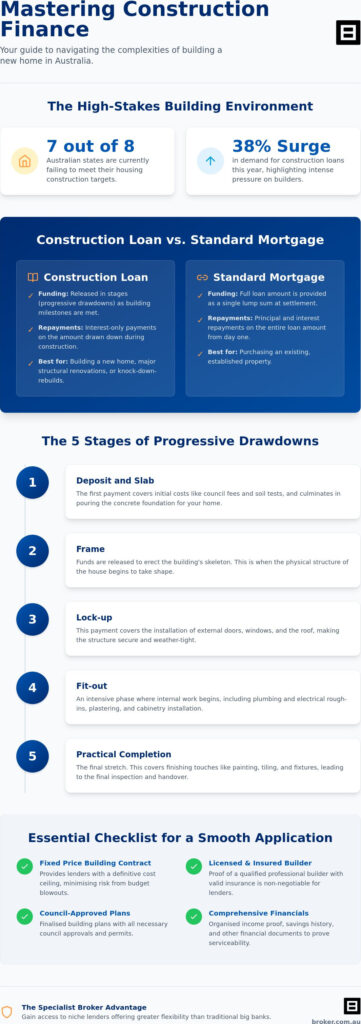
With seven out of eight Australian states currently failing to meet their housing construction targets, the pressure on builders and developers has never been higher. You might be one of the many professionals contributing to a 38% surge in demand for a construction loan this year, yet the path to securing finance remains notoriously difficult. It is a high-stakes environment where a single valuation shortfall or a delayed drawdown can stall a project indefinitely.
It is perfectly natural to feel anxious about strict bank valuations or the prospect of running out of cash before you have even reached the lock-up stage. We understand how frustrating it is to prove income as a self-employed developer or to decode the complexities of progressive payments. This guide will help you master these intricacies so you can secure a flexible loan that supports your project from the first sod to the final inspection. We will explore the five critical stages of construction finance and show you how to streamline your application for a stress-free experience that puts you back in control of your build.
Key Takeaways
- Understand how a construction loan operates through progressive drawdowns rather than a lump sum to keep your project’s cash flow fluid.
- Master the five critical stages of finance, from the initial slab pour to the final inspection, to avoid mid-build funding gaps.
- Learn why interest-only repayments on drawn funds provide a tactical advantage for managing your budget during the construction phase.
- Organise a professional “Builder Pack” and financial documents to streamline your application and meet 2026’s stricter valuation standards.
- Discover how working with a specialist broker provides inside access to niche lenders that offer more flexibility than traditional big banks.
Table of Contents
- What is a Construction Loan and Why is it Different?
- Understanding the 5 Stages of Progressive Drawdowns
- Construction Loans vs. Standard Mortgages: A Tactical Comparison
- Essential Checklist: Preparing for Your Application in 2026
- Navigating the Lending Landscape with an Expert Broker
What is a Construction Loan and Why is it Different?
A construction loan is a specialised financial facility designed to fund the building of a new home or the execution of a major structural renovation. Unlike a standard mortgage where the lender hands over the full loan amount at settlement, this product operates through a series of progressive drawdowns. This means the bank releases funds in increments as your builder hits specific milestones on-site. It is a dynamic way to manage a project that doesn’t yet exist in its final form, providing a level of financial agility that a traditional lump sum loan simply cannot offer.
Lenders utilise this staged structure primarily to manage their exposure to risk. Because the security for the loan is an unbuilt asset, the bank needs to ensure that the value of the property increases in tandem with the money they release. For you, the primary advantage is the interest-only repayment structure during the build. You only pay interest on the funds that have been physically drawn down. If you have only used the first $60,000 for the slab, you aren’t charged interest on the remaining $500,000 of the facility. This is a vital cash-flow tactic, especially in 2026, as rental costs have hit record highs and every dollar of holding cost matters.
When should you choose a construction loan over a standard mortgage?
You should opt for a construction loan if your project involves major structural changes that alter the footprint or the integrity of the building. Simple cosmetic updates like a new kitchen or fresh paint can often be funded through a standard equity release or a top-up. however, if you are planning a knock-down-rebuild or a significant extension, a specialised facility is essential. Timing is critical here; you’ll often secure your land finance first and then transition into the construction phase once your building plans are finalised and council-approved. This ensures your finance is tailored to the specific demands of the build rather than a generic valuation.
The role of the Fixed Price Building Contract
Lenders insist on a Fixed Price Building Contract because it provides a definitive ceiling for the project’s cost. With construction costs in 2026 ranging from $2,100 to over $5,000 per square metre, banks are incredibly wary of budget blowouts. They want to see a contract that minimises “prime cost” items and provisional sums, which are often the culprits behind mid-build shortfalls. To secure approval, you must also provide evidence that you are working with a licensed builder who holds valid insurance. This protection ensures that if variations do occur, your borrowing power is shielded by a professional framework, keeping your project on track and your stress levels low.
Understanding the 5 Stages of Progressive Drawdowns
The rhythm of a construction loan is dictated by the physical milestones of your build. This staged approach isn’t just a bank requirement; it’s a safety net for your finances. By breaking the project into manageable chunks, you ensure that you aren’t over-leveraged before the house is even standing. Understanding how construction loans work through these five phases is the first step toward a successful handover.
- Stage 1: Deposit and Slab. This covers the initial costs like council fees and soil tests, culminating in the pouring of the concrete base. It is the literal foundation of your project and your loan.
- Stage 2: Frame. Once the skeleton of the house is up, the second payment is released. This is often the most exciting stage for developers as the project finally takes shape.
- Stage 3: Lock-up. This stage involves the installation of windows, external doors, and the roof. It is about making the structure weather-tight and secure.
- Stage 4: Fit-out. Here, the internal work begins. Plumbing, electrical rough-ins, plastering, and cabinetry are completed during this intensive phase.
- Stage 5: Practical Completion. The final stretch involves painting, tiling, and fixing. Once finished, you’ll prepare for the final inspection and the transition to a standard mortgage.
Managing progress payments without the stress
To keep the process seamless, you’ll need to submit a formal claim form alongside the builder’s invoice at each milestone. Lenders typically send a valuer to the site to verify that the work matches the invoice before they release any funds. Practical Completion is the point where the building is fit for its intended purpose and all major works are finished. Having your paperwork organised ahead of time prevents delays that could otherwise stall your trades and inflate your holding costs. If you want to ensure your documentation is airtight, you might speak with an expert who can manage the lender communications on your behalf.
Contingency planning for cost overruns
Even the best-planned projects face variations. If you decide to upgrade your kitchen stone or move a wall mid-build, these costs usually fall outside the original construction loan amount. You’ll need a contingency fund to cover these extras, as banks are often reluctant to increase a loan once work has started. Most lenders also set a 24-month limit for the construction period. If your build drags on due to weather or material shortages, you might find yourself needing to renegotiate terms. A specialist broker can help you handle these hurdles, providing the “high-level fix” needed to keep your project moving toward that final inspection.
Construction Loans vs. Standard Mortgages: A Tactical Comparison
While a standard mortgage serves as a static debt facility for an existing property, a construction loan is a dynamic tool that evolves alongside your building project. The most significant tactical difference lies in how interest is calculated. With a traditional home loan, you pay interest on the full principal from day one. In contrast, a construction facility calculates interest based on the daily balance of drawn funds. This means your interest bill starts small and only grows as your builder completes more of the work. It’s a sophisticated way to keep your holding costs manageable while you aren’t yet living in the home or collecting rent.
The repayment structure also differs significantly. Most construction facilities are set up as interest-only during the building phase. This prioritises cash flow when you need it most, especially if you’re balancing a mortgage on your current residence or paying rent elsewhere. The approval process is undeniably more complex than a standard purchase. Lenders require an “as-if-complete” valuation, which means they assess the future value of the property based on your plans and specifications. This requires a higher level of “up-front” work, including providing council-approved permits and a fixed-price building contract before the loan is finalised.
The Offset Account Advantage
A 100% offset account is a powerful strategy during the build, yet not all lenders offer this feature on a construction loan. By keeping your savings in a linked account, you reduce the interest charged on your drawn balance while keeping your capital accessible for unexpected variations. It’s an efficient way to make your money work harder without locking it away. When comparing options, we look for lenders who provide this flexibility, as it can save you thousands in interest over a twelve-to-eighteen-month build program.
Converting to a standard loan after completion
Once your builder hands over the keys and the local council issues a Certificate of Occupancy, your finance enters the “End Loan” phase. This is when the facility typically converts from interest-only to a standard principal and interest repayment structure. It’s also the perfect time to review your position. With the project finished, the actual market value might be higher than the initial valuation. This newly created equity can be a springboard for your next project, allowing you to refinance or use the increased value to secure your next development site. We ensure this transition is seamless, so you can focus on the final inspection rather than the paperwork.
Essential Checklist: Preparing for Your Application in 2026
Preparation is the antidote to anxiety when it comes to high-stakes finance. Securing a construction loan in 2026 requires more than just a dream and a block of land. Lenders have maintained a rigorous 3 percentage point serviceability buffer, and with the RBA cash rate sitting at 4.10% as of April 2026, your financial “Builder Pack” must be flawless. This dossier includes your council-approved plans, detailed specifications, and the fixed-price building contract we highlighted earlier. For your personal documentation, you’ll need the last two years of tax returns and recent BAS statements to prove your stability.
Special Guidance for Business Owners and Developers
Business owners often face unique hurdles that standard bank algorithms don’t quite understand. We specialise in creating tailored applications that might use existing commercial assets as collateral to strengthen a residential construction loan request. By utilising AI-driven financial modelling, we can project your project’s viability with a level of precision that speeds up the approval process significantly. This proactive debt structuring ensures your business cash flow remains healthy while your capital is committed to the build, protecting your day-to-day operations from the pressures of construction.
The Valuation Hurdle
The valuation stage is where many developers feel the most uncertainty. Because lenders are naturally conservative, it is common for a bank valuation to come in lower than the actual contract price. This creates a “valuation shortfall” that you’ll need to cover with your own capital or by adjusting the project scope. Understanding the lender’s perspective is key to navigating this without blowing your budget or stalling the project before the first sod is turned.
An “As If Complete” valuation is a lender’s estimate of the property’s market value once all proposed construction is finished.
Because these appraisals are based on future market conditions, they don’t always align with your builder’s quote. If you’re worried about how your project will be appraised in the current market, get in touch with our team to review your figures before you submit your formal application. We can provide the “inside access” needed to find lenders whose valuation panels have a more nuanced understanding of your specific location and build quality.
Navigating the Lending Landscape with an Expert Broker
While the “Big Four” banks are a common starting point for many, they often lack the agility required for a complex construction loan. Their rigid credit policies and automated approval systems can be a significant roadblock for builders with unique income structures or ambitious project timelines. We provide a bridge to niche lenders who look beyond the standard checkboxes, offering criteria that actually align with the realities of the Australian building industry in 2026. This “inside access to the best rates” and flexible terms ensures your project isn’t stalled by a lender who doesn’t understand the nuances of a progressive build.
The Broker.com.au advantage lies in our sophisticated blend of technology and personal touch. Our team, including specialists like Matt, Kylie, and Flavio, utilises proprietary AI-driven financial modelling to ensure your application is accurate and compelling from the first submission. This proactive approach reduces the back-and-forth that typically plagues these loans. We act as your “High-Level Fixer,” managing the builder’s claims, coordinating with valuers, and handling the bank’s administrative hurdles. It is a seamless, stress-reduction promise that allows you to focus on the site while we ensure the capital keeps flowing.
Tailored Solutions for Complex Projects
For developers moving beyond a single residential build, our expertise extends into specialised development finance for multi-unit or mixed-use projects. We understand that these builds require a different level of oversight and a more robust debt structure. We can also coordinate fit-out finance for commercial premises simultaneously, ensuring your entire project is funded through a cohesive, professional strategy. This bespoke level of service is essential when dealing with situations that fall outside of the norm, providing you with a seasoned partner who is deeply knowledgeable about the entire lending landscape.
Ready to start your project?
The first step toward a successful build is never about mountains of paperwork; it’s about a low-pressure conversation. We want to hear about your specific goals, your timeline, and the unique needs of your project. From there, we provide a tailored borrowing power estimate that reflects your actual capacity in the current 2026 market. We are here to lead you from a state of uncertainty toward a feeling of streamlined confidence, ensuring your project is supported from the first sod to the final inspection.
I’m interested — let’s discuss your construction finance options
Build Your Future with Confidence
Mastering the intricacies of a construction loan is the defining factor between a project that stalls and one that thrives. By aligning your finance with the five stages of progressive drawdowns and preparing a meticulous application, you’ve already mitigated the primary risks facing Australian builders in 2026. You now possess the tactical insight to manage daily interest balances and navigate the valuation hurdles that often hinder the unprepared.
You don’t have to manage this high-stakes financial journey on your own. At Broker.com.au, we offer award-winning finance solutions powered by proprietary AI technology to ensure your approval process is both fast and accurate. With inside access to over 40 Australian lenders, our expert team is ready to act as your seasoned guide, managing the bank and the valuer while you focus on the physical build.
I’m interested — Get started with an award-winning broker
Your vision deserves a financial foundation that is as solid as the slab you’re about to pour. We’re here to help you turn your 2026 blueprints into a successful reality.
Frequently Asked Questions
Can I get a construction loan if I am an owner-builder?
Yes, you can secure finance as an owner-builder, though the lending criteria are significantly stricter than for projects using a licensed builder. Most traditional banks view these projects as high-risk due to the potential for budget overruns and lack of professional oversight. You will likely need a larger deposit and a highly detailed project plan to satisfy the requirements of a specialist lender.
How much deposit do I need for a construction loan in Australia?
You generally need a deposit of at least 20% of the total land and construction cost to avoid paying Lenders Mortgage Insurance (LMI). While some lenders may allow for a deposit as low as 5% if you qualify for specific government guarantee schemes, having a larger equity stake often leads to more competitive rates. It is essential to have your equity or cash reserves clearly organised before you begin the application process.
What happens if the building costs increase during construction?
You are typically responsible for covering any cost increases or variations from your own funds once the loan has been finalised. Because lenders base their approvals on a fixed-price contract, they are often reluctant to increase the loan amount mid-build. This is why we recommend maintaining a healthy contingency fund to manage unexpected material price hikes or labour shortages without stalling your project.
Can I use a construction loan for a major renovation of my current home?
Yes, a construction loan is the standard choice for major structural renovations that involve altering the home’s footprint or structural integrity. If you are planning a significant extension or a second-storey addition, a standard equity release may not provide the necessary oversight. This specialised facility allows you to access funds in stages as your renovation milestones are met, keeping your interest costs lower during the project.
How long do I have to finish the building project?
Most lenders require you to complete your building project within 12 to 24 months from the date of the first drawdown. If your build faces significant delays due to weather or supply chain issues, you must communicate with your lender as early as possible. We can help you negotiate an extension if your project timeline needs to be adjusted beyond the standard period allowed by the bank.
Do I pay interest on the whole loan amount from day one?
No, you only pay interest on the portion of the loan that has been physically drawn down to pay your builder at each stage. This is a key advantage of this type of finance compared to a standard mortgage. For example, if your total facility is $700,000 but you have only drawn $150,000 for the slab and frame, your interest repayments are calculated only on that $150,000 balance.
What is an “As-If-Complete” valuation and why is it important?
An “As-If-Complete” valuation is a professional appraisal of what your property will be worth once the construction is finished according to your plans. It is a critical part of the approval process because it determines your borrowing power and the loan-to-value ratio. Lenders use this figure to ensure the final asset provides enough security for the debt, protecting your financial position and the bank’s investment.
Can I link an offset account to my construction loan?
Yes, you can link an offset account to a construction loan with certain lenders, although it is not a feature offered by every bank. An offset account allows you to use your savings to reduce the interest charged on your drawn balance, which is an excellent way to manage your cash flow during the build. We can help you identify which lenders provide this specific functionality to ensure your money works as hard as possible.