
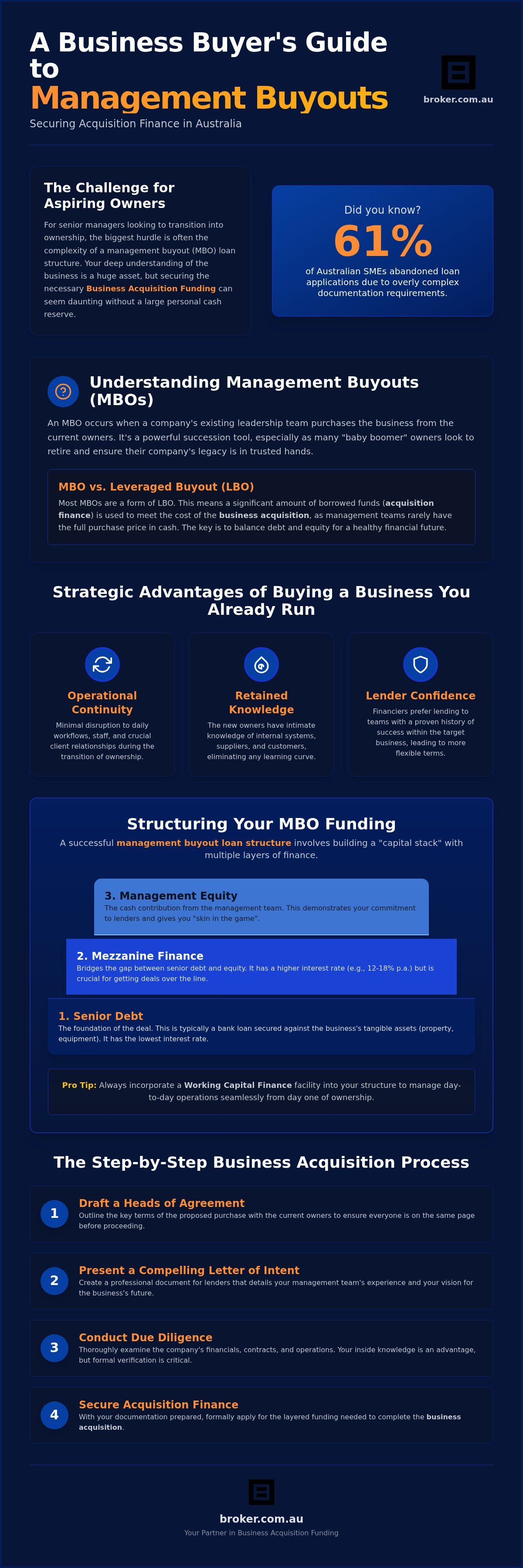
Did you know that 61% of Australian SMEs abandoned their loan applications in 2026 because the documentation requirements were too complex? For a senior manager looking to transition into ownership, the primary hurdle isn’t your ability to lead, but the intricate nature of a management buyout loan structure australia. You’ve spent years driving the company’s growth, yet securing the necessary Business Acquisition Funding often feels impossible when you don’t have a massive personal cash reserve to tip into the deal.
It’s a common frustration to feel that your deep understanding of the company’s cash flow is overlooked by lenders who only see tangible assets. This guide provides the clarity you need to move from employee to business buyer with confidence. We’ll outline a definitive roadmap for acquisition finance, showing you how to leverage the business’s own performance to secure a business acquisition. You’ll gain “inside access” to strategic buying a business insights, from navigating 2026 lender requirements for goodwill to identifying the ideal funding partner for your specific industry.
Key Takeaways
- Learn why MBOs are currently surging in the Australian SME market and how to position yourself as a serious business buyer during the transition.
- Discover how to design a robust management buyout loan structure australia by layering senior debt, mezzanine finance, and equity to bridge the funding gap.
- Understand the specific deposit and equity requirements for Business Acquisition Funding in 2026, including how lenders evaluate goodwill versus tangible assets.
- Master the step-by-step business acquisition process, from drafting a Heads of Agreement to presenting a compelling Letter of Intent to secure acquisition finance.
- Find out how to gain inside access to over 50 lenders and use proprietary AI technology to streamline your journey when buying a business.
Table of Contents
- Understanding Management Buyouts in the Australian SME Market
- Acquisition Finance: Structuring Your MBO Funding
- Lender Requirements: Deposit, Equity, and Servicing
- The Step-by-Step Business Acquisition Process
- Securing MBO Funding with Broker.com.au
Understanding Management Buyouts in the Australian SME Market
In the current Australian market, the management buyout (MBO) has evolved from a niche corporate manoeuvre into a vital succession tool. At its core, an MBO occurs when a company’s existing leadership team takes the reins from the current owners. This trend is accelerating as a massive wave of “baby boomer” business owners look to retire, prioritising stability for their legacy. For a business buyer already within the firm, the transition involves a profound mindset shift. You’re no longer just managing a P&L; you’re leveraging your professional future to secure Business Acquisition Funding.
Unlike external acquisitions where an outsider enters with fresh eyes but limited context, an MBO relies on the management team’s intimate knowledge of operations. This internal insight often makes a management buyout loan structure australia more attractive to lenders, as the team already understands the nuances of the company’s cash flow. To explore the foundational concept further, you can read more about What is a Management Buyout? and how it functions globally.
MBO vs Leveraged Buyout (LBO): What Managers Need to Know
While they sound different, most MBOs in Australia are technically a form of Leveraged Buyout. An LBO uses a significant amount of borrowed funds to meet the cost of the business acquisition. Because most management teams don’t have the liquid capital to buy a company outright, they rely on acquisition finance to bridge the gap. The goal is to balance the debt-to-equity ratio so the business remains healthy. Over-leveraging can starve a company of the working capital it needs to grow, while under-leveraging might mean the management team misses their chance to buy in.
Strategic Advantages of Buying a Business You Already Run
The primary benefit of buying a business from the inside is the reduction of “information asymmetry.” You already know the strengths of the staff, the reliability of the suppliers, and the loyalty of the customer base. This reduces the risk of nasty surprises during due diligence. Key advantages include:
- Operational Continuity: Minimal disruption to daily workflows or client relationships.
- Retained Knowledge: No learning curve for the new owners regarding internal systems.
- Lender Confidence: Financiers prefer teams with a proven history in the target business.
When you apply for Business Acquisition Funding, being able to demonstrate a proven track record within that specific entity can lead to more flexible terms. It ensures that the transition is “stress-free” for external stakeholders, maintaining the brand’s value from day one of your ownership.
Acquisition Finance: Structuring Your MBO Funding
Structuring a successful deal requires more than just a single loan; it involves building a “capital stack.” A robust management buyout loan structure australia often blends several layers of finance to bridge the gap between your management team’s available cash and the total purchase price. This multi-layered approach allows a business buyer to preserve personal liquidity while ensuring the company remains well-capitalised for future growth. By balancing different types of Acquisition finance, you can create a repayment schedule that aligns with the business’s projected cash flow.
By leveraging existing business assets like heavy machinery, vehicle fleets, or commercial property, you can often unlock more favourable interest rates. Secured Business Acquisition Funding typically offers lower rates than unsecured alternatives, as the physical assets provide a safety net for the lender. It is also vital to incorporate a Working Capital Finance facility into your initial structure. This ensures you have the necessary liquidity to manage day-to-day operations and payroll from the very first morning you take full control of the entity.
Senior Debt and Mezzanine Finance Explained
Senior debt forms the bedrock of most business acquisition deals. This is typically a bank loan secured against the target company’s primary assets. However, traditional banks rarely provide 100% of the required capital. This is where mezzanine finance plays a critical role. While it carries a higher interest rate than senior debt, often ranging between 12% and 18% p.a. in 2026, it requires less collateral. It’s an efficient way to fill the funding gap without being forced to surrender a significant equity stake to external private equity firms. When designing a management buyout loan structure australia, managers should look to mezzanine layers to provide the flexibility that traditional banks often lack.
Seller Financing: A Critical Tool for Australian MBOs
In the Australian SME market, vendor carry-back loans are an increasingly popular tool for buying a business. In this scenario, the seller agrees to receive a portion of the purchase price over an agreed period, effectively acting as a secondary lender. This arrangement can offer the seller tax deferral benefits and a steady stream of interest income. For you, the management team, seller financing serves as a powerful vote of confidence. When a primary lender sees that the previous owner is willing to leave “skin in the game,” they often view the business acquisition as a lower-risk proposition, which can lead to smoother approvals. If you’re unsure how to layer these options, exploring tailored funding structures with an expert can help you find the right balance for your specific industry.
Lender Requirements: Deposit, Equity, and Servicing
Securing Business Acquisition Funding in 2026 requires more than just a solid resume; it demands a clear demonstration of “skin in the game.” Lenders prioritise management teams who are financially committed to the deal, as this aligns your interests with the long-term success of the company. For a standard management buyout loan structure australia, you should expect to contribute between 10% and 30% of the purchase price as management equity. While some specialist lenders offer flexibility, major Australian banks typically stick to the higher end of this range to mitigate their risk exposure.
When you are buying a business, a significant portion of the valuation often rests on “goodwill” rather than physical assets. Lenders scrutinise this intangible value by examining the sustainability of historical earnings, often applying a multiple of 3 to 6 times EBITDA. To satisfy these requirements, a business buyer must present a robust three-year financial forecast. This document needs to account for current market pressures, such as the payday superannuation requirements introduced in July 2026, to prove that the business can maintain its margins under your new ownership.
Cash Flow Servicing and Lender Scrutiny
Financiers place the Debt Service Coverage Ratio (DSCR) at the centre of their assessment process. They want to see that the business generates enough net operating income to cover all debt obligations with a comfortable margin. With the RBA cash rate at 4.35% as of August 2026, lenders are stress-testing Acquisition finance applications against higher interest environments, often applying a 2% to 3% buffer to your projected rates. Serviceability in an MBO context is the business’s demonstrated capacity to meet all interest and principal repayments from its future cash flow while retaining enough liquidity for daily operations.
Equity Requirements and Sourcing Your Contribution
Meeting the equity threshold is frequently the most challenging part of a business acquisition for a management team. If you don’t have the liquid cash readily available, there are several ways to source your contribution:
- Personal Property Equity: Many managers use home loans for business owners to unlock equity in their residential property to fund the deposit.
- Silent Investors: Bringing in external high-net-worth individuals can help you meet equity targets without sacrificing operational control.
- Equity Rollover: In some cases, existing owners may allow managers to earn into their equity over time, though this requires careful legal structuring.
Specialist lenders often provide more “inside access” to flexible terms than traditional banks, especially for industries with high recurring revenue. By identifying the right lender for your specific sector, you can often negotiate an Acquisition finance package that rewards your operational expertise rather than just your personal balance sheet.
The Step-by-Step Business Acquisition Process
Executing a successful transition requires a disciplined approach to timing. Once you’ve reached a verbal agreement with the current owner, the first formal step is drafting a Heads of Agreement (HoA). This document outlines the proposed purchase price and the essential terms of the deal, serving as the non-binding foundation for your management buyout loan structure australia. From here, you’ll move to a Letter of Intent (LoI). This is a critical asset when approaching financiers; it proves to a lender that the business acquisition is a serious, exclusive negotiation rather than a hypothetical discussion.
The middle phase of the process is the most intense. You must run due diligence and your finance application on parallel tracks. Lenders in 2026 expect to see your progress in real-time, often requiring updates on your findings before issuing a final letter of offer. Coordinating these streams ensures that when you reach the final settlement day, the legal handover and the financial drawdown occur simultaneously. It’s a high-stakes moment that requires precise alignment between your solicitors, accountants, and finance partners.
Financial Modelling for a Successful Buyout
Lenders don’t just want to see how the business performs when things go well; they want to see how it survives a downturn. Your financial modelling must include both a “Base Case” and a “Downside Case.” The downside case should factor in potential 2026 interest rate fluctuations and any industry-specific headwinds. Professional corporate advisory is vital here to ensure your debt repayments don’t stifle the company’s ability to reinvest in equipment or staff. If your model shows that the Acquisition finance repayments leave the business with less than a 1.25x Debt Service Coverage Ratio, you’ll likely need to restructure the deal.
Due Diligence from a Business Buyer Perspective
As an internal business buyer, your due diligence focus is different from an external party. You already know the culture, so your focus should be on “add-backs” to determine the true EBITDA. You’ll need to verify that the owner’s personal expenses or one-off costs are accurately extracted to show the business’s real earning power. Additionally, you must check for pending regulatory hurdles, such as the new ACCC merger notification laws effective from January 2026, which may apply if the transaction meets certain monetary thresholds. Ensure all key customer contracts and supplier agreements contain “change of control” clauses that allow for a seamless transfer to your new entity.
Managing these moving parts can be overwhelming without the right support. To ensure your transition is efficient and professionally structured, get started with a tailored finance assessment to see which lenders best fit your specific acquisition goals.
Securing MBO Funding with Broker.com.au
Designing a robust management buyout loan structure australia requires more than a simple bank application; it demands a sophisticated engineering of debt. As an award-winning broker, we act as your “High-Level Fixer,” providing the corporate advisory necessary to build a capital stack that balances risk and growth. By leveraging our expertise, a business buyer avoids the common pitfalls that lead to high loan abandonment rates. We don’t just identify a lender; we structure a comprehensive solution that supports your transition from senior management to full ownership.
Our team provides “inside access” to over 50 Australian lenders, ranging from major banks to specialist private credit providers. This breadth of choice is essential when buying a business, as it allows us to match your specific industry needs with a lender who understands your sector’s nuances. Whether you require secured Business acquisition funding or complex mezzanine layers, our goal is to move you from a state of uncertainty toward streamlined confidence.
AI-Powered Finance Matching for Faster Approvals
Our proprietary AI technology changes the game for Acquisition finance. Instead of spending weeks manually comparing 2026 interest rates and lending criteria, our system analyses lender appetites in real-time. This saves you valuable time and provides access to competitive rates that managers often cannot find on their own. It transforms our “stress-free” promise into a practical reality, ensuring your business acquisition remains on track while you focus on the daily operations of the firm you are about to own.
Tailored Support for the Australian Business Buyer
Technology is only half the story. When you’re buying a business, you need a seasoned partner who understands the local landscape. Our team, including experts like Matt, Kylie, and Flavio, provides personalised guidance from your initial enquiry through to final settlement and beyond. We go above and beyond to ensure every detail of your management buyout loan structure australia is handled with boutique-level attention. Whether you’re navigating complex M&A debt or need assistance with working capital, we ensure you feel informed rather than rushed. If you’re ready to take the next step in your professional journey, we’re here to open the right doors for you.
I’m interested in management buyout financing
Step Into Business Ownership with Confidence
Transitioning from manager to owner is a significant professional milestone that requires a sophisticated financial approach. You now understand that a successful management buyout loan structure australia is built on a multi-layered capital stack, balancing senior debt with mezzanine finance and management equity. By focusing on future cash flow and meeting the 2026 serviceability requirements, you can bridge the funding gap without exhausting your personal reserves. This strategic alignment ensures the business remains healthy while you take full control of its destiny.
As an award-winning Australian business loan broker, Broker.com.au provides the expert corporate advisory and inside access to over 50 lenders needed to navigate this complexity. Our team is here to ensure your transition is seamless and stress-free, from the initial valuation through to the final settlement day. We take pride in being the expert guide that turns your professional ambition into a tangible reality.
I’m interested in management buyout financing
Your dream of ownership is within reach. With the right financial partner by your side, you’ll have the streamlined confidence to lead your company into its next successful chapter.
Frequently Asked Questions
How much personal cash do I need for a management buyout in Australia?
Most lenders require a management equity contribution ranging from 10% to 30% of the total purchase price. This “skin in the game” demonstrates your commitment to the long-term success of the business. While some specialist lenders offer greater flexibility, traditional banks often stick to the higher end of this range. Having this capital ready ensures a smoother application for your management buyout loan structure australia, though you can sometimes source these funds through external investors.
Can I use the business assets I am buying as collateral for the loan?
Yes, you can leverage the tangible assets of the target company to secure your funding. Lenders frequently use equipment, vehicles, and commercial property as collateral to lower the risk profile of the loan. This approach often results in more competitive interest rates compared to unsecured options. By using these assets, you create a more stable management buyout loan structure australia that preserves your personal liquidity while providing the financier with the necessary security.
What is the typical interest rate for acquisition finance in 2026?
In 2026, interest rates for acquisition finance vary based on the lender and the security provided. Senior bank debt typically ranges from 7% to 10% per annum for well-established businesses. If you require private credit or mezzanine financing to bridge an equity gap, rates generally sit between 12% and 18% per annum. These figures reflect the current RBA cash rate of 4.35% and the specific risk premiums associated with purchasing an existing SME.
How long does the MBO financing process usually take?
The timeline for securing MBO financing usually spans between eight and twelve weeks from the initial enquiry to final settlement. This period includes the time needed for valuation, due diligence, and formal lender approval. While traditional bank applications can be notoriously slow, utilising proprietary AI technology can significantly streamline the matching process. Starting the conversation early and having two years of audited financial statements ready will help ensure your transition remains on schedule.
Is an unsecured business loan an option for an MBO?
Unsecured business loans are a viable option, particularly for businesses with strong, consistent cash flow but limited tangible assets. These loans don’t require specific collateral like property or machinery, which provides greater flexibility for the management team. However, because they represent a higher risk to the lender, they often carry higher interest rates than secured options. They are frequently used as a supplementary layer within a broader capital stack to cover immediate needs.
What happens if the current owner wants to keep a small share of the business?
It is increasingly common for sellers to retain a minority stake, often between 10% and 20%, to ensure a smooth transition. Lenders generally view this positively as it keeps the founder’s expertise available and aligns their interests with yours. This arrangement can also reduce the amount of initial capital the management team needs to raise. We can help you structure a shareholder agreement that clearly defines the path for you to acquire the remaining equity.
Do I need a formal business plan to get MBO funding approved?
A comprehensive business plan is mandatory for securing acquisition finance in the Australian market. Lenders need to see a clear strategy for growth, a detailed three-year financial forecast, and evidence of the management team’s ability to run the company independently. Your plan should address how you will handle operational challenges and meet debt obligations. Providing a professional, well-structured document gives financiers the confidence that the business will thrive under your new leadership.
Can I use my superannuation (SMSF) to help fund a business acquisition?
You can use a Self-Managed Super Fund (SMSF) to assist in the acquisition, though strict regulations apply. Typically, an SMSF is used to purchase the commercial property the business operates from, which is then leased back to the company. This can free up capital within the business deal itself. However, you cannot generally use SMSF funds to buy the trading entity’s goodwill or operational assets directly. It is a complex area that requires specialist guidance.