
What if you could deploy a fleet of high-end workstations and a multi-year enterprise software suite without touching a single cent of your core operating capital? For many Australian organisations, the rapid pace of technological change creates a constant tension between the need to stay competitive and the desire to protect cash flow. You’ve likely felt the sting of high upfront costs for intangible assets or the frustration of traditional lenders who don’t quite grasp the value of “soft” tech. It’s a common hurdle, but it shouldn’t stall your growth.
In this 2026 guide, you’ll discover how tailored financing for IT hardware and software allows you to scale your digital infrastructure through predictable monthly repayments. We’ll examine tax-effective structures like Chattel Mortgages and explain how a business buyer can use acquisition finance to modernise a company immediately after a business acquisition or when buying a business. From navigating the permanent A$20,000 instant asset write-off to securing fast approvals for complex tech bundles, this is your roadmap to maintaining a sharp edge in the Australian market.
Key Takeaways
- Learn why shifting from CAPEX to an OPEX model helps Australian organisations maintain a competitive edge without exhausting their cash reserves.
- Discover how to overcome the “soft cost” challenge when securing financing for IT hardware and software, even for intangible assets like multi-year cloud licences.
- Compare the tax advantages of a Chattel Mortgage against the flexibility of Finance Leases to determine which structure suits your 2026 tech replacement cycle.
- Understand how a business buyer can integrate IT upgrades into their acquisition finance to modernise a company immediately after buying a business.
- Identify the essential documents and financial audits required to streamline your application and gain inside access to specialised Australian lenders.
Table of Contents
- Understanding IT Hardware and Software Financing in Australia
- Hardware vs. Software: Navigating Tangible and Intangible Asset Finance
- Comparing IT Finance Structures: Leases, Chattel Mortgages, and Unsecured Loans
- Strategic Planning: How to Optimise Your IT Finance Application
- Expert Guidance: Why Broker.com.au is Your Partner in Technology Growth
Understanding IT Hardware and Software Financing in Australia
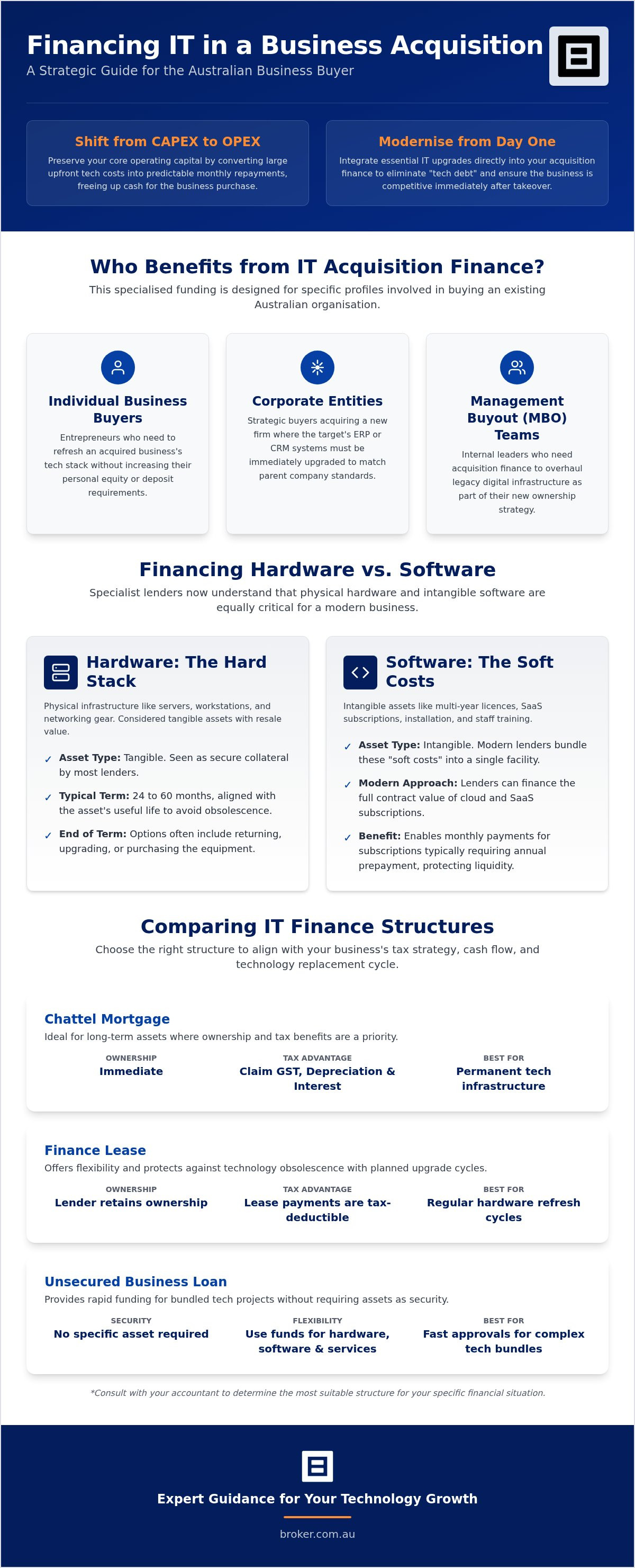
In the high-stakes environment of a 2026 business acquisition, technology is often the hidden variable that determines day-one profitability. Acquiring an existing entity frequently reveals a “tech debt” of outdated servers and legacy software that requires immediate attention. Financing for IT hardware and software serves as a critical strategic tool, allowing a business buyer to modernise these systems without the burden of a massive capital outlay. By shifting from CAPEX to OPEX, buyers can preserve their cash reserves for the actual purchase price while ensuring the company’s digital infrastructure is fit for purpose from the moment the deal closes.
The 2026 lending landscape has evolved alongside the “Everything-as-a-Service” (XaaS) trend. Specialist lenders now understand that a comprehensive tech stack is the lifeblood of an acquired firm. Navigating this niche market requires an expert guide with inside access to lenders who possess the appetite for complex digital assets. We act as a high-level fixer, ensuring that your Business Acquisition Funding package is robust enough to cover both the physical assets and the intangible software suites necessary for operational continuity.
The Strategic Shift to Tech Asset Finance
Maintaining liquidity is paramount when buying a business in the current Australian economic climate. Utilising a finance lease allows a business buyer to align technology replacement cycles with the company’s new growth trajectory. This approach prevents technology obsolescence by scheduling regular hardware upgrades, ensuring the acquired firm doesn’t fall behind competitors. IT asset finance is a cash-flow-first approach to digital growth during a transition. It protects your working capital, providing the breathing room needed to manage the complexities of a post-acquisition integration.
Who is IT Financing For?
This specialised funding is designed for specific profiles involved in the purchase of an existing organisation:
- Individual Business Buyers: Entrepreneurs entering a new industry who need to refresh the “hard stack” of an acquired business without increasing their personal equity contribution or deposit requirements.
- Corporate Entities: Strategic buyers undertaking bolt-on acquisitions where the target’s ERP or CRM systems must be immediately migrated or upgraded to match the parent company’s standards.
- Management Buyout (MBO) Teams: Internal leaders who understand the legacy tech flaws and require acquisition finance to overhaul the digital infrastructure as part of their new ownership strategy.
Hardware vs. Software: Navigating Tangible and Intangible Asset Finance
Distinguishing between the physical “metal” of a server and the digital “logic” of a software suite is the first step in structuring effective financing for IT hardware and software. Historically, traditional Australian banks have viewed these assets through vastly different lenses. Tangible hardware, such as networking gear and storage arrays, is seen as secure collateral. In contrast, intangible software licences are often dismissed as “soft costs” because they lack resale value in a liquidation scenario. However, the 2026 market has matured. Modern specialised lenders now recognise that software is the engine of the business, frequently packaging licences, installation, and even staff training into a single, seamless facility.
The 2026 landscape for multi-year software-as-a-service (SaaS) contracts requires a more nuanced approach than a standard equipment loan. Lenders who understand the XaaS model are increasingly willing to finance the full contract value of cloud subscriptions, allowing you to pay monthly rather than annually in advance. This preserves your liquidity and ensures your tech stack evolves as fast as your industry demands.
Financing the Hard Stack
Physical infrastructure remains the backbone of most IT finance applications. For hardware like servers, workstations, and high-speed switches, the typical Australian sweet spot for finance terms ranges from 24 to 60 months. This alignment ensures you aren’t paying for equipment that’s already reached its performance floor. At the end of the term, you usually face a choice: return the gear, upgrade to the latest model, or pay a residual to take full ownership. Hardware often acts as the primary security for combined tech loans, providing the “anchor” that allows lenders to feel comfortable including more volatile software costs in the same agreement.
The Rise of Software and Cloud Financing
The real complexity in 2026 lies in financing multi-year SaaS contracts and the heavy implementation costs that follow. A business buyer managing a business acquisition often inherits a “tech debt” that requires immediate customisation of existing systems. Through tailored acquisition finance, you can fund the total cost of digital transformation, including the intangible intellectual property and bespoke coding. This is particularly tax-effective, as treating software as an operating expense (OPEX) can provide immediate deductions. It’s also worth investigating the Small Business Technology Investment Boost for additional incentives when buying a business and upgrading its digital capabilities. If you’re unsure how to bundle these diverse costs, speaking with a specialist advisor can help bridge the gap between your tech needs and lender requirements. We specialise in valuing these intangible assets, ensuring your software implementation isn’t stalled by a lack of upfront capital.
Comparing IT Finance Structures: Leases, Chattel Mortgages, and Unsecured Loans
Selecting the right legal vehicle for your technology debt is just as vital as the specifications of the servers you’re installing. In 2026, the Australian market offers several distinct pathways for financing for IT hardware and software, each with unique tax and balance sheet implications. For a business buyer engaged in a business acquisition, these choices directly impact the day-one cash flow of the new entity. Whether you prioritise immediate ownership or the ability to upgrade frequently, the structure of your acquisition finance must align with your long-term digital roadmap.
The current interest rate environment adds another layer of complexity. With the RBA cash rate sitting at 4.35 percent as of August 2026, and institutions like ANZ forecasting a rise to 4.60 percent by November, many organisations are locking in fixed-rate facilities. This provides certainty in a volatile market, ensuring that your monthly tech repayments remain predictable even if broader economic conditions shift.
Leasing Structures for Rapidly Depreciating Assets
Operating leases are often the preferred choice for hardware that becomes obsolete quickly, such as laptops or mobile devices. This structure keeps the equipment off your balance sheet, which can improve your financial ratios and make the organisation appear more agile. In contrast, a finance lease is a path toward eventual ownership. While the asset appears on your balance sheet, you have the option to take title at the end of the term. For IT equipment with a typical three-year lifespan, the choice depends on whether you want the hassle of disposing of old gear or the flexibility to simply “return and refresh” at the end of the contract.
Chattel Mortgages and Commercial Hire Purchase
The Australian chattel mortgage remains the “Expert Guide” choice for long-term server and networking infrastructure. It allows for immediate ownership, meaning you can claim the full GST input tax credit on the purchase price in your next BAS. This is particularly powerful for assets under the permanent A$20,000 instant asset write-off threshold. When buying a business, a chattel mortgage can be structured with a balloon payment at the end, matching the expected resale value of the hardware. This keeps monthly repayments low while allowing the business to benefit from depreciation and interest deductions. For software-only needs where no physical collateral exists, an unsecured business loan might be the faster choice, though it typically carries a higher interest rate, often ranging from 9.5 percent to 18 percent depending on the lender’s appetite.
Strategic Planning: How to Optimise Your IT Finance Application
Securing financing for IT hardware and software as part of a business acquisition requires a higher level of preparation than a standalone equipment loan. Lenders don’t just look at the hardware; they evaluate how the new technology will support the servicing capacity of the acquired entity. For a business buyer, the goal is to demonstrate that the upgraded tech stack will drive the efficiencies needed to meet repayment schedules. This process begins with a meticulous audit of the target company’s “tech debt” to identify which legacy systems must be replaced immediately to ensure operational continuity post-settlement.
Optimising your application involves five critical strategic steps:
- Step 1: Audit the target’s current infrastructure and identify 2026 replacement cycles to avoid financing assets that are near their performance floor.
- Step 2: Prepare detailed financial statements, including “add-back” schedules that show how modernising IT will reduce previous owner expenses.
- Step 3: Quantify the cash flow benefits, proving that the new software or hardware will enhance the firm’s ability to service the acquisition finance.
- Step 4: Engage a specialised broker to navigate the niche tech lender market, especially for bundles involving high “soft” implementation costs.
- Step 5: Review all existing vendor contracts for early termination penalties to ensure a seamless transition to your new finance facility.
Equity and Deposit Requirements for Tech Bundles
When buying a business, lenders typically look for a business buyer to contribute between 20 percent and 30 percent equity toward the total transaction value. However, when bundling IT upgrades into your Business Acquisition Funding, the physical hardware can often serve as its own security. This may allow you to leverage the equipment at a higher percentage than the goodwill portion of the business purchase. Lenders will closely examine your “day one” cash flow to ensure that the combined repayments for the business loan and the IT infrastructure don’t overstretch the company’s liquidity during the sensitive integration phase.
Common Pitfalls in Acquisition-Linked IT Finance
A frequent error for those buying a business is failing to account for the total cost of ownership (TCO), including the implementation downtime and staff training required for new software. Over-committing to long terms on rapidly depreciating assets can also create a “negative equity” trap where you owe more than the hardware is worth. Furthermore, ignoring the specific lender requirements for “soft costs” can lead to a sudden shortfall in funding. To ensure your digital transformation is structured correctly from the start, speak with our expert advisory team for a stress-free assessment of your equity and servicing options.
Expert Guidance: Why Broker.com.au is Your Partner in Technology Growth
Broker.com.au isn’t just another digital portal. We’re a team of seasoned partners who understand that the Australian tech lending landscape is more complex than a standard balance sheet suggests. By leveraging our proprietary AI technology, we accurately match your organisation with best-in-class tech lenders who have a genuine appetite for digital assets. This isn’t about generic algorithms; it’s about using precision tools to secure inside access to the best rates and terms available in 2026. We act as your expert guide, ensuring you’re in good hands from the initial audit to the final approval.
We take pride in our role as a “High-Level Fixer” for complex tech bundles. While traditional banks often retreat when faced with a mix of physical servers and intangible cloud subscriptions, we lean in. We solve the puzzles that others reject, ensuring your digital infrastructure isn’t stalled by rigid, outdated lending criteria. Our approach is designed to move you from a state of technology uncertainty toward a feeling of streamlined financial confidence and relief. It’s a boutique level of personal attention paired with elite technical capability.
Inside Access to Specialised IT Lenders
Traditional banks frequently struggle with applications that are heavy on “soft” costs. They see a lack of physical collateral and perceive high risk. We bridge that gap by connecting you with specialised lenders who value the operational importance of your software. We negotiate terms that can include implementation, customisation, and even staff training costs within a single facility. This holistic view ensures that your financing for IT hardware and software covers the actual cost of deployment, not just the hardware on the invoice.
For a business buyer, this specialised access is a game-changer. When you’re managing a business acquisition, your acquisition finance needs to do more than just cover the purchase price. Through our Business Acquisition Funding, we can incorporate a complete tech refresh into your loan structure. This allows you to modernise the company immediately after buying a business, ensuring you hit the ground running with a competitive edge. We handle the complexities of the lending landscape so you can focus on your new venture’s growth.
Ready to Upgrade Your Infrastructure?
Smart, tailored financing for IT hardware and software is about more than just debt; it’s about strategic capital preservation. By spreading the cost of your digital transformation, you protect your working capital for other growth initiatives. You’re not just getting a loan; you’re gaining a seasoned partner who prioritises your specific needs. Your digital transformation is in professional, award-winning hands. We’re here to make the process stress-free, efficient, and ultimately successful.
I’m interested in IT financing
Empower Your Digital Future with Strategic Finance
Staying ahead in Australia’s fast-paced tech landscape requires more than just a vision; it demands a flexible financial foundation. By shifting from heavy upfront costs to an agile OPEX model, you can maintain a cutting-edge infrastructure while protecting your vital cash reserves. Whether you’re a seasoned business buyer looking to modernise an entity through financing for IT hardware and software or an SME scaling remote capabilities, the right structure is key. We’ve explored how Chattel Mortgages and specialised leases can align your repayments with the actual lifespan of your assets.
As an award-winning Australian business loan broker, we provide the expertise needed to navigate these high-stakes decisions. Our proprietary AI matching technology ensures faster approvals by connecting you with our inside access to over 30 specialised tech lenders. This human-led advisory process removes the anxiety of traditional banking and puts you in control of your digital transformation. You don’t have to tackle complex tech bundles alone. Take the next step toward a stress-free upgrade today.
I’m interested in IT financing
Frequently Asked Questions
Can I finance 100% of my software and implementation costs?
Yes, you can often finance the total cost of your software licences along with implementation and training fees. Specialised lenders in the 2026 market recognise that digital infrastructure is more than just hardware. By bundling these “soft costs” into a single facility, you avoid large upfront outlays. This preserves your working capital for daily operations while ensuring your team is fully equipped to use the new systems effectively from day one.
What is the minimum amount I can finance for IT hardware in Australia?
Minimum finance amounts generally start around A$5,000 to A$10,000 depending on the specific lender’s criteria. While major banks might prefer larger transactions, niche tech lenders often cater to smaller upgrades like a fleet of new laptops or networking gear. If your requirement is below these thresholds, an unsecured business loan or a business line of credit might provide a more flexible alternative to traditional asset finance structures.
How does a Chattel Mortgage for IT equipment work with GST?
A Chattel Mortgage allows your organisation to take immediate ownership of the equipment while the lender holds a “mortgage” over it as security. Because you own the asset from the start, you can typically claim the full GST input tax credit on your next Business Activity Statement. This structure is a popular choice for financing for IT hardware and software among GST-registered businesses looking to maximise their upfront tax benefits and depreciation.
Is it better to lease or buy IT hardware in 2026?
The decision depends on how quickly the technology becomes obsolete. For hardware with a short performance window, such as mobile devices or high-end workstations, leasing is often better because it allows for easy upgrades. If you’re investing in long-term infrastructure like server racks or networking cables, buying via a Chattel Mortgage might be more cost-effective. This allows you to build equity in assets that have a longer functional life.
What happens at the end of an IT equipment lease term?
You typically have three main choices at the end of a lease term. You can return the equipment to the lender, upgrade to the latest technology by starting a new lease, or purchase the assets outright by paying a predetermined residual value. This flexibility is particularly useful for maintaining a competitive tech edge. It ensures you aren’t stuck with outdated hardware that hinders productivity or creates security vulnerabilities within your organisation’s network.
Can I add more hardware to my existing finance facility later?
Yes, many lenders offer master lease agreements or revolving limits that allow you to add new equipment as your business grows. This “add-on” capability is essential for scaling organisations that need to deploy hardware in stages. Instead of applying for a completely new loan every time you hire a staff member, you simply draw down on your existing facility. This streamlines the administrative process and keeps your technology expansion predictable.
Do I need to provide personal property as security for IT finance?
In most cases, the IT equipment being financed serves as the primary security for the loan. This is the core advantage of asset finance; it reduces the need to tie up personal property or real estate as collateral. However, for large software-only bundles or applications with weaker financials, a lender might request a director’s guarantee. This provides an extra layer of reassurance without necessarily requiring a mortgage over your family home or other personal assets.
How long does the approval process take for tech financing through a broker?
The approval process is often significantly faster than traditional bank applications, frequently taking between 24 and 48 hours. By using proprietary AI technology, we can quickly match your needs with the right lenders from our specialised panel. This efficiency is vital when you’re securing financing for IT hardware and software to meet an immediate project deadline. Having all your financial documentation ready before you apply will help ensure the most seamless experience.