
Could you really acquire a multi-million dollar Australian enterprise using the target company’s own cash flow as your primary lever? While the concept sounds aggressive, securing leveraged buyout financing australia is a sophisticated strategy that allows an ambitious business buyer to scale without needing 100% of the purchase price upfront. It’s a high-stakes move where the right debt structure makes the difference between a thriving legacy and a debt-heavy burden.
You likely recognise that the path to buying a business is rarely a straight line. Between the RBA’s recent interest rate shifts and the ACCC’s mandatory merger control regime introduced in January 2026, the financial hurdles can feel higher than ever. It is natural to feel concerned about over-leveraging or meeting the strict equity demands of traditional lenders who often lack the appetite for complex deals.
This guide is designed to remove that uncertainty and provide a clear roadmap for your Business Acquisition Funding. We will break down current lender requirements for acquisition finance, explain how to manage the latest tax covenant changes, and show you how to organise competitive funding through specialised channels. By the end, you will have the inside access needed to move from a state of complexity toward streamlined confidence.
Key Takeaways
- Learn how a business buyer can leverage a target’s assets, such as machinery or vehicle fleets, to secure the necessary capital for a successful business purchase.
- Discover how to structure leveraged buyout financing australia by balancing senior debt, mezzanine layers, and equity to ensure your acquisition remains sustainable.
- Navigate the strict lender requirements and “stress tests” that define modern acquisition finance, ensuring your business plan meets 2026’s rigorous standards.
- Uncover practical methods for meeting the 20-40% deposit requirements, from utilising property equity to negotiating strategic vendor finance arrangements.
- Streamline your business acquisition by accessing proprietary AI matching and expert guidance to find the right funding solution without the usual bank-led stress.
Table of Contents
- Understanding Leveraged Buyout (LBO) Financing in the Australian Market
- Structuring Your Deal: How Business Acquisition Funding Works
- Lender Requirements for an Australian Business Buyer
- Navigating Equity, Deposits, and Cash Flow Servicing
- Partnering with a Specialist Broker for Your Business Purchase
Understanding Leveraged Buyout (LBO) Financing in the Australian Market
A leveraged buyout (LBO) is a financial strategy where a buyer acquires a company using a significant portion of borrowed funds. The primary objective is to use the target company’s own cash flow and assets as collateral to service and secure the debt. For those seeking leveraged buyout financing australia, this mechanism allows for the purchase of established, cash-generative businesses that might otherwise be out of reach. Understanding Leveraged Buyouts is essential because it shifts the focus from your personal balance sheet to the inherent value and stability of the business you are buying.
The 2026 market presents a unique window for an Australian business buyer. While the Reserve Bank of Australia increased rates in early 2026 following a 2025 low of 3.60%, the landscape has shifted toward more flexible, non-bank alternatives. New mandatory merger control rules that commenced on 1 January 2026 mean that deal structures must be more precise than ever. Success now relies on balancing traditional senior debt with more nimble private credit options that have seen Australian assets under management reach approximately A$200 billion. This shift provides a sophisticated path for buying a business without the rigid constraints of traditional retail banking.
The Role of Acquisition Finance in Australian Business Growth
Acquisition finance acts as the engine for rapid expansion. It allows an entrepreneur to undertake a business acquisition that is significantly larger than their current cash reserves would permit. By using professional debt structuring, you can protect your personal assets while ensuring the target company’s earnings cover the interest and principal repayments. This approach turns a company’s potential into immediate purchasing power.
Acquisition Finance is a specialised category of funding designed specifically to facilitate the purchase of an existing business by leveraging its future cash flows and underlying asset base.
Key Players in the LBO Ecosystem
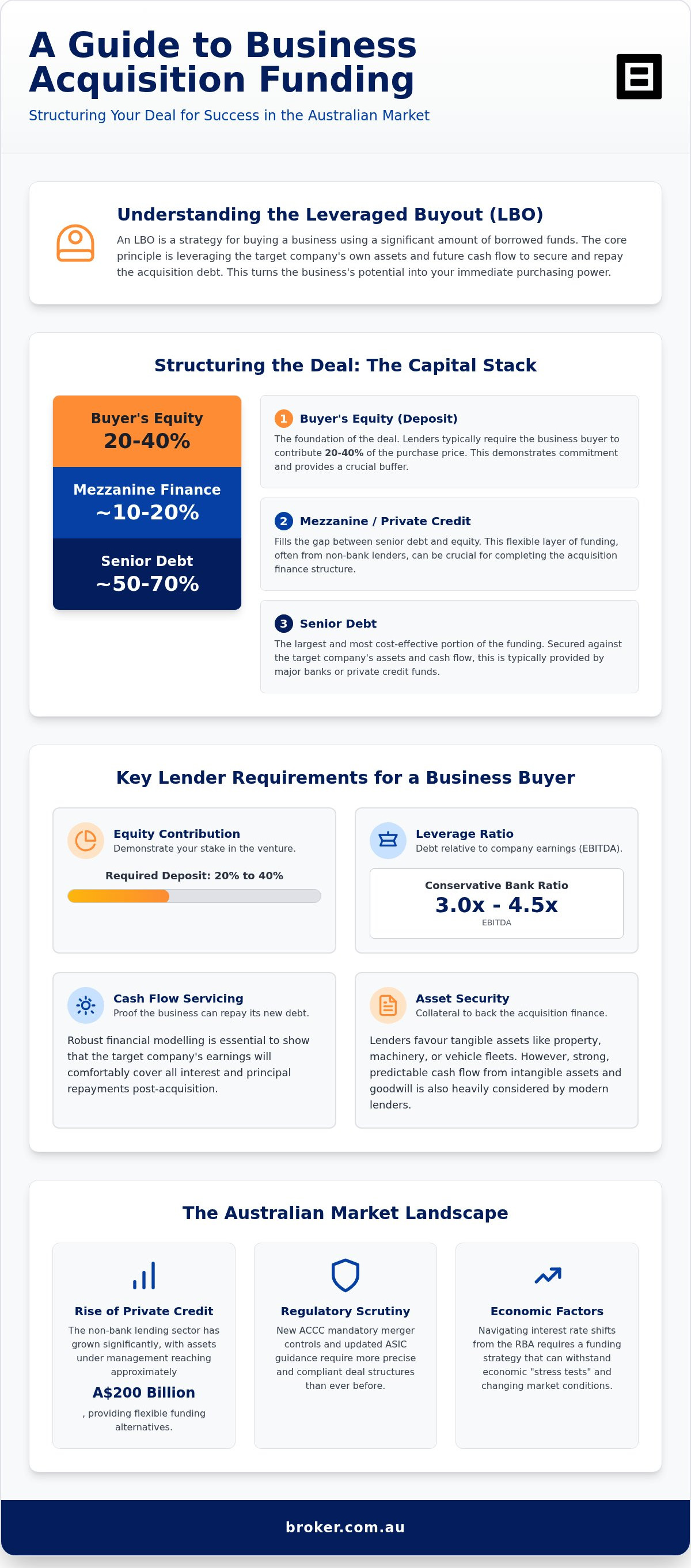
The Australian lending market is no longer a simple four-bank monopoly. While major banks still offer competitive senior debt, they often maintain conservative leverage ratios between 3.0x and 4.5x EBITDA. Private credit providers and non-bank lenders have stepped in to offer “unitranche” or “stretch senior” facilities that provide higher leverage for the right deal. A specialised broker acts as your expert guide, providing inside access to these diverse tiers of capital. Their corporate advisory expertise ensures that your financial modelling stands up to the scrutiny of the ACCC and ASIC’s updated 2026 corporate finance guidance, making the transition from prospect to owner a seamless experience.
Structuring Your Deal: How Business Acquisition Funding Works
Structuring a successful business acquisition requires more than just a single loan application. It involves assembling a “capital stack” that balances cost with flexibility. Most deals rely on senior debt as the foundation, typically covering the largest portion of the purchase price. However, to bridge the gap between your available cash and the total cost, you may need to introduce mezzanine finance or private credit. This tiered approach ensures that the debt remains serviceable without crippling the target company’s growth potential. A well-structured deal often incorporates Australian LBO Legal Guide principles to ensure compliance with the Corporations Act while protecting the buyer’s interests.
Lenders look closely at the split between tangible assets and goodwill. While banks prefer tangible security like property or machinery, modern acquisition finance also considers the cash flow generated by intangible assets. To maximise your leverage, you can utilise specialised Asset Finance to unlock the value in the target company’s existing vehicle fleet or equipment. This reduces the amount of high-interest capital required and keeps the deal efficient. Robust financial modelling is the tool that proves this viability to lenders, showing exactly how the business will meet its obligations under various scenarios. If you are unsure how to balance these elements, our team can help you organise a tailored finance structure that fits your specific acquisition goals.
Secured vs Unsecured Options for Business Acquisition
The choice between secured and unsecured funding depends on your timeline and asset base. Secured Business Loans offer the most competitive rates because they are backed by residential or commercial property. If you need to move quickly to beat a competing business buyer, an Unsecured Business Loan can provide a rapid injection of capital without the need for immediate collateral. By gaining inside access to specialised lender panels, you can often find hybrid options that combine the speed of unsecured funds with the stability of a secured facility.
The Importance of Working Capital in the Acquisition Phase
Cash flow is the lifeblood of any new ownership period, particularly in the first 90 days. It is a common mistake to exhaust all available funds on the purchase price, leaving the business “cash poor” during the transition. Integrating Working Capital Finance or a Line of Credit into your primary acquisition loan ensures you have the liquidity to manage day-to-day operations and unexpected costs. This proactive approach keeps the transition stress-free and allows you to focus on growth from day one.
Lender Requirements for an Australian Business Buyer
Securing leveraged buyout financing australia requires passing a series of rigorous “stress tests” that go far beyond a simple credit check. Lenders in 2026 focus heavily on whether the target business can survive a 10% drop in revenue or a sudden spike in interest rates. They don’t just look at the numbers; they look at the story behind them. This is where your industry experience becomes a critical asset. A business buyer with a proven track record in the same sector is viewed as a much lower risk than a newcomer. The Reserve Bank of Australia’s analysis of the private equity market highlights how professional management is a key driver of deal success, a sentiment echoed by modern acquisition lenders.
Proprietary AI technology has changed how we assess these deals. We use AI-driven tools to accurately model loan-to-value ratios (LVR) and debt-to-equity scenarios before they even reach a credit committee. This ensures your business acquisition is positioned as a viable, low-stress opportunity for the lender. By matching your profile against specific lender appetites, we can identify which institutions are currently favouring your specific industry.
Documentation and Compliance Checklist
You will need a comprehensive documentation suite to meet 2026 ASIC and Australian lending standards. This includes at least two years of BAS statements, detailed P&L reports, and tax returns for the target entity. A robust business plan is non-negotiable. It must outline your strategy for growth and debt repayment. An award-winning broker can help you organise these documents into a professional format, ensuring the acquisition finance process remains seamless and efficient.
Proving Servicing Capacity
The metric that matters most to a lender is the Debt Service Coverage Ratio (DSCR). For senior bank debt, typical thresholds in 2026 include an interest cover ratio of a minimum of 2.0x to 3.0x. This ensures there is enough cash flow to cover interest expenses and principal repayments. When buying a business, you must also prove the “stickiness” of the revenue. Lenders look for recurring contracts or a loyal customer base that won’t disappear after the previous owner exits. Your 2026 projections must explicitly account for potential interest rate fluctuations to show you can service the debt even in a volatile economic climate.
Navigating Equity, Deposits, and Cash Flow Servicing
Securing leveraged buyout financing australia often hinges on your ability to provide a clean equity contribution. In the current 2026 lending environment, most Australian institutions require a deposit between 20% and 40% of the total purchase price. While some private credit funds may offer higher leverage, they typically offset this risk with higher interest margins or warrants. For an ambitious business buyer, the challenge is often finding this capital when buying a business without draining personal reserves. You might consider vendor finance, where the seller leaves a portion of the purchase price in the business as a subordinated loan, effectively reducing your upfront cash requirement.
Beware of the “servicing trap” during your business acquisition. A target might boast impressive top-line revenue, but if its margins are thin or its debt deductions exceed 30% of “tax EBITDA”—under the thin capitalisation rules—your borrowing capacity could be significantly curtailed. If the deal involves commercial premises, utilising SMSF Loans can be a tax-effective way to fund the property component while keeping the operational acquisition finance separate. This ensures that the debt remains manageable and the business stays resilient against market shifts.
Equity Contribution Strategies
Many entrepreneurs use a “Home Loan for Business Owners” approach to meet equity requirements. By unlocking equity in your residential property, you can provide the hard capital lenders demand. While bringing in silent partners or private equity can bridge larger gaps, remember that Australian lenders prioritise hard capital over “sweat equity” every time. Silent partners can provide the necessary capital injection but will expect a share of the profits and potentially a say in operations. Private equity funds are increasingly active in the Australian mid-market, though their requirements for governance and reporting can be intensive. If you are ready to see what your equity can unlock, you can get started with a tailored assessment today.
Optimising Cash Flow for Debt Repayment
Once the keys are handed over, the focus shifts to debt servicing. Invoice Finance is an excellent tool for a business buyer to accelerate cash flow by unlocking the value of outstanding invoices immediately. This liquidity is vital for meeting the first few months of repayments when buying a business. We often work with clients to organise debt recycling strategies, turning non-deductible debt into tax-effective business debt. This is a sophisticated wealth-building strategy that works alongside your leveraged buyout financing australia. Additionally, aligning your repayment schedule with the business’s seasonal cycles ensures you aren’t under pressure during quieter trading months.
Partnering with a Specialist Broker for Your Business Purchase
Achieving the right structure for leveraged buyout financing australia is rarely a solo endeavour. While a major bank might offer a single path with rigid criteria, a specialist broker provides inside access to over 80 lenders, including private credit funds and non-bank specialists. This diversity is crucial for a business buyer because it allows for a tailored capital stack that fits the specific cash flow profile of the target. Our role as an Expert Guide is to transform a complex, high-stakes M&A scenario into a streamlined, confidence-building experience.
We bridge the gap between traditional lending and modern speed through proprietary AI technology. This is not just about automation; it is about accurately matching your specific deal parameters with the lenders most likely to approve your business acquisition. This efficiency reduces the anxiety often associated with acquisition finance and ensures you are not left waiting while a competitor moves on your target. By organising your funding through a specialised intermediary, you gain a “High-Level Fixer” who can navigate the nuances of the 2026 lending landscape on your behalf.
The Broker.com.au Process: From ‘I’m Interested’ to Settlement
The journey begins with a low-pressure conversation. When you click “I’m interested”, you are not just starting a loan application; you are engaging with a human-led advisory. Our team, including specialists like Matt, Kylie, and Flavio, assesses your borrowing power and evaluates the historical performance of the target business. We then utilise our AI to facilitate quick loan applications, ensuring your documentation meets the 2026 standards discussed earlier. This bespoke approach has solved countless “outside the norm” scenarios where traditional banks simply could not see the value in the deal, providing a stress-free path to settlement.
Taking the Next Step in Your Acquisition Journey
Waiting for the perfect market conditions can be a costly mistake. In 2026, the best businesses are often acquired by those who have their acquisition finance ready to deploy. Professional corporate advisory is the final piece of the puzzle, providing the insight needed during the high-pressure negotiation stage when buying a business. By organising your funding early, you position yourself as a serious, credible buyer. If you are ready to move from uncertainty to streamlined relief, I’m interested — speak with an award-winning broker today.
Secure Your Future as an Australian Business Owner
Mastering the intricacies of leveraged buyout financing australia is the final step in transitioning from an aspiring entrepreneur to a successful business owner. By balancing a sophisticated capital stack with robust financial modelling, you can navigate the 2026 lending landscape with precision. You now understand that a successful business acquisition relies on more than just high revenue; it requires a strategic approach to debt servicing, equity contribution, and meeting the rigorous benchmarks set by modern lenders.
You don’t have to manage this high-stakes process alone. As an award-winning Australian business loan broker, we provide the expert guidance and local insights needed to make your business purchase seamless. With inside access to over 80 specialised lenders and proprietary AI for faster loan matching, we ensure you are always in good hands. If you are ready to move from uncertainty to streamlined confidence, I’m interested in Business Acquisition Funding. Your next chapter as a business leader is within reach, and we are here to help you organise the finance that secures it.
Frequently Asked Questions
What is a typical deposit for business acquisition funding in Australia?
A typical deposit for business acquisition funding in Australia ranges between 20% and 40% of the total purchase price. This requirement ensures you have enough “skin in the game” to satisfy lender risk profiles. While some private credit providers might consider a lower equity contribution for high-growth sectors, they often compensate for this with higher interest margins. Having a clear plan for your deposit is a vital part of securing leveraged buyout financing australia successfully.
Can I use my home equity to fund buying a business?
Yes, you can certainly use your residential property to fund a business purchase. This is often referred to as a home loan for business owners. By unlocking equity in your home, you can provide the hard capital that lenders require for the deposit. This strategy is frequently used by Australian entrepreneurs to bridge the gap between their available cash and the total acquisition cost, making the deal more attractive to senior lenders.
How long does it take to get approval for acquisition finance?
Approval times for acquisition finance vary depending on the complexity of the deal. A straightforward transaction might take two to four weeks; however, a complex multi-tiered LBO could take six to eight weeks. At Broker.com.au, we use proprietary AI technology to facilitate quick loan matching, which significantly reduces the initial assessment phase. This streamlined approach ensures you can move from the “I’m interested” stage to a formal offer with minimal delay.
What is the difference between a secured and unsecured acquisition loan?
The main difference lies in the collateral required. A secured business loan uses assets like commercial or residential property to back the debt, resulting in lower interest rates. An unsecured business loan doesn’t require specific physical collateral but relies heavily on the target business’s historical cash flow. While unsecured options offer faster turnaround times for quick acquisitions, they typically come with higher rates and shorter repayment terms to offset the lender’s increased risk.
Do I need a business plan to get leveraged buyout financing?
A comprehensive business plan is absolutely essential for securing leveraged buyout financing australia. Lenders need to see a clear roadmap that outlines your management experience, growth strategies, and detailed financial projections. Your plan must demonstrate how the business will maintain its Debt Service Coverage Ratio (DSCR) even under economic pressure. A well-prepared document transforms your application from a simple request into a professional investment case, significantly increasing your chances of a seamless approval.
How does the lender calculate the value of goodwill in a business purchase?
Lenders calculate goodwill by looking at the gap between the purchase price and the value of the company’s tangible assets. This is often based on a multiple of the business’s EBITDA. While banks are traditionally conservative regarding intangible assets, they will consider funding a portion of the goodwill if you can prove the “stickiness” of the revenue. This involves showing loyal customer contracts, strong brand equity, and a stable history of cash flow performance.
Can I use my SMSF to help with acquisition finance?
You can use your Self-Managed Super Fund (SMSF) to assist with the commercial property component of an acquisition. Through specialised SMSF loans, your fund can purchase the premises where the business operates, which is then leased back to the company. This is a tax-effective strategy that allows you to separate the property investment from the operational business debt. It is a sophisticated move that requires careful adherence to strict Australian superannuation regulations.
What happens if interest rates rise after I complete my LBO?
Lenders include a “stress test” buffer in their initial assessment to account for potential interest rate rises. They typically look for an interest cover ratio of at least 2.0x to 3.0x to ensure the debt remains serviceable. If rates increase, you might explore refinancing options or use working capital finance to manage temporary liquidity gaps. Our corporate advisory team can help you model these scenarios during the deal structuring phase to keep the process stress-free.