Buying the freehold alongside the business isn’t just a growth move; it’s the ultimate de-risking strategy for Australian business owners. Most entrepreneurs hesitate because they’re tired of being told their family home is the only acceptable security, or they’re bogged down trying to separate goodwill from bricks and mortar value. If you’ve felt the frustration of slow bank approvals while trying to secure a loan to buy an existing business with property, you aren’t alone. It’s a complex path that often feels designed to protect the lender rather than empower the buyer.
We’ve designed this guide to help you move from uncertainty to streamlined confidence. You’ll discover how to structure a high-leverage loan that protects your personal assets and secures your future. We’ll explore the 2026 lending landscape, including how the current 4.35% cash rate and new APRA debt-to-income limits impact your borrowing capacity. From accessing inside rates with non-bank lenders to navigating the latest commercial benchmarks, we provide the expert insights needed for a stress-free acquisition.
Key Takeaways
- Learn why purchasing the freehold is a preferred strategy for lenders and how it eliminates the long-term uncertainty of lease negotiations.
- Discover how to structure a high-leverage loan to buy an existing business with property by combining acquisition debt and commercial property finance into a single, efficient package.
- Gain inside access to the 2026 lending landscape to identify which Tier 2 and non-bank lenders have the strongest appetite for your specific industry.
- Understand the critical differences between ‘goodwill’ and ‘asset’ valuations to ensure your serviceability assessment aligns with current bank requirements.
- Follow a proven roadmap from initial consultation to settlement that protects your personal assets and organises your debt for long-term security.
Table of Contents
- The Strategic Advantage: Why Buying a Business with Property Changes the Lending Landscape
- Structuring Your Loan: Combining Business Acquisition and Commercial Property Finance
- Lender Appetite and Requirements: What Australian Banks Look For in 2026
- The Roadmap to Approval: From Due Diligence to Settlement
- Securing Your Future with Broker.com.au: Inside Access to Australia’s Best Rates
The Strategic Advantage: Why Buying a Business with Property Changes the Lending Landscape
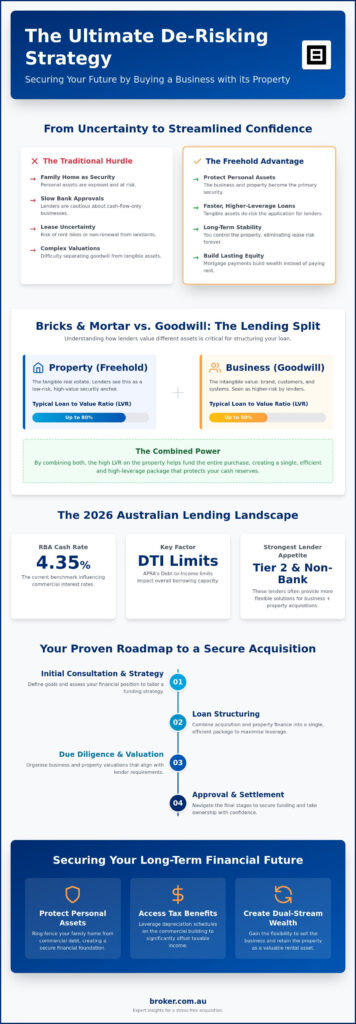
When you’re looking for a business loan, the structure of the deal often dictates the speed of the approval. Buying an existing operation is one thing; buying the dirt it stands on is quite another. In the 2026 Australian market, lenders have become increasingly cautious about cash-flow-only lending. By securing a loan to buy an existing business with property, you’re offering the bank a security anchor. This tangible asset transforms the application from a high-risk bet on future goodwill into a secured investment backed by real estate.
Owning the freehold eliminates lease risk, which is one of the most common points of failure for SMEs. You no longer have to worry about a landlord refusing to renew a lease or spiking the rent just as your business hits its stride. This stability provides long-term security that banks value. It also fundamentally changes your balance sheet. Instead of a monthly rent expense that vanishes, you’re making mortgage repayments that build equity. This shift increases your overall borrowing power, allowing you to capitalise on future growth opportunities with far less friction.
Market conditions in 2026 currently favour these asset-backed acquisitions. While the RBA cash rate sits at 4.35%, we’ve seen a slight easing of lending standards for commercial real estate. Some lenders are now more willing to lower presale requirements or loosen covenants if a solid, “going concern” business is part of the package. It’s a professional strategy that moves you from a state of uncertainty toward streamlined confidence.
Bricks and Mortar vs. Goodwill: The Lending Split
Goodwill represents the intangible value of a business, including its brand, systems, and customer loyalty. Banks are traditionally hesitant to fund goodwill at high percentages because it can’t be sold as easily as a warehouse. However, when property is involved, the bricks and mortar act as a “security anchor” for the entire facility. Lenders typically offer a higher Loan to Value Ratio (LVR) on the freehold portion, which helps cover the total purchase price and reduces the need for you to tip in excessive amounts of capital or risk your family home.
Tax Benefits and Long-term Wealth Creation
The financial advantages of this structure extend well beyond the initial approval. As an owner-occupier, you can access depreciation schedules on the commercial building, which can significantly offset your taxable income. This prepares you for a stress-free exit strategy. When you eventually decide to move on, you can sell the business and the property together, or sell the business and keep the building to become the landlord yourself. This creates a dual-stream wealth model that most renters can only dream of.
Structuring Your Loan: Combining Business Acquisition and Commercial Property Finance
Structuring a high-leverage deal requires more than a standard bank application. Most traditional lenders view business acquisition and commercial property as separate silos, but a hybrid loan model allows you to link these two debt facilities for better efficiency. When you secure a loan to buy an existing business with property, you’re essentially creating a bespoke finance package that uses the freehold as the primary collateral to fund both the bricks and the goodwill. This approach simplifies your monthly obligations and often results in a more competitive overall interest rate.
Cross-collateralisation is often the engine behind these deals. It’s a double-edged sword that allows you to borrow a higher percentage of the total purchase price, but it also ties the performance of your business directly to your property ownership. To organise this safely, we focus on ring-fencing assets where possible. This ensures that while the property supports the acquisition, your personal family home remains protected from the commercial debt. If you’re unsure how to balance these debt facilities, starting a conversation with a specialist can clarify your options.
Post-settlement, your cash flow needs will shift. Integrating a Line of Credit into your initial structure provides a safety net for day-to-day working capital. This prevents the common trap of being asset rich but cash poor immediately after taking the keys. By having a flexible facility in place, you can manage the transition period without the stress of seeking additional approvals during those critical first few months of operation.
SMSF Loans: A Powerful Tool for Property Acquisition
Using your Self-Managed Super Fund (SMSF) to purchase the business premises is a sophisticated move for 2026. Under the “Arm’s Length” rule, your business pays market-rate rent directly into your super fund, effectively building your retirement nest egg while you operate. Regulatory requirements in 2026 demand strict compliance with these leasing arrangements, but the tax advantages often outweigh the administrative effort. It’s a seamless way to separate your business operations from your long-term wealth strategy.
Equipment and Asset Finance Integration
Don’t overlook the machinery, technology, or vehicle fleet that comes with the business. We often separate Asset Finance from the main property mortgage. This allows you to preserve working capital and structure repayments that match the seasonal cash flow of the existing operation. Whether it’s a fit-out for a retail space or heavy equipment for a workshop, specific asset finance ensures your debt is as efficient as your new business. This tailored approach keeps your balance sheet lean and your momentum high.
Lender Appetite and Requirements: What Australian Banks Look For in 2026
The lending landscape in 2026 has evolved into a two-tier system. While the Big Four banks remain a primary source of capital, their appetite for risk is often constrained by the APRA debt-to-income limits activated earlier this year. If you are seeking a loan to buy an existing business with property, looking beyond the major institutions is often the key to a successful settlement. Tier 2 and non-bank lenders frequently show a stronger appetite for specific industries, such as medical services or specialized manufacturing, where traditional banks might apply a one-size-fits-all rejection.
Serviceability is the primary hurdle in the current environment. Lenders don’t just look at the property value; they scrutinize the “going concern” profit of the business against your total debt obligations. With the RBA cash rate at 4.35% as of July 2026, interest cover ratios are under more pressure than in previous years. Lenders want to see that the business can comfortably handle repayments while accounting for the Payday Super regulations that now require superannuation contributions to be paid within seven business days of payday. Having inside access to niche lenders allows you to find terms that accommodate these modern cash flow pressures without the rigid 30% deposit requirements often found on the high street.
A clean credit history and a solid Business Plan are non-negotiable for 2026 approvals. Lenders are looking for “Expert Guides” who understand their industry. This is where a human-led advisory makes the difference. By presenting a professional case that highlights your experience and the business’s historical stability, you move from being a “risky applicant” to a “preferred client.”
The Role of Financial Modelling in Your Application
Relying solely on two years of historical tax returns is a strategy of the past. In 2026, lenders demand robust, future-dated cash flow forecasts that they can actually trust. They want to see how the business will perform under your leadership. Our team assists in refining your financial data, ensuring your presentation is best in class. This proactive modelling moves the conversation from a simple debt assessment to a strategic growth discussion.
Security Requirements: Protecting Your Personal Assets
One of the biggest fears for business owners is losing the family home as security. We focus on structuring loans that use the commercial freehold itself as the primary collateral. This often involves a General Security Agreement (GSA) over the business assets combined with a specific charge over the property. While Director Guarantees remain common, we work to negotiate terms that limit your personal exposure. This ensures the process remains stress-free and your personal assets stay protected from your commercial debt.
The Roadmap to Approval: From Due Diligence to Settlement
The transition from a potential buyer to a business owner is often the most stressful phase of the journey. Securing a loan to buy an existing business with property requires a synchronised approach where due diligence and finance applications run in parallel. Our roadmap begins with an initial consultation to identify your specific needs and match them to a tailored finance solution. This isn’t a generic application; it’s a strategic plan designed to navigate the 2026 regulatory environment with streamlined confidence.
Frustration with slow bank approval times is a common complaint among Australian entrepreneurs. To solve this, we leverage proprietary AI that facilitates quick, accurate matching between your acquisition and our vast lender panel. This technology allows us to identify the lenders with the highest appetite for your industry in seconds, ensuring your application lands on the right desk first. It transforms a complex, manual process into a professional path toward settlement, giving you a distinct advantage over competitors who are still waiting for a callback from a branch manager.
Final approval and settlement involve coordinating with solicitors and the vendor for a seamless transition. We handle the technical friction, allowing you to focus on the operational handover. If you’re ready to start this journey with a team that values speed and precision, tell us about your dream acquisition today.
Valuations: The Make-or-Break Moment
Valuations are often the make-or-break moment in a commercial deal. Lenders look at ‘Going Concern’ valuations, which include the business’s trading value, versus ‘Vacant Possession’ valuations, which only consider the empty building. If a valuation comes in lower than expected, it doesn’t mean the deal is dead. We have the expertise to challenge a valuation using local market data and historical performance insights to ensure the loan to buy an existing business with property reflects its true potential and value.
Working with the Right Professional Team
You need a team of high-level fixers in your corner to manage the synergy between your broker, accountant, and commercial lawyer. Whether it’s Matt, Kylie, or Flavio, our human-led advisory handles the heavy lifting of financial modelling and lender negotiations. We also ensure you’re prepared for day one by organising Fit-out Finance or equipment funding early in the process. This proactive approach ensures you hit the ground running with the working capital you need to succeed from the moment you take the keys.
Securing Your Future with Broker.com.au: Inside Access to Australia’s Best Rates
Navigating a loan to buy an existing business with property requires more than a standard mortgage broker. You need an award-winning partner who understands the intricate dance between commercial real estate and business valuation. At Broker.com.au, we provide inside access to over 50 lenders, including niche non-bank players that often offer more flexible terms than the Big Four. This breadth of choice ensures you aren’t just getting a loan; you’re getting the most competitive rate and structure available in the 2026 market.
Our team, led by experts like Matt, Kylie, and Flavio, acts as your high-level fixer. We specialise in those complex scenarios that fall outside of the norm, where traditional banks often struggle to find a path forward. We’re committed to a stress-free experience, handling the technical friction of the application so you can remain focused on your business goals. From the first conversation to the final settlement, you’re in good hands with an advisor who goes above and beyond to protect your interests.
Tailored Solutions for Every Industry
Different sectors have different cash flow rhythms. Whether you’re acquiring a medical centre in Melbourne or a hospitality venue in Sydney, we apply specialist knowledge to your specific industry. We customise loan features to align with your needs, including:
- Ballon Payments: Structuring lower monthly repayments to assist with initial cash flow.
- Interest-Only Periods: Providing flexibility during the crucial transition phase of a new acquisition.
- Industry-Specific Terms: Customised solutions for retail, industrial, medical, and hospitality sectors.
Our can-do attitude means we don’t just look for reasons to say no; we find the structure that makes “yes” possible even for complex applications.
Start the Conversation Today
Exploring your financing options shouldn’t feel like a high-pressure sales pitch. Our “I’m interested” approach is designed to be the start of a low-pressure conversation about your future. You can also use our 2026 calculators to get a quick borrowing power estimate, helping you understand your position before you even make an offer. If you’re ready to secure your future with a loan to buy an existing business with property, we’re ready to help you make it happen.
Secure Your Commercial Legacy Today
Combining a business purchase with its freehold premises is the most effective way to build long-term equity while eliminating lease uncertainty. Success in the 2026 lending landscape requires a sophisticated approach to serviceability and asset protection. By correctly structuring your loan to buy an existing business with property, you move from a state of financial complexity toward streamlined confidence.
Navigating this process doesn’t have to be a source of anxiety. At Broker.com.au, we combine proprietary AI for faster approvals with the human-led advisory of expert fixers like Matt, Kylie, and Flavio. As an award-winning Australian brokerage, we provide the inside access needed to unlock competitive rates across a vast lender panel, even for deals that fall outside the norm. We’re here to handle the heavy lifting so you can focus on running your new enterprise.
If you’re ready to explore your options with a team that values your dream as much as you do, we’re ready to start the conversation. I’m interested
Let’s turn your vision into a secured reality.
Frequently Asked Questions
Can I get a loan to buy a business and the property together with one deposit?
Yes, you can combine these into a single hybrid loan facility where the commercial property acts as the primary security. This structure is often more attractive to lenders because the tangible asset de-risks the goodwill component of the business. It allows you to manage one set of repayments and often results in a higher overall loan-to-value ratio than if you were purchasing the business alone.
What is the typical interest rate for a commercial property loan in Australia in 2026?
As of July 2026, with the RBA cash rate sitting at 4.35%, interest rates vary depending on the lender’s risk assessment. For instance, Westpac’s Small Business Loan Rate is currently 7.91% p.a., while their Business Development Rate is 9.02% p.a. Non-bank lenders may offer different structures, so it’s essential to compare the broader market to find a rate that fits your specific financial modelling.
How much deposit do I need to buy an existing business with property?
You’ll typically need a deposit of 20% to 30% for the property component, though this can vary based on the industry and the strength of the business’s cash flow. When you apply for a loan to buy an existing business with property, the equity in the freehold can sometimes be leveraged to cover a portion of the business goodwill. This can reduce the total cash deposit you need to provide upfront.
Can I use my home equity as a deposit for a business acquisition?
Yes, using your home equity is a common and effective strategy to fund a business purchase. By securing part of the debt against your residential property, you can often access more competitive interest rates and preserve your working capital. It’s a proactive way to get the deal moving without draining your liquid cash reserves, provided you’re comfortable with the cross-collateralisation involved.
What documents do I need to provide for a secured business loan?
Lenders require a comprehensive application pack, including two years of historical tax returns and financial statements for the existing business. You’ll also need to provide a solid business plan and, crucially for 2026 approvals, future-dated cash flow forecasts. These documents help the lender assess your serviceability and ensure the business can handle its debt obligations alongside new regulations like Payday Super.
How long does the approval process take for a commercial property and business loan?
The approval process usually takes between four and eight weeks from the time you submit your full application. This timeframe allows for the property valuation, business due diligence, and the lender’s internal credit assessment. Using proprietary AI can significantly speed up the initial stage by matching your deal with the right lender appetite in a matter of seconds.
What is a ‘going concern’ and how does it affect GST on the property purchase?
A ‘going concern’ refers to a business that is actively trading and is expected to continue operating after the ownership transfer. If the property is sold as part of a going concern, the transaction may be GST-free under Australian tax law. This is a significant advantage as it prevents you from having to find an extra 10% of the purchase price at settlement.
Is it better to buy the business property through an SMSF?
Buying through a Self-Managed Super Fund (SMSF) can be an excellent strategy for long-term wealth creation and tax efficiency. It allows your business to pay market-rate rent directly into your retirement fund, effectively building your nest egg while you work. While the regulatory requirements are strict, the benefit of separating your business assets from your personal retirement strategy is often worth the extra effort.