
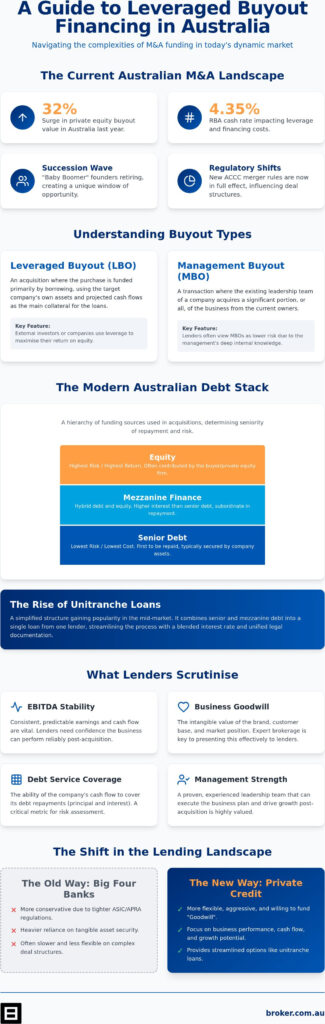
Private equity buyout value in Australia surged by 32% last year, proving that the appetite for strategic acquisitions remains fierce despite a shifting economic landscape. As you explore the potential of leveraged buyout financing australia, you likely already know that the traditional path through the Big Four is no longer the only, or even the best, route to success. Navigating the high complexity of debt layers while managing the fear of over-leveraging a target business is a significant hurdle for any executive. It’s a high-stakes puzzle where the pieces don’t always seem to fit, especially with the RBA holding the cash rate at 4.35% and new ACCC merger rules now in full effect.
This guide is designed to help you master these complexities so you can fund your next major acquisition with streamlined confidence. We’ll provide a clear roadmap to securing funding, from understanding the nuances of senior versus mezzanine debt to accessing competitive private credit rates that stay off the radar of mainstream lenders. You’ll gain the professional insight needed to organise a sophisticated debt structure that protects your company’s future while fuelling its growth, ensuring the entire process feels controlled and stress-free.
Key Takeaways
- Unpack the modern Australian “debt stack” to see how senior, mezzanine, and unitranche facilities work together to fund your acquisition.
- Identify the critical metrics lenders scrutinise, including the Debt Service Coverage Ratio and the vital role of consistent EBITDA stability.
- Follow a clear roadmap to secure leveraged buyout financing australia, utilising AI technology to match your deal with the ideal institutional or private credit lender.
- Learn how to prepare a professional Information Memorandum that highlights business value while protecting your credit profile from the risks of “shopping” your deal.
- Discover how to access competitive rates and flexible structures beyond the Big Four banks, ensuring a seamless and stress-free transition for your new business.
Table of Contents
- Understanding Leveraged Buyout (LBO) and Management Buyout (MBO) Financing
- Core Financing Structures for Australian Acquisitions
- Assessing Eligibility: Is the Acquisition Financeable?
- The Roadmap to Securing LBO Financing in 2026
- Why Expert Brokerage is Essential for Complex Acquisitions
Understanding Leveraged Buyout (LBO) and Management Buyout (MBO) Financing
Understanding Leveraged Buyouts (LBO) begins with a simple premise: using the target company’s own balance sheet to fund its purchase. In an LBO, the assets and projected cash flows of the business you’re acquiring serve as the primary collateral for the loan. This is distinct from a Management Buyout (MBO), where the existing leadership team, the people already steering the ship, decides to buy the business from the current owners. Both pathways are essential components of leveraged buyout financing australia, but they require different strategic approaches to satisfy modern lenders.
As we move through 2026, the Australian market is witnessing a significant wave of business transitions. With a vast number of “baby boomer” founders reaching retirement age, succession planning has moved from a boardroom discussion to an urgent economic reality. This shift creates a unique window for ambitious executives and private investors to step in. However, securing the necessary capital requires a sophisticated understanding of how Australian lenders view “Goodwill.” While tangible assets like property or machinery are straightforward to value, the intangible value of a brand or a loyal customer base is often where deals stall. Expert brokerage becomes vital here, as we help you present these intangible strengths in a way that aligns with the risk appetite of non-bank lenders.
LBO vs MBO: Key Differences for Australian Buyers
The primary distinction between these two structures lies in the depth of internal knowledge and the resulting risk profile. In an MBO, lenders often feel a sense of reassurance because the buyers already understand the operational nuances and potential “skeletons in the closet.” Because the management team is already in place, the transition is seen as lower risk. To bridge the funding gap in these deals, vendor finance is a frequent feature in the Australian market. This is where the seller agrees to leave a portion of the purchase price in the business as a loan, which is paid back over time. Using debt strategically allows you to preserve your own capital, ensuring you have the “dry powder” needed to fund growth and innovation immediately after the acquisition is finalised.
The Evolving Australian Debt Landscape
The era of relying exclusively on the Big Four banks for complex M&A deals is effectively over. While ASIC and APRA regulations have tightened the requirements for traditional bank lending, the private credit market has flourished, providing more flexible and aggressive options. These niche lenders are often more willing to look beyond simple asset-backing to the actual performance and potential of the business. LBO financing is a strategic tool for scaling without equity dilution. By accessing these tailored debt structures, you can maintain full control of your company’s future while leveraging its current success to reach the next level of growth.
Core Financing Structures for Australian Acquisitions
Building a successful acquisition deal requires more than just capital. It requires a balanced “debt stack” that aligns with the target company’s cash flow. This hierarchy of funding determines who gets paid first and what security is required. In the current market, leveraged buyout financing australia often relies on a sophisticated mix of senior debt, mezzanine finance, and equity. For larger transactions, “Term Loan B” (TLB) structures have become increasingly popular. These facilities offer bullet repayments at maturity, which allows the business to reinvest its operational cash flow into growth rather than aggressive principal reduction during the critical first years of ownership.
We are also seeing a significant rise in unitranche loans across the mid-market. This structure simplifies the acquisition process by combining senior and subordinated debt into a single facility with a blended interest rate. It’s an efficient way to streamline the deal and reduce the number of lenders you need to manage. When choosing your path, you’ll need to decide between asset-based lending, which uses equipment or property as collateral, and cash-flow lending, which is based on EBITDA. The right choice depends entirely on the nature of your target company. If you’re unsure which path fits your specific industry, our team can provide tailored business acquisition funding advice to clarify your options.
Senior Debt and Secured Business Loans
Senior debt is usually the foundation of any acquisition stack. It remains the cheapest capital available because it sits at the top of the repayment priority list. In 2026, typical Loan-to-Value Ratios (LVR) for Australian commercial assets hover between 60% and 80%, depending on the lender’s risk appetite. While cost-effective, senior debt often comes with strict requirements. This is why many borrowers now seek “Covenant Lite” (cov-lite) options. These loans provide greater operational freedom by reducing the number of financial hurdles you must clear each quarter. As noted in this Australian acquisition finance guide, the shift toward flexible terms is a defining feature of the current landscape.
Mezzanine and Subordinated Debt
Mezzanine finance acts as the vital bridge between your senior loan and your own equity contribution. It is more expensive than senior debt, with higher interest rates reflecting the fact that these lenders have lower security priority. However, it’s a powerful tool for maximising leverage without giving up more equity. To manage this complexity, lenders use inter-creditor agreements. These documents clearly define the priority of claims if the business faces insolvency. It ensures everyone knows their place, reducing friction and providing peace of mind for all parties involved in the transaction.
Assessing Eligibility: Is the Acquisition Financeable?
Before you sign a Heads of Agreement, you need to know if the deal will actually hold water with sophisticated lenders. In the competitive space of leveraged buyout financing australia, the Debt Service Coverage Ratio (DSCR) is the most critical metric. Lenders use this to ensure the business generates enough cash to cover its interest and principal repayments with a comfortable buffer. They look for historical EBITDA stability above all else. If a business has “lumpy” cash flow or seasonal dips that aren’t well-explained, it’s a major red flag. Financiers want to see a steady stream of income that can weather a storm; not a roller-coaster ride of revenue.
Beyond the raw numbers, asset quality plays a vital role in your eligibility. If the target business owns plant, equipment, or commercial real estate, these can be used as collateral to secure more favourable rates. However, lenders also look for “Management Alpha.” This refers to your ability as a leader to maintain or even improve existing margins once the previous owner exits. Proving you have the expertise to drive the business forward is often what tips the scales in a high-stakes application. It’s about showing that the business won’t just survive the transition, but thrive under your leadership.
Financial Modelling and Due Diligence
Your financial model needs to be more than just a basic spreadsheet; it must be a robust stress test. Lenders will want to see how the business survives if interest rates rise or if revenue drops by 10%. A professional Quality of Earnings (QofE) report is often mandatory for high-leverage debt. This report digs deeper than standard tax returns to show the “true” profitability of the firm. During this phase, you must also hunt for hidden liabilities. Issues like accrued employee entitlements or long-term lease commitments can significantly impact your borrowing capacity if they aren’t accounted for early in the process.
Management Experience and Track Record
Lenders back people just as much as they back a P&L statement. They want to see a track record of success and a clear “100-Day Plan” for the period immediately following the acquisition. This plan should outline exactly how you’ll manage the transition and mitigate any operational risks. This is where our corporate advisory team at Broker.com.au steps in to help. We assist you in polishing your management presentation, ensuring you speak the lender’s language and project the streamlined confidence needed to secure the best possible terms. We move you from a state of uncertainty toward a feeling of total readiness.
The Roadmap to Securing LBO Financing in 2026
Securing leveraged buyout financing australia is a structured journey that transforms a complex acquisition into a manageable reality. It’s a process where precision meets momentum. We break this down into five distinct phases to ensure you stay in control while we handle the heavy lifting with lenders, moving you from initial uncertainty to a finalised settlement.
- Step 1: Preliminary Assessment: We begin with a deep dive into the deal’s fundamentals. Our proprietary AI technology instantly matches your acquisition profile with a curated list of institutional and private credit lenders who have a proven appetite for your specific industry.
- Step 2: Information Memorandum (IM): We help you organise a compelling IM and robust financial projections. This document is your technical “pitch deck” to lenders, proving the business’s resilience and your vision for its future.
- Step 3: Term Sheets: Once the IM is issued, we secure competing Term Sheets. This stage is vital for comparing interest rates, repayment structures, and overall flexibility across multiple offers.
- Step 4: Formal Due Diligence: Lenders conduct their final “look under the hood.” This involves verifying financial records and asset valuations to reach formal credit approval.
- Step 5: Settlement: With approval in hand, we move to legal documentation and final settlement, ensuring a seamless transition of funds and ownership.
Navigating Term Sheets and Covenants
The Term Sheet is where the fine print determines your future operational freedom. You’ll likely encounter “Negative Pledges,” which are promises to the lender that you won’t take on additional debt or encumber assets without their consent. It’s vital to negotiate for sufficient “Headroom” within your financial covenants. This buffer ensures that a single quiet quarter doesn’t trigger a technical breach of your loan agreement. Additionally, always distinguish between committed funding lines, which are guaranteed, and uncommitted lines that the lender can withdraw at their discretion. If you want to see how these structures apply to your deal, you can get started with our specialised business acquisition funding team today.
The Role of Private Credit and Non-Bank Lenders
While the Big Four often struggle with “Goodwill” lending, the private credit market in Australia has become a sophisticated alternative. These lenders are frequently more flexible, looking at the total enterprise value rather than just hard assets. Through our institutional relationships, we provide inside access to rates and structures that aren’t available on the open market. This allows for a more tailored approach to high-leverage deals that traditional banks might miss. Private credit often provides higher leverage for a slightly higher price. This trade-off is frequently worth it for buyers who prioritise speed and flexibility over the rigid requirements of traditional banking institutions.
Why Expert Brokerage is Essential for Complex Acquisitions
Approaching a bank directly with a complex M&A proposal is often a high-risk strategy that can backfire. When you “shop your deal” to multiple lenders without a coordinated plan, you risk creating a trail of credit inquiries that can signal desperation or instability to the market. Each rejection or hesitation from a traditional lender leaves a mark on your corporate credit profile. We act as your professional shield, using our award-winning expertise to present your case only to the lenders most likely to approve it. By managing leveraged buyout financing australia through a specialised intermediary, you move from a position of uncertainty to one of streamlined confidence.
Our proprietary AI technology changes the game for mid-market acquisitions. Instead of guessing which bank might have an appetite for your specific industry, our system identifies niche lenders and private credit funds with a proven track record in your sector. This “inside access” ensures you aren’t just getting a loan; you’re getting a facility tailored to the unique cash-flow cycles of your new business. We focus on results that go beyond the initial transaction, ensuring your debt is structured to protect your personal assets and family home from the inherent risks of high-stakes corporate growth.
Beyond Traditional Broking: Corporate Advisory
We don’t just find loans; we provide a high-level corporate advisory service that speaks the language of M&A. Our team, led by experts like Matt and Flavio, assists in debt restructuring to optimise your balance sheet before and after the deal is finalised. Having an advocate who understands the technical nuances of transaction multiples and equity cushions is invaluable. We’ve facilitated seamless transitions for multi-million dollar acquisitions where the “M&A speak” of lawyers and accountants needed to be translated into a compelling case for credit approval. You can rest easy knowing your vision is being represented by professionals who know how to close the gap between a dream and a funded reality.
Securing Your Future Growth
A successful acquisition is only the first step. The real challenge is ensuring your debt structure doesn’t stifle your future working capital needs. We look at the “big picture” by integrating secondary facilities like asset finance for new equipment or invoice finance to smooth out cash flow. This holistic approach ensures that your post-acquisition phase is focused on expansion rather than just servicing debt. If you’re ready to explore your options without the pressure of a formal bank application, our “I’m interested” approach is the perfect starting point for a low-pressure conversation about your goals.
I’m interested in acquisition funding
Take Command of Your Next Acquisition
Mastering the nuances of the Australian M&A landscape requires more than just ambition; it demands a strategic alignment of capital and vision. By understanding the interplay between senior and mezzanine debt and following a structured roadmap, you can navigate the complexities of leveraged buyout financing australia with streamlined confidence. You’ve seen how the right debt stack preserves your equity while providing the fuel needed for post-settlement growth.
As an award-winning Australian brokerage, we provide the expert guidance needed to move from uncertainty to a funded reality. Our proprietary AI matching technology gives you inside access to over 80 institutional and private lenders, ensuring you secure competitive term sheets without the stress of traditional bank delays. Whether you’re planning a management buyout or a strategic corporate takeover, we’re here to ensure you’re in good hands.
I’m interested in exploring acquisition finance options
Your next major business milestone is within reach, and we’re ready to help you secure it.
Frequently Asked Questions
What is the typical interest rate for LBO financing in Australia?
Interest rates for leveraged buyout financing australia vary depending on the risk profile and the layer of debt you’re accessing. In the current 2026 market, secured variable rates for business acquisitions typically start from approximately 6.99% p.a., while fixed-term loans begin around 7.35% p.a. If you’re accessing unsecured funding or private credit, rates can range from 12.74% p.a. to over 20% p.a. for higher-risk profiles.
Can I use my family home as collateral for a management buyout?
You can certainly use equity in your family home to fund a management buyout, but it’s often not the most efficient strategy. Most sophisticated buyers prefer to use the target company’s assets or cash flow as collateral to keep personal and business risks separate. However, for smaller acquisitions, leveraging residential property can sometimes help you secure a lower interest rate than a pure commercial facility.
What is the maximum leverage (LVR) available for business acquisitions?
Most Australian lenders operate at a Loan-to-Value Ratio (LVR) of 60% to 80% for business acquisitions. This means you’ll typically need a deposit or equity contribution of 20% to 40% of the total purchase price. While some private credit funds might offer higher leverage, they’ll usually require strong evidence of stable historical EBITDA and a robust post-acquisition growth plan to offset the increased risk.
How long does it take to secure leveraged buyout financing?
The timeline to secure leveraged buyout financing australia generally spans between 4 and 8 weeks from the initial application to settlement. While our proprietary AI technology can generate preliminary lender matches and term sheets within days, the formal due diligence and credit approval phases take longer. Being prepared with a high-quality Information Memorandum and stress-tested financial models is the best way to speed up this process.
Do Australian banks fund management buyouts for small businesses?
Australian banks do fund management buyouts for small businesses, but they’re often conservative in their lending criteria. They typically prefer deals where there’s a significant amount of tangible collateral, such as commercial property or equipment. If your small business acquisition is primarily based on “goodwill” or intangible assets, you’ll likely find more flexible and supportive terms through non-bank private credit lenders.
What is the difference between senior debt and unitranche debt?
Senior debt is the cheapest form of capital and holds the highest priority for repayment, but it comes with the most restrictive covenants. Unitranche debt is a hybrid structure that combines senior and subordinated debt into a single loan facility with a blended interest rate. Unitranche is increasingly popular in Australia because it simplifies the “debt stack,” requiring you to manage only one lender and one set of loan documents.
Will I need to provide a personal guarantee for an LBO loan?
In the Australian mid-market, most lenders will require some form of personal guarantee from the directors. This provides the lender with additional security and ensures the management team is fully committed to the business’s success. However, the extent of these guarantees can often be negotiated. Some private credit providers may offer “limited” guarantees or non-recourse options if the business assets and cash flows are exceptionally strong.
How does thin capitalisation affect LBO structures in Australia?
Thin capitalisation rules are tax regulations that limit the amount of interest a business can deduct if its debt-to-equity ratio is considered too high. In an LBO, where debt levels are intentionally elevated, these rules can significantly impact your post-tax cash flow. It’s vital to work with your corporate advisory team to ensure your debt structure is compliant with Australian Taxation Office (ATO) requirements while still maximising your leverage.