
What if the thousands of dollars currently locked in your unpaid invoices could be transformed into immediate working capital without the soul-crushing weight of big bank red tape? For many Australian business owners, the gap between issuing an invoice and receiving payment is the single biggest barrier to scaling. It’s a frustrating cycle where lumpy cash flow prevents you from making that crucial new hire or securing bulk stock discounts, even when your turnover is healthy.
We understand that finding the right business funding can feel overwhelming, particularly with the Reserve Bank’s cash rate sitting at 4.35% and new e-invoicing mandates approaching in late 2026. This guide will show you how to use invoice finance as a strategic growth accelerator rather than a last resort. You’ll discover how to access immediate liquidity that scales alongside your sales and learn how to select a facility that protects your professional reputation. We’ll break down the difference between factoring and discounting, providing the expert insight needed to avoid high-interest traps and find a tailored solution that puts you back in control.
Key Takeaways
- Unlock the mechanics of revolving credit to access up to 90% of your invoice value in as little as 24 hours.
- Compare the strategic benefits of factoring versus discounting to determine the best way to manage your sales ledger while protecting your brand’s reputation.
- Discover why a specialist broker offers a more tailored invoice finance facility than the rigid security requirements often found at the big four banks.
- Assess your eligibility for funding by understanding the importance of B2B credit terms and the role of fully rendered services in securing approval.
- Follow our streamlined, step-by-step path to funding that minimises administrative burden and maximises your immediate liquidity.
Table of Contents
- What is Invoice Finance and How Does it Work in Australia?
- Factoring vs. Discounting: Comparing the Two Primary Paths
- The Strategic Advantage: Why Use a Broker Over a Big Four Bank?
- Assessing Eligibility: Is Your Business Ready for Invoice Finance?
- Getting Started: Your Stress-Free Path to Funding
What is Invoice Finance and How Does it Work in Australia?
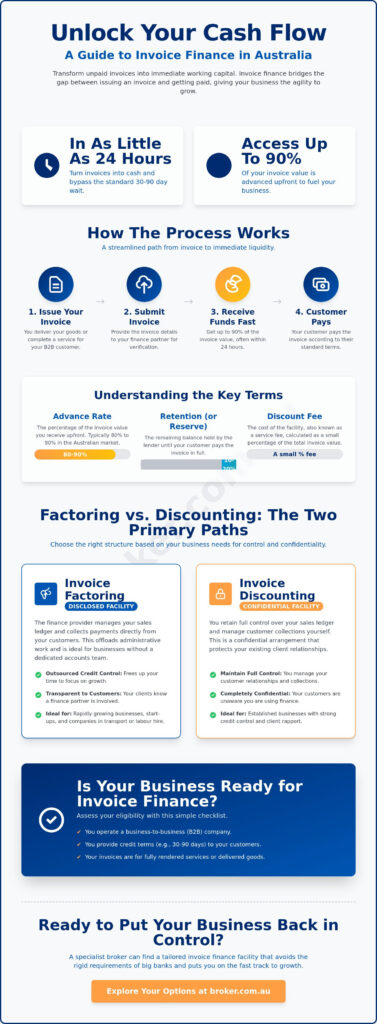
In the evolving Australian financial landscape, business owners are moving away from the restrictive nature of property-backed lending. To understand What is Invoice Finance, you should view it as a revolving facility that unlocks the value of your accounts receivable. Unlike a traditional term loan that requires a fixed repayment schedule and often your family home as security, invoice finance allows you to access your own earnings before your customers actually pay. It’s an efficient way to bypass the standard 30 or 60 day wait, turning a paper asset into liquid cash in as little as 24 to 48 hours.
The mechanics are designed for speed. Once you’ve delivered goods or completed a service, you simply provide the invoice details to your finance partner. They verify the ledger and advance a significant portion of the funds immediately. This provides a level of agility that a standard bank overdraft or unsecured loan simply cannot match, especially when your sales are growing faster than your available cash. It’s a proactive tool that scales automatically; as your billings increase, so does your access to capital.
The Working Capital Gap: Why Timing Matters
Many Australian industries, from construction and transport to wholesale trade, operate on extended 30, 60, or 90 day payment cycles. While you might have thousands of dollars in revenue on your books, you can’t pay staff, settle GST obligations, or buy materials with an unpaid PDF. This lumpy cash flow often stalls growth. It prevents you from seizing a sudden business acquisition opportunity or upgrading essential equipment. In a competitive market, cash today is fundamentally worth more than a full payment three months from now. Using invoice finance bridges this gap, ensuring your momentum isn’t dictated by your customers’ payment schedules.
Key Terminology for Australian Business Owners
Gaining a clear understanding of the technical side helps you choose a partner with confidence. Here are the three pillars of most facilities:
- Advance Rate: This is the percentage of the invoice value you receive upfront. In the current Australian market, this typically sits between 80% and 90%.
- Retention (or Reserve): This is the remaining balance held by the lender. Once your customer pays the invoice in full, this amount is released to you, minus any fees.
- Discount Fee: Also known as a service fee, this represents the cost of the facility. It’s usually calculated as a small percentage of the total invoice value.
Factoring vs. Discounting: Comparing the Two Primary Paths
Choosing the right path for your business depends on more than just your balance sheet; it’s about how you want to manage your customer relationships and your internal workload. There are two primary avenues within invoice finance, each offering a distinct approach to how your sales ledger is handled. While both provide the liquidity you need to grow, the strategic trade-offs between factoring and discounting will determine how much control you retain and how your clients perceive the facility.
Invoice factoring is often referred to as a “disclosed” facility. In this model, the finance provider takes over your accounts receivable management, including the collection of payments from your customers. This transparency means your clients are aware that a third party is involved. For many, this is a massive relief, as it offloads the administrative burden of chasing late payments. When Assessing Eligibility for Invoice Finance, lenders often favour factoring for younger companies because the lender’s direct involvement reduces the risk of bad debts.
Invoice discounting, by contrast, is typically an “undisclosed” or confidential arrangement. You retain full control over your sales ledger and continue to manage your own collections. Your customers don’t need to know you’re using a finance facility, which is often a priority for established firms that have spent years building personal rapport with their clients. If you’re unsure which structure fits your current turnover, it’s worth having a chat with an expert to explore your options and see which model aligns with your long-term goals.
When to Choose Invoice Factoring
This model is a game-changer for rapidly growing businesses in sectors like labour hire or transport. If you don’t have a dedicated accounts receivable team, factoring provides professional credit control as part of the service. It reduces your internal administrative overheads and ensures that your cash flow isn’t held hostage by a lack of follow-up. It’s an efficient way to professionalise your collections process without hiring more staff.
When to Choose Invoice Discounting
Discounting is usually the preferred choice for established manufacturers or wholesalers with robust internal finance processes. Because the facility remains invisible to your customers, you maintain the personal touch in your relationship management. It’s a sophisticated tool for businesses that have the systems in place to manage their own debt but simply want to accelerate their access to working capital to fund bulk stock purchases or expansion.
The Strategic Advantage: Why Use a Broker Over a Big Four Bank?
Many entrepreneurs default to their existing business bank when they need capital. It’s often seen as the path of least resistance, but it frequently leads to a dead end of rigid turnover requirements and excessive paperwork. The big four banks typically view invoice finance through a very narrow lens. They might demand a minimum annual turnover of $1 million or insist on an “all-assets” general security agreement. This approach can tie up your company’s future borrowing capacity unnecessarily and leave you feeling stuck in a cycle of red tape.
Working with an expert guide provides you with inside access to a vast network of specialised non-bank lenders who understand specific industry dynamics. These lenders are often more agile, focusing on the quality of your debtors rather than just your historical balance sheet strength. Because we represent a significant volume of business, we have the negotiation power to secure better advance rates and lower service fees than a single business could achieve on its own. This Strategic Guide to Unlocking Cash Flow highlights how modern digital tools are making it easier for SMEs to professionalise their operations and access these tailored facilities without the traditional bank headaches.
Breaking the “Property-Backed” Habit
Traditional banks have a long-standing habit of asking for the family home as security for a business line of credit. It’s a high-stakes move that creates unnecessary anxiety for you and your family. A tailored invoice finance facility changes the conversation entirely. It uses your business’s own assets, your unpaid invoices, as the primary security. This unencumbers your personal property, giving you the freedom to use your home equity for other investments or simply providing the peace of mind that your personal life isn’t tied to your business’s daily cash flow needs. It’s about moving from a position of vulnerability to one of streamlined confidence.
Proprietary AI and Expert Insight
At Broker.com.au, we don’t just shop around; we use proprietary technology to match your specific ledger profile with the lender most likely to offer the best terms for your industry. Our specialist advisors move beyond transactional lending to become your high-level fixer. They provide the local insight needed to structure your facility for maximum ROI, ensuring it grows seamlessly as your sales volume increases. By partnering with us, you gain inside access to the best rates and a partner who is willing to go above and beyond to find a solution that fits your unique business dream.
Assessing Eligibility: Is Your Business Ready for Invoice Finance?
Determining if your business is ready for a tailored facility starts with the nature of your sales. The core requirement is operating in a B2B (Business-to-Business) environment where you offer credit terms to other reputable companies. Lenders aren’t just looking at your own credit score; they’re primarily interested in the creditworthiness of your customers. For an invoice finance facility to be approved, your invoices must be “clean.” This means the goods have been delivered or the services fully rendered without any outstanding disputes. Lenders generally avoid progressive billings or milestone payments because they need to ensure there’s no contractual reason for the customer to withhold payment.
While some major banks set rigid turnover thresholds as high as $4 million, the specialist market we access is far more accommodating. We regularly help SMEs with annual turnovers starting from $1 million find competitive, high-level solutions that the big four might overlook. Beyond turnover, your financial health is assessed through your balance sheet and your ATO Integrated Client Account. Lenders want to see that you’re managing your tax obligations and that the business is a viable, going concern. If you’re ready to see how your ledger stacks up against current market criteria, you can get started with an expert assessment to see which facility fits your growth plans.
Industry-Specific Considerations
Different sectors face unique cash flow hurdles. In labour hire, the pressure is constant because you must meet weekly payroll for contractors while waiting 30 or 60 days for client payments. Manufacturers and wholesalers face a similar gap, often needing to pay for raw materials or bulk stock long before a retailer settles their account. Even in transport and logistics, high fuel costs and equipment maintenance require immediate cash, yet payment terms in that industry are notoriously long. A well-structured facility acts as a high-level fixer for these specific timing gaps.
The Role of Modern Accounting Software
The days of manual ledger audits and paper trails are over. Most modern lenders now require a seamless sync with accounting platforms like Xero or MYOB. This real-time data sharing allows for a much faster approval process and provides the transparency that lenders love. By maintaining a digital ledger, you provide your finance partner with a clear, up-to-date view of your accounts receivable. This level of insight not only speeds up your initial application but also ensures that your invoice finance limit can grow automatically as your sales volume increases.
Getting Started: Your Stress-Free Path to Funding
Moving from a state of cash flow uncertainty toward streamlined confidence shouldn’t be a hurdle. When you’re ready to unlock the capital tied up in your sales ledger, the process is designed to be efficient and supportive. Unlike the cold, impersonal experience of a traditional bank application, working with an expert guide ensures you’re matched with a facility that actually aligns with your operational reality. The journey from your initial enquiry to your first drawdown is a logical progression that prioritises your time and your business’s specific growth needs.
To begin, you’ll need to gather a few essential documents that provide a clear picture of your ledger’s health. This typically includes your most recent aged accounts receivable (AR) trial balance and your latest financial statements, such as a profit and loss and balance sheet. Lenders also look at your ATO Integrated Client Account to confirm your tax obligations are in order. Once these are submitted, the timeline to full setup generally takes between five and ten business days. This speed allows you to respond to opportunities like a sudden business acquisition or a bulk stock offer with the agility that your competitors might lack.
The “I’m Interested” Conversation
We believe the best financial solutions start with a low-pressure conversation rather than a thick stack of application forms. This discovery call is where we identify your specific goals, whether you’re looking to fund new equipment or simply bridge a seasonal gap. You’ll speak with one of our specialist advisors, like Matt, Kylie, or Flavio, who will provide the local insight needed to structure your invoice finance facility correctly from day one. This personalised approach ensures you aren’t just another number in a system; you’re a partner with a dream we’re committed to helping you realise.
Ongoing Management and Scaling
Once your facility is live, it integrates seamlessly into your daily workflow. By syncing with your accounting software, the process of uploading invoices and requesting funds becomes almost automatic. One of the most significant advantages of invoice finance is that it scales with you. As your sales grow, your funding limit increases automatically, providing a truly revolving source of working capital. To use the facility most efficiently, we recommend only drawing down the funds you need for immediate expenses, which helps you manage costs while maximising your overall return on investment.
I’m interested in exploring invoice finance options for my business
Securing Your Business Momentum for 2026 and Beyond
Managing cash flow shouldn’t be a source of constant anxiety for Australian business owners. You’ve seen how invoice finance can liberate your working capital by using your own unpaid invoices as security, rather than risking your family home with traditional property-backed loans. Whether you choose the administrative support of factoring or the privacy of a confidential discounting facility, the right choice depends on your unique business dream and operational structure.
As an award-winning Australian business loan broker, we provide the expert guide you need to navigate the complex lending landscape. With inside access to a panel of over 50 specialised lenders and proprietary AI technology designed for faster, more accurate applications, we ensure you’re in good hands. We’re here to help you move away from bank red tape and toward a future of streamlined confidence. Our boutique approach means we prioritise your specific needs, helping you find a high-level fixer for even the most complex funding situations.
Start a conversation with our expert brokers today and discover how a tailored facility can fuel your next phase of growth. You’ve built a strong business; now it’s time to let your assets work as hard as you do.
Frequently Asked Questions
Is invoice finance more expensive than a traditional business loan?
Interest rates and fees for these facilities are generally higher than a secured bank loan because the lender takes on more operational risk and management. However, when you factor in the lack of real estate security and the speed of access, many businesses find the return on investment justifies the cost. It’s often more affordable than a standard unsecured loan or the lost opportunity cost of stagnant cash flow.
Will my customers know that I am using an invoice finance facility?
Not necessarily, as this depends on whether you choose a factoring or a discounting structure. If you opt for confidential invoice discounting, your customers remain completely unaware of the arrangement because you continue to manage your own collections. Factoring is a disclosed facility where the lender manages the ledger, meaning your customers will be notified to pay the finance provider directly.
Can I use invoice finance if I already have a secured business loan?
Yes, it’s often possible to run these facilities side-by-side, provided the existing lender doesn’t have a specific charge over your accounts receivable. We frequently help businesses structure their funding so that a mortgage-backed loan covers long-term assets while invoice finance manages daily working capital. A deed of priority is sometimes used between lenders to clarify which assets secure which loan.
What happens if a customer doesn’t pay their invoice?
This depends on whether your facility is recourse or non-recourse. With a recourse facility, which is the most common in Australia, you’re responsible for repurchasing the invoice from the lender if the customer fails to pay within a set period. Non-recourse facilities include bad debt protection, where the lender absorbs the loss if a customer becomes insolvent, though these usually come with higher service fees.
Is there a minimum turnover required to qualify for invoice finance?
While major banks often require a minimum turnover of $1 million or even $4 million, many specialist lenders have much lower thresholds. Some boutique providers will consider businesses with as little as $200,000 to $500,000 in annual credit sales. The most important factor is the quality and reliability of your B2B customers rather than just the total volume of your sales.
How long does it take to get the first payment once the facility is set up?
Once your facility is fully established, you can typically receive funds within 24 hours of uploading a new invoice. The initial setup process through a broker generally takes between five and ten business days, depending on how quickly you can provide your financial documentation. After the first drawdown, the process becomes a seamless part of your weekly or daily banking routine.
Do I have to finance all of my invoices or can I choose specific ones?
You can often choose between a whole of ledger facility or selective invoice finance. A whole of ledger approach covers all your credit sales and usually offers the lowest interest rates. Selective options allow you to choose specific high-value invoices or particular customers to finance, which provides greater flexibility but often carries a slightly higher fee per transaction.
Is invoice finance available for new businesses or startups in Australia?
Yes, many non-bank lenders specialise in supporting startups that have a strong B2B customer base but limited trading history. Because the facility is secured against the value of the work you’ve already completed for reputable clients, lenders are often more willing to fund a new business than a traditional bank would be. You’ll generally need at least six months of trading history to qualify.