
Relying on your long-term bank manager for your next tractor might actually be the most expensive way to grow your agribusiness in 2026. You likely know the frustration of trying to explain harvest-based cash flow to a city-based lender who only understands rigid monthly repayments. It’s a common headache for producers across the country who need machinery paddock-ready before the season breaks, not weeks after the paperwork has been sitting on a desk.
We understand that waiting for a slow approval while the weather window closes is simply not an option for a modern enterprise. This guide will show you how to strategically compare traditional agricultural banking against specialised asset finance to secure the best farm equipment finance australia can provide. You’ll discover how to build a finance structure that matches your actual income cycles while preserving your vital working capital.
We will preview the latest 2026 interest rates, the permanent $20,000 instant asset write-off, and the specific advantages of using a specialist broker to access a panel of over 50 lenders. By the end, you will have the insights needed to make a stress-free decision for your farm’s future.
Key Takeaways
- Learn how modernising your machinery serves as a strategic tool for maintaining a competitive edge in the 2026 global agricultural market.
- Compare the benefits of a market-wide broker approach against traditional banking to protect your credit profile and access flexible repayment terms.
- Evaluate the tax and ownership advantages of chattel mortgages versus leasing to secure the best farm equipment finance australia for your ABN.
- Discover how to safeguard your family assets by structuring finance that avoids the common traps of cross-collateralisation.
- Use advanced technology to streamline your application and secure the right machinery without the typical delays of traditional lending.
Table of Contents
- Navigating the Landscape of Farm Equipment Finance in Australia
- Traditional Agricultural Banking vs. Specialist Finance Brokers
- Comparing Finance Structures: Chattel Mortgage, Hire Purchase, and Leasing
- Strategic Considerations for Agribusiness Asset Acquisition
- Securing Your Property’s Future with Broker.com.au
Navigating the Landscape of Farm Equipment Finance in Australia
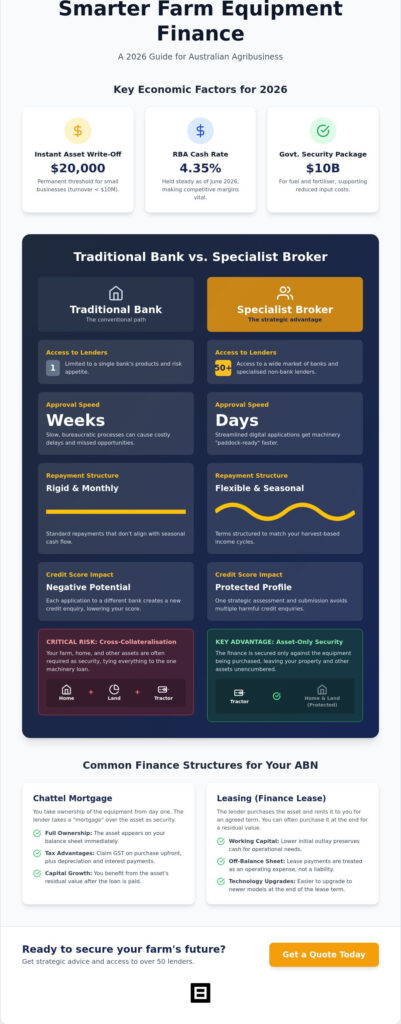
Modern farm equipment finance in Australia is far more than a simple debt facility; it’s a strategic lever that allows primary producers to scale without draining their cash reserves. As we move through 2026, the pressure to maintain global competitiveness has never been higher. Efficient machinery reduces input costs and improves yields, particularly with the $10 billion fuel and fertiliser security package announced in the latest budget. With the RBA cash rate held at 4.35% as of June 2026, finding a competitive margin is vital. The permanent $20,000 instant asset write-off for small businesses with turnover under $10 million makes this a pivotal year for machinery upgrades. Choosing the right path involves a choice between the comfort of your long-term bank and the agility of a specialist finance broker.
Securing “paddock-ready” finance is critical because the Australian climate doesn’t wait for bank committees. When the season breaks, you need the gear on-site and operational. Delays in approval don’t just cause stress; they represent lost revenue and missed opportunities in the field. This is why understanding the evolving Agricultural finance overview is essential for any agribusiness looking to thrive in the current economic climate. Whether you’re looking at a new harvester or a fleet of tractors, the funding structure you choose will dictate your flexibility during lean seasons.
The Role of Agricultural Banking in the Modern Farm
The traditional relationship-based model remains a cornerstone for many. Major Australian banks employ “Agri-specialists” who understand the broad strokes of primary production and can offer a sense of institutional stability. These loans are usually secured, often requiring a mortgage over the land or other significant assets to satisfy strict internal credit policies. While this can offer competitive rates for prime borrowers, the approval process is frequently slow and bureaucratic. You might find yourself stuck in a queue during peak seasons when every day counts. Banks also tend to prefer “all-in-one” relationships, which can limit your ability to shop around for better terms on specific pieces of machinery.
The Rise of Specialist Asset Finance Brokers
Specialist brokers have grown in popularity by offering a more tailored, efficient alternative. They provide inside access to a panel of over 50 lenders, including private and non-traditional sources that banks simply can’t reach. This competition often leads to more flexible repayment structures that match your harvest cycles rather than a rigid calendar month. Technology plays a massive role here; streamlined applications mean you can often get an answer in days rather than weeks. Most importantly, specialists help you avoid cross-collateralisation. By using farm equipment finance australia specifically for the asset itself, you ensure your land and family home remain unencumbered by the machinery debt, giving you a cleaner balance sheet and much-needed peace of mind.
Traditional Agricultural Banking vs. Specialist Finance Brokers
Agricultural banking is a holistic but often slower financial relationship. For many producers, the local branch feels like the natural first stop. It’s the “all-in-one” comfort zone where your home loan, business accounts, and overdraft already live. However, this loyalty often comes at a cost of limited choice. When you apply for farm equipment finance australia through a single bank, you’re restricted to their specific appetite for risk and their current interest rate floor. If their internal policy changes, your expansion plans might grind to a halt.
In contrast, a specialist broker offers a market-wide perspective. Instead of one product, you get access to a panel of over 50 lenders. This competition works in your favour. One of the biggest misconceptions in the industry is that brokers are always more expensive. In reality, brokers often secure wholesale rates that aren’t available to the general public. More importantly, they protect your credit score. Applying directly to three different banks results in three separate credit enquiries, which can negatively impact your rating. A broker performs a single strategic assessment to identify the most likely approval before any formal submission is made.
Speed is the final differentiator. While a traditional bank might take weeks to move a file through various state-based committees, a broker-led application often reaches approval in days. This efficiency ensures your machinery is on-site exactly when you need it. If you’re looking for a more streamlined way to compare options, you might find it helpful to explore tailored finance solutions that fit your specific harvest cycle.
When to Stick with Your Current Bank
Your existing bank is often the right choice for simple, low-value needs. If you have a twenty-year history and significant equity, they might offer bundled discounts that link your home loan and business facilities. For minor equipment purchases where a simple overdraft extension suffices, the convenience of using existing data can outweigh the need for a new lender. It’s a path best suited for those whose financial needs remain entirely within the standard banking box.
When to Engage a Specialist Broker
Engagement becomes essential when you require “best in class” rates or are managing complex scenarios like a business acquisition. If your situation falls outside the norm, such as needing a low-doc loan or a balloon payment structure that matches seasonal income, a broker acts as a high-level fixer. They provide a stress-free experience by managing multiple lender requirements on your behalf, ensuring you stay in good hands while you focus on the day-to-day running of your property.
Comparing Finance Structures: Chattel Mortgage, Hire Purchase, and Leasing
Choosing the right lender is only half the battle. The specific legal structure of your farm equipment finance australia agreement determines your tax position, GST recovery, and balance sheet strength. For 2026, the Australian government has made the $20,000 instant asset write-off a permanent fixture for small businesses with an aggregated turnover under $10 million. This means that for smaller implements or used gear, the immediate tax deduction can be a significant cash flow boost. However, for larger investments like harvesters or air seeders, the choice between ownership and usage becomes more nuanced.
Seasonal repayment schedules are a non-negotiable feature for most primary producers. Whether you choose a mortgage or a lease, your finance must mirror your income. Rigid monthly payments often clash with the reality of Australian farming, where income might only arrive once or twice a year. Aligning your repayments with your harvest cycles ensures you aren’t dipping into working capital during the lean months leading up to a crop. It’s about ensuring the machinery pays for itself as it works, rather than becoming a drain on your reserves during the off-season.
The Chattel Mortgage: Ownership and Tax Benefits
The chattel mortgage remains the most popular tool for Australian agricultural SMEs for several reasons. Under this structure, you take ownership of the machinery at the point of purchase, while the lender secures a mortgage over the asset. Because you own the equipment, you can generally claim the full GST amount as an input tax credit on your next Business Activity Statement (BAS). This provides an immediate cash injection back into the business. Additionally, you can claim both the interest on the loan and the depreciation of the asset as tax deductions. For long-term assets that you intend to keep for many years, this clear path to ownership is often the most cost-effective solution.
Leasing and Hire Purchase: Managing Cash Flow
Hire purchase agreements offer a middle ground, where the lender owns the asset until the final payment is made. It’s a conditional ownership structure that suits businesses wanting to keep the debt structured differently on their balance sheet while still having the option to own the gear eventually. Leasing, on the other hand, is increasingly favoured for high-turnover machinery. A finance lease allows you to use the latest technology without the heavy upfront costs of ownership. By utilising balloon payments, or residual values, you can significantly lower your regular repayment amounts. This is particularly useful for gear like tractors that you might want to trade in every few years to avoid high maintenance costs and benefit from the latest fuel-efficiency gains.
Strategic Considerations for Agribusiness Asset Acquisition
Machinery should be viewed through the lens of a problem-solution framework rather than just a balance sheet entry. If a new harvester reduces your time in the paddock by 15% or cuts grain loss by 2%, the finance cost is often dwarfed by the extra yield secured in the silo. This ROI-led approach ensures that every piece of gear you acquire is actually driving the business forward. For many producers, the real value lies in reliability; a new machine with a full warranty prevents the costly downtime that often plagues older, used equipment during a tight harvest window.
One of the most dangerous traps in farm equipment finance australia is the practice of cross-collateralisation. Traditional banks often prefer to secure a tractor loan against your primary farmland or the family home. While this might seem like a simple administrative shortcut, it limits your future borrowing power and puts your most vital assets at risk. By utilising a specialist broker, you can ensure your machinery debt remains secured only by the asset itself. This preserves your main credit lines for major land purchases or property developments, keeping your financial foundation separate and secure.
Equipment finance also serves as a strategic tool during broader business acquisitions. If you’re looking to purchase a neighbouring property that comes with a fleet of aged machinery, you can use asset finance to immediately upgrade that fleet. This allows you to preserve your main acquisition funding for the land itself while ensuring the new acreage is productive from day one. If you’re ready to see how a tailored approach can support your growth, you can get started with a strategic finance assessment today.
Matching Repayments to Harvest Cycles
Seasonal repayments are a non-negotiable requirement for the grain, sugar, and livestock sectors. A rigid monthly repayment schedule can create an unnecessary cash flow crunch during the off-season when expenses are high but income is low. We focus on structures that offer quarterly, half-yearly, or annual payments that align perfectly with when your cash actually hits the bank account. This ensures your working capital remains fluid throughout the year, allowing you to pay for inputs like fertiliser and fuel without the stress of an ill-timed loan bill.
The Importance of Financial Modelling
Modern agribusiness requires a level of financial modelling usually reserved for corporate firms. By predicting the impact of new debt over a five-year horizon, you can see exactly how a machinery upgrade affects your long-term viability. This “best in class” approach to finance supports future expansion and restructuring. It moves your operation away from reactive purchasing toward a proactive asset management strategy, ensuring you stay in good hands as the Australian agricultural landscape continues to evolve through 2026 and beyond.
Securing Your Property’s Future with Broker.com.au
Broker.com.au is far more than a digital lending portal; we are an award-winning partner dedicated to the long-term prosperity of Australian primary producers. We recognise that farm equipment finance australia is often the catalyst for your next stage of growth. Whether you are navigating a complex business restructure or simply need to replace a fleet of tractors before the next season breaks, our role is to act as your high-level fixer. We move the needle from financial uncertainty to streamlined confidence, ensuring your capital works as hard as you do.
Our approach is built on the belief that high-stakes financial decisions should be stress-free. By bridging the gap between technical financial expertise and the practical needs of a working farm, we ensure you stay in good hands throughout the entire lifecycle of your loan. We don’t just look for a generic product; we seek out the “best in class” solutions that align with the strategic considerations we have discussed, such as avoiding cross-collateralisation and matching repayments to your harvest cycles.
Why Our AI-Led Approach Wins for Farmers
Our proprietary AI technology is designed to do the heavy lifting that traditional banks often struggle with. By instantly analysing your specific business profile against a panel of over 50 lenders, we ensure a precise match. This isn’t just about finding any loan; it’s about identifying the specific lender appetite that suits your ABN and industry sector. This technology significantly reduces the paperwork burden for busy producers who would rather be in the paddock than behind a desk. Speed of approval is where we truly shine. We understand that weather windows are short, so we focus on getting your gear paddock-ready in days rather than the weeks required by institutional committees.
Boutique Service with National Reach
While our technology provides the speed, our people provide the insight. Working with named experts like Matt or Kylie means you have a seasoned partner who understands the nuances of the Australian lending landscape. We offer inside access to rates and flexible terms that aren’t available to the general public, providing you with a competitive advantage. We pride ourselves on a proactive, “can-do” attitude, often going above and beyond for situations that fall outside the norm. This boutique level of personal attention ensures your specific goals remain the priority.
Our “I’m interested” model reflects our commitment to a low-pressure, supportive conversation. There is no aggressive sales pitch; it’s the start of a professional dialogue about how we can help you achieve your goals. If you are ready to explore your options without the corporate red tape, I’m interested in farm equipment finance and would like to discover how we can help you secure your farm’s future.
Positioning Your Agribusiness for 2026 and Beyond
Success on the land requires more than just hard work; it demands a financial strategy as resilient as your soil. You’ve seen how moving beyond the traditional bank relationship can unlock more flexible repayment structures that respect your harvest cycles. By prioritising asset-specific security and avoiding the risks of cross-collateralisation, you protect your property’s long-term equity while modernising your fleet. Choosing the right farm equipment finance australia is about ensuring your machinery works for your balance sheet as hard as it does in the paddock.
As an award-winning business loan broker, we combine proprietary AI technology with deep industry expertise to streamline your application process. We specialise in complex business acquisition and asset finance, acting as your high-level fixer when traditional lenders move too slowly. If you’re ready to experience a stress-free path to your next machinery upgrade, we invite you to start a low-pressure conversation with our team today.
I’m interested in tailored farm finance solutions
Your goals are within reach, and with the right partner, you can face the coming season with streamlined confidence and the best gear for the job.
Frequently Asked Questions
What is the difference between a chattel mortgage and a commercial hire purchase for farm gear?
A chattel mortgage provides you with immediate ownership of the machinery from the day of purchase, while the lender holds a mortgage over the asset as security. This structure is highly popular because it typically allows you to claim the full GST amount on your next Business Activity Statement. In contrast, a commercial hire purchase is a conditional agreement where the lender retains ownership until you make the final payment, which may suit different balance sheet requirements.
Can I get farm equipment finance if I have a seasonal income?
Yes, you can secure farm equipment finance australia with a structure that specifically matches your seasonal income cycles. Specialist lenders often offer tailored repayment schedules, including quarterly, half-yearly, or annual payments that align with your harvest or shearing times. This flexibility ensures you aren’t forced to meet monthly obligations during the lean months when your working capital is tied up in essential inputs like fuel and fertiliser.
Do I need to put my farm up as security for a tractor loan?
You generally don’t need to use your land or family home as security for a tractor loan. Most equipment finance is secured by the machinery itself, which prevents the risks associated with cross-collateralisation. This asset-backed approach keeps your property unencumbered, allowing you to preserve your main credit lines for future land acquisition or large-scale property developments without risking your primary residence.
What are the current interest rates for farm equipment finance in Australia for 2026?
As of June 2026, interest rates for business equipment finance start from 7.49% per annum for prime borrowers, depending on the lender and your specific circumstances. For new tractors, indicative rates currently sit between 6.5% and 8.0% p.a., while harvesters are being financed at rates between 6.5% and 8.5% p.a. These figures reflect the RBA cash rate being held at 4.35% at the mid-year meeting.
Can I finance used farm machinery, or does it have to be new?
You can certainly finance used farm machinery, provided the equipment meets the lender’s age and condition requirements. Indicative rates for used tractors in 2026 range from 7.0% to 9.5% p.a., depending on the asset’s history and your business profile. Financing used gear is an efficient way to acquire reliable technology without the steep depreciation costs associated with brand-new models, helping you maintain a leaner operation.
How long does it typically take to get approval for an agricultural equipment loan?
Approval times vary between institutions, but a broker-led application often reaches approval within a few business days. While traditional agricultural banks might take several weeks to move a file through regional committees, our proprietary AI technology streamlines the process by matching you with the right lender immediately. This efficiency ensures your equipment is paddock-ready exactly when the season breaks and the weather window opens.
What is a balloon payment, and should I include one in my farm finance?
A balloon payment, or residual value, is a lump sum owed at the end of your finance term that represents the estimated value of the machinery. Including a balloon payment allows you to significantly lower your regular seasonal repayments, which preserves your daily working capital for other operational needs. It’s a strategic choice for high-turnover assets that you plan to trade in or upgrade before the term expires.
Can I include the cost of fit-outs or attachments in my equipment finance?
You can usually include the cost of fit-outs, GPS technology, and essential attachments within your primary farm equipment finance australia facility. Bundling these costs ensures your machinery is fully operational from day one without requiring a separate unsecured loan or a large cash outlay. This comprehensive approach allows you to manage the entire acquisition under a single, efficient repayment structure that supports your business growth.