
What if the true cost of delaying your next asset purchase isn’t just a missed opportunity, but a measurable drain on your 2026 profit margins? While it’s natural to feel a sense of unease about taking on new debt, using an equipment finance calculator is your first step toward transforming that uncertainty into a calculated strategic advantage. You want to grow, yet the fear of over-leveraging or being blindsided by a large balloon payment at the end of your term can make any business owner hesitate.
We understand that balancing ambitious expansion with a healthy cash flow is a delicate act. This article promises to give you total clarity on your monthly outgoings while helping you navigate the 100% bonus depreciation benefits available for equipment placed in service by 31 December 2026. By the time you’ve finished reading, you’ll have a clear figure for your repayments and the confidence to organise a finance structure that supports your specific goals. We’ll explore how to compare different loan types, understand the total cost of ownership, and ensure your next move is backed by expert financial modelling.
Key Takeaways
- Learn how to use an equipment finance calculator to model various repayment scenarios without impacting your business credit score.
- Discover how to align your loan terms with the revenue generated by your new assets to ensure your debt remains productive and sustainable.
- Understand the critical differences between a Chattel Mortgage and a Finance Lease to choose the most tax-effective structure for your business.
- Gain insights into why tailored financial modelling from a specialist provides more accuracy and better rates than generic online estimates.
Table of Contents
- What is an Equipment Finance Calculator and Why Do SMEs Need One?
- Understanding the Calculator Inputs: How to Get Accurate Results
- Strategic Considerations: Tax Benefits and Asset ROI
- Choosing the Right Structure: Chattel Mortgage vs. Lease
- Why a Broker Beats a DIY Calculator Every Time
What is an Equipment Finance Calculator and Why Do SMEs Need One?
An equipment finance calculator is a sophisticated digital tool designed to help business owners estimate monthly or fortnightly repayments for essential assets. It serves as a sandbox for your financial decisions, allowing you to model different scenarios for machinery, vehicles, or technology fit-outs without triggering a credit check or impacting your credit score. By adjusting variables like the loan amount and term, you can identify the “sweet spot” where repayments align perfectly with your operational cash flow.
For small and medium enterprises, this tool is indispensable for budgeting. Whether you are looking to upgrade a fleet of delivery vans or invest in high-tech medical equipment, knowing the numbers before you start an application reduces the inherent anxiety of high-stakes borrowing. It allows you to move beyond guesswork, providing a clear picture of how a new acquisition fits into your existing balance sheet. This level of insight ensures you are in good hands when it comes to maintaining a healthy debt-to-equity ratio.
The Role of Calculation in 2026 Business Planning
Precise forecasting is critical in the current Australian economic climate. With interest rates stabilising at a higher baseline than previous years, every dollar of interest must be justified by a corresponding increase in productivity. Using an equipment finance calculator helps you transition from asking “can we afford this?” to “how does this asset generate revenue?”
By integrating these calculations into your 2026 financial modelling, you can plan for seasonal fluctuations and ensure your growth remains sustainable. For example, if a new piece of manufacturing equipment increases your output by 20 percent, the calculator helps you determine if that extra revenue comfortably covers the finance costs. It turns a daunting purchase into a logical step in your business evolution.
Beyond the Monthly Figure: Total Cost of Finance
While the monthly repayment is often the first number business owners look at, the total interest payable over the life of the loan is equally important. A lower monthly payment achieved through a longer term might feel easier on the cash flow today, but it often results in a higher total cost of ownership. Understanding this trade-off is vital for long-term profitability. Whether you are considering a chattel mortgage or a finance lease, understanding the underlying structure is vital for your bottom line.
Equipment finance is a strategic tool for preserving working capital while simultaneously acquiring the assets needed for growth. By using a calculator to compare different interest rates and structures, you can ensure that your finance choice supports your broader business goals rather than just solving a short-term equipment need. This proactive approach leads to streamlined confidence and a more resilient operation.
Understanding the Calculator Inputs: How to Get Accurate Results
To get the most out of an equipment finance calculator, you must look beyond the simple sliders. The accuracy of your estimate depends entirely on the quality of the data you input. While it’s tempting to use placeholder figures, taking the time to gather precise numbers ensures your 2026 financial modelling remains grounded in reality. This clarity allows you to move forward with a sense of streamlined confidence rather than second guessing your budget.
The core inputs typically include:
- Loan Amount: This is the total purchase price of your asset. Remember to include GST, delivery fees, and any necessary installation costs.
- Loan Term: Most Australian lenders offer terms ranging from 12 to 84 months. A shorter term reduces your total interest but increases your monthly commitment.
- Interest Rate: These are not one-size-fits-all. Market rates vary significantly based on your business age, credit profile, and the specific type of asset you are financing.
- Residual or Balloon Payment: This is a lump sum paid at the end of the term. It’s a strategic lever used to lower your ongoing monthly overheads.
If you’re unsure which inputs best reflect your current situation, you can get started with a conversation to tailor your modelling to your specific industry needs.
Mastering the Balloon Payment Strategy
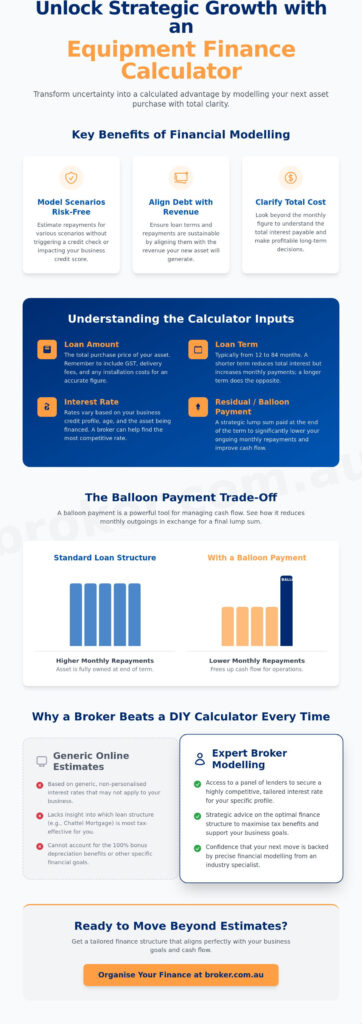
A balloon payment is a powerful tool for managing cash flow. By setting a 20% or 30% residual at the end of your loan, you drastically reduce your monthly outgoings, freeing up capital for other operational needs. However, this is a trade-off. You are essentially trading lower monthly overheads for a large future liability. This strategy is often ideal for assets that hold their value well. Conversely, for technology or machinery with high depreciation rates, a nil residual might be the safer path to avoid owing more than the asset is worth. Understanding these nuances is similar to how global tax standards, such as the Section 179 deduction, encourage businesses to think critically about asset life cycles and tax timing.
Interest Rates vs. Comparison Rates
It is vital to distinguish between the “headline rate” and the actual cost of the loan. The headline rate is the base interest, but the comparison rate includes fees and charges that can sneak up on the unwary. Equipment finance rates also behave differently to residential mortgage rates because the asset itself acts as the primary security. Because of this, Broker.com.au often provides inside access to wholesale rates that aren’t available to the general public. This exclusive advantage ensures you aren’t just getting a generic bank rate, but a professional solution tailored to your business’s specific risk profile and growth trajectory.
Strategic Considerations: Tax Benefits and Asset ROI
An equipment finance calculator provides the raw data, but the real value lies in how those figures align with your profit margins. Productive debt is a powerful lever for growth. If a new excavator earns your business $5,000 in monthly billable hours while the finance costs only $2,000, you aren’t just taking on a liability; you’re securing a $3,000 monthly surplus. This “Asset ROI” mindset shifts the focus from the cost of the loan to the value of the equipment’s output, ensuring every acquisition is a step toward greater efficiency.
The 2026 tax landscape offers unique advantages for SMEs looking to upgrade their capabilities. With 100% bonus depreciation available for qualifying assets placed into service by 31 December 2026, the timing of your purchase is critical to your financial modelling. This is why we always recommend consulting with your accountant before finalising the numbers you see on a calculator. They can help you understand how these deductions impact your specific tax bracket and ensure your purchase is timed to maximise your year-end position.
Instant Asset Write-Off and Depreciation
Current Australian tax laws can significantly lower the “net cost” of your investment. While the calculator shows your gross repayments, the ability to claim interest and depreciation can effectively discount your actual out-of-pocket costs. It’s vital to distinguish between claiming interest as an operating expense and claiming depreciation on the asset itself. These tax benefits can effectively “discount” your repayments, making a high-end machine more affordable than it first appears on paper.
Preserving Working Capital for Operations
For many growing firms, paying cash for major assets is a strategic mistake. It ties up your “dry powder” in illiquid machinery, leaving you vulnerable to sudden market shifts or unexpected operational costs. By using finance, you keep your cash reserves available for day-to-day operations and opportunistic growth. You might even consider a Working Capital Finance solution alongside your equipment loan to ensure your business remains agile and resilient. This multi-layered approach to funding ensures you have the tools to grow without sacrificing the liquidity that keeps your business running smoothly.
Choosing the Right Structure: Chattel Mortgage vs. Lease
While an equipment finance calculator provides a clear figure for your monthly outgoings, it cannot determine which legal structure best suits your balance sheet. The “how” of your financing is just as critical as the “how much.” Choosing the wrong structure can lead to missed tax opportunities or cash flow bottlenecks that hinder your 2026 growth plans. Whether you prioritise immediate ownership or the flexibility to upgrade, understanding these frameworks ensures you are in good hands from the start of your application.
Chattel Mortgage: The SME Favourite
The chattel mortgage remains the most popular choice for Australian SMEs and ABN holders. Under this arrangement, you take ownership of the asset from the moment of purchase, with the lender using the equipment itself as security. This structure is particularly efficient for GST-registered businesses because you can generally claim the full GST amount on the purchase price in your next Business Activity Statement (BAS). This upfront cash flow boost can be significant, especially when acquiring high-value machinery or vehicles.
Because the asset is yours from day one, you also have the freedom to manage its maintenance and eventual sale. If you’re ready to secure a structure that aligns with your tax profile, you can apply for equipment finance to lock in a tailored solution today. For most businesses, the simplicity of a chattel mortgage combined with its immediate tax advantages makes it the logical choice for long-term assets.
Leasing for Technology and Rapid Upgrades
For industries where technology moves fast, a finance lease or an operating lease may be more appropriate. A finance lease allows you to “rent” the equipment from the lender for a fixed term. You don’t own the asset during the term, which can simplify your balance sheet and change your GST treatment, as GST is typically paid on the monthly rentals rather than upfront. This is often the preferred route for medical technology, high-end IT infrastructure, or specialised tools that become obsolete within a few years.
When using an equipment finance calculator to compare these options, it’s helpful to look at the “cost to use” versus the “cost to own.” An operating lease, for example, often includes a “hand back” option at the end of the term. This protects your business from the risk of owning an obsolete asset and allows for a seamless transition to the latest model. It keeps your operations at the cutting edge without the burden of disposing of old machinery.
Other Strategic Options
There are also middle-ground solutions like Hire Purchase, where the lender owns the asset until the final payment is made. This can be a useful structure for businesses that want the benefits of eventual ownership but prefer a different accounting treatment during the loan term. Each of these structures offers unique levers to manage your debt-to-equity ratio and operational agility. By aligning your finance structure with your specific asset life cycle, you turn a standard loan into a strategic advantage for your 2026 operations.
Why a Broker Beats a DIY Calculator Every Time
While an equipment finance calculator is an excellent starting point for your 2026 planning, it remains a blunt instrument in a world of sharp financial modelling. These digital tools typically rely on “average” market rates and generic assumptions that don’t account for the unique strengths of your business profile. Moving from a calculated estimate to a settled loan requires more than just a slider; it requires a high-level fixer who can navigate the complexities of the Australian lending landscape on your behalf.
At Broker.com.au, we use proprietary AI technology to scan the market in seconds, comparing hundreds of products from over 30 lenders. This isn’t just about finding a number that looks good on a screen. It’s about securing the best possible rate based on your specific industry, credit history, and asset type. We take the stress out of the process by handling the paperwork and the bank negotiations, ensuring you move from uncertainty toward streamlined confidence.
Access to the Full Australian Lending Landscape
Relying on a single bank often leads to unnecessary rejections. Every lender has different appetites for risk and specific criteria for certain industries. For example, a major bank might hesitate to fund a specialised medical laser or a heavy transport fleet, whereas a niche lender might offer “inside access” to superior rates for those exact assets. Our role is to bridge that gap, providing you with options that a standard equipment finance calculator simply cannot see.
A critical advantage of working with a specialist is our focus on protecting your broader interests. We work hard to avoid cross-collateralisation, a common trap where lenders secure your business equipment against your family home or other personal assets. By structuring the deal correctly, we ensure your “dry powder” and personal wealth remain protected while your business grows.
The Human Element: Expert Guidance Beyond the Numbers
The numbers are only half the story. Behind our technology is a team of seasoned partners like Matt and Kylie, who provide the expert guidance needed to navigate situations that fall outside of the norm. They understand the “inside track” of the lending world and are committed to going above and beyond to ensure your application is successful. This boutique level of personal attention is what transforms a cold digital portal into a human-led advisory.
We believe in a low-pressure approach to business growth. Our “I’m interested” philosophy means you can start a conversation without the weight of an aggressive sales pitch. If you’re ready to move beyond estimates and secure a professional result, you can get started with a tailored equipment finance quote today. Let us handle the complexity so you can focus on leading your business into a successful 2026.
Secure Your 2026 Business Growth with Confidence
Your 2026 business strategy shouldn’t be left to chance. While an equipment finance calculator provides the essential baseline for your budgeting, the path to a sustainable and tax-effective acquisition requires a more nuanced approach. You’ve seen how the right loan structure protects your cash flow and why strategic timing is vital to capitalise on depreciation benefits before the year-end deadline.
The transition from a raw estimate to a settled loan is where our expertise makes the difference. Broker.com.au is an award-winning brokerage with inside access to over 30 Australian lenders. We use proprietary AI technology for faster, more accurate loan matching, while our dedicated specialists go above and beyond to handle the complexities of your specific industry. We’re here to ensure you stay in good hands throughout the entire process.
If you’re ready to move beyond the sliders and secure a result that supports your long-term vision, we’re ready to start the conversation. Taking the next step is simple and entirely stress-free.
I’m interested in an equipment finance quote
We look forward to helping you lead your business into its most successful year yet.
Frequently Asked Questions
How accurate are equipment finance calculators for Australian businesses?
An equipment finance calculator provides a highly accurate estimate of your repayments based on standard lending formulas and current market averages. While these tools are excellent for initial budgeting and scenario modelling, they should be viewed as a guide rather than a formal quote. Your final rate depends on your specific credit profile, the age of the asset, and the lender’s current appetite for your industry sector.
What is a balloon payment and should I use one for my equipment loan?
A balloon payment, also known as a residual, is a lump sum paid to the lender at the end of your loan term. By deferring a portion of the principal, you significantly reduce your monthly commitment, which can be a vital strategy for maintaining healthy cash flow. You should consider a balloon payment if the asset has a strong resale value or if you plan to upgrade the equipment before the final payment falls due.
Do I need to be GST registered to use an equipment finance calculator?
You don’t need to be GST registered to use the tool, as it calculates repayments based on the total amount borrowed. However, being GST registered changes how you interact with the results, particularly if you choose a Chattel Mortgage structure. Registered businesses can often claim the GST component of the purchase price back in their next Business Activity Statement, which provides an immediate cash flow injection that isn’t reflected in the monthly repayment figure.
What interest rate should I put into the calculator for a used truck?
For a used commercial truck in 2026, you should typically model your repayments using an interest rate between 7 percent and 14 percent APR. Used assets often carry slightly higher rates than brand new equipment because the lender perceives a higher risk in the asset’s remaining life cycle. Starting your equipment finance calculator modelling with a mid-range figure like 9 percent provides a realistic baseline for your financial planning.
Can I include the cost of delivery and installation in the finance amount?
Yes, most Australian lenders allow you to bundle “soft costs” like delivery, professional installation, and initial training into the total loan amount. This is a strategic way to preserve your working capital, as it prevents large out-of-pocket expenses before the equipment has started generating revenue. Including these costs ensures your repayment estimate covers the true total cost of getting the asset operational on your site.
Is equipment finance tax-deductible for SMEs in 2026?
Equipment finance is generally tax-deductible, though the specific benefits depend on your chosen loan structure. Under current laws, businesses can usually deduct the interest component of their repayments as an operating expense. For assets placed in service by 31 December 2026, you may also be eligible for 100 percent bonus depreciation, allowing you to deduct the full cost of the equipment in the first year. Always verify these details with your accountant.
What happens if I want to pay out my equipment loan early?
Most lenders provide the flexibility to pay out your loan before the term ends, though early exit fees or “break costs” often apply. These costs are calculated based on the remaining interest and the time left on the contract. If you anticipate a high likelihood of an early payout, it’s vital to discuss this with your broker during the application stage to ensure we select a lender with the most favourable early termination terms.
Will using an equipment finance calculator affect my credit score?
Using a calculator has absolutely no impact on your credit score. It’s a completely anonymous way to explore different financial scenarios and repayment structures. You can adjust the loan terms, interest rates, and balloon payments as many times as you like to find a configuration that suits your budget. Your credit file is only accessed once you decide to move forward with a formal application through a professional broker.