
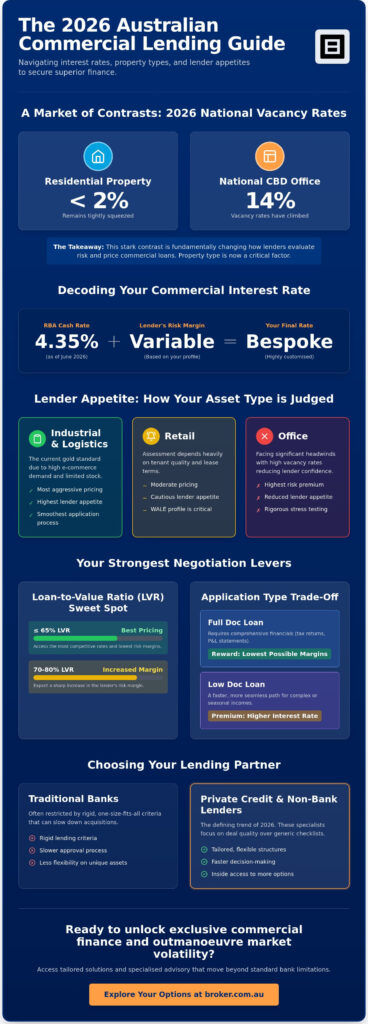
Did you know that while residential vacancy remains under 2%, national CBD office vacancy rates have climbed as high as 14% in 2026? This stark contrast is fundamentally changing how lenders evaluate risk and, more importantly, how they price commercial property loan rates. It’s understandable to feel a sense of hesitation when the big-four banks tighten their criteria or hide complex fees in the fine print. You’ve likely realised that the gap between a standard business mortgage and a truly tailored finance solution has never been wider.
We’re here to ensure you move forward with streamlined confidence. This guide will help you master the complexities of the 2026 commercial lending market so you can secure lower interest margins and flexible redraw options for your next acquisition. We’ll examine the latest Federal Budget impacts on property investment and provide a clear roadmap to a seamless, stress-free application process that bypasses traditional bank hurdles. By the end of this guide, you’ll have the inside access needed to outmanoeuvre market volatility and lock in a deal that actually fits your business cash flow.
Key Takeaways
- Identify how the shifting RBA landscape and national vacancy trends impact your specific borrowing capacity and risk profile.
- Discover how to use LVR and security structures as powerful negotiation tools to secure more competitive commercial property loan rates.
- Evaluate the pros and cons of traditional banks versus private credit to find the most efficient path for your next acquisition.
- Learn to organise your financial modelling and WALE profile to present a professional, “bank-ready” business case that reduces lender friction.
- Access tailored finance solutions and specialised corporate advisory that move beyond the limitations of standard retail lending.
Table of Contents
- Navigating the 2026 Commercial Lending Landscape in Australia
- Key Determinants of Your Commercial Interest Rate
- Comparing Commercial Lenders: Banks vs Private Credit
- Strategic Steps to Secure a Best-in-Class Commercial Rate
- How Broker.com.au Unlocks Exclusive Commercial Finance
Navigating the 2026 Commercial Lending Landscape in Australia
The Australian commercial market in 2026 is a study in contrasts. While the residential sector remains tightly squeezed, the commercial side is responding to a unique set of economic pressures. As of June 2026, the RBA has held the cash rate at 4.35%, creating a baseline that influences every aspect of commercial property loan rates. However, the headline rate is only part of the story. Lenders are currently applying wider margins to account for global volatility and domestic shifts in property demand, making the “base plus margin” calculation more complex than in previous cycles.
The RBA and the 2026 Interest Rate Cycle
Current economic forecasts for 2026 suggest a period of cautious stability. While the RBA held steady in June, some economists are still pricing in a final insurance hike before a prolonged hold. For SMEs, this means the cost of capital isn’t just about the RBA’s decisions. It’s about how banks interpret future risk. When securing a commercial mortgage, you’ll find that commercial margins have widened significantly compared to residential products. This reflects the higher risk profile lenders associate with business-backed debt in a fluctuating economy. It’s no longer enough to look at the cash rate alone. You need to understand the lender’s internal cost of funds and how they view the road ahead.
Market Sentiment: Industrial vs Retail vs Office
Property type is now the single biggest factor in your stress test calculation. Industrial warehouses and logistics hubs are the current gold standard. Because of limited stock and high demand from e-commerce, lenders are offering their most aggressive pricing in this sector. In contrast, the office sector is facing significant headwinds. With national CBD office vacancy rates averaging between 12% and 14% in 2026, many traditional lenders have reduced their appetite for these assets. This creates a risk premium. If you’re looking at retail or office space, expect a more rigorous assessment of your tenant’s strength and lease expiry profile. Lenders are looking for certainty, and they’ll price your loan accordingly.
The shift from Big Four dominance to specialised private credit is the defining trend of the year. Traditional banks are often restricted by rigid lending criteria that don’t account for the nuances of a high-growth business or a unique property asset. By leveraging inside access to non-bank lenders, you can often find more tailored structures that circumvent standard rate hikes. These lenders are often more interested in the quality of the deal than a generic checklist. It’s about finding a partner who sees the potential in your acquisition rather than just the risk, ensuring you move forward with streamlined confidence.
Key Determinants of Your Commercial Interest Rate
Securing the most competitive commercial property loan rates isn’t just about timing the market. It’s about how you position your security and serviceability to the lender. Unlike the standardised world of residential mortgages, commercial pricing is highly bespoke. Lenders look at a combination of your asset’s quality, your financial history, and the specific structure of the deal. While the Reserve Bank of Australia’s official lending rates provide the foundation, the actual margin you pay is a direct reflection of your perceived risk profile.
LVR and Security: Finding the Sweet Spot
The Loan-to-Value Ratio (LVR) is your strongest lever for rate negotiation. Most tier-one lenders offer their best pricing when the LVR sits at or below 65%. Once you push toward the 70% or 80% mark, you’ll notice a sharp increase in the risk margin applied by the bank. If you want to lower your costs, using residential equity as additional security can often unlock rates that standalone commercial assets can’t reach. Just be mindful of cross-collateralisation. While it can lower your immediate interest expense, it can also restrict your flexibility if you plan to sell one of the properties in the future. If you’re looking for a way to balance these factors, you can explore our tailored finance options to see which structure fits your long-term goals.
You also need to decide between “Full Doc” and “Low Doc” applications. A Full Doc loan requires comprehensive tax returns and profit and loss statements, but it rewards you with the lowest possible margins. Low Doc options offer a faster, more seamless path for those with complex business structures or seasonal income, though they typically carry a premium. It’s a trade-off between administrative speed and long-term interest savings.
SMSF Commercial Loans: A Unique Rate Structure
For many Australian investors, SMSF property acquisition is a key strategic move. These loans require a Limited Recourse Borrowing Arrangement (LRBA) to protect the rest of your fund’s assets. Because of this compliance complexity and the restricted recourse for the lender, commercial property loan rates within an SMSF often carry a premium of 0.5% to 1.5% above standard investment loans. Lenders also look closely at your fund’s liquidity and the strength of the property’s Net Operating Income (NOI). A strong lease with a reliable tenant can help offset some of this premium by proving the fund’s ability to service the debt without relying on external contributions. It’s about presenting a bank-ready case that minimises their uncertainty and maximises your savings.
Comparing Commercial Lenders: Banks vs Private Credit
Choosing a lender is about more than just finding the lowest number on a term sheet. While the “Big Four” banks often provide the most competitive commercial property loan rates for low-risk, established assets, their rigid approval processes can be a significant hurdle for time-sensitive acquisitions. Tier-two banks and credit unions represent a vital middle ground. They often offer more personalised service and a greater willingness to look at “outside of the box” scenarios while keeping pricing within a reasonable range of the majors. This allows you to maintain a professional edge without the bureaucratic delays of a larger institution.
It’s vital to remember that the “cheapest” rate can sometimes be the most expensive loan. A low headline rate might be offset by high establishment fees, annual line fees, or restrictive Interest Cover Ratio (ICR) covenants. If a bank’s conditions prevent you from drawing on your equity or force you into a costly revaluation every twelve months, the initial interest savings quickly evaporate. We focus on the total cost of capital, ensuring your debt structure supports your cash flow rather than strangling it.
Bank vs Non-Bank: The Strategic Trade-off
Approval speed is often the deciding factor in a competitive market. A traditional bank might take ten business days just to issue a conditional approval, whereas many private lenders can provide a credit-backed offer within 48 hours. This agility allows you to move with streamlined confidence during an auction or a short settlement period. Beyond speed, non-bank lenders typically have fewer “strings attached.” They focus primarily on the asset’s value and your exit strategy rather than demanding years of exhaustive tax returns. This “stress-free” factor is why many seasoned investors choose private credit for their growth phase, even if it carries a slight premium.
Negotiating Rates for Loans Over $1 Million
When you’re dealing with seven-figure acquisitions, the concept of a “standard” rate disappears. This is the domain of the Negotiated Rate. For loans over $1 million, we use multi-lender competition to drive down margins. By presenting a bank-ready business case that highlights your financial modelling and property strength, we force lenders to bid for your business. This process often unlocks specialised facilities, such as a tailored Line of Credit, which provides the liquidity needed to pounce on new opportunities. Having inside access to these wholesale channels ensures you aren’t just taking what’s offered, but are actively shaping a deal that fits your long-term portfolio goals.
Strategic Steps to Secure a Best-in-Class Commercial Rate
Securing the most competitive commercial property loan rates is a proactive process that starts long before you sign a contract. While your choice of lender is critical, your internal preparation often dictates the final margin you’re offered. To move from a state of uncertainty to streamlined confidence, you must present a bank-ready case that addresses risk before the underwriter even asks. This involves a sophisticated blend of financial modelling and asset management that proves your acquisition is a sound investment.
Refining Your Financial Presentation
Your Profit & Loss statement should tell a story of resilience and growth. Lenders in 2026 are particularly focused on your ability to handle potential rate fluctuations without compromising your operations. Before submitting your application, calculate your Debt Service Cover Ratio (DSCR). DSCR is the ratio of operating income to debt obligations. A ratio of 1.5x or higher is generally the benchmark for premium pricing. If you’re opting for low-doc solutions, ensure your ABN and GST registration history is spotless. Any gaps in your compliance history can lead to a risk loading on your interest rate, even if your current cash flow is strong. If you’re ready to see how these structures could work for your portfolio, you can get started with a tailored finance assessment today.
Fixed vs Variable: Hedging Your Bets in 2026
The 2026 market remains volatile, making the choice between fixed and variable rates a strategic decision. Fixing your rate provides absolute certainty for your business budget, protecting you from any late-cycle RBA hikes. However, commercial fixed loans often come with significant break costs if you need to refinance or sell early. For many investors, a split loan structure offers the best of both worlds: the security of a fixed portion combined with the flexibility of a variable component that allows for extra repayments or redraws.
Another sophisticated strategy is Interest in Advance. By paying your interest for the following year before June 30, you may be able to pull forward tax deductions, which is a powerful tool for managing your overall investment yield. Finally, don’t overlook your Weighted Average Lease Expiry (WALE). A property with a long WALE is far more attractive to tier-one lenders. If you have tenants with leases nearing expiry, negotiate extensions before applying for finance. This simple move can drastically reduce the risk premium applied to your commercial property loan rates, potentially saving you thousands over the life of the loan.
How Broker.com.au Unlocks Exclusive Commercial Finance
The landscape we’ve explored is undeniably complex. From RBA shifts to the specific risk premiums of CBD offices, the path to the best commercial property loan rates is rarely a straight line. This is where Broker.com.au moves beyond traditional brokerage. We act as your high-level fixer, combining award-winning finance solutions with a deeply personal touch. Our goal is to move you from a state of uncertainty toward a feeling of streamlined confidence, ensuring your next acquisition is handled with professional authority and local insight.
AI-Driven Insights for Faster Approvals
In a market that moves as fast as Australia’s does in 2026, waiting weeks for a traditional bank to assess your file is a risk you can’t afford. We leverage proprietary AI technology to scan the market and identify lenders who have a specific appetite for your industry or security type. This technology allows us to provide quick and accurate loan matching, filtering out lenders who would otherwise apply a heavy risk premium to your profile. By streamlining digital applications, we significantly reduce the paperwork burden. More importantly, this tech-led approach grants you “inside access” to wholesale rates and niche products that aren’t advertised to the general public, giving you a distinct advantage.
The Human Element: Expert Guides for Your Journey
While our technology provides the data, our people provide the strategy. When you work with us, you’re in the hands of seasoned specialists like Matt and Kylie. We understand that your business goals are unique, and we pride ourselves on a “can-do attitude” that goes above and beyond for situations that fall outside the norm. We don’t just process applications; we provide specialised corporate advisory to ensure your debt structure supports your long-term vision.
Consider a recent case where we assisted an investor with a diversifying portfolio. They were facing a significant rate hike on their CBD office assets due to the rising vacancy rates we discussed earlier. By restructuring their debt and using their high-performing industrial warehouses as primary security, we were able to lower their overall interest margin across the entire portfolio. This wasn’t just about a single loan. It was a tailored solution that prepared them for 2026 growth while keeping the entire process seamless and efficient.
We don’t believe in aggressive sales tactics. Our “I’m interested” approach is designed to start a low-pressure, expert conversation about your specific needs. It’s the first step in a stress-free process where we handle the complexity, so you can focus on your next move. If you’re ready to explore your potential and see what’s possible, I’m interested in seeing my commercial rate options.
Securing Your Competitive Edge in 2026
The path to the most competitive commercial property loan rates in 2026 requires more than just a passing interest in market trends. It demands a strategic alignment of your asset’s performance, your financial modelling, and your choice of lending partner. By focusing on high-performing sectors like industrial warehouses and refining your WALE profile, you position yourself as a low-risk borrower in a high-stakes environment. You’ve already seen how LVR and serviceability ratios act as your primary negotiation levers; now it’s time to put that insight into action.
You don’t have to manage this complexity alone. As an award-winning business loan broker, we provide the inside access needed to outmanoeuvre traditional bank limitations. We utilise proprietary AI for accurate loan matching across a panel of 50+ Australian lenders, ensuring you find a fit that actually supports your cash flow. Whether you’re navigating an SMSF acquisition or a large-scale corporate refinancing, our team is here to ensure the process is seamless and efficient. We handle the heavy lifting so you can stay focused on your next acquisition.
If you’re ready to move forward with streamlined confidence, we’re ready to help. I’m interested in exploring commercial property loan rates. Your next successful acquisition is just a conversation away.
Frequently Asked Questions
How much deposit do I need for a commercial property loan in 2026?
Most lenders require a deposit of 30% to 40% of the property value, which equates to a 60% to 70% Loan-to-Value Ratio (LVR). If you’re a strong owner-occupier looking at quality industrial assets, you might secure a loan with as little as a 20% deposit. These higher LVRs are often reserved for prime security types where the lender has high confidence in the asset’s long-term resilience.
Can I get a commercial property loan with a low-doc application?
You can certainly secure finance through a low-doc application, particularly with non-bank and private lenders. This is a seamless option for business owners who have a complex income structure but a clean ABN and GST registration history. While it reduces the paperwork burden, you should expect a higher interest rate premium compared to a full-doc loan where comprehensive tax returns are provided.
What is the difference between owner-occupier and investor commercial rates?
Owner-occupier rates are typically lower than investor rates because the lender views the business’s direct use of the space as a lower risk. In mid-2026, owner-occupier rates for prime assets start from approximately 6.25% p.a., while investment loans generally begin at 6.50% p.a. This gap reflects the additional risk premium lenders apply when the loan’s serviceability relies on external tenant income and market vacancy fluctuations.
How does an SMSF commercial property loan work?
An SMSF loan allows your super fund to purchase property using a Limited Recourse Borrowing Arrangement (LRBA). This structure ensures the lender’s recourse is limited to the property itself, protecting your fund’s other assets. Because of the compliance complexity and restricted recourse, these commercial property loan rates usually carry a premium of 0.5% to 1.5% above standard commercial products. It’s a strategic move for long-term wealth building.
Are commercial property loan rates higher than residential rates?
Yes, commercial property loan rates are almost always higher than residential mortgages. Lenders view commercial assets as higher risk due to longer vacancy periods and a smaller pool of potential buyers or tenants. While residential loans are highly standardised, commercial lending is bespoke. The higher rates account for this increased volatility and the specialised underwriting required to assess business cash flow and lease profiles.
How long does it take to get a commercial loan approved in Australia?
Approval times vary significantly depending on the lender type you choose. A traditional major bank can take ten business days or more to provide a conditional offer due to rigid internal committees. Conversely, specialised private lenders can often issue a credit-backed approval within 48 hours. This speed is essential for investors participating in auctions or those who need to move with streamlined confidence to secure a competitive asset.
What are the typical fees associated with a commercial property loan?
You should budget for several standard costs, including establishment fees, valuation fees, and legal expenses. Establishment fees typically range from 0.5% to 1.5% of the loan amount, while professional valuation costs for commercial assets are higher than residential equivalents. Some facilities also include ongoing line fees or facility management charges. We work to ensure these costs are transparent so you can manage your acquisition budget without surprises.
Can I use a residential property as security for a commercial loan?
You can definitely use residential equity to secure a commercial loan, a process known as cross-collateralisation. By offering a residential property as additional security, you often lower the lender’s risk and unlock more competitive interest rates. It’s an efficient way to maximise your borrowing power, though you should consider how this might impact your ability to sell or refinance individual properties in the future.