
The headline interest rate is only part of what a business loan may cost. The hidden costs of business loans in Australia can include application and establishment fees, ongoing account charges, late-payment penalties and early repayment costs. No single fee is reasonable for every loan, so understand the total cost and when each charge applies.
It’s understandable to focus on the rate when you’re weighing up finance, especially when buying a business or planning an acquisition. But fees and loan terms can affect cash flow too, and a charge buried in the agreement can change how much flexibility you have later.
This guide explains which fees to look for, how Australian disclosure and complaints pathways work, and what to ask before signing. It also covers fixed-rate break costs, which can matter if you repay or restructure early, and how to assess loan costs alongside an acquisition plan and cash flow. Use these questions to review an offer before committing.
Key Takeaways
- Look beyond the interest rate and map upfront and ongoing charges against the loan’s full term.
- Understand what Australian fee disclosure and complaints pathways mean if a charge is unclear or disputed.
- Check how late payments, redraws and early repayment could affect your cash flow.
- Ask about review conditions, personal guarantees and fees that may apply if your plans change.
- For a business acquisition, weigh finance costs and repayment flexibility against the business’s expected cash flow.
Table of Contents
- 1. Application and Establishment Fees: What’s Reasonable?
- 2. Australian fee disclosure and complaint options
- 3. Late payment, redraw and early repayment charges
- 4. Questions to ask lenders before signing
- 5. Fixed-rate certainty and break costs
- Broker.com.au
1. Application and Establishment Fees: What’s Reasonable?
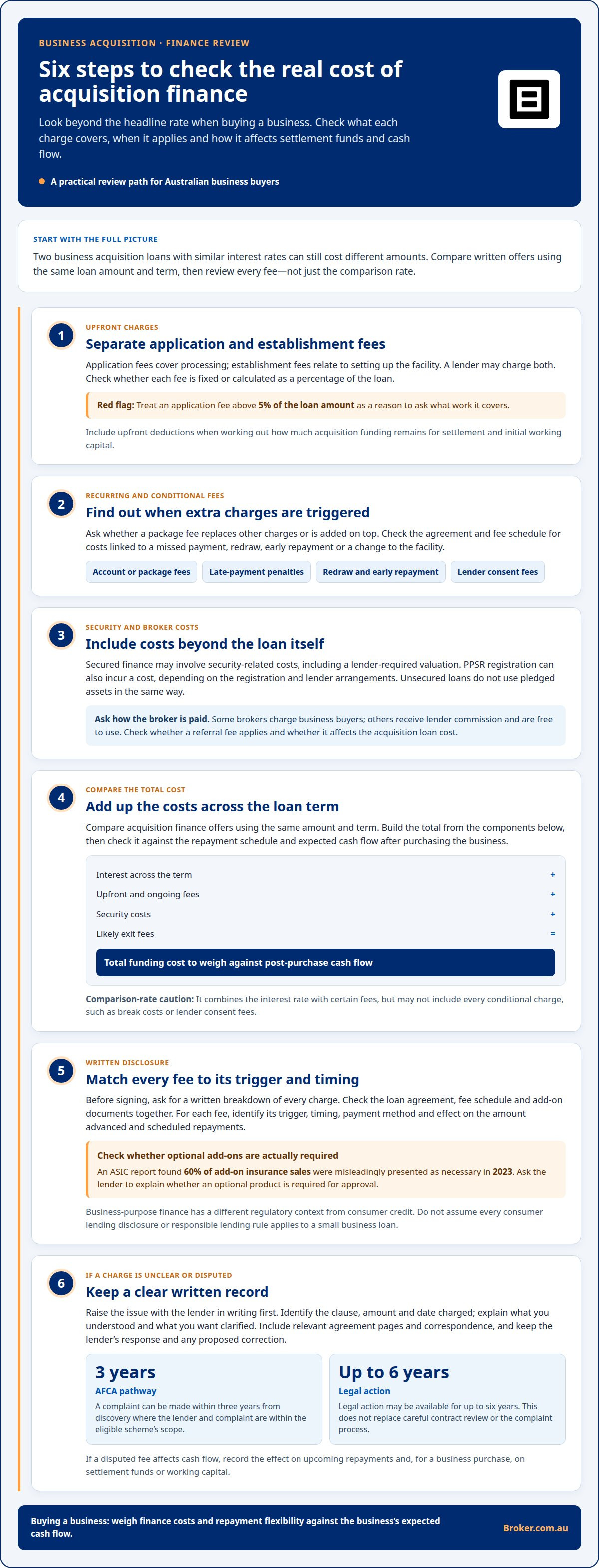
Upfront fees can make two business acquisition loans with similar interest rates cost different amounts. These are market ranges, not caps. Compare each lender’s written offer and check whether fees are fixed or calculated as a percentage of the loan.
Application fees cover processing, while establishment fees relate to setting up the facility. Some lenders charge both. Treat an application fee above 5% of the loan amount as a red flag, and ask what work it covers. When buying a business, include these deductions when calculating the acquisition funds available for settlement and initial working capital.
Ongoing charges matter too. Ask whether a package fee replaces other charges or is added on top, and factor it into the cost of funding your purchase.
The interest rate is the lender’s charge for borrowing; a comparison rate combines the interest rate with certain fees to show a broader cost. It may not include every conditional charge, such as break costs or lender consent fees. Compare acquisition finance offers with the same amount and term, then check the fee schedule for charges excluded from the comparison.
Secured loans may involve security-related costs, while unsecured loans do not use pledged assets in the same way. A lender may require a valuation for secured borrowing. PPSR registration can also incur a cost, depending on the registration and lender arrangements. Include these costs in your business purchase budget so they do not reduce funds needed at settlement or leave too little working capital after acquiring a business.
Broker costs vary: some brokers charge business buyers, while others receive lender commission and are free to use. Ask how the broker is paid, whether any referral fee applies, and whether that affects the cost of your acquisition loan. A clear explanation helps you distinguish lender charges from intermediary remuneration when arranging funding to purchase an existing business.
Australian law also sets important context. The Treasury Legislation Amendment (Small Business and Unfair Contract Terms) Act 2015 came into effect on 12 November 2016, according to the Federal Register of Legislation. The National Consumer Credit Protection Act 2009 (Cwlth), including its responsible lending obligations, did not apply to small business lending, according to the Federal Register of Legislation. Section 588G of Australia’s Corporations Act obliges company directors to prevent insolvent trading, according to the Federal Register of Legislation.
To calculate the total cost of funding a business acquisition, add interest across the term, upfront charges, ongoing fees, security costs and any likely exit fees. Then compare the total with the lender’s repayment schedule and your expected post-purchase cash flow. Businesses with a solid repayment history can negotiate rates or fees. Provide evidence from similar acquisition finance products and ask the lender to explain any difference. For refinancing, compare setup and ongoing fees with potential interest savings, including any exit fee on the existing loan.
2. Australian fee disclosure and complaint options
Before signing, ask for a written breakdown of every charge linked to the finance. Match each fee to its trigger, timing and payment method. A percentage-based charge can rise with the loan amount, while a flat charge affects smaller facilities differently. Ask the lender to show how each item changes the amount advanced and scheduled repayments.
Check the loan agreement, fee schedule and any separate add-on documents together. Look for charges that apply only after a missed payment, redraw request, early repayment or change to the facility. If an optional product appears beside the loan, ask whether it is required for approval. An ASIC report found 60% of add-on insurance sales were misleadingly presented as necessary in 2023.
Business-purpose finance has a different regulatory context from consumer credit. Don’t assume every consumer lending disclosure or responsible lending rule applies to a small business loan. A practical safeguard is to get a clear, written explanation of the contract terms before committing. Keep the lender’s offer, final agreement and any later variation together so you can identify differences before repayments begin.
If a fee is unclear, raise the issue with the lender in writing first. Identify the clause, amount and date charged, and explain what you want clarified. Include the relevant agreement page and supporting correspondence. Ask for a written response and keep a record of the complaint, the lender’s reply and any proposed correction. This creates a dated account of the dispute.
Where the lender belongs to an eligible external dispute resolution scheme, AFCA is a complaint pathway. An AFCA complaint can be made within three years from discovery. ASIC Regulatory Guide 139 sets out the role and approval criteria for ASIC-approved external dispute resolution schemes. Check whether the lender and complaint fall within the scheme’s scope before relying on that process.
Legal action may be available for up to six years. That timeframe does not replace a careful contract review or the complaint process. If a disputed charge affects cash flow, record its effect on upcoming repayments and explain the practical impact in your complaint. For acquisition finance, include any effect on settlement funds or the working capital needed after purchasing a business.
Keep the complaint focused and specific. State what you understood when signing, what the lender charged and what outcome you’re seeking. For a percentage fee, show the calculation and relevant loan balance. For an add-on, include the sales material or consent record. Clear documents help explain the issue while keeping day-to-day finance obligations in view.
For a business purchase, a detailed review of the proposed finance can help clarify costs before signing. Explore business finance options alongside the agreement terms and cash-flow plan.
3. Late payment, redraw and early repayment charges
A missed payment can trigger a charge on top of overdue interest. Late payment penalties are often 4% of the payment. Read the contract to see whether the percentage applies to the missed amount or another figure. Also note when the lender applies the charge and how it affects the next repayment.
Timing matters. If a payment falls during a quiet trading period, a penalty can put pressure on cash flow. Map repayment dates against expected customer receipts. For acquisition finance, allow for the transition after buying a business, when operating costs and revenue timing may change.
Redraw access can help manage short-term needs, but withdrawing funds may carry a fee. Redraw fees can be 1–2% of withdrawn funds. For example, the charge is calculated against the amount redrawn, not the original loan balance. Confirm whether the fee applies per withdrawal and how quickly funds become available.
Early repayment and exit charges vary by contract. They can reduce the benefit of paying out a loan ahead of schedule.
Some contracts set a minimum interest period. One example applies three months of minimum interest, meaning a borrower who finishes a loan in six weeks may still pay interest for three months. Before choosing a shorter loan term or planning an early payout, calculate the interest obligation alongside any exit charge.
Ask the lender to explain each trigger in plain language. Does a late-payment charge apply immediately or after a grace period? Is a redraw fee charged each time? Does early repayment incur a flat fee, a percentage or both? Note the answers beside the relevant contract clauses before signing.
Compare the cost of paying early with the interest saved. Include the remaining balance, any minimum interest period, discharge costs and fees for changing the facility. If you expect a seasonal cash surplus, model both options. Paying down debt can support growth, but a charge may reduce the benefit of a planned payout.
For a business acquisition, early repayment terms can matter if you plan to refinance after trading stabilises. Include the potential fee in your acquisition cash-flow plan rather than treating it as a remote possibility. If redraw supports working capital, weigh its fee against the value of keeping funds available for stock, wages or an unexpected repair.
Keep records of payment dates, redraw requests and lender notices. If a charge appears, compare its date and calculation with the contract wording. This can show whether the fee follows the agreed trigger and help you raise a precise query before the next repayment cycle.
4. Questions to ask lenders before signing
For a business acquisition, ask how the lender assesses the purchase price and your contribution. Clarify what evidence supports the valuation, how much equity you must provide and when the funds are due. Separate settlement funds from cash needed to operate after completion. This helps you plan the purchase without treating every available dollar as acquisition funding.
Ask how the lender assesses servicing capacity using the business’s financial information. Find out which trading records, forecasts and existing debts matter. Discuss how proposed repayments fit expected revenue, operating expenses and cash flow after the sale. Understand how the lender evaluates both your financial position and the business being acquired.
An agreed loan term may still involve later reviews. Australian commercial lenders commonly conduct annual reviews even when the agreed loan term is 3+ years. Ask what information the review needs and whether changes to the business, ownership or financial position could affect the facility. For an acquisition, clarify how the review treats the transition from seller to new owner.
Clarify guarantees and security before signing. A personal guarantee for a company loan may remain enforceable after the company stops trading unless the lender releases it. Ask which people or assets are covered, what events could trigger enforcement and how a release is documented. If you’re buying through a company, understand the obligations attached to that borrowing structure.
To uncover hidden costs of business loans in Australia, request a written schedule of charges and their triggers. Ask which costs arise at settlement, during reviews or when ownership changes. Confirm whether a valuation or lender consent is needed for the proposed purchase. Keep each answer beside the relevant agreement clause so your acquisition budget reflects the funding terms.
Ask how the lender treats goodwill, acquired assets and working capital in its assessment. Clarify whether the finance can cover each part of the transaction and what evidence supports those amounts. Find out whether funds are released together or in stages. These answers help align the finance structure with the sale agreement and the practical requirements of buying a business.
Test proposed repayments against post-purchase cash flow. Map expected customer receipts against wages, stock, rent and other operating commitments. Ask how the lender assesses a forecast that includes a transition period or changes in trading. If the business needs cash for immediate operations after settlement, establish how that fits alongside the acquisition borrowing.
Finally, ask what happens if settlement is delayed or the purchase terms change. Would the lender need updated information, a revised valuation or further approval? Clarify how changes could affect drawdown timing and available funds. These questions reveal the hidden costs of business loans in Australia and help you assess whether the funding supports the purchase and ongoing operations.
5. Fixed-rate certainty and break costs
Australian commercial fixed rates may be offered for terms of 1–5 years. A fixed rate can make interest costs more predictable during that period. The trade-off is flexibility: repaying early may incur break costs. Before choosing a fixed rate, compare the value of predictable repayments with the possibility of changing your plans.
Break costs may apply when a borrower repays a fixed-rate commercial loan before its agreed end date. Selling an asset or refinancing, for example, could prompt an early payout. The charge depends on the loan contract and its break-cost provisions. Ask the lender to explain the calculation and which events could trigger it.
Find out whether partial repayments and a full payout are treated differently. Ask how the lender handles refinancing, a business sale or a change in borrowing structure. Request worked examples based on your proposed loan and likely repayment dates. This helps you understand the cost before committing to a fixed term.
Fixed-rate certainty can support budgeting, but it doesn’t remove other business risks. If profit falls or cash flow tightens, scheduled repayments may still take priority. Map repayments against expected income and planned spending. If you’re buying a business, include settlement costs and the cash needed to operate after the purchase.
Restructuring also deserves attention. This example shows why a loan’s flexibility matters alongside its rate. Ask whether a proposed restructure would require lender consent, repayment or replacement finance.
Consider how a fixed loan fits your assets and future plans. If you expect to sell an asset, refinance or change ownership, identify the relevant contract clauses before signing. Ask what happens to the loan if the secured asset is sold, and whether the lender can release security after repayment.
A variable facility, such as a line of credit, may suit a different funding need than fixed-term borrowing. Compare its structure, repayment obligations and costs with your cash-flow position. Don’t choose solely to avoid break costs; assess how each option supports planned growth and protects operating funds.
Before proceeding, ask the lender for the fixed-rate period, early repayment conditions, break-cost method and any release requirements in writing. Keep that explanation with the loan offer. If you’re assessing funding options against a business purchase or asset plan, explore finance options that fit your position.
Broker.com.au
Broker.com.au helps business owners consider loan options alongside fees, repayment terms and cash-flow needs. For a business purchase, Business Acquisition Funding can support the financing process, while Secured Business Loans, Unsecured Business Loans and Working Capital Finance address different funding requirements.
Bring your proposed loan terms, fee schedule and purchase plans to the discussion. This gives the team context to assess how the finance structure fits your acquisition and ongoing business needs. It can help when comparing offers, planning a business purchase or reviewing funding before signing.
Contact Broker.com.au to discuss your business loan costs and funding needs.
Make your next funding decision with clarity
Understanding the hidden costs of business loans in Australia gives you a stronger starting point, but the next step is matching finance to your plans. If you’re buying a business, consider how the loan structure supports both the purchase and the cash flow needed to run it. For established businesses, focus on whether repayments and conditions leave room for your next move.
Broker.com.au offers Secured Business Loans, Unsecured Business Loans and Business Acquisition Funding. The right option depends on the purpose of the borrowing, the business’s financial position and the terms available. A conversation can help you consider these needs together, rather than judging a loan by its rate alone.
Contact Broker.com.au to discuss your funding needs and explore a suitable next step. A clear plan can help you move forward with greater confidence.
Frequently Asked Questions
What fees should I check when arranging finance to buy a business?
Check the total upfront fees against the funds you’ll need to complete the purchase, especially if charges are deducted at settlement. Ask the lender to explain each fee and whether it’s refundable if the application doesn’t proceed. Include any acquisition-related costs in your funding plan so you know how much equity or working capital you’ll need.
Is insurance required when applying for business acquisition finance?
Insurance isn’t automatically required or unnecessary; its value depends on the cover and your circumstances as a business buyer. Ask whether the policy is a condition of the acquisition finance or an add-on. Request its premium, cover details, exclusions and cancellation terms in writing, then consider whether it addresses a real risk to the business you’re purchasing.
What fees and charges are common when financing a business acquisition in Australia?
Charges can include application, establishment, account-keeping, package, valuation, lender-consent, late-payment, redraw and discharge fees. Which apply depends on the acquisition loan structure and what happens during the term. If you may sell an asset or refinance, pay particular attention to consent and discharge conditions. Request the fee schedule and identify which charges apply at settlement and which depend on an event.
How do acquisition finance fees affect the funds available to buy a business?
An origination charge may be described separately or included in establishment costs, so check how the lender defines it. Ask whether each charge is a flat amount or calculated against the loan, and whether it is deducted from the advance. This affects how much acquisition funding is available at settlement and how much equity you may need to contribute.
How should I assess ongoing fees when purchasing a business?
Ask whether account-keeping and service fees both apply and whether a package includes services that replace separate charges. Map each recurring fee against the loan’s expected duration and the acquired business’s cash-flow cycle. A monthly fee can continue during a quiet trading period, so allow for it when assessing servicing.
What happens if I miss a payment on a business acquisition loan?
Late-payment penalties are often 4% of the payment, while dishonour and default charges depend on the loan contract. Check what event triggers each fee, how the lender calculates it, and whether interest or another charge also applies. A missed direct debit, for example, may have separate consequences from a late payment. If payment dates conflict with the business’s expected customer receipts, ask about the lender’s process before signing.
What should I ask a lender before taking out acquisition finance in Australia?
Ask for a written list of upfront, ongoing and conditional fees, with each trigger and calculation explained. Ask what equity contribution is required, how the lender will assess the business’s ability to service the acquisition loan, and how costs change if you repay early, refinance or alter the business structure. Clarify which charges could affect settlement funds or post-purchase working capital. Compare the answers with the agreement before signing, and request written clarification for any unclear clause.