
A loan with a lower rate can still be the wrong choice. One common mistake when arranging business acquisition funding is comparing secured and unsecured acquisition finance on interest alone, without considering what the lender can claim if repayments become difficult or whether repayments fit the business’s cash flow.
That trade-off matters when buying a business or purchasing an existing business. A secured acquisition loan may require an asset as security; unsecured finance avoids that specific form of security but may still involve other obligations. The right option depends on the acquisition purpose, the business buyer’s capacity to repay and the loan terms.
This guide explains how to assess affordability against changing cash flow and existing debts, choose a lender with relevant experience, and match loan terms to the funding need. It also covers what to weigh when comparing secured and unsecured finance for acquiring a business, including the risks of tying an asset to a loan. Understanding these trade-offs can help you make a more considered funding decision.
Key Takeaways
- Stress-test acquisition loan repayments against the business’s seasonal cash flow, existing debts and future costs to assess servicing capacity.
- Check the deposit or equity required and choose acquisition finance suited to buying the business, including any specialised equipment being acquired.
- Align the loan term with how long acquired assets are expected to generate value and when they may need replacing.
- Match the funding structure to the purchase: short-term cash-flow gaps and longer-term business acquisition costs call for different approaches.
- Compare secured and unsecured acquisition finance, weighing borrowing terms against the consequences of offering security; unsecured lending may still involve a personal guarantee.
Table of Contents
- 1. Assessing affordability against cash-flow fluctuations and other debts
- 2. Selecting a lender experienced with the asset type
- 3. Matching loan terms to asset life and replacement cycles
- 4. Matching loan terms to the purpose and useful life of funding
- 5. Secured versus unsecured business finance
- Broker.com.au
1. Assessing affordability against cash-flow fluctuations and other debts
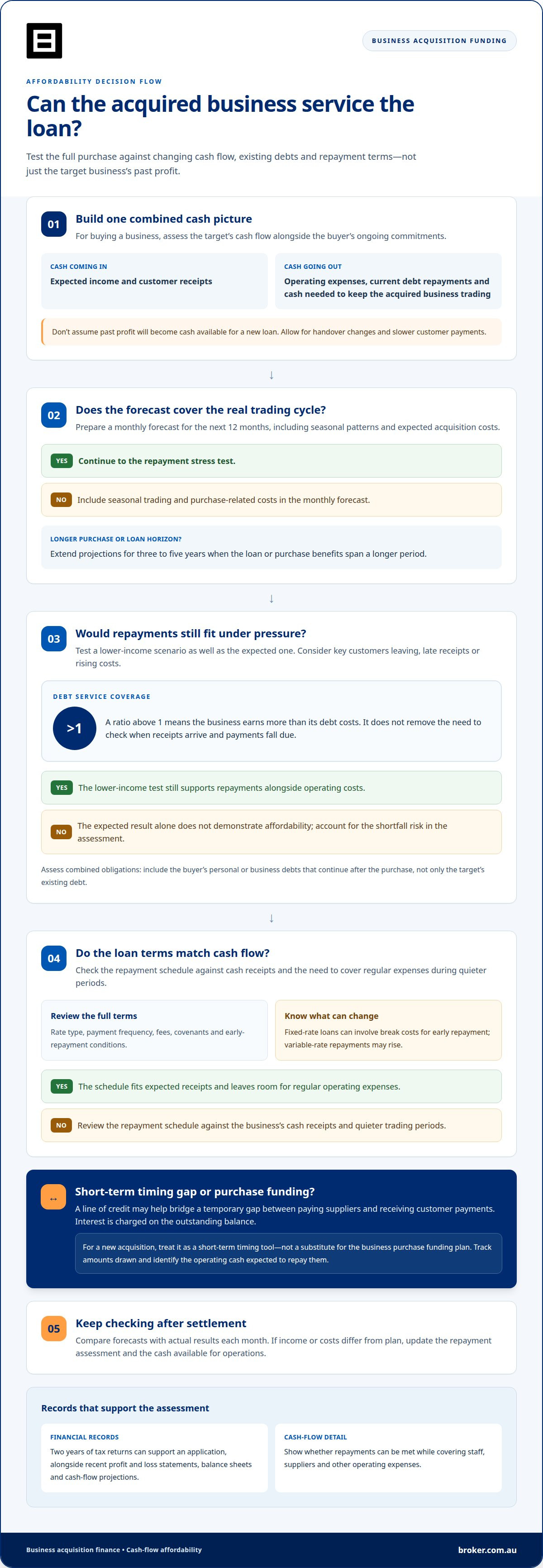
For a business buyer, affordability means testing the purchase against both the target business’s cash flow and the buyer’s existing commitments. Build a combined view of expected income, operating expenses, current debt repayments and the cash needed to keep the acquired business trading. Don’t assume past profit will translate directly into cash available for a new loan. Allow for changes during the handover and slower customer payments.
Prepare a monthly forecast for the next 12 months, including seasonal trading patterns and expected acquisition-related costs. Extend projections for three to five years when the loan or purchase benefits span a longer period. Test a lower-income scenario as well as the expected one: consider what happens if key customers leave, receipts arrive late or costs rise. A business buyer should also include personal or business debt commitments that continue after the purchase.
Organise current financial records for both the buyer and the business being acquired. Two years of tax returns can support an application, alongside recent profit and loss statements, balance sheets and cash-flow projections. An accountant can help assess how tax payments and transaction timing affect available cash. The forecast should show whether the business can meet repayments while covering staff, suppliers and other operating expenses.
Use debt service coverage to compare cash available for repayments with the debt costs due. A ratio above 1 means a business earns more than its debt costs, but the timing of receipts still matters. For an acquisition, test the combined obligations rather than looking only at the target’s existing debt or the buyer’s current position. A profitable business can still face a cash shortfall when several payments fall due before customers pay.
Review the loan terms and repayment schedule, including the rate type, payment frequency, fees, covenants and early-repayment conditions. Fixed-rate loans can involve break costs for early repayment, while variable-rate repayments may rise. Check that the schedule fits the acquired business’s cash receipts and leaves room for regular expenses during quieter periods.
A line of credit may help manage a temporary gap between paying suppliers and receiving customer payments, with interest charged on the outstanding balance. For a new acquisition, treat it as a tool for short-term timing needs, not a substitute for the purchase funding plan. Track any amount drawn and identify the operating cash expected to repay it.
After settlement, compare forecasts with actual results each month. If income or costs differ from the plan, update the repayment assessment and the cash available for operations. This helps the buyer spot pressure early and judge whether borrowing remains affordable as the acquired business’s trading pattern becomes clearer.
2. Selecting a lender experienced with the asset type
For a business purchase, choose a lender familiar with acquisition finance, not only lending against individual assets. The application may involve goodwill, physical assets and working capital, each playing a different role in the transaction. A lender assessing the whole purchase can consider how the business operates and how its assets support future income, rather than treating the request as an isolated equipment or property loan.
Present the target business’s information separately from the buyer’s financial position. Organise the target’s financial statements, bank statements, tax returns and operational details. Then provide the buyer’s records and a clear account of existing borrowing, available contribution and relevant business experience. This helps a lender assess the acquired trading history alongside the buyer’s capacity to take ownership and manage the obligations.
Explain how the purchase price is allocated. Identify the amounts relating to goodwill, included assets and working capital, and connect each component to the transaction plan. For example, if funds are needed to maintain operations after settlement, show which ongoing expenses they will cover. A clear breakdown helps lenders understand the request and assess whether its structure fits the purchase.
Lenders may assess whether the target’s income can support the proposed repayments, alongside the buyer’s existing commitments and the available financial information. They may review financial statements, bank statements, tax returns and a debt service coverage ratio. A business plan can explain how the operation earns revenue, what may change under new ownership and how the buyer intends to sustain trading.
Make the application easy to follow. Label documents by business and period, reconcile figures across statements and explain material differences. If the target’s records show seasonal income or unusual costs, provide context instead of leaving lenders to infer the cause. Gaps or inconsistent figures can lead to requests for more information or further preparation.
Experience with the relevant assets still matters when machinery or vehicles form part of the purchase. Lenders may specialise in passenger vehicles, heavy transport, earthmoving or agricultural equipment, or specialised and imported machinery. Identify the assets included in the sale and explain their role in generating income. This helps align the lender’s assessment with what the buyer is acquiring.
Before applying, compare the lender’s eligibility criteria with the transaction: funding purpose, target-business records, buyer position, assets and repayment capacity. This preparation can reveal gaps early and keep the acquisition application focused on the purchase as a whole.
3. Matching loan terms to asset life and replacement cycles
For a business buyer, the equipment included in a purchase can affect both the funding need and the acquired business’s ability to trade. Review each major asset’s condition, operational role and expected remaining useful life. A machine that needs replacing soon may require a separate investment after settlement, while an asset in good working order may support income for longer. Include these needs in the acquisition plan.
Don’t rely on the sale description alone. Compare asset records with the equipment the business uses day to day, and identify what is essential to producing goods or delivering services. Note planned upgrades, maintenance or replacements in the forecast. This helps distinguish assets that contribute to the purchase’s value from those that may create near-term cash demands.
Match the loan term to how long the financed assets are expected to support the business. If repayments extend beyond an asset’s useful life, the buyer could still owe money after replacing the equipment. If the term is too short relative to the asset’s income contribution, scheduled payments may put unnecessary pressure on operating cash. Test the proposed term against the asset’s condition and the business’s replacement pattern.
When equipment is financed separately, it may serve as security while repayments are made. Understand which asset secures the borrowing and how this affects plans to sell or replace it. In an acquisition, distinguish equipment included in the purchase from assets requiring additional finance. This avoids counting the same asset both as part of the acquisition value and as a separate funding requirement.
What are the risks of using personal guarantees or home equity for business finance in Australia? A personal guarantee may put personal assets at risk if the business cannot repay. If a home is offered as security through home equity, that property may also be at risk if repayments aren’t met.
For each major asset, record its condition, operational importance, likely replacement timing and proposed funding structure. Then assess the repayment schedule against expected income from the acquired business. If an essential asset is nearing replacement, plan for that cost rather than assuming the purchase financing covers future upgrades. This gives the buyer a clearer view of the commitments needed to keep the business operating.
Acquiring a business means assessing more than its current equipment list. Consider whether the assets can support the business plan throughout the loan term and whether replacement needs could coincide with acquisition repayments. Aligning asset life, income generation and repayment timing helps the buyer avoid carrying debt for equipment that no longer contributes to the business.
4. Matching loan terms to the purpose and useful life of funding
Start with the acquisition outcome the borrowing needs to support, then choose a term that fits. Business acquisition funding covers different needs from equipment or working capital finance, so one repayment structure may not suit all three. Separate the purchase price and acquisition costs from short-term operating costs in the funding plan. This helps assess whether proposed repayments fit the period when the funding will deliver value.
Calculate the full funding requirement before applying. For a business purchase, include the acquisition amount and the additional costs of completing the transaction and supporting operations afterwards. Identify the buyer’s available contribution and which costs need funding. This gives the lender a clearer view of the required acquisition loan and the buyer’s equity in the purchase.
Avoid stretching short-lived spending across an unsuitable long loan term. Consider the expected useful life of what the funding pays for, the income it may generate and the business’s capacity to repay. A longer term can reduce scheduled payments but may extend debt beyond the benefit. When buying a business, also assess whether the proposed term and repayments are supported by the acquired business’s cash flow.
A business plan helps the buyer assess the acquisition and explain it to lenders. Set out the business’s goals, customers, products or services, industry opportunities and risks, and current and projected financial position. Include a profit and loss statement, balance sheet and cash flow statement. For an existing business, base financial statements on current information; for a start-up, use projections. Update the plan as aims or circumstances change.
For a business buyer, connect the acquisition plan to the funding request. Explain how the purchased business will operate, where revenue is expected to come from and how the buyer will manage the transition. Forecast the business’s position after settlement rather than relying only on historic profit. This helps lenders assess servicing capacity and whether projected cash flow can cover loan repayments and operating costs.
Timing matters. For an acquisition, prepare the funding plan while assessing the transaction, not after making commitments. Bring together the purchase details, the buyer’s contribution, operating plan and forecasts, then assess how the proposed acquisition finance fits the business’s wider funding position and post-settlement cash flow.
Review the plan before taking on debt, especially when costs or circumstances change. If costs rise or expected income shifts, update the funding requirement and repayment assumptions. A loan should serve the acquisition and fit the period in which it contributes to the business. This helps buyers avoid paying for funding long after its intended benefit has passed.
5. Secured versus unsecured business finance
When seeking business acquisition funding, compare secured and unsecured acquisition loans by weighing the terms against the assets and obligations involved. A secured loan for buying a business uses collateral, such as business equipment or property, to support the borrowing. Security may help a lender offer a lower interest rate or higher borrowing limit than unsecured finance. If the business defaults, however, the lender can take the collateral.
Unsecured acquisition finance doesn’t use that specific collateral structure, but “unsecured” doesn’t always mean personal assets are out of the picture. A lender may require a personal guarantee, which could put a guarantor’s personal assets at risk if the business cannot repay. Read the guarantee and loan terms together, including who is responsible and what happens after default.
Before accepting security for purchasing a business, identify exactly which assets the agreement covers and whether the security applies to one asset or a broader pool. Then read the default clauses, repayment obligations and any covenants. ASIC Report 565 highlighted risks in small-business lending when security rights and default clauses are very broad or not clearly explained. Clear terms matter as much as the headline rate.
For a business buyer, compare the effect on the acquired business’s operations, not just the initial funding. Pledging equipment may affect plans to sell or replace it, while offering property could expose an important business or personal asset. An unsecured acquisition loan may have different terms and still require a guarantee. Match the structure to the purchase purpose, available assets, income and capacity to repay through quieter trading periods.
When acquiring a business, consider which assets are being purchased and whether the funding structure links them to the borrowing. Distinguish assets offered as security from those needed to keep the acquired business operating. If a key vehicle or machine is tied to the loan, losing it after default could disrupt income and make recovery harder.
Australian small businesses may access grants and government-backed financing programs, with eligibility and permitted uses depending on each program. These are distinct from secured or unsecured commercial acquisition loans, so assess whether the funding purpose and conditions suit the business before relying on them.
Compare the acquisition loan amount, rate structure, repayment schedule, collateral, guarantees and default terms side by side. Consider how each option affects cash flow and the assets the acquired business relies on. A lower rate may not justify risking essential property, while avoiding collateral may not remove personal exposure. The better fit is the structure whose obligations the business can understand and manage.
Explore secured and unsecured business finance to assess which structure may suit your business acquisition funding needs.
Broker.com.au
For business buyers, Broker.com.au can help assess Business Acquisition Funding against the purchase purpose, cash flow and available security. If you’re buying a business, this funding can support the financing side of the acquisition. Secured and unsecured business loans may suit different purchasing needs, while Working Capital Finance can address operating cash-flow requirements. The right structure depends on the business’s financial position, available assets and the obligations attached to each option. Consider speaking with Broker.com.au when weighing these trade-offs or preparing to purchase a business, so the funding discussion can focus on your goals and circumstances. To talk through your acquisition finance needs, contact Broker.com.au.
Make your next funding decision with clarity
Before seeking finance, prepare a brief outlining the business you plan to acquire, the funds required and how the business’s cash flow can support repayments. Include your available deposit or equity and consider how your position meets lender requirements. This gives you a practical basis for discussing acquisition finance with an adviser.
Preparing for a business acquisition starts with choosing a funding structure that reflects your circumstances. Broker.com.au offers Business Acquisition Funding, alongside Secured Business Loans and Unsecured Business Loans, giving you options to discuss when buying a business. Take the next step with a conversation focused on the acquisition, your financial position and funding priorities.
Contact Broker.com.au to discuss your options and take the next step towards funding your business acquisition.
Frequently Asked Questions
What financial mistakes should business buyers avoid?
Financial mistakes can make it harder to meet obligations or fund the transition after an acquisition. Examples include treating a credit limit as spare income, mixing personal and business spending, or failing to record how borrowed funds were used. When buying a business, overlooking working capital and other cash needs after settlement can put pressure on the new owner. Clear records and realistic planning help a business buyer identify funding gaps earlier.
What are common business acquisition finance mistakes Australian buyers make?
Common acquisition finance mistakes include borrowing without a defined purpose, focusing on the interest rate alone and overlooking conditions attached to security or early repayment. Another is assuming lender approval means the loan suits the acquisition and the buyer’s plans. A buyer may also underestimate the working capital needed after purchasing a business. Assess the full funding requirement and obligations together, rather than treating approval as the end of the decision.
How much acquisition finance should an Australian business buyer borrow?
Borrow only what is needed for the acquisition and can be repaid alongside existing commitments. Start with a costed plan, identify the purchase price and other transaction costs, and establish the buyer contribution available. Then assess repayments against the business’s expected income after routine costs. When acquiring a business, include the transition’s operating needs, not just the agreed purchase amount, so the funding supports the business beyond settlement.
How can buyers avoid overborrowing and cash flow problems when financing an acquisition?
Break the funding request into defined uses, such as the purchase price, acquisition costs or operating expenses, and remove items without a clear business case. Map when funds are needed against when income is expected, especially if the business relies on customer payments or staged work. Keep borrowed funds traceable in the accounts and review actual spending against the plan. This can reveal unused borrowing early and reduce the temptation to treat it as available profit.
How can business buyers compare acquisition lenders and avoid unsuitable finance offers?
Compare the complete written offer, not just its advertised rate. Review repayment timing, fees, covenants, early-repayment conditions, guarantees, security rights and default clauses. Ask for unclear terms to be explained in writing before signing, and compare how the obligations affect the acquired business under a weaker trading scenario. Be cautious about pressure to decide before you understand the contract, particularly when collateral or personal guarantees are involved.
What tax and accounting issues should Australian buyers consider when borrowing to purchase a business?
Keep the loan agreement, drawdown records, asset invoices and repayment statements together, and record how funds are used. This gives the accountant a clear trail for bookkeeping and financial reporting. Discuss the transaction’s tax treatment before committing, particularly for business acquisitions involving assets and goodwill, as the structure and use of funds matter. Also align expected tax payments with the business’s cash plan, rather than treating borrowed funds as profit.