
Why does a standard borrowing power calculator give you one figure, while a different lender might offer you hundreds of thousands more? It’s a common frustration for many Australians who feel their property goals are being sidelined by conservative bank buffers or the complexities of proving self-employed income. With the RBA holding the cash rate at 4.35% as of June 2026 and APRA’s strict 3% serviceability stress tests in place, it’s easy to feel like your lending capacity has hit a brick wall.
We believe your financial situation is more than just a set of data points. This guide will show you how to look beyond generic online tools to uncover your true borrowing potential. You’ll learn how to navigate the latest debt-to-income regulations and strategically position your profile to access lenders with more flexible policies. We’ll provide a clear roadmap to help you move from uncertainty to a place of streamlined confidence so you can secure the funding you need for your next move.
Key Takeaways
- Realise that a standard borrowing power calculator is only a baseline; your true capacity depends on specific lender “servicing” models and 2026 serviceability buffers.
- Uncover how self-employed borrowers can use strategic “add-backs” like depreciation and superannuation to reveal their actual earning power to lenders.
- Learn why unused credit card limits and “Buy Now, Pay Later” accounts can unexpectedly slash your borrowing potential by significant margins.
- Discover five actionable strategies to optimise your financial profile and improve your standing with a broad panel of over 30 lenders.
- Gain inside access to tailored lending policies that go beyond generic bank algorithms to support your specific property or business goals.
Table of Contents
- What is a Borrowing Power Calculator and How Does It Work?
- The Factors Lenders Use to Determine Your Capacity
- Borrowing Power for Business Owners and the Self-Employed
- 5 Strategic Ways to Boost Your Borrowing Capacity
- Why a Broker.com.au Expert Beats a Generic Calculator
What is a Borrowing Power Calculator and How Does It Work?
A borrowing power calculator is more than a simple estimation tool; it’s a window into how a lender views your financial reliability. While many people focus on the size of their deposit, banks are primarily interested in your “servicing” ability. This refers to your capacity to meet monthly repayments without falling into financial hardship. Unlike a repayment calculator, which tells you what a specific loan amount will cost each month, a borrowing power calculator works backwards. It takes your income and expenses to determine the maximum debt a lender is willing to let you carry.
Every bank uses a unique algorithm to assess risk. This explains why one major bank might offer you $600,000 while another might cap your limit at $520,000. These variations occur because lenders weight certain income types differently. For instance, some might honour 100% of your overtime or bonuses, while others only count 80%. In the current 2026 landscape, these nuances can be the difference between securing your dream home or being forced to compromise.
The Core Components of Your Calculation
Lenders don’t just look at your salary; they dissect your entire financial ecosystem. They focus on your net income, your actual take-home pay, to ensure you have enough cash for daily life. However, they also monitor your debt-to-income ratio to gauge your overall leverage. As of February 1, 2026, APRA rules limit most banks to having no more than 20% of their new mortgage lending go to borrowers with a DTI of six times or more.
Your existing commitments play a massive role. Lenders assess credit cards based on their total limit, not the balance you actually owe. A $10,000 limit can reduce your borrowing capacity by significantly more than $10,000 because the bank assumes you might max it out at any time. Similarly, HECS/HELP debts and the number of dependents in your household are factored in using the Household Expenditure Measure (HEM) to estimate your realistic cost of living.
The Role of APRA and Serviceability Buffers
The most significant hurdle in 2026 is the serviceability buffer. By law, Australian lenders must test your ability to repay a loan at an interest rate that is at least 3 percentage points higher than the rate you are actually applying for. With the RBA cash rate sitting at 4.35% as of June 2026, this “stress test” means you are often assessed as if the interest rate were 8% or 9%.
These buffers are designed to protect you if rates rise further, but they naturally restrict how much you can borrow. Because the economy showed a slowdown in early 2026, with GDP growth at just 0.3% in the March quarter, lenders have become even more meticulous. Understanding these mechanics allows you to work with a broker to find lenders whose internal policies might be more favourable to your specific financial profile.
The Factors Lenders Use to Determine Your Capacity
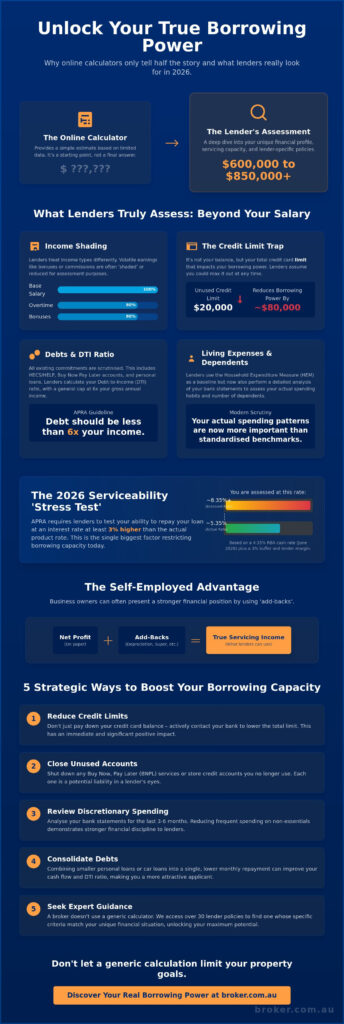
Most people assume that their income is the only major variable in a borrowing power calculator, but the reality is far more nuanced. Lenders apply a range of internal filters to your financial data before they arrive at a final figure. One of the most significant, yet often overlooked, factors is your total credit card limit. Even if you pay your balance in full every month, banks assess your capacity based on the potential debt you could accrue. An unused $20,000 credit card limit can slash your borrowing power by $80,000 or more because lenders must assume you might max out that card the day after your home loan settles.
Lenders also apply a process known as “shading” to different types of income. While your base salary is usually taken at 100%, more volatile earnings like annual bonuses, commission, or overtime are often shaded down to 80%. This conservative approach acts as a secondary buffer against income fluctuations. Similarly, your Loan-to-Value Ratio (LVR) influences a lender’s appetite for risk. If you have a larger deposit and a lower LVR, some lenders may be more willing to stretch their internal servicing limits, whereas a 5% deposit often triggers much stricter scrutiny of your disposable income.
Understanding the HEM Benchmark
The Household Expenditure Measure (HEM) is the standard benchmark banks use to estimate your annual living costs. It classifies your lifestyle as “modest” or “comfortable” based on your location and the number of people in your home. However, relying solely on HEM is a mistake in 2026. Since the Royal Commission, banks have moved away from broad benchmarks and now scrutinise your actual bank statements with high precision. They look for recurring subscriptions, gambling transactions, and high-frequency luxury spending. To present the best possible profile, we recommend “cleaning up” your transaction history at least three months before you start using a borrowing power calculator to plan your purchase.
Income Types and How They Are Weighted
Lenders view PAYG income as the gold standard because of its stability. However, if you rely on rental income to boost your servicing, be aware that banks typically only count 75% to 80% of the gross rent to account for property management fees, maintenance, and vacancy periods. More complex income streams, such as dividends or trust distributions, require a specialist’s touch to be fully recognised by a lender’s credit department. If your situation involves these complex layers, seeking inside access to lenders with flexible policies can significantly improve your results compared to a generic bank tool.
Borrowing Power for Business Owners and the Self-Employed
For an entrepreneur, a standard borrowing power calculator can be a source of immense frustration. These tools are typically designed for PAYG employees with simple payslips; they rarely account for the sophisticated financial structures used by Australian business owners. If your tax returns are structured to legally minimise your tax obligations, they may not reflect your true earning power. This often leads to a “no” from traditional bank algorithms that fail to see the cash flow behind the taxable profit.
We solve this by identifying “add-backs” that can significantly boost your perceived income. Add-backs are legitimate business expenses that lenders can add back to your net profit to demonstrate your actual servicing capacity. Common examples include depreciation on equipment, one-off professional fees, and voluntary superannuation contributions. By presenting these figures correctly, we can often reveal a much higher borrowing limit than what a generic bank tool suggests. Our proprietary AI technology further assists by matching your specific business structure, whether it involves trusts, companies, or partnerships, with the lenders most likely to approve your application.
Grooming Your Business Financials
Preparation is vital for a successful 2026 application. Lenders generally require at least two years of trading history, meaning your 2024 and 2025 tax returns will be the foundation of their assessment. To improve your profile, aim for consistent director drawings rather than sporadic, large lump-sum profit distributions. Banks value stability and a predictable income stream. Additionally, consider a strategic debt restructure. Consolidating high-interest business debts into a single, lower-rate facility can reduce your monthly commitments and immediately improve your personal borrowing capacity.
Specialist Lenders vs. The Big Four
A rejection from a major bank does not mean you cannot secure a loan. While the Big Four often have rigid “Full Doc” requirements, a growing number of specialist lenders offer “Alt Doc” and “Low Doc” solutions. These lenders are often more pragmatic; they may verify your income using Business Activity Statements (BAS), GST turnover, or even an accountant’s letter instead of requiring two years of full tax returns. Through our inside access to over 30 lenders, we identify those with a higher appetite for risk who understand the nuances of self-employment. This boutique approach ensures you aren’t penalised for being an entrepreneur, allowing you to access the capital needed for your next property or business acquisition.
5 Strategic Ways to Boost Your Borrowing Capacity
The result you see on a borrowing power calculator is not a fixed limit; it’s a snapshot of your current financial profile. By making tactical adjustments before you apply, you can significantly shift the needle in your favour. One of the fastest ways to improve your standing is by closing “Buy Now, Pay Later” accounts. Even if you have no outstanding balance, lenders often view platforms like Zip and Afterpay as high-risk liabilities that suggest a reliance on credit for daily living. Eliminating these accounts simplifies your financial profile and removes an unnecessary hurdle during the credit assessment process.
Reviewing your discretionary spending is equally vital. Banks now scrutinise transaction history to identify costs that can be paused or cancelled. If you have multiple streaming services, gym memberships you rarely use, or high-frequency food delivery habits, pausing these three months before an application shows the lender that your “true” living expenses are lower than the HEM benchmark. Additionally, increasing your deposit can move you into a lower Loan-to-Value Ratio (LVR) tier. This often unlocks more competitive interest rates, which lowers your assessed repayments and naturally boosts your total capacity.
Consolidating high-interest personal loans or car finance into a single facility can also improve your debt-to-income ratio. By reducing the total monthly repayment amount across your debts, you free up more “serviceable” income in the eyes of the bank’s algorithm. This proactive grooming of your finances ensures that when you finally submit your application, you are positioned as a low-risk, high-capacity borrower.
The Credit Card Trap
Credit cards are often the single biggest drag on an Australian home loan application. Most banks calculate your serviceability by assuming a monthly repayment of approximately 3% of your total credit card limit, regardless of whether you owe a cent. Reducing a $10,000 credit card limit can increase your borrowing power by approximately $40,000. If you have cards you no longer use, or limits that far exceed your monthly needs, a simple phone call to your bank to lower those limits can add tens of thousands of dollars to your home loan potential.
Optimising Your Income Profile
Timing is everything. If you are expecting a pay rise or have recently completed a strong financial year in your business, waiting for those figures to be reflected in a new tax return can be a game-changer. For those looking at business acquisition funding, we focus on “Super Profits” to demonstrate the future earning potential of the entity you are purchasing. You might also consider debt recycling as a strategy to transform non-deductible home loan debt into tax-deductible investment debt, though this requires a tailored approach. If you’re ready to see how these strategic shifts impact your specific situation, get started with an expert assessment today.
Why a Broker.com.au Expert Beats a Generic Calculator
A digital borrowing power calculator is a useful baseline, but it lacks the nuance required for a truly successful application. These tools operate on a “one size fits all” logic that often defaults to the most conservative lending policies. At Broker.com.au, we replace that rigid algorithm with a “one size fits you” strategy. Our team acts as your expert guide, navigating the complexities of the Australian lending landscape to ensure your specific financial goals aren’t just estimated, but achieved. We move you from a state of uncertainty toward streamlined confidence by providing the human insight that a computer program simply cannot offer.
We specialise in the “outside of the norm” scenarios that typically trigger a rejection from major bank systems. Whether you have a complex company structure, are looking to leverage SMSF loans, or need asset finance for business expansion, we find the path to “yes.” With access to over 30 lenders, including boutique and non-bank institutions that do not deal directly with the public, we provide a level of choice that no single bank website can match. This professional advantage is particularly critical in 2026, as lenders continue to adjust their serviceability buffers in response to shifting economic conditions.
Inside Access to the Best Rates
The most competitive interest rates in Australia are rarely found on a public-facing website. They are negotiated behind the scenes through established industry relationships. We use advanced proprietary technology to match your profile with the lender most likely to offer favourable terms based on your unique servicing capacity. This tailored matching process removes the guesswork and alleviates the inherent anxiety of high-stakes financial decisions. Our “I’m interested” approach ensures the process begins with a low-pressure conversation, allowing you to explore your options without the stress of an immediate, formal application.
Beyond the Home Loan
Our expertise extends far beyond standard residential mortgages. We are high-level fixers for business owners who need sophisticated solutions like business acquisition funding, equipment finance, or commercial property loans. We understand that your business and personal financial lives are often intertwined. By taking a holistic view of your assets and liabilities, we help you secure a home loan even when your income structure is complex or unconventional. Our goal is to move you from a state of uncertainty toward streamlined confidence. If you are ready for a professional, stress-free assessment of your true capacity, simply let us know I’m interested and our team will handle the rest.
Secure Your Financial Future with Expert Insight
While a borrowing power calculator provides a helpful baseline, it cannot account for the nuanced lender policies that often separate a rejection from an approval. You now understand how serviceability buffers, credit card limits, and business “add-backs” influence the final figure in 2026. By proactively grooming your financials and identifying the right lending partner, you can move beyond generic estimates and secure a limit that truly reflects your potential.
We are here to help you navigate these high-stakes decisions with award-winning finance solutions. Our team provides inside access to over 30 Australian lenders and utilises proprietary AI technology to deliver faster, more accurate results for your specific needs. If you’re ready for a professional, stress-free assessment, we invite you to start a low-pressure conversation today.
I’m interested — Get a professional borrowing assessment
You’re in good hands, and your property or business goals are well within reach.
Frequently Asked Questions
How accurate are borrowing power calculators really?
Most online tools provide a baseline estimate rather than a definitive lending limit. While a borrowing power calculator is an excellent starting point for your research, it cannot account for the specific credit policies or internal “shading” rules used by individual banks. Your actual capacity is often higher or lower depending on which lender is assessing your unique financial profile.
Will using a borrowing power calculator affect my credit score?
Using a borrowing power calculator on a website will not impact your credit score. These tools are designed for educational purposes and do not involve a formal enquiry with credit reporting bureaus. You can experiment with different income and expense scenarios as often as you like without leaving any footprint on your credit file.
Does my credit card limit affect how much I can borrow even if I pay it off every month?
Lenders assess your capacity based on your total credit card limit, not your current balance. Even if you pay your card in full every month, the bank must assume you could spend up to the full limit at any time. Reducing an unused limit is one of the most effective ways to immediately improve your standing before a formal application.
Can I include my partner’s income in the calculation for a joint loan?
You can certainly combine incomes for a joint application, which typically increases your overall capacity. Lenders will look at your combined gross income and then subtract your combined living expenses and debts. This often allows couples to access higher loan amounts than they could achieve as individual applicants.
How do lenders view HECS/HELP debt when calculating borrowing power?
Lenders treat HECS/HELP debt as a significant financial commitment because it reduces your net take-home pay. When you have a student debt, your employer withholds a portion of your salary for repayments, leaving you with less disposable income for mortgage serviceability. This reduction in cash flow is factored into every lender’s internal calculation.
What is a “serviceability buffer” and why does it change?
A serviceability buffer is a mandatory 3% interest rate “stress test” applied by lenders to ensure you can handle future rate rises. This buffer is set by APRA and exists to protect borrowers from financial hardship. It changes based on the regulator’s assessment of the Australian economy and the current risk levels within the housing market.
How many months of bank statements do I need to provide to prove my expenses?
Most Australian lenders require three months of consecutive bank statements to verify your spending habits. This allows the credit assessor to establish a realistic average of your “discretionary” spending versus your essential costs. Ensuring your accounts are “clean” during this ninety-day window is vital for a smooth approval process.
Can I get a loan if I am self-employed and have only been in business for one year?
While most major banks require two years of trading history, certain specialist lenders offer solutions for those in business for just twelve months. These “Alt Doc” loans may use your Business Activity Statements (BAS) or an accountant’s letter to verify your income. We specialise in identifying these flexible lenders for entrepreneurs who fall outside the standard lending criteria.