
A strong credit score alone won’t secure your first business loan: lenders also assess your trading history, cash flow, debts and supporting documents. To understand how to get approved for a business loan for the first time, prepare for lenders to ask for an active ABN with 6 to 24 months of history, depending on the lender, alongside financial records that show how you’ll repay the borrowing.
It’s understandable to feel unsure about what to gather or which funding option fits, especially when you’re buying a business and need to assess both the purchase and its cash flow. A clear, well-organised application helps lenders see the full picture.
This guide explains what lenders assess, which documents to prepare, how personal and business credit can affect an application, and why secured and unsecured loans may be assessed differently. You’ll also learn how to plan repayments around cash flow and match the loan structure to your business acquisition needs.
Key Takeaways
- Build a lender-ready document pack around your business structure, trading history and funding purpose, including records that support your income and cash flow.
- Review personal and business credit histories before applying, and prepare a clear explanation for any past credit issues.
- Use income, expenses, existing debts and cash flow forecasts to work out a borrowing amount the business can reasonably service.
- For a business acquisition, organise the sale details and financial information for the business being purchased so lenders can assess the opportunity and repayment plan.
- Compare secured and unsecured options against your available security, funding purpose and repayment capacity before choosing a loan structure.
Table of Contents
- What do you need for business loan approval?
- Checking personal and business credit histories
- Reviewing assets, liabilities, affordability and cash flow
- Using a finance broker to compare lender criteria
- Understanding secured and unsecured loans
- Broker.com.au: Secured Business Loans
What do you need for business loan approval?
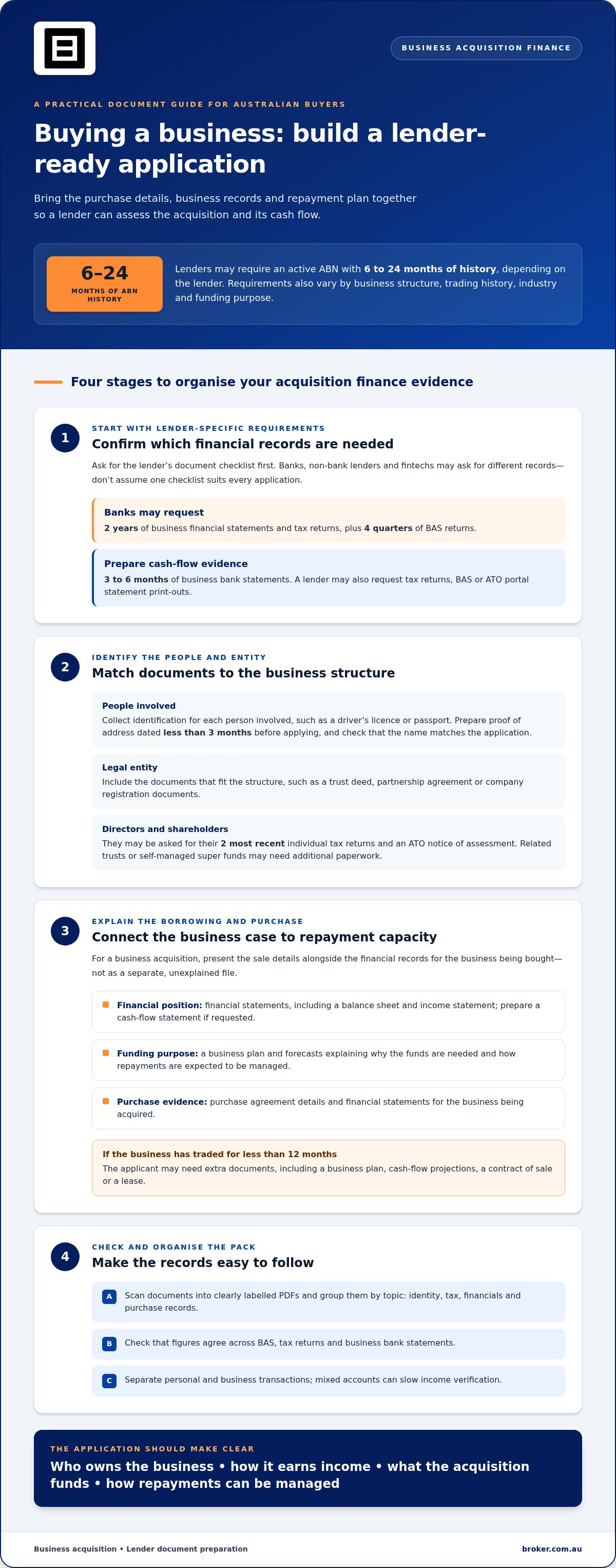
Prepare documents that show who owns the business, how it earns income and how it can manage repayments. Requirements vary according to business structure, trading history, industry and funding purpose.
- Check lender document requirementsAsk for the lender’s document checklist before assembling your application. Banks may request two years of business financial statements and tax returns, plus four quarters of BAS returns. Non-bank lenders and fintechs may have different requirements, so confirm which records they need rather than assuming one checklist suits every application.Prepare three to six months of business bank statements to show cash flow. Lenders may also request tax returns, BAS or ATO portal statement print-outs. For an acquisition, include purchase agreement details and financial statements for the business being bought. Learning how to get approved for a business loan for the first time starts with matching evidence to the funding purpose.
- Gather identity and business-entity documentsCollect identification for each person involved, such as a driver’s licence or passport. New customers may need to provide identification, while existing customers applying with their current lender may not need to repeat this step. Prepare proof of address dated less than three months before applying, and check that the name matches the application.Add documents that match the legal structure, such as a trust deed, partnership agreement or company registration documents. Directors or shareholders may be asked for their two most recent individual tax returns and an ATO notice of assessment. Related trusts or self-managed super funds may require additional paperwork, so include them in your checklist.
- Prepare loan application documentsOrganise financial statements, including a balance sheet and income statement, and prepare a cash-flow statement if requested. Include a business plan and forecasts explaining the funding purpose and expected repayments. If you’re buying a business, present the sale details alongside its financial records, rather than as a separate, unexplained file.Scan documents into clearly labelled PDFs and group them by topic, such as identity, tax, financials and purchase records. Check that figures agree across BAS, tax returns and business bank statements. Separate personal and business transactions, as mixed accounts can slow income verification. These steps help you understand how to get approved for a business loan for the first time.
- Can a startup or new business get a loan in Australia? Yes, but an applicant with less than 12 months of trading may need extra documents, including a business plan, cash-flow projections, a contract of sale or a lease. Other funding options include business loans, overdrafts and credit cards. Choose the option that fits the funding purpose and expected repayments.
- What do Australian lenders require for a first-time business loan? They commonly assess business identity and structure, financial statements, tax records, bank statements, credit history and a repayment plan. For a business purchase, include sale information and records supporting the proposed transaction. Requirements depend on the business and loan purpose.
- Are there Australian government grants, loan schemes or state-based programs for small businesses? Grants, loan schemes and state-based programs are separate funding pathways, each with its own purpose and eligibility criteria. Consider potential program support separately from a lender’s loan assessment, and show how the business can manage repayments without relying on uncertain funding.
Checking personal and business credit histories
Review both personal and business credit before submitting an application. Lenders assess repayment conduct, existing commitments and recent credit activity against their own criteria.
- Obtain your personal and business credit reports, then compare the entries with your records. Check legal names, addresses, account balances, repayment histories and defaults. A company director’s personal credit may be considered alongside the business profile, particularly if the director supports the application. If an accountant manages your records, ask them to help reconcile unfamiliar business debts or reporting errors.
- Check the personal credit score thresholds relevant to the lender you’re considering. Some non-bank lenders require a personal score of 500 or higher on the Equifax scale, while banks may want 600 or higher. These figures are screening criteria, not approval guarantees. Lenders can also assess income, business performance, security and the reason for borrowing.
- Review defaults, court judgments and bankruptcies with their dates and current status. Australian lenders may consider these events from the past 5 years, so prepare a brief, factual explanation for any issue and describe what has changed. For example, show that a disputed account was corrected or that a past repayment difficulty has been addressed. Don’t leave a credit issue unexplained.
- Look for incorrect listings and repeated applications before lodging a new request. Some lenders may flag more than two or three credit enquiries in the past 6 months. If a report contains an error, request a correction and allow 7 to 14 days for it to be addressed. Avoid lodging multiple applications at once, as each enquiry can affect how your recent lending activity appears.
- List every line of credit, overdraft, credit card and loan, including limits and current balances. An unused facility may still be relevant to a lender’s assessment of your commitments. A personal guarantee also creates risk: if the business fails to repay, the guarantor may have to meet the guaranteed debt. With a variable-rate loan, rate changes can increase repayments and put pressure on cash flow.
- Before buying a business, connect the credit review to your acquisition finance plan: existing debts and credit conduct can influence the lender’s view of servicing capacity. If you need help comparing lending criteria, review business loan options as part of your preparation.
Reviewing assets, liabilities, affordability and cash flow
Map the business’s finances before deciding how much funding to request. Lenders use income, expenses, assets, debts and forecasts to assess whether repayments fit available cash flow.
- Review income, expenses and debtsList each revenue stream, operating expense, tax payment and existing debt repayment. Use recent financial records to separate regular income from one-off receipts, such as an unusually large customer payment. Record asset values and liabilities clearly, including equipment, property, loans and credit facilities. This gives you a practical view of what the business owns and owes.Compare debt repayments with revenue. Lenders may consider existing business debt repayments alongside revenue when assessing affordability. Treat this as an assessment preference, not a borrowing target: seasonal income or uneven expenses can still affect affordability.
- Assess affordability and cash flowEstimate proposed repayments alongside current commitments and routine costs. Test whether the business can cover wages, suppliers, rent, tax and loan payments during quieter trading periods. Apply before cash flow becomes desperate, rather than waiting until unpaid bills leave few options. A rushed funding request can make it harder to present a clear repayment plan.Set the requested amount by working backwards from the purpose and repayment capacity. For example, separate funds needed for equipment from a cash-flow buffer, then assess each against the income expected to support repayments.
- Prepare cash-flow forecasts and a business planBuild a forecast estimating future sales, operating costs and payment timing. For a start-up or a business with limited trading history, show the assumptions behind projected customer demand and expenses. Australian lenders usually want to see a business plan before approving a business loan, so connect each forecast to the plan’s sales strategy and operating model.For an acquisition, base projections on the business’s financial performance and your planned costs after settlement. Include the possibility of additional capital needs during the first six to twelve months after purchase, and explain how available funds would cover them.
- Stress-test the forecast by changing key assumptions, such as slower customer payments or higher supplier costs. Note which costs can be reduced and which payments remain essential. This shows where cash flow may tighten and whether the proposed borrowing still fits.
- Choose funding that matches the cash-flow need. An overdraft can bridge a short-term gap between receipts and bills, but shouldn’t fund capital purchases or long-term needs. Match the facility’s purpose to the expense rather than using short-term access to cover ongoing shortfalls.
- Keep the forecast, business plan and requested amount consistent throughout the approval process. If the purchase plan changes, update the figures and repayment explanation before applying. Clear assumptions help a lender understand how the business expects to meet payments without relying on optimistic sales alone.
Using a finance broker to compare lender criteria
Compare lenders against your funding purpose, financial position and repayment capacity before applying. For a business purchase, assess acquisition finance options against the purchase details and the business’s cash flow.
- Set your comparison criteria before reviewing offers. Compare the interest rate, fees, repayment schedule, loan term, security requirements and early repayment flexibility. A lower rate alone doesn’t show the total cost or suitability. Compare repayments and fees over the full term, then check whether the structure suits seasonal revenue or a one-off purchase.
- Match your situation to each lender’s eligibility criteria. Banks may suit established businesses with strong financials and property security, while non-bank lenders can assess a broader range of circumstances. The Reserve Bank of Australia notes that non-banks face fewer prudential regulatory constraints than banks and tend to lend to riskier borrowers. That difference doesn’t remove the need to demonstrate repayment capacity.
- Review what the lender will assess in your business bank statements. Australian business lenders commonly review 3 to 6 months of transactions, looking for regular income, operating costs, existing debt payments and cash-flow patterns. Explain unusual deposits or large one-off expenses with supporting records. Keep personal spending separate so business finance statements show the trading position clearly.
- Build processing time into your purchase or funding plans. Bank approval can take 2 to 6 weeks, while non-bank approval may take 1 to 3 weeks. Online lenders can often assess and fund applications within 24 to 48 hours; fintech lenders may assess and fund within 24 to 72 hours. A complete application and the lender’s credit approval process affect timing.
- Check a finance company’s legitimacy before sharing sensitive information. Search its business name or ABN on the Australian Securities and Investments Commission register. Treat an unexpected call or email about a loan you didn’t apply for as almost certainly a scam, and report it to Scamwatch. Keep application records and lender communications together.
- A finance broker can help compare lender criteria when your business needs a tailored assessment, such as buying a business with uneven earnings or limited trading history. Give the broker consistent financial information and explain the purchase purpose, available security and repayment plan. This helps identify which lender’s criteria fit before a formal application is submitted.
Understanding secured and unsecured loans
Secured loans use collateral, while unsecured loans rely more heavily on the business’s financial health. Banks and non-bank lenders assess different criteria, so compare security, repayments and total borrowing terms against your purpose.
- Identify what the lender would take as security. A secured business loan is backed by collateral, which a lender may take to cover losses if the borrower doesn’t repay. Property can be offered as security, but the asset is at risk if repayments aren’t maintained. For acquisition finance, consider the effect on your personal or business assets before pledging them.
- Compare the collateral requirement with the amount you need. Most private lenders generally keep loan-to-value ratios at 70-80% of the property value. That ratio affects how much funding the property may support, while the lender also assesses affordability and the property itself. Don’t assume an asset’s full value will be available as borrowing.
- Assess an unsecured option against the business’s financial position. Without property collateral, lenders generally focus on whether the business can repay from its financial performance. They may review revenue, existing commitments and bank statements to assess that capacity. A buyer with limited trading history should consider how purchase projections and the acquired business’s cash flow support repayments.
- Compare banks and non-bank lenders by their assessment approach, terms and overall suitability. The Reserve Bank of Australia notes that non-banks face fewer prudential regulatory constraints than banks and tend to lend to riskier borrowers. This describes a difference in lender profiles, not an approval shortcut. Both types assess applications, and criteria can vary with the borrower, security and loan purpose.
- Compare the actual offer, not just whether it is secured or unsecured. Review the interest rate, fees, repayment frequency, loan term, security conditions and consequences of missed payments. A lower rate may not make a loan suitable if the repayment schedule clashes with the business’s cash flow. Check how variable repayments could respond to rate changes.
- Match the structure to the purchase or funding need. A long-term asset purchase and a temporary cash-flow gap have different repayment demands. For a business acquisition, weigh the purchase funding against available equity, security and the target business’s ability to service debt. Before choosing, explore business acquisition funding options that align with the transaction and repayment plan.
Broker.com.au: Secured Business Loans
Broker.com.au helps business owners assess funding options against their borrowing purpose, financial position and repayment capacity. If you’re buying a business, Business Acquisition Finance & Advisory can support the purchase finance process, while Business Loans may suit borrowers considering available collateral.
If property security isn’t suitable, unsecured business loans are another option to explore, with lenders assessing the business’s ability to repay. Working Capital Finance may suit businesses managing operational cash flow rather than funding a purchase. The right pathway depends on what you’re funding and how repayments fit your forecasts.
Use your prepared financial information and purchase details to discuss which lending criteria may fit your situation. For a considered conversation about your next step, contact Broker.com.au or visit Broker.com.au.
Move forward with a clear funding plan
Turn your borrowing goal into a practical funding plan. Set out what the finance will support, how it fits your business plans and what repayment structure feels manageable. If you’re learning how to get approved for a business loan for the first time, a focused discussion can help you approach the application with greater clarity.
For a business buyer, starting the funding conversation around the proposed purchase can connect the transaction details with the finance required. Broker.com.au offers Business Acquisition Finance & Advisory and Business Loans, including secured and unsecured options, to discuss based on your purchase purpose, security and business position.
Bring your current financial picture and intended use of funds to the conversation. Contact Broker.com.au to discuss your options and take the next step with a clearer plan. You can move forward at a pace that suits your decision.
Frequently Asked Questions
What documents do lenders usually require?
Lenders usually ask for identity, business structure and financial records, with extra documents depending on the loan purpose. If you’re purchasing a business, include the sale agreement, information about the assets or goodwill being acquired, and records supporting the proposed purchase. If a guarantor is involved, prepare their financial details too. Keep documents consistent: mismatched business names or figures can prompt follow-up questions.
Does the application include a credit check?
Yes, lenders commonly assess credit history as part of a business loan application. They may consider the business’s credit profile as well as those of directors, partners or guarantors. For example, a director applying through a company may still have their personal credit assessed. Before lodging, review who the application covers and make sure each person understands their financial position may form part of the assessment.
What credit score and credit history do Australian business loan applicants need?
There’s no single score that guarantees approval, because lenders weigh credit alongside trading performance, debt and security. Some non-bank lenders require a personal Equifax score of 500 or higher, while banks may want 600 or higher. A score is only one part of the assessment. A lender may also consider defaults, court judgments or bankruptcies from the past 5 years and how you’ve managed credit since.
What financial documents are needed to apply for a business loan in Australia?
Expect to provide records showing the business’s financial position and the source of repayments. Depending on the application, these may include a balance sheet, income statement, cash-flow statement, tax returns, BAS and business bank statements. For an acquisition, add the target business’s accounts and purchase information. If figures differ between records, explain the reason clearly, such as a one-off expense or timing difference.
How long must an Australian business have been operating to qualify for a loan?
Requirements vary by lender, but businesses commonly need an active ABN with 6 to 24 months of history. A start-up or business with less than 12 months of trading may need stronger supporting material, such as forecasts, a business plan, a signed contract of sale or a lease. For a purchase, show how the new owner’s experience and the acquired business’s trading model support ongoing operations.
How much deposit, collateral or personal guarantee might an Australian lender require?
There’s no standard deposit or guarantee amount across business loans. The lender weighs the purchase price, available equity, security value, business cash flow and existing debts. For example, a buyer may need to contribute more equity if the proposed security doesn’t support the requested borrowing. A personal guarantee can make an individual responsible under its terms, so understand its scope and the obligations it covers.
What are typical Australian business loan interest rates, fees and repayment terms?
Rates, fees and repayment terms depend on the lender, loan structure, security, business finances and application risk. Compare the full offer, not just the advertised interest rate: establishment or ongoing fees, repayment frequency and loan term all affect the overall cost. For example, a lower rate with a shorter term can mean higher regular repayments. Check that the schedule suits the business’s revenue cycle.
How can I improve my chances of business loan approval in Australia?
Strengthen the application by making its purpose, repayment source and supporting figures easy to follow. Correct report errors before applying, explain unusual transactions, and avoid submitting several applications close together. For a business purchase, connect the sale terms to the buyer’s operating plan and the business’s expected cash flow. A clear explanation of your experience running or managing a similar operation can also help lenders assess the proposal.