
The biggest loan available may be the wrong finance for growth. Securing your business’s future with the right finance starts with matching the funding to its purpose, timing and repayment capacity. A credit line may suit changing cash-flow needs, while a term loan can be more appropriate for a defined expense with a clear repayment plan.
It’s understandable to want finance that supports growth without putting extra strain on day-to-day cash flow. This guide explains how to compare a line of credit with a term loan, assess options when credit is less than ideal, and weigh repayments against your business’s cash flow.
You’ll also learn how to match funding to a specific need, such as working capital or buying a business, and what to prepare before discussing finance. The aim is to help you understand the trade-offs and identify a practical next step.
Key Takeaways
- Match a credit line, overdraft or term loan to the way your business will use the funds and manage repayments.
- Review your credit history and prepare clear financial records before applying, especially if past credit issues could affect a lender’s assessment.
- For a business acquisition, plan how the purchase will be funded and show how the business’s cash flow can support repayments.
- Compare the amount needed, when you need it and how quickly you can repay it before choosing a finance structure.
- Discuss your funding plan with an accountant or finance professional to understand the impact on cash flow and borrowing capacity.
Table of Contents
- 1. Line of credit or fixed term loan?
- 2. What About Businesses with Bad Credit?
- 3. Choosing finance based on funding purpose, amount and timeframe
- 4. Consulting a financial professional before borrowing
- 5. Business finance for growth and working capital
- Broker.com.au: Secured Business Loans
1. Line of credit or fixed term loan?
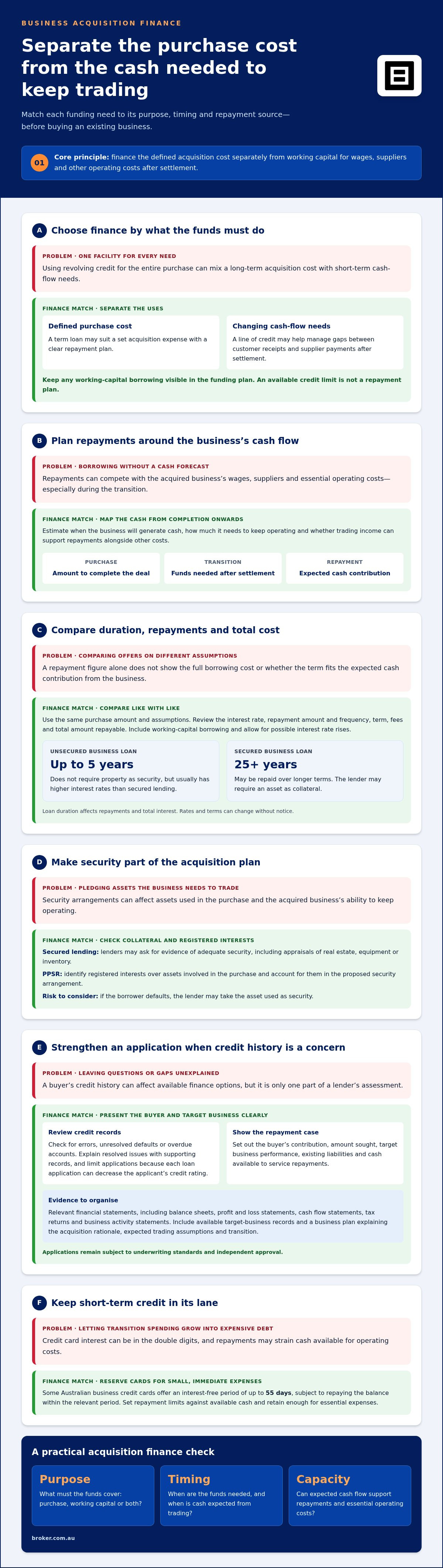
For a business acquisition, match the finance to both the purchase and the cash the business will need after settlement. A term loan may suit a defined purchase cost, while a line of credit can provide access to funds as post-settlement expenses arise. Separate the amount needed to complete the purchase from working capital for wages, suppliers and other operating costs. This helps avoid using short-term credit for a long-term acquisition cost.
A bank term loan may suit a mature business that is at least two years old. For an acquisition, the lender will assess whether the buyer and business can support the repayments. A bank overdraft may also suit a business at least two years old, particularly for short-term cash-flow gaps. It generally has no fixed term, with repayments made within the agreed limit.
A line of credit can suit fluctuating needs, such as gaps between customer receipts and supplier payments after a purchase. It offers flexibility, but an available limit is not a repayment plan. Estimate when the acquired business will generate cash and how much it will need to keep operating. Draw funds for the intended purpose, and avoid relying on revolving credit to fund the entire purchase.
Secured lending uses an asset as collateral. Commercial lenders may ask for evidence of adequate security, including appraisals of real estate, equipment or inventory. If the borrower defaults, the lender may take the asset used as security. Unsecured business loans don’t require property as security, but usually have higher interest rates than secured loans. Weigh any security offered against the assets the acquired business needs to keep trading.
Loan duration affects both repayments and total interest. Unsecured business loans in Australia may have terms of up to five years, while secured business loans may be paid off over terms of 25 or more years. For acquisition finance, compare the proposed repayment period with the expected cash contribution from the business being purchased.
Compare offers using the same purchase amount and assumptions. Review the interest rate, repayment amount and frequency, term, fees and total amount repayable. Include any working-capital borrowing in the comparison, and allow for possible interest rate rises. Loan rates and terms can change without notice.
Credit cards may cover small, immediate expenses during a business transition, but interest can be in the double digits. Some Australian business credit cards offer an interest-free period of up to 55 days, subject to repaying the balance within the relevant period. Debt can strain the acquired business if repayments compete with operating costs. Set repayment limits against available cash and retain enough funds for essential expenses.
2. What About Businesses with Bad Credit?
A buyer’s credit history can affect the finance options available for purchasing an existing business, but it is only one part of the assessment. Lenders may also consider the buyer’s contribution, the target business’s financial performance, existing liabilities and the cash available to service repayments. Present these as distinct parts of the application so the proposed acquisition can be assessed clearly.
Start by reviewing the business and personal credit records relevant to the application. Check for errors, unresolved defaults or overdue accounts. Explain resolved credit issues with supporting records, and limit applications because each loan application can decrease the applicant’s credit rating.
For acquisition finance, show how the purchase will be funded from completion through the transition. Set out the buyer’s available contribution, the amount sought and the funds needed to keep the business operating after settlement. The contribution and funding structure depend on the transaction and the buyer’s financial position. Forecast whether the target’s trading income can support repayments alongside wages, suppliers and other operating costs.
Support the forecast with evidence. Australian businesses applying for finance should provide relevant financial statements, including balance sheets, profit and loss statements, cash flow statements, tax returns and business activity statements. For a purchase, include the target business’s available financial records alongside the buyer’s own information. A business plan should explain the acquisition rationale, expected trading assumptions and how the buyer intends to manage the transition.
Security also needs attention. Lenders search the Personal Property Securities Register (PPSR), and registrations can affect which business assets are available to secure lending. Identify registered interests over assets involved in the purchase, then account for them in the proposed security arrangement. This matters particularly when the target relies on equipment, inventory or other assets to continue operating.
Loan applications remain subject to underwriting standards and independent approval. A business credit card may help establish a business credit record, but it won’t replace the evidence required for an acquisition application. Keep card use manageable and avoid extra repayments that could weaken the buyer’s capacity to service the proposed finance.
Organise the buyer’s credit information, contribution details and target-business records before lodging an application. If you’re preparing for a purchase, business finance options can help you consider the next step.
3. Choosing finance based on funding purpose, amount and timeframe
Securing your business’s future with the right finance starts with linking the amount requested to a defined purpose, a realistic timeframe and a repayment source. Buying an existing business calls for a different plan from covering a temporary cash-flow gap or purchasing equipment. For an acquisition, identify what the funds must cover, what equity you can contribute and how the business will generate cash to service debt. This gives a lender a clearer picture of the proposed transaction.
Forecast cash flow by mapping expected receipts and payments across a 12-month budget. Compare actual results with forecasts, then identify periods when cash available for debt repayments may fall short. Include revenue, operational expenses, overheads, debtors, creditors, inventory and gross margin. These seven cash drivers help show whether a funding gap is temporary, seasonal or tied to a longer-term investment.
Calculate the funding amount from the shortfall, not just the headline cost. A buyer should account for the purchase requirements and the operating cash needed after completion. A growth project may need start-up capital, operating capital and contingency funds. Separating these needs helps avoid borrowing too little to complete the plan or taking on debt the business cannot comfortably service.
Match the structure to the purpose and repayment source. Debt finance generally involves repayment obligations, while its effect on ownership depends on the financing arrangement. Equity finance can provide funds without scheduled loan repayments, but gives investors some ownership or influence. Other sources may suit a specific plan. Compare the effect of each option on control, cash flow and the business’s ability to meet ongoing commitments.
When acquiring a business, build the forecast around the target’s expected income and costs, not just the buyer’s current trading position. Test whether cash flow can cover existing operating expenses alongside proposed repayments. Consider how changes in revenue, debtor payments or inventory needs could affect available funds. Separate the purchase amount from the capital needed to keep the business operating.
Present the funding plan clearly: how much is needed, when it is needed, where it will come from, how it will be used, when debts will be repaid and when investors can expect returns. If the aim is to grow the business’s valuation within seven years for a profitable exit, link each funding request to a milestone and explain how it supports that outcome.
A useful final test for securing your business’s future with the right finance is whether the forecast still works under less favourable trading conditions. Compare actual cash flow with the budget, update expected receipts and costs, and reassess the amount available for repayments. This keeps each funding decision tied to a clear purpose, timeframe and realistic repayment source.
4. Consulting a financial professional before borrowing
Before funding a business purchase, ask an accountant or professional financial adviser to review both the transaction and the loan. Their assessment can help distinguish the target’s reported performance from the cash it may generate under new ownership. Take the sale information, proposed purchase structure and your own financial records to the discussion. This gives the review a practical foundation.
Ask the accountant to examine the target’s financial statements for consistency across reporting periods. Discuss owner payments, unusual expenses, outstanding obligations and changes in revenue. For example, a profit figure may not show whether the business can meet supplier costs immediately after settlement. Understanding how the figures translate into available cash helps assess the acquisition’s capacity to support borrowing.
Review the purchase funding as a complete plan. Separate the buyer’s contribution, borrowed funds and capital needed for the transition. Account for costs that arise before the business’s normal trading cycle resumes, such as supplier payments or operational changeover costs. This helps avoid directing every available dollar towards completion and leaving the acquired business short of operating funds.
Discuss the assumptions behind projected earnings with the adviser. Consider whether expected sales depend on particular customers, key staff or agreements that may change after ownership transfers. If revenue relies on a small number of relationships, test how a disruption could affect cash available for repayments. A scenario with slower receipts can reveal pressure points that a headline profit figure may conceal.
Ask how the proposed loan’s interest rate, payment schedule and conditions fit the acquisition plan. Review any lender reporting requirements, including information about receivables or customer creditworthiness. Also discuss how changes to the company’s status could affect tax and reporting obligations. These details can influence the administration and cash planning required after the purchase.
Before accepting an offer, have the professional compare the written terms with the agreed funding plan. Clarify how the security, repayment obligations and permitted use of funds affect the buyer and the acquired business. If a term changes the expected contribution or leaves less money for transition costs, revise the plan before proceeding. Consider the whole transaction, not just the loan amount.
Set a review point after completion to compare the target’s actual performance with the assumptions used for borrowing. If trading differs from the forecast, an accountant can help identify which costs or receipts have shifted and what that means for repayment capacity. This ongoing review connects acquisition decisions with operating results and supports informed finance choices.
5. Business finance for growth and working capital
Growth can absorb cash before it generates additional revenue. Build a 12-month cash flow budget covering expected receipts, operating expenses, planned investment and debt repayments. This forecast helps reveal when capital is needed and whether the business can support repayments while meeting routine costs. Update it as actual trading results come in, so decisions reflect current conditions rather than an outdated projection.
Separate funding needs into start-up capital, operating capital and contingency funds. For example, a business launching a new product may need funds for initial production, day-to-day costs before sales arrive, and a reserve for delays or weaker demand. Keeping these needs distinct makes it easier to assess the purpose and timing of each funding request.
Match the funding structure to the expense. Leasing equipment can provide access to tools for growth without an outright purchase, helping limit the immediate effect on cash flow. Invoice finance can release funds tied up in outstanding invoices. A line of credit may help manage changing working-capital needs, while a defined investment requires a repayment plan that fits its expected returns.
Look for cash-flow improvements alongside borrowing. If a business is waiting for customer invoices to be paid, review payment terms with suppliers and customers, then forecast the effect on available cash. When supplier payments fall due before customer receipts arrive, the timing gap may create pressure even when sales are healthy. Mapping those dates makes the size and duration of the need clearer.
Compare debt and equity against the business’s plans. Debt and equity finance can affect a business in different ways, so consider the implications for repayments, ownership and control. Equity finance brings in capital in return for some ownership or influence. An investor may also contribute experience and direction, but their involvement changes how decisions are made. Weigh the value of that contribution against the control the owner is prepared to share.
Australian government grants may not need to be repaid, but applications can be lengthy and complex, and conditions may restrict how funds are used. Treat grant funding as one possible part of a broader plan, rather than relying on it to cover every project cost. Check that the proposed use fits the grant’s purpose and account for expenses it won’t cover.
Test the plan against seasonal changes, unexpected expenses and weaker trading. Leaving no financial buffer can expose a business to cash-flow strain, while repayments beyond its capacity can compound the pressure. Compare actual cash flow with the budget, revise forecasts as receipts and costs change, and discuss options with your accountant. This helps keep funding aligned with the business’s actual trading position.
If you’re planning growth or managing a working-capital gap, discuss your business funding needs and the options that may fit your plan.
Broker.com.au: Secured Business Loans
Broker.com.au helps business owners assess finance options when a purchase, expansion or cash-flow need calls for external funding. Its Secured Business Loans may suit businesses able to offer an asset as security. The right structure depends on the purpose, repayment capacity and available collateral.
For a business buyer, Business Acquisition Funding can help finance the purchase of an existing business. Working Capital Finance may suit day-to-day expenses or growth plans that put pressure on available cash. Unsecured Business Loans offer another option for businesses that don’t want to use property as security.
Bring your funding purpose, cash-flow forecast and financial records to the discussion. These details help clarify which options may fit your needs and how repayments could affect the business. Contact Broker.com.au to discuss your business finance needs.
Make your next funding decision with purpose
Finance should support where your business is heading, not simply relieve today’s pressure. As plans evolve, revisit how borrowing fits your goals, cash flow and capacity to repay. This ongoing perspective can help you make deliberate decisions about growth, acquiring a business or protecting working capital.
Securing your business’s future with the right finance means connecting your funding purpose with a suitable lending pathway. Broker.com.au offers Secured Business Loans, Unsecured Business Loans and Business Acquisition Funding, giving business owners options for different borrowing needs.
If you’re weighing finance for a business purchase or growth plan, contact Broker.com.au about business finance to discuss a suitable next step. A considered conversation can help you move forward with greater clarity and confidence.
Frequently Asked Questions
How can I secure finance for my business?
Prepare a clear case for the amount, purpose and repayment source, then present it with current financial records. Lenders assess the business’s financial position and capacity to meet repayments, so make sure your figures tell a consistent story. If funding will support a new contract, for example, explain the costs required before delivery and when customer revenue is expected. This connects the request to a practical business outcome.
Debt or equity?
Debt may suit owners who want to retain their shareholding and can manage scheduled repayments from business cash flow. Equity may suit a growth plan that needs capital without loan repayments, provided the owner accepts sharing ownership or influence. An investor could contribute funds and relevant experience, for example, but may also participate in business decisions. Compare repayment costs with the effect of sharing control before choosing.
Line of credit or fixed term loan?
A line of credit can suit recurring needs that rise and fall, such as bridging gaps between supplier bills and customer receipts. A fixed-term loan can better match a single planned expense, such as a fit-out, where the amount and purpose are known. Consider how often you’ll draw funds and whether repayments should follow a defined investment period. The right fit depends on the cash-flow pattern the borrowing will support.
Secured or unsecured?
A secured loan uses collateral, which can affect the lender’s risk assessment and the assets exposed if repayments aren’t met. An unsecured loan doesn’t use specific property as security, so the lender may focus more on trading performance and repayment capacity. A business with valuable equipment, for example, should weigh the benefit of using it as security against the risk to that asset.
Step 4: Borrow, seek investors or self-fund?
Choose a funding source after comparing repayment capacity, ownership preferences and available cash. Borrowing can preserve ownership but creates debt obligations. Investors contribute capital in return for an ownership interest or influence. Self-funding avoids external repayments or shared ownership, but using too much cash can leave the business exposed to operating costs. Retain enough working capital to pay suppliers before committing surplus funds to a project.
What about businesses with bad credit?
Businesses with bad credit should first understand what caused the issue and whether the credit record is accurate. Gather evidence of resolved defaults, explain exceptional circumstances and show how current trading supports repayments. Avoid multiple applications without a clear plan, as repeated applications can affect credit standing. If an asset is already registered as security on the Personal Property Securities Register, account for that when assessing available collateral.
What types of business finance are available in Australia?
Australian businesses can consider secured or unsecured loans, a line of credit, invoice finance, equipment finance and commercial property finance. Business buyers may also explore acquisition funding, while businesses managing day-to-day expenses could consider working capital finance. Each option has a different purpose: invoice finance can release cash tied up in unpaid invoices, while equipment finance is linked to acquiring business assets.
How do I choose the right business finance for my goals and cash flow?
Start by identifying what the funds will achieve, then map the timing of costs and expected returns against the business’s cash flow. Check whether repayments remain manageable during slower trading, not just under the strongest forecast. For an acquisition, assess the target’s earnings alongside your contribution and post-purchase operating needs. A finance professional or accountant can help test assumptions before you commit.