
When comparing private lenders vs Big Four banks for commercial property, the lowest interest rate is only one part of the decision. A bank may suit a straightforward deal with strong supporting evidence, while a private lender’s approach may be worth considering if the property, borrower or transaction doesn’t fit a conventional application. Neither pathway is automatically right for every purchase or refinance.
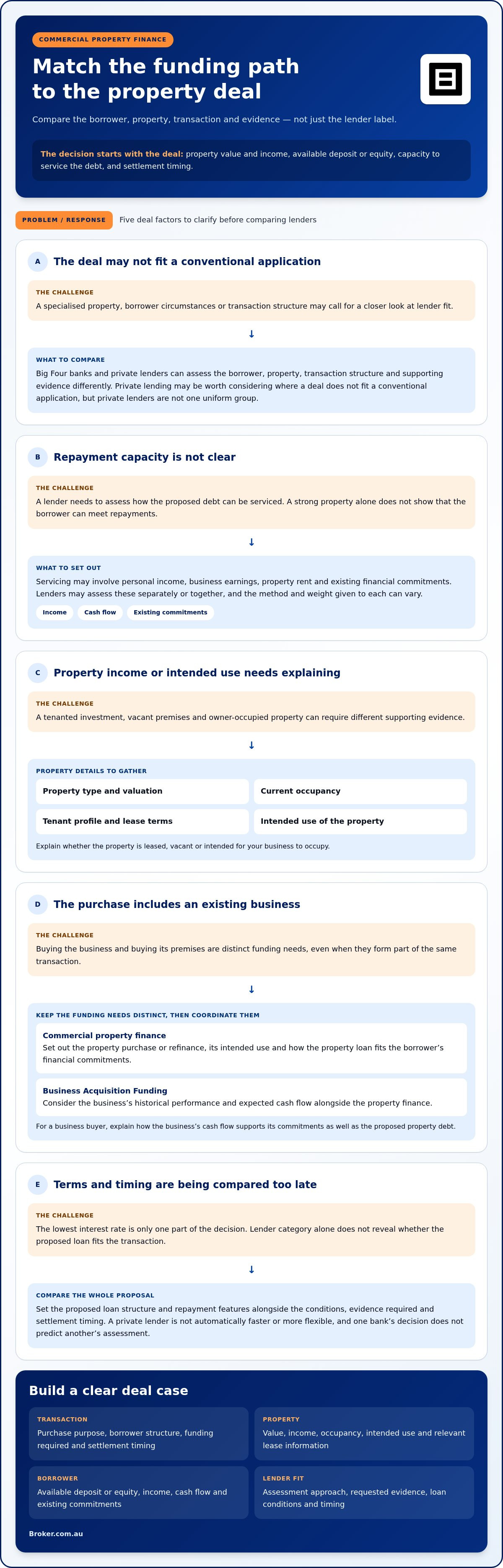
The best comparison starts with the transaction: the property’s value and income, your available deposit or equity, your capacity to service the debt and your settlement timing. If you’re also buying an existing business, you’ll need to consider the business’s cash flow and acquisition finance alongside the property loan. Comparing these needs separately, then looking at how they fit together, helps clarify the funding required.
This guide explains what Big Four banks and private lenders may assess, where their approaches can differ and what to prepare before discussing finance. You’ll be better placed to weigh costs, conditions and timing against your priorities. Broker.com.au facilitates commercial property finance applications with lenders and can help you compare options based on your transaction and borrower profile.
Key Takeaways
- Compare private lenders vs Big Four banks for commercial property by looking beyond the lender label to the deal, evidence required and proposed loan conditions.
- Prepare to explain how borrower income, business cash flow and existing commitments support loan servicing.
- Gather property details, intended use, tenancy information and lease documents to build a clear application.
- If the purchase includes an existing business, consider how Business Acquisition Funding and the business’s cash flow fit alongside the property finance.
- Set out your purchase purpose, borrower structure and funding needs before comparing lender pathways with a broker.
Table of Contents
- Private lenders vs Big Four banks for commercial property: what is the real difference?
- How banks and private lenders assess a commercial property application
- Compare private lenders and Big Four banks against the needs of your deal
- Prepare your commercial property finance application with a clear deal case
- Compare your commercial property funding options with Broker.com.au
Private lenders vs Big Four banks for commercial property: what is the real difference?
The difference isn’t simply that one lender is a bank and the other isn’t. Lenders can assess the borrower, property, transaction structure and supporting evidence differently. The best fit depends on the details of your deal. A borrower with a straightforward purchase and well-organised financial records may have different priorities from someone refinancing a specialised property or working to a tight settlement timetable.
A commercial property loan is finance used to acquire commercial real estate or secured against it. A commercial mortgage can have different structures and repayment features, so compare the proposed terms as well as the lender category. If you’re buying premises to operate your business from, explain that intended use in the property application. Buying an existing business is a separate funding need: the business purchase price and the property purchase may require distinct but coordinated finance.
What does private lending mean for a commercial property borrower?
Private lending generally means finance provided outside the major-bank channel, including by private credit providers and specialist non-bank lenders. These lenders aren’t one uniform group. Their policies, assessment methods, documentation requirements and loan conditions can differ, so the label “private” alone doesn’t show whether a lender will suit your transaction or approve an application.
Some private lenders may place greater emphasis on the property or transaction structure, while others may examine the borrower’s circumstances and repayment capacity closely. These are possible differences, not guarantees. A private lender isn’t automatically faster or more flexible in every case. The process depends on the lender, the deal’s complexity and how complete the application is.
Which institutions are known as the Big Four banks?
The Big Four is the collective name for Australia’s four largest major banks. In commercial property finance, the Big Four refers to Australia’s four largest major banks, each with its own lending criteria. Their size doesn’t mean they assess every commercial property application in the same way. A decision by one bank also doesn’t predict how another will assess your application.
For example, a borrower seeking finance for a tenanted investment property could compare how lenders consider the lease, rental income, property value and borrower’s financial position. A business purchasing premises for its own use may need to explain the intended use and how the loan fits its financial commitments. The evidence lenders request and the weight they give it can vary.
Frame the choice as a deal-fit exercise, not a contest between two labels. Compare how each pathway may suit the property, borrower, purpose and available documentation. If the transaction also includes an operating business, identify the property funding and Business Acquisition Funding needs separately. This makes it easier to compare lender criteria, conditions and timing.
How banks and private lenders assess a commercial property application
A lender doesn’t assess a property in isolation. It considers how the borrower can meet the proposed repayments, what income the property may generate and whether the requested loan fits its policies and the transaction. Two applications involving similar properties can receive different assessments if the borrowers, ownership structures, existing debts, intended use or supporting evidence differ.
How servicing and cash flow shape lender decisions
Servicing is the capacity to meet loan repayments from relevant income and cash flow. Depending on the application, a lender may consider personal income, business earnings, rent from the property and existing financial commitments. It may assess these sources separately or together. The method and weight given to each can vary by lender and deal.
A business owner buying premises, for example, may need to show how the business’s cash flow supports its commitments alongside the proposed property debt. For an investment property, lease income may be relevant, but it doesn’t necessarily replace consideration of the borrower’s wider financial position. If the purchase also involves an existing business, the funding discussion may need to include its historical performance and expected cash flow.
How the property and security can affect assessment
Property details help a lender understand the proposed security and its use. Potential considerations include property type, valuation, current occupancy, tenant profile and lease terms. A leased property with documented income requires different evidence from vacant premises or a property intended for owner occupation. The lender may also consider whether the proposed loan structure and purpose align with its commercial property criteria.
A strong property can support an application, but it doesn’t by itself show that the borrower can service the loan. Security and repayment capacity are related parts of the assessment, not substitutes for one another. This matters when a property appears attractive but the borrower has substantial existing commitments or the income supporting repayments is uncertain.
Loan-to-value ratio (LVR) describes the loan amount in relation to the lender’s assessed property value. A lender may consider LVR alongside servicing, property type and transaction details. There isn’t one threshold that applies across all lenders and commercial property deals.
Evidence requirements can differ, too. One lender may request particular financial records, lease documents or valuation information, while another may ask for different documents or assess the same information differently. Organise a clear account of income, debts, property use and tenancy so the lender can understand the deal. A broker-led commercial property finance comparison can help match those details to lender pathways, including when acquisition funding is also part of the transaction.
Compare private lenders and Big Four banks against the needs of your deal
Compare how the proposed finance fits the transaction and what evidence you’ll need to provide, rather than choosing by lender label. A straightforward purchase supported by clear records may suit a different pathway from a deal involving unusual property, a complex borrower structure or a tight settlement. The differences below are possibilities, not rules. Each lender sets its own criteria and conditions.
| Comparison point | Big Four banks | Private lenders |
|---|---|---|
| Assessment approach | Lender-dependent: may suit a well-documented application that fits the bank’s commercial lending criteria. | Lender-dependent: some may consider a different mix of borrower, property and transaction factors. |
| Documentation | Lender-dependent: evidence may need to support income, servicing, property value and intended use. | Lender-dependent: required records vary, and an alternative assessment doesn’t necessarily mean less documentation. |
| Structure and conditions | Lender-dependent: compare proposed term, repayment arrangement, security and any conditions attached to the offer. | Lender-dependent: assess the same details, including any specific conditions or restrictions that affect your plans. |
| Costs and obligations | Lender-dependent: weigh the full repayment and fee commitments, not just the headline interest rate. | Lender-dependent: consider interest, fees, repayment structure and other obligations across the proposed term. |
| Exit considerations | Lender-dependent: consider how the loan fits your longer-term ownership or refinancing plans. | Lender-dependent: if relying on a future refinance or sale, assess whether that exit plan is realistic without assuming it will be approved. |
When a Big Four bank may be worth considering
A bank pathway may be worth assessing if your income is established, your financial records are clear and the property case is well supported. A simpler transaction can be easier to present when the borrower structure, purchase purpose and repayment plan are straightforward. This doesn’t guarantee approval or better terms. The application still needs to meet the individual bank’s criteria.
When a private lender may be worth comparing
Consider comparing a private lender when a specific feature of the transaction creates a constraint. Look at whether its assessment approach addresses that issue. Don’t treat private finance as an automatic fallback after a bank declines an application. Review all conditions and fees, understand the repayment structure and test any proposed exit strategy against practical alternatives.
Buying commercial premises alongside an existing business adds another layer. Property finance and Business Acquisition Funding may need to be considered together, including the business’s cash flow and your equity contribution. When comparing private lenders vs Big Four banks for commercial property, assess the whole obligation against your priorities and risk tolerance. Broker.com.au facilitates applications with lenders and can help compare pathways based on the borrower and transaction. Explore commercial property finance options as part of your comparison.
Prepare your commercial property finance application with a clear deal case
A clear application shows how the property purchase and, where relevant, the business purchase fit together financially. Start with a funding breakdown, then gather evidence for each part of the transaction. This helps lenders assess what you’re asking them to fund and how the borrowing may be serviced.
- Define the purchase. Explain whether you’re buying premises, an operating business or both. Separate the property price from the business purchase price and identify any refinance or settlement requirements.
- Set out who is borrowing. Describe the proposed borrower and ownership structure, the buyer’s role in the business and relevant experience managing it. Include existing debts and commitments that could affect repayment capacity.
- Map the funding sources and uses. Show the equity or deposit available, the amount sought for the property and the amount needed for the business. If the purchase includes goodwill, business assets or working capital, identify those components separately. Deposit and equity needs depend on the lender and transaction.
- Build the repayment case. Explain how borrower income, property income and the target business’s cash flow may support the proposed commitments. Use evidence and forecasts that align with the purchase plan.
What information helps explain the borrower and transaction?
For the borrower, organise financial statements, income evidence, liabilities and existing loan details. For the property, include the purchase contract or refinance information, available valuation material and relevant tenancy or lease records. For the target business, gather financial statements and records that explain historical trading performance, profitability and cash flow. Lenders may also seek a business plan and forecasts showing how you intend to manage the business after completion. The precise evidence required varies by lender and deal.
How buying a business can change the funding picture
Commercial property finance addresses the premises, while Business Acquisition Funding supports the purchase of an existing business. Depending on the transaction and lender, Acquisition finance may need to account for goodwill, assets or working capital as well as the buyer’s contribution. Don’t assume the property loan will fund these business components.
As a Business buyer, prepare a purchase-price breakdown and show how the target business’s trading history informs your cash flow forecasts and servicing plan. Explain how you’ll operate the business, meet its ongoing obligations and manage the proposed debt. A lender may assess the business’s past financial performance alongside your own financial position. The evidence and assessment approach can vary. If you’re Buying a business and its premises together, coordinate the funding requests and explain how each part supports the overall acquisition.
A well-supported deal case gives lenders a clearer view of both the property and business purchase. Broker.com.au facilitates applications for commercial property finance and Business Acquisition Funding. Discuss your commercial property finance application with your transaction details and funding breakdown ready.
Compare your commercial property funding options with Broker.com.au
Once you’ve set out the property, borrower and purpose, compare funding pathways against the actual deal. Broker.com.au acts as a finance intermediary, facilitating applications with lenders rather than lending directly. A broker-led comparison can connect the details of your transaction with relevant lender options, including when a purchase or refinance has features that need careful explanation.
The comparison should reflect your priorities as well as the application. An investor refinancing a tenanted property may focus on the lease, existing loan and future plans. A business acquiring its premises may need to explain the intended use and how repayments fit with the business’s financial position. If you’re also buying an existing business, consider the property loan and Business Acquisition Funding together, without assuming one facility will cover both.
What to expect when discussing a commercial property transaction
Start with the essentials: what the property is, whether you’re purchasing or refinancing, who will borrow, how the property will be used and your preferred funding timeline. Outline the deal’s strengths and constraints, such as available equity, existing commitments, tenancy details or a purchase involving an operating business.
These details help shape a lender comparison around your circumstances rather than a generic checklist. Broker.com.au uses proprietary AI technology to support the preparation of quick and accurate loan applications. Clear information about the transaction supports that preparation, while lender criteria and application outcomes remain specific to the lender and deal.
Choose a next step that fits your funding objective
For a purchase, be ready to outline the property, intended use, borrower structure and how the purchase is being funded. If premises form part of a business purchase, describe the property component separately from the business and its cash flow needs. This gives the funding discussion a clearer view of the overall transaction.
For a refinance, summarise the current loan arrangements, the property and your objectives for changing the finance. Your priorities may include aligning repayments with cash flow, reviewing the loan structure or planning for a future transaction. A clear objective makes it easier to compare options against what you need the finance to achieve.
The choice between private lenders vs Big Four banks for commercial property depends on how the borrower profile, property, evidence and transaction fit each lender’s approach. You don’t need to have every detail resolved before beginning a discussion. A well-organised summary is a practical starting point, and options can be considered in light of your funding objective.
If you’re weighing commercial property finance alongside acquisition needs, I’m interested in exploring my options.
Turn your funding priorities into a clear next step
Turn your priorities into a practical funding brief: what the property needs to do, how the borrowing fits your finances and which conditions matter most to you. This gives a lender comparison a clear purpose instead of making the decision on a label alone. The right pathway for private lenders vs Big Four banks for commercial property is the one that aligns with your transaction and can be assessed against your needs.
Broker.com.au arranges commercial property loans for acquisitions and refinances, and provides Business Acquisition Funding when a purchase includes an existing business. As a finance intermediary, Broker.com.au facilitates applications with lenders and uses proprietary AI technology to support quick and accurate application preparation. This helps bring the key details of a transaction together without promising a particular lending outcome.
Whether you’re planning a purchase, considering a refinance or coordinating property finance with a business acquisition, start a tailored discussion about your objectives and circumstances. I’m interested in exploring commercial property finance. A clear first step can make a complex funding decision more manageable.
Frequently Asked Questions
Is a private lender always faster than a Big Four bank?
No, a private lender isn’t always faster. Timing depends on the lender’s process, the transaction’s complexity and how quickly you can provide the required information. A purchase involving several borrowing entities or incomplete property records, for example, may take longer to assess than a well-prepared application through a bank. If settlement timing matters, include the key dates in your funding brief and compare the likely process as well as the lender type.
Can a Big Four bank finance any type of commercial property?
No, a Big Four bank’s appetite for a property depends on its own criteria and the application. Property type, condition, intended use, occupancy and available valuation information may all be relevant. A specialised property or unusual use may call for closer assessment than a conventional office or warehouse. Describe the asset accurately and consider whether its characteristics align with the lender’s commercial property approach before committing to a funding plan.
How much deposit do I need for a commercial property loan?
There isn’t one deposit amount that applies to every commercial property loan. The equity contribution can depend on the lender’s assessment of the property, borrower, transaction and proposed loan. Allow for other purchase funding needs, too, rather than assuming the deposit is your only cash requirement. Prepare a clear account of your available equity and its source, then compare how lenders assess the full funding position.
Can I refinance from a private lender to a bank later?
It may be possible, but future refinancing isn’t assured. A bank will assess your circumstances and the property when you apply, including repayment capacity, outstanding commitments and the property’s current position. If refinancing is part of your plan, set out what would need to change before that step and consider what you’d do if it takes longer than expected or isn’t available. Don’t rely on an unapproved refinance as your only exit plan.
What happens if a Big Four bank declines my commercial property application?
A decline doesn’t mean every lender will reach the same decision, but it doesn’t guarantee another pathway will be available. First, identify the reason, such as servicing, property suitability, documentation or transaction structure. Then address any information gaps and reassess the request against your priorities. A broker can help compare lender pathways using the application details, rather than simply resubmitting the same case without changes.
Is commercial property finance separate from business acquisition finance?
They can be separate funding needs, even when the property and business are part of one purchase. A buyer may need finance for premises as well as funding for the operating business, its goodwill or assets. Prepare a breakdown of what each amount will fund and how cash flow will support the resulting obligations. Coordinating the applications makes the overall transaction clearer without assuming one loan will cover everything.
Do all private lenders assess commercial property applications the same way?
No, private lenders don’t use one shared assessment approach. Their policies, evidence requirements and views of property security, borrower capacity and transaction structure can differ. One lender may suit a particular property or funding purpose, while another may assess the same case differently. Compare the specific proposed conditions and information requested, and don’t assume a lender will approve an application simply because another lender has declined it.