
What if the purchase price isn’t the main reason your business acquisition loan stalls? The common mistakes in business acquisition loans often start earlier: relying on turnover instead of evidenced cash flow, misjudging the equity needed, or overlooking funds for goodwill, assets and transition working capital. If you’re buying a business, it’s understandable to be unsure what lenders will expect and whether the business can support repayments.
A stronger funding case brings together evidence about the business and the buyer, rather than starting with a borrowing target. This guide explains how to avoid key Business Acquisition Funding missteps, assess serviceability and equity, and prepare information lenders need to evaluate a purchase. It also covers the full funding requirement and ways to compare acquisition finance structures. With a clearer view of the risks before you commit, you can make more informed decisions about the target business, funding approach and next steps.
Key Takeaways
- Spot common mistakes in business acquisition loans, including relying on seller figures without checking them against supporting records.
- Assess how the target’s cash flow may support repayments, alongside the deposit and equity you can contribute.
- Compare secured and unsecured acquisition finance based on the purchase, available security and your circumstances as a business buyer.
- Review the sale terms, assets, liabilities and working capital needs before presenting your funding request.
- Business Acquisition Funding can be structured around the purchase, including goodwill, assets and transition working capital.
Table of Contents
- Business acquisition loans: why the purchase needs its own funding plan
- Common business acquisition loan mistakes that weaken an application
- Compare acquisition finance options before choosing a structure
- A practical pre-application checklist for buying a business
- How Broker.com.au supports business acquisition funding
Business acquisition loans: why the purchase needs its own funding plan
A promising business can move quickly, but arranging finance takes careful preparation. The challenge is to match the opportunity with a funding plan that is financeable and sustainable after settlement. A borrowing figure based only on the seller’s asking price can miss parts of the transaction or leave too little cash for the handover.
Business acquisition finance is funding arranged to purchase an existing business and relevant assets, with the structure shaped by the transaction and the buyer’s circumstances. Unlike finance for ordinary operating expenses, it centres on the purchase and the evidence supporting the value, structure and repayment plan. Common mistakes in business acquisition loans often begin when buyers treat the deal as a simple extension of day-to-day business funding.
Lenders assess the buyer, proposed purchase structure and target business’s financial evidence together. They may consider how the purchase is documented, what is being acquired and whether the trading information supports the proposed repayments. Requirements vary between lenders and transactions, so no single checklist or structure applies to every deal.
What an acquisition loan may need to fund
The purchase may involve more than physical assets. A funding plan could also need to account for goodwill and transition working capital to help meet cash needs as ownership changes. Set out each requirement clearly rather than combining everything in one unexplained figure.
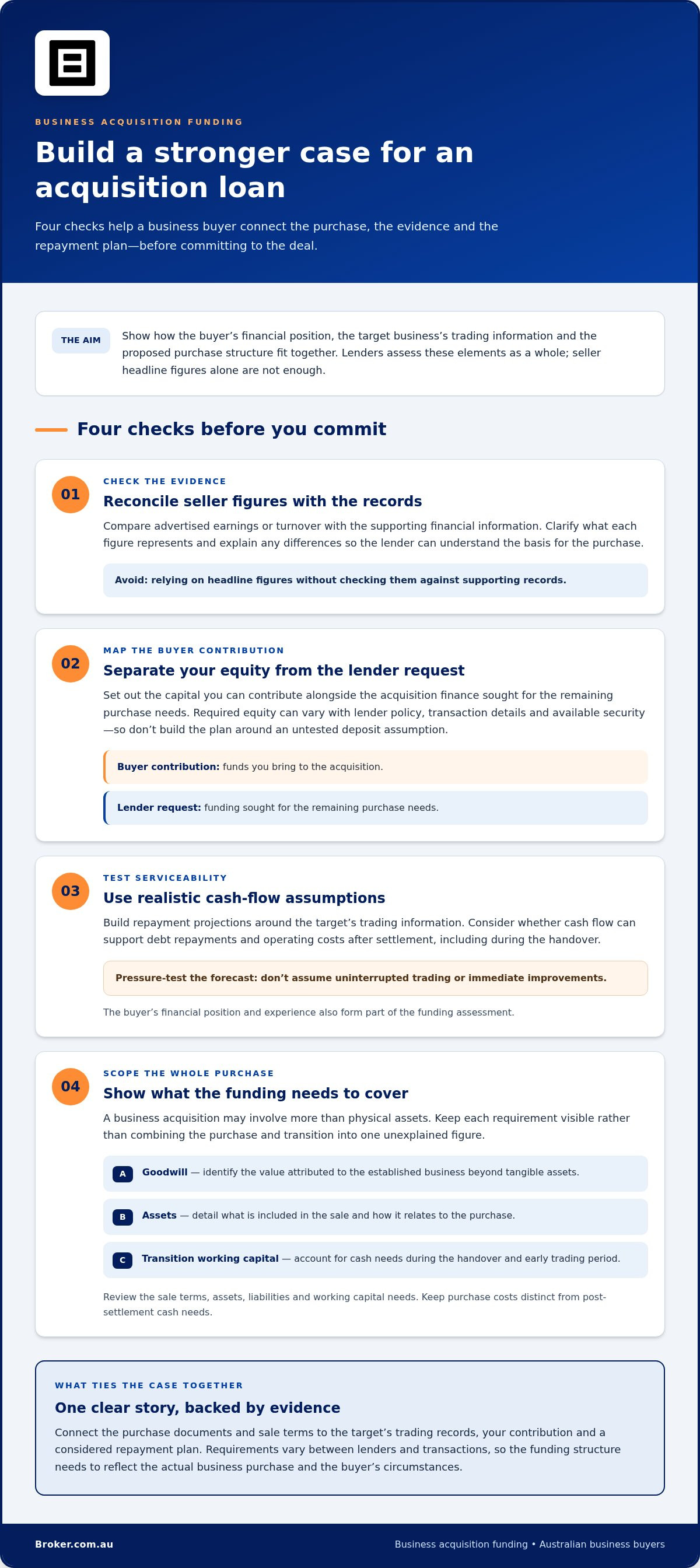
- Goodwill: Identify the amount attributed to the business’s established value beyond its tangible assets.
- Assets: Detail the assets included in the sale and how they relate to the purchase.
- Transition working capital: Estimate the cash needed to support the handover and early trading period.
Separate purchase costs from post-settlement cash needs. This shows whether the proposed funding addresses the transaction while leaving a considered plan for the transition. For example, list the assets included in the sale separately from the cash needed to support the business as you take over. Keeping these components distinct also makes the funding request easier to explain.
Why a business purchase is assessed differently
Buying a business involves two connected assessments: the buyer’s capacity to take on the purchase and the target’s ability to support the proposed debt. The funding case is stronger when purchase documents, sale terms and trading records tell a consistent story. Explain how the agreed structure relates to the business information supplied instead of relying on the seller’s headline figures alone.
Prepare evidence that helps a lender understand both sides of the transaction. The buyer’s financial position and experience form part of the picture, while the target’s trading information helps demonstrate the basis for servicing the debt. Present assumptions clearly, including how cash flow may change during the handover. A tailored Business Acquisition Funding plan connects these details to the actual purchase rather than treating the deal like generic borrowing.
Common business acquisition loan mistakes that weaken an application
A purchase can look viable on paper but become difficult to fund when the evidence, buyer contribution and repayment assumptions don’t align. These common mistakes in business acquisition loans can leave a lender with unanswered questions or reveal a cash shortfall after you have committed to the transaction. Treat each figure as something to substantiate, not just a number in the sale proposal.
- Using headline seller figures without reconciling them to records. If advertised earnings or turnover don’t match the supporting financial information, a lender may be unable to rely on the figures used to explain the purchase. Reconcile differences and clarify what each figure represents.
- Underestimating the buyer contribution. Planning around an assumed deposit can leave a gap if the required equity, transaction details or available security don’t fit the proposed structure. The shortfall may emerge after you have started progressing the deal.
- Overstating servicing capacity. Forecasts that assume uninterrupted trading or immediate improvements can understate repayment pressure. If actual cash flow is weaker, the business may struggle to meet debt commitments and operating costs.
Underestimating equity, deposit and purchase contribution
The buyer’s contribution is the capital they bring to the acquisition; the lender request is the funding sought for the remaining purchase needs. These figures are connected, but they aren’t interchangeable. Required equity can vary with lender policy, transaction details and available security. Before committing funds, map the complete acquisition funding plan and allow for the transition.
Show how your contribution fits alongside the proposed finance. This can reveal a funding gap early instead of relying on an untested assumption about how much a lender may provide. Distinguish funds available for the purchase from cash you expect to need once the business changes hands.
Overlooking servicing and the target’s cash flow
Acquisition servicing depends on evidence, realistic assumptions and lender assessment, not the seller’s forecast alone. Build projections around the target’s trading information and consider whether cash flow can support repayments while the business continues operating after settlement. A purchase may appear affordable based on its price but leave too little cash for operating needs once debt commitments begin.
Test how the plan responds if revenue softens, expenses increase or planned improvements take longer than expected. Treat seller forecasts as assumptions to assess, not guaranteed future performance. Explain the basis for key projections and distinguish existing trading results from changes you intend to make as the new owner.
Keep the funding request consistent with the sale terms, buyer contribution and expected cash flow. Broker.com.au arranges tailored business acquisition funding to help buyers present their purchase requirements and funding needs.
Compare acquisition finance options before choosing a structure
No single funding structure suits every business purchase. Start by considering what the transaction needs to fund, what you can contribute and whether security is available. Compare how each option fits the whole acquisition rather than choosing based on one feature. Terms, eligibility and lender requirements depend on the transaction and lender assessment.
| Funding pathway | Potential purpose | Buyer considerations |
|---|---|---|
| Secured business loan | May support acquisition funding where acceptable collateral forms part of the lending assessment. | Consider what security may be required, the associated obligations and how much equity you can contribute. |
| Unsecured business loan | May be considered for an acquisition without relying on specific collateral, subject to lender assessment. | Suitability depends on the buyer, transaction and lender’s requirements. Compare the proposed terms and repayment impact. |
| Funding for purchase components | May be structured around elements such as goodwill, assets or transition working capital. | Set out each component separately. A lender may assess parts of the transaction differently. |
Secured and unsecured acquisition funding
A secured pathway involves borrowing supported by collateral, subject to the lender’s assessment of the security and the overall deal. An unsecured option doesn’t rely on specific collateral in the same way, but it won’t necessarily suit every buyer or transaction. Compare the security offered, your willingness to provide it, the contribution available and the repayment plan. Neither pathway is automatically preferable.
Match funding to goodwill, assets and working capital
Separate the business purchase from assets transferring as part of the sale, and identify any goodwill component. Then plan for transition working capital alongside the acquisition amount. These are distinct needs, even if they form part of one overall funding request. Present the transaction clearly and don’t assume goodwill or every requested cost will be treated alike by lenders.
For an Australian purchase, consider how your contribution, available security and the target’s cash flow fit the funding structure. This can help avoid common mistakes in business acquisition loans, such as comparing options without accounting for what the transaction requires. Match the proposed structure to the deal rather than relying on a generic borrowing template.
Broker.com.au arranges Business Acquisition Funding and helps structure and present requests across relevant lender options. Explore tailored business acquisition funding to consider how goodwill, assets and working capital may fit your purchase plan.
A practical pre-application checklist for buying a business
A clear funding case brings the purchase documents, your contribution and the target’s cash-flow assumptions into one consistent picture. Work through the review in order, from understanding the transaction to presenting the funding request. This won’t guarantee approval, but it can help surface gaps before they complicate discussions or affect your purchase plans.
Review the business and transaction evidence
The core documents provide evidence for assessing what’s being purchased and how you may repay the proposed funding. Organise the available records and compare them with the seller’s claims. If figures don’t reconcile, note the difference and identify what information could explain it. Keep unresolved questions visible rather than presenting assumptions as established facts.
- Gather the business information: Organise available financial statements, Business Activity Statements and other trading or operational records relevant to the target.
- Review the sale terms: Map what the proposed agreement says is included in the purchase and how the transaction is structured.
- List assets and liabilities: Identify the assets transferring with the business and any liabilities or obligations relevant to the deal.
- Record transition needs: Note what may be required to support the handover, including working capital, and separate these needs from the purchase components.
Build a realistic funding and cash-flow picture
Bring the purchase price, your contribution, proposed funding and post-settlement working capital into one plan. This shows how the parts fit together and whether the business may have capacity to operate while meeting repayments. Don’t rely on optimistic seller projections alone. Make the basis for each assumption clear, especially where expected trading changes form part of your plan.
- Map the funding requirement: Set out the purchase components and transition needs, then show your contribution and the amount sought from a lender.
- Model repayments: Include proposed debt repayments alongside the target’s expected cash flow and ongoing operating needs.
- Test plausible changes: Consider how the plan could respond if revenue softens, costs increase or planned improvements take longer than expected. Avoid unsupported benchmark figures.
- Check consistency: Make sure the sale terms, funding request, buyer contribution and cash-flow assumptions agree across the application materials. Explain any remaining uncertainties.
For a business buyer, this preparation turns a collection of documents into a coherent view of the transaction and its financial demands. It can also reduce common mistakes in business acquisition loans, such as submitting figures that don’t match or overlooking cash needed after settlement. Keep a record of open questions as the purchase progresses.
Prepare your purchase information for a tailored business acquisition funding discussion with Broker.com.au.
How Broker.com.au supports business acquisition funding
Buying an existing business involves a specific transaction, not just a borrowing request. Broker.com.au is a finance broker that arranges Business Acquisition Funding, rather than lending directly. It helps structure and present a funding request across relevant lender options based on the purchase and the buyer’s circumstances.
Funding needs differ from deal to deal. A purchase may include goodwill and assets, while the incoming owner may also need working capital to manage the transition. Broker.com.au helps bring these elements into a considered funding plan instead of treating the acquisition as a generic business loan. The proposed structure remains subject to the lender’s assessment of the transaction and buyer.
A funding conversation centred on the purchase
Start by outlining the business you’re buying, the proposed sale structure and what the agreed purchase includes. Share the supporting information you’ve gathered, along with any gaps or assumptions that need attention. This gives the funding discussion a practical foundation and helps clarify which parts of the request relate to the purchase, assets or transition needs.
Your contribution and the amount sought from a lender are also central. Be ready to discuss the deposit or equity available, any security relevant to the proposal, and how you expect the business to service repayments after settlement. The target’s cash flow matters alongside your own financial position. If projections rely on changes to trading, explain the assumptions and distinguish expectations from existing performance.
These details help shape how the request is presented, but they don’t predetermine a lender’s decision. Requirements, eligibility and possible structures vary with the buyer and transaction. Addressing the evidence and assumptions directly can help avoid common mistakes in business acquisition loans, such as a funding request that doesn’t match the sale terms or overlooks the handover period.
Technology to support the application process
Broker.com.au uses proprietary AI technology to support quick and accurate loan applications. The technology supports the application process, while the substance of the funding case still depends on relevant information about the buyer, purchase and target business. Clear, consistent records give the broker a stronger foundation for presenting the proposed acquisition finance.
Before discussing the opportunity, bring together the sale information, the target’s available trading records, your proposed contribution and a clear breakdown of funding needs. You don’t need to have every assumption resolved before starting a conversation, but identifying open questions makes it easier to discuss their implications for the transaction and proposed structure.
A well-prepared case can make lender discussions more focused and keep decisions grounded in the purchase rather than optimistic assumptions. If you’re considering an acquisition, take a considered next step and I’m interested in discussing business acquisition funding.
Take your acquisition plans forward with clarity
Turn your interest in a business into a funding conversation grounded in the specific opportunity. Before making commitments, consider what information is outstanding, which assumptions could change and how the proposed purchase fits your longer-term plans as a business buyer. Keeping those questions visible can help you make deliberate decisions as the transaction develops.
Common mistakes in business acquisition loans are easier to address when the funding request reflects the deal rather than an assumed borrowing target. A focused conversation about your acquisition plans can bring the purchase requirements and your priorities into view without treating any outcome as guaranteed.
Broker.com.au arranges Business Acquisition Funding for Australian buyers. Its proprietary AI technology supports quick and accurate loan applications, while the funding approach can be tailored to the purchase. Take the next step and explore business acquisition funding.
With a well-prepared case and the right questions in view, you can move towards your purchase with greater confidence.
Frequently Asked Questions
How long can business acquisition finance take to arrange in Australia?
There’s no fixed timeframe for arranging acquisition finance in Australia. The process depends on the transaction’s complexity, how complete the purchase information is and the lender’s assessment. An unclear sale structure or missing financial records, for example, may prompt further questions and affect progress. Start funding discussions early, allow time to provide requested information and don’t assume finance will be ready by a particular settlement date.
Can I apply for acquisition finance before signing a business purchase contract?
Yes, you can discuss a potential purchase and funding needs before signing a contract. Early conversations can help identify information a lender may need and clarify your proposed contribution and funding request. A lender’s formal assessment may require transaction documents, so early discussions aren’t the same as final approval. Before signing, understand the contract’s terms and seek appropriate legal advice about conditions, timing and your obligations.
What happens if due diligence reveals liabilities in the business I want to buy?
Pause and establish what the liabilities relate to and how the proposed transaction treats them. An outstanding supplier balance, for example, may affect the deal differently depending on its structure and agreed terms. Discuss the finding with your legal and accounting advisers, then update your purchase assumptions and funding request as needed. Give your broker and lender accurate, current information rather than relying on figures that no longer reflect the transaction.
How do lenders assess goodwill when financing a business acquisition?
Lenders may assess goodwill in light of the purchase details and evidence supporting the business’s value. Their approach varies by lender and transaction, and a seller’s goodwill figure alone may not explain how it was reached. Be ready to show the basis for the amount and provide relevant records that help explain the business’s trading and proposed purchase allocation. The lender’s assessment determines how goodwill is considered in a funding request.
Can a newly established company borrow to buy an existing business?
A newly established company may seek acquisition finance, but without a trading history, the wider evidence becomes especially important. An assessment may consider the buyer’s financial position and experience, the target’s trading information, the proposed contribution and the transaction structure. Lender policies differ, so forming a company doesn’t by itself establish eligibility or repayment capacity. Prepare a clear explanation of who will own and operate the acquired business.
Does buying a business mean I take on the seller’s existing debts?
Not automatically. How existing debts are treated depends on the transaction structure and sale documents. The treatment may differ depending on whether the purchase involves company ownership or specified business assets, so don’t assume liabilities transfer or remain with the seller. Ask your legal adviser to explain the agreement’s effect before committing. Disclose relevant liabilities in funding discussions, as they may change the purchase assumptions or the business’s expected cash needs.
What information should a business buyer prepare for an acquisition finance discussion?
Prepare a concise deal brief covering the business, proposed purchase structure, available sale documents and what the price includes. Add the target’s financial records, an asset and liability schedule, your proposed contribution and a cash-flow forecast that includes repayments. Identify which figures are confirmed and which remain assumptions. An organised, transparent pack helps address common mistakes in business acquisition loans, such as unexplained figures or inconsistent versions of the transaction.