
Could the very debt that keeps you awake at night actually become the catalyst for your next major expansion? For the ambitious business buyer, the weight of overwhelming debt servicing costs and the fear of breaching bank covenants often feel like insurmountable barriers to growth. It’s natural to feel that negotiating with major Australian banks is a daunting, complex hurdle that stalls your momentum. However, a well-executed business loan restructuring agreement isn’t a sign of distress; it’s a strategic tool used by savvy investors to protect cash flow and secure necessary acquisition finance.
In this guide, we’ll master the nuances of debt realignment to help you achieve a sustainable repayment schedule and an improved debt-to-equity ratio. You’ll discover how to position yourself for Business Acquisition Funding even when your current balance sheet feels crowded. We’ll walk through the essential lender requirements for buying a business and how to leverage professional insights to turn a restrictive financial situation into a flexible foundation for your next business acquisition. By the end, you’ll have the clarity needed to approach lenders with confidence and secure the capital required for future growth.
Key Takeaways
- Learn how a formal business loan restructuring agreement serves as a strategic pivot for turnaround opportunities, allowing you to modify debt terms to suit your specific acquisition goals.
- Discover how to optimise your cash flow through tailored repayment schedules and interest rate adjustments, ensuring the target business remains viable and profitable post-purchase.
- Understand how to leverage Business Acquisition Funding to retire high-interest legacy debt and improve the company’s debt-to-equity ratio for future growth.
- Master a step-by-step framework for conducting a comprehensive financial audit and developing a compelling business case that aligns with the lender’s risk appetite.
- Identify the critical difference between transactional brokers and corporate advisors when accessing specialty finance for complex restructures that fall outside traditional banking rules.
Table of Contents
- What is a Business Loan Restructuring Agreement?
- Key Components of a Debt Restructuring Agreement
- Restructuring for Business Acquisition and Growth
- Negotiating the Agreement: A Step-by-Step Framework
- Why a Specialist Broker is Essential for Restructuring
What is a Business Loan Restructuring Agreement?
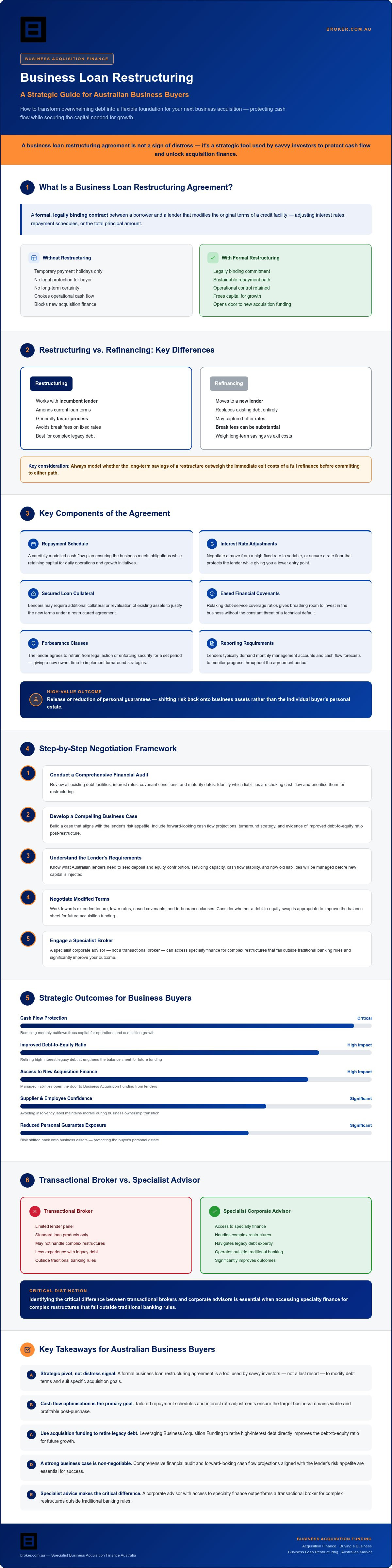
A business loan restructuring agreement is a formal, legally binding contract between a borrower and a lender that modifies the original terms of a credit facility. It’s far more than a simple handshake or a temporary reprieve. This document provides a structured framework to adjust interest rates, repayment schedules, or even the total principal amount. For an Australian business buyer, it’s often the difference between a failing enterprise and a viable acquisition. It moves the conversation from a position of distress to a strategic plan for growth.
Many buyers encounter targets with legacy debt that threatens to choke operational cash flow. While a bank might offer a temporary payment holiday, these informal arrangements lack the legal protection and long-term certainty of a formal agreement. A binding business loan restructuring agreement ensures that both parties are committed to a sustainable path forward. It often serves as the essential first step in securing Business Acquisition Funding, as lenders need to see that old liabilities are managed before they feel comfortable injecting new capital into the venture.
The Purpose of Restructuring in the Australian Market
In the local lending landscape, restructuring is primarily about financial agility. By extending loan tenures, a business buyer can significantly reduce monthly outflows, freeing up capital for essential upgrades or marketing. In more complex scenarios, you might negotiate a debt-to-equity swap or a lower interest rate to balance the books. This proactive approach helps the entity avoid the insolvency label, which is critical for maintaining supplier relationships and employee morale during a transition. It allows the new owner to maintain operational control while the business regains its financial footing.
Restructuring vs. Refinancing: Key Differences
While they sound similar, the mechanics of these two paths differ. Refinancing involves moving to a new lender to replace existing debt entirely, often to capture better rates or access more Acquisition finance. Restructuring usually involves working with the incumbent lender to amend current terms. Staying with your current bank can be faster, but you must weigh this against the costs of breaking existing contracts in Australia. Fixed-rate break fees can be substantial. It’s vital to model whether the long-term savings of a restructure outweigh the immediate exit costs of a full refinance. When buying a business, understanding these nuances ensures your capital is deployed where it matters most.
Key Components of a Debt Restructuring Agreement
Every successful restructure relies on a precise, legally sound document that balances the needs of the lender with the operational realities of the business. A business loan restructuring agreement serves as this blueprint. It outlines the specific modifications made to the original debt, ensuring that the new terms are sustainable for the long term. For a business buyer, the most critical element is the repayment schedule. This isn’t just a list of dates; it’s a carefully modelled cash flow plan that ensures the target company can meet its obligations while still having enough capital to fund daily operations and growth initiatives.
Interest rate adjustments also play a central role. You might negotiate a move from a high fixed rate to a variable rate, or perhaps secure a “rate floor” that protects the lender while giving you a lower entry point. How Secured Business Loans are treated is equally vital. Lenders will often require additional collateral or a revaluation of existing assets to justify the new terms. By easing financial covenants, such as debt-service coverage ratios, the agreement allows you the breathing room to invest in the business without the constant threat of a technical default. If you’re unsure how these clauses apply to your specific acquisition, speaking with an expert advisor can clarify your position.
Essential Clauses for Business Buyers
A robust agreement includes forbearance clauses, where the lender agrees to refrain from taking legal action or enforcing security for a set period. This window is essential for a new owner to implement turnaround strategies. You’ll also encounter strict reporting requirements. Lenders typically demand monthly management accounts and cash flow forecasts to monitor progress. Perhaps the most sought-after outcome for many buyers is the release or reduction of personal guarantees, shifting the risk back onto the business assets rather than your personal estate.
Managing ATO Debt within the Agreement
Integrating Australian Taxation Office (ATO) obligations into your bank restructure is a sophisticated move that requires careful timing. Lenders view significant tax debt as a primary risk factor during a business acquisition because the ATO has powerful recovery mechanisms. Negotiating a remission of the General Interest Charge (GIC) as part of a broader payment plan can save thousands. A well-aligned business loan restructuring agreement demonstrates to the bank that you’ve accounted for all creditors, including the taxman, which significantly increases your chances of securing the necessary approvals for your purchase.
Restructuring for Business Acquisition and Growth
For an ambitious business buyer, restructuring is less about survival and more about scalability. Many targets in the Australian market possess strong underlying operations but are held back by poorly structured debt. By implementing a formal business loan restructuring agreement before or during the sale, you transform a risky prospect into a “bankable” asset. This process often involves using Business Acquisition Funding to retire high-interest legacy loans, effectively lowering the cost of capital from day one. It’s a strategic move that turns a cluttered balance sheet into a streamlined foundation for the new owner.
Lenders typically expect a business buyer to bring significant skin in the game. While deposit requirements vary, you’ll often need 20% to 30% equity, depending on the industry and the strength of the target’s balance sheet. It’s common for new Acquisition finance to be entirely contingent on the successful execution of a debt restructure. Banks want to see a clean slate where the new owner isn’t immediately crippled by the previous owner’s financial missteps. This ensures that the capital provided is used to drive value rather than simply plugging old holes.
Buying a Distressed Business: The Restructure Playbook
When you identify a distressed target, your first move is evaluating the debt-to-equity ratio. If the business is over-leveraged, the restructuring agreement becomes your primary negotiation lever. You can often argue for a lower purchase price by highlighting the cost and effort required to realign the debt. Crucially, your deal structure must include enough working capital to sustain the business through the post-acquisition transition. Successful buyers don’t just fund the purchase; they fund the turnaround by ensuring the new debt profile matches the company’s actual earning capacity.
Servicing and Cash Flow Considerations
In 2026, lenders are placing even greater emphasis on the Debt Service Coverage Ratio (DSCR). Most Australian banks look for a DSCR of at least 1.25x, meaning the business generates $1.25 in operating income for every $1 of debt obligation. Robust financial modelling is your best tool here. You must demonstrate that the proposed restructure leads to a healthy, sustainable cash flow. This data-driven approach proves to the lender that the business can comfortably service its new commitments while leaving room for reinvestment. Without this proof, securing the necessary funding for a business acquisition becomes significantly more difficult.
Negotiating the Agreement: A Step-by-Step Framework
Negotiating a business loan restructuring agreement requires a blend of clinical financial data and strategic storytelling. You aren’t just asking for a favour; you’re presenting a superior alternative to a default. For a business buyer, this framework ensures that the lender views you as a partner in recovery rather than a risk to be managed.
Step 1: Conduct a comprehensive financial audit. You must understand every cent of debt, including aged payables and ATO portals. This forensic look at the last three years of tax returns and current management accounts provides the baseline for all future negotiations. You can’t fix what you haven’t measured, so accuracy here is non-negotiable.
Step 2: Develop a “Business Case for Restructure”. This document must pivot the conversation from the business’s past failures to its future potential under your leadership. It highlights how the restructure preserves the lender’s capital more effectively than a forced liquidation or a fire sale.
Step 3: Engage a specialist broker. This provides “inside access” to the actual decision-makers in the credit department, bypassing the gatekeepers who only see a balance sheet. If you’re ready to begin this process, you can discover more through our expert advisory team today.
Step 4: Present the proposal. Focus on long-term servicing and how you’ll protect the bank’s assets. Your presentation should include a detailed forecast of your debt-service coverage ratio to prove the new terms are sustainable in the current market.
Step 5: Finalise the legal documentation. Once the agreement is signed, strict compliance monitoring begins. This builds the track record needed for future growth and additional Acquisition finance down the line.
Addressing Lender Objections
Banks often ask why they shouldn’t just call in the loan immediately. Your response must be grounded in transparency and data. By adopting an “Expert Guide” approach, you show them that a fire sale would result in a significant loss, whereas your turnaround plan ensures full repayment over time. Using secondary collateral, such as equity in other commercial property, can provide the additional security needed when buying a business. This often tips the scales in your favour, turning a hesitant lender into a supportive partner.
The Role of AI in Speeding Up Approvals
Broker.com.au uses proprietary AI technology to streamline what has traditionally been a slow, manual process. Our system matches your specific scenario with the lenders most likely to approve a restructure based on their current risk appetite. This significantly reduces the “stress-test” anxiety often felt by a business buyer. By using accurate financial modelling, we ensure your application is submitted correctly the first time. This efficiency allows you to move quickly and decisively in a competitive acquisition environment, securing the target before other buyers can react.
Why a Specialist Broker is Essential for Restructuring
A transactional broker typically focuses on simple outcomes, such as finding the lowest interest rate for a standard mortgage. In contrast, a corporate advisor acts as a high-level fixer who understands the intricate legal and financial mechanics of a business loan restructuring agreement. This distinction is critical when you’re buying a business with a complex debt profile. A specialist broker provides the “inside access” needed to reach decision-makers at over 100 lenders, including specialty finance providers who look beyond the rigid rules of traditional big banks. They ensure the new debt structure doesn’t just solve an immediate cash flow crisis but aligns perfectly with your five-year growth strategy.
The broker’s role is to manage the inherent tension between the business buyer, the vendor, and the lender. Each party has different priorities during a restructure. The bank wants security, the seller wants a clean exit, and you want a sustainable path to profitability. By acting as an expert guide, a broker facilitates these high-stakes negotiations, ensuring that the final agreement protects your interests while satisfying the lender’s risk requirements. This professional oversight is what transforms a high-stress turnaround into a streamlined, successful acquisition.
Expertise in Business Acquisition Funding
Navigating the unique requirements of M&A finance in Australia requires a tailored approach that generalist brokers often lack. Whether you are buying a medical practice, a transport firm, or a manufacturing plant, the specific industry nuances dictate how a lender views your application. Acquisition finance is rarely a one-size-fits-all product. An award-winning broker understands the deposit and equity requirements specific to your sector and can structure your funding to include essential working capital. This level of specialisation ensures a stress-free experience, allowing you to focus on the operational transition while your finance team handles the heavy lifting with the banks.
Next Steps: Moving from Interest to Action
Taking the first step toward realigning your debt doesn’t have to be a high-pressure event. We utilise a low-pressure “I’m interested” approach, which allows you to start a conversation with our specialists without any immediate impact on your credit score. Before your first consultation, you should prepare your current management accounts, a summary of existing debt, and a brief outline of your acquisition goals. This preparation helps us provide immediate, actionable insights into your eligibility for Business Acquisition Funding. When you’re ready to secure your company’s future, our team is here to lead the way.
I’m interested in a business debt restructure
Empower Your Next Acquisition through Strategic Realignment
Realignment of existing debt is the most effective way to transform a distressed target into a high-growth asset. By focusing on sustainable repayment schedules and improving your debt-to-equity ratio, you create the financial headroom required for a successful business acquisition. A robust business loan restructuring agreement serves as the cornerstone of this transformation, protecting your cash flow while satisfying the stringent requirements of Australian lenders. It’s about moving from a state of financial uncertainty toward a position of streamlined confidence.
As Award-Winning Finance Brokers, we provide inside access to over 100 lenders and offer deep expertise in complex Business Acquisition Funding. Our team acts as your expert guide, managing the intricate negotiations with major banks so you can focus on the operational success of your new venture. We specialise in situations that fall outside the norm, ensuring you’re always in good hands. You don’t have to manage these high-stakes decisions alone.
I’m interested in exploring business loan restructuring
Your journey toward a more profitable and stable business starts with a single conversation. We’re ready to help you unlock the full potential of your next purchase and ensure your growth strategy remains on track.
Frequently Asked Questions
What is the main difference between debt restructuring and refinancing?
Debt restructuring involves amending the terms of your current facility with your existing bank, whereas refinancing means moving the debt to a new lender entirely. A business loan restructuring agreement is a strategic choice when you want to avoid the costs of breaking existing contracts. It’s a common tool for a business buyer to stabilise a company before seeking more competitive Acquisition finance later. This process ensures the target is viable before approaching new lenders.
Will a business loan restructuring agreement affect my credit score?
Entering into a business loan restructuring agreement might be recorded on your commercial credit report, but it’s often seen as a responsible step toward financial health. Unlike a formal default, a restructure shows that you’re actively managing obligations. It’s essential to ask your broker to negotiate how the lender reports this change. This ensures your ability to secure future Business Acquisition Funding isn’t unfairly compromised by a proactive decision to realign your debt.
Can I use acquisition finance to buy a business that is currently being restructured?
You can certainly use acquisition finance to buy a business in the middle of a restructure. In many cases, lenders find these deals appealing because the financial heavy lifting of realigning legacy debt is already underway. You’ll need to provide robust financial modelling to show that the new ownership can service the debt. This approach allows a savvy business buyer to acquire valuable assets that were previously hindered by poor capital structures.
What are the typical deposit requirements for a restructured business loan?
Lenders generally require a deposit of 20% to 30% for loans involving a restructured business. This equity requirement ensures the buyer is fully committed to the turnaround. While some specialty finance providers might offer more flexibility, having a 20% deposit is the safest benchmark for a business buyer. If you have additional collateral, such as commercial property, you may be able to negotiate more favourable terms or a lower cash contribution.
How long does it take to negotiate a formal restructuring agreement with a bank?
The negotiation process usually spans four to twelve weeks. This duration depends on the complexity of the business’s financial position and the bank’s internal review cycles. A specialist broker speeds this up by using proprietary AI to match your needs with the right credit appetites. Getting to yes faster is crucial in a competitive acquisition environment where delays can lead to the seller looking for alternative offers from other buyers.
Does the ATO need to be a party to my business loan restructuring agreement?
While the ATO isn’t usually a direct signatory to a bank agreement, their involvement is critical. Banks will check your Integrated Client Account for any outstanding tax debt before approving a restructure. If you have tax liabilities, you must negotiate a separate payment plan with the ATO. Aligning these two processes shows the bank that you have a holistic plan for the business’s survival and future growth.
What happens if I breach a covenant in my new restructuring agreement?
If a covenant is breached, the lender may technically be able to demand full repayment. However, banks usually prefer to avoid the cost of a forced sale. If you notice a potential breach early, you can often negotiate a waiver or an amendment to the agreement. This proactive communication, managed by your advisor, keeps the relationship professional and prevents the bank from taking aggressive recovery actions that could disrupt operations.
Can a broker help me if my bank has already issued a default notice?
Yes, a broker can provide essential help even after a default notice. We act as a high-level fixer to negotiate a stay of proceedings while we explore alternative funding options. This often involves accessing specialty finance lenders who specialise in situations that fall outside of the norm. While the pressure is higher, presenting a credible new business case can often convince a bank to rescind the notice in favour of a structured repayment plan.