
Why does a traditional bank look at your thriving enterprise and see a high-risk liability instead of a success story? It’s a common frustration for the modern business buyer who finds that their true cash flow is often buried under complex tax structures or ignored due to the two-year rule while planning a business acquisition. Understanding how to get a mortgage when self-employed australia shouldn’t feel like an uphill battle against rigid institutional policies that fail to recognise your hard-earned growth.
We know that the path to home ownership is often complicated by the very things that make you successful, like reinvesting profits or managing acquisition finance for a new venture. This 2026 guide provides a clear roadmap to navigate the current lending landscape, including the impact of the latest APRA debt-to-income caps and RBA cash rate shifts. You’ll discover how to present your financials to secure a tailored home loan while buying a business, ensuring your personal and professional dreams move forward together. We’ll break down the specific documentation you need to turn a rejection into an approval and make your next application entirely stress-free.
Key Takeaways
- Understand why the 2026 Australian lending market is shifting toward more nuanced income assessments for ABN holders, moving away from rigid institutional rules.
- Discover how to get a mortgage when self-employed australia by identifying the specific documentation required to bridge the gap between tax-effective financials and true borrowing capacity.
- Learn how to align your acquisition finance with personal property goals to ensure buying a business strengthens rather than compromises your home loan application.
- Master the process of identifying and documenting ‘add-backs’ like depreciation and one-off expenses to boost your reportable income for lender servicing.
- Access inside insights on matching with specialist lenders who understand complex business acquisition structures through proprietary AI and expert guidance.
Table of Contents
- Challenges and Opportunities for Self-Employed Borrowers in 2026
- Understanding Lender Requirements: From Full Doc to Alternative Solutions
- Strategic Business Acquisition: Financing Your Growth and Your Home
- The Business Buyer’s Preparation Checklist for Mortgage Success
- How a Specialist Broker Simplifies Self-Employed Lending
Challenges and Opportunities for Self-Employed Borrowers in 2026
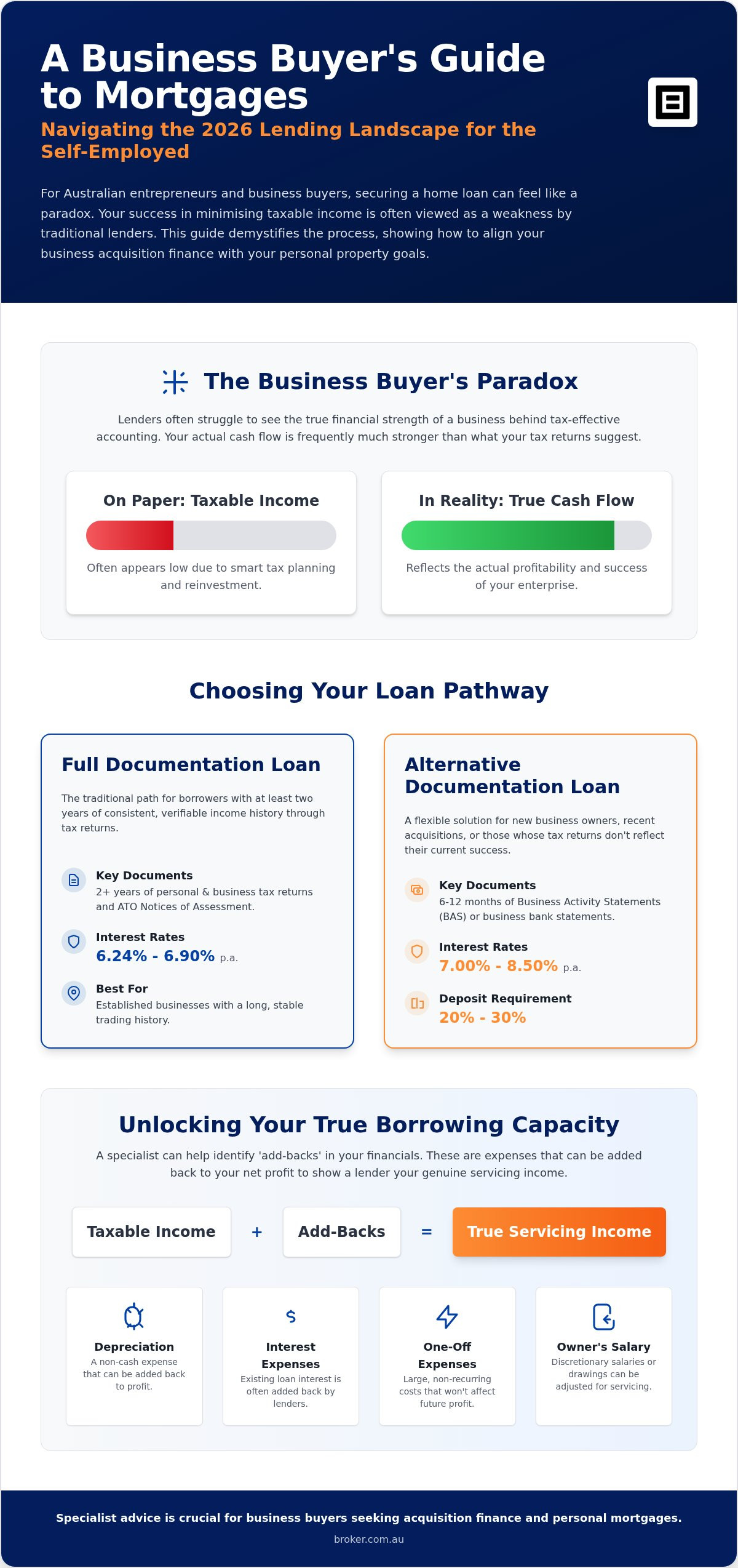
The Australian lending market has long been a source of frustration for entrepreneurs. If you’ve spent years refining your tax strategy to keep more of your profit, you’ve likely discovered that banks often interpret your low taxable income as a lack of borrowing power. It’s a paradox; your financial intelligence is effectively being used against you. As we move through 2026, understanding how to get a mortgage when self-employed australia requires a shift in strategy. While traditional lenders remain cautious, a new wave of nuanced income assessments is emerging for ABN holders who can demonstrate consistent cash flow despite their paper-thin tax returns.
Your choice of structure, whether you’re a Sole Trader or operating through a Pty Ltd company, changes the game entirely. A Pty Ltd setup allows for more sophisticated income distribution, but it also requires a lender who can look past the company tax return to see the individual’s true earning potential. This is where an expert guide becomes essential to help you navigate the divide between big bank rigidity and non-bank flexibility.
The ‘Two-Year Rule’ and 2026 Market Realities
Most big banks still cling to the ‘two-year rule,’ demanding twenty-four months of lodged tax returns and ATO Notices of Assessment. However, the 2026 landscape is shifting. With the RBA cash rate sitting at 4.35% as of June, and the APRA debt-to-income (DTI) cap now limiting banks to issuing just 20% of new mortgages to borrowers with a DTI over 6, the standard path is narrower than ever. If you’re a business buyer looking to expand, you should know that some lenders may now consider just one year of trading under specific conditions. This flexibility is vital for those recently transitioning from PAYG to their own ABN or those midway through a business acquisition.
Bridging the Gap Between Business and Personal Finance
The psychological toll of a bank rejection can be heavy, but it’s often just a sign that you’re talking to the wrong credit team. Your business’s success is actually your greatest asset when framed correctly. This is where the role of a mortgage broker becomes indispensable. A specialist provides the inside access needed to reach credit assessors who understand acquisition finance and how business assets can support personal borrowing. By identifying ‘add-backs’, such as one-off expenses or depreciation, you can transform your application. We focus on moving you from a state of uncertainty to a position of streamlined confidence, ensuring your personal home loan doesn’t stall while you’re buying a business.
Understanding Lender Requirements: From Full Doc to Alternative Solutions
The “Full Doc” path is the traditional gateway to home ownership, typically requiring two years of personal and business tax returns along with ATO Notices of Assessment. For a business buyer, this can be a significant hurdle if you’ve recently completed a business acquisition and your latest returns don’t yet reflect your new earning capacity. Lenders use these documents to verify consistency, but they often fail to account for the strategic ‘add-backs’ or the immediate cash flow improvements that follow a successful purchase. Understanding how to get a mortgage when self-employed australia means knowing when to follow this standard path and when to pivot toward more flexible alternatives.
Full Doc vs Low Doc: A Comparison for Business Owners
When your tax returns don’t tell the full story of your success, ‘Low Doc’ or alternative documentation loans offer a sophisticated solution. While Full Doc loans offer the lowest interest rates, usually between 6.24% and 6.90% for variable products, they demand exhaustive historical proof. In contrast, Low Doc options allow you to prove your income using Business Activity Statements (BAS) or business bank statements, typically covering the last six to twelve months. This is particularly useful for those managing acquisition finance where current performance outpaces historical data. You should expect a higher deposit requirement of 20% to 30% for these products, and interest rates often sit between 7% and 8.5% p.a. as of late 2026.
If you’re unsure which path fits your current equity position, you might want to explore tailored finance solutions that align with your specific business trajectory.
The Power of an Accountant’s Letter
An Accountant’s Letter acts as a professional declaration of your ability to service a loan. This document is a powerful tool when your business is thriving but your most recent tax filings are outdated or reflect heavy reinvestment. Following the ATO guidelines for new businesses ensures your financial structure is compliant from day one, which adds significant weight to your accountant’s declaration. A well-crafted letter can bypass the need for two years of returns by confirming your current net income and solvency. It effectively moves you from a state of institutional uncertainty to a position of streamlined confidence, showing the lender that you are a low-risk business buyer with a clear path to repayment. This proactive approach is often what differentiates a rejected application from a successful approval in the eyes of specialised credit teams.
Strategic Business Acquisition: Financing Your Growth and Your Home
For many entrepreneurs, the goal of buying a business often coincides with the desire to secure a family home. While traditional banks might view a business acquisition as an added layer of risk, a strategic approach turns this expansion into a financial strength. The key to how to get a mortgage when self-employed australia while simultaneously managing acquisition finance lies in proving that your new asset generates more than enough cash flow to cover both commercial and residential obligations. Instead of seeing debt as a barrier, we help you position it as a lever for long-term property success.
Acquisition Finance and Your Borrowing Power
Lenders are increasingly sensitive to the Australian Prudential Regulation Authority (APRA) debt-to-income (DTI) caps, which as of February 2026, limit banks to issuing only 20% of new mortgages to those with a DTI ratio of 6 or higher. If you are a business buyer, your acquisition finance will naturally increase your total debt profile. However, the income derived from an established business can significantly lower your DTI ratio when presented correctly to the right credit team.
- Historical Performance: Lenders will scrutinise the target business’s last two years of financial statements to ensure income stability.
- Transition Planning: A clear handover plan reduces the “key person risk” that often scares off residential credit assessors.
- Add-backs: Navigating how to get a mortgage when self-employed australia requires ensuring that one-off acquisition costs don’t artificially deflate your personal servicing capacity.
Deposit and Equity Requirements for Business Buyers
Securing a home loan while funding a business purchase requires a dual-track equity strategy. Most lenders expect a deposit of 20% to 35% for a business purchase, which can compete for the same capital needed for a home deposit. A sophisticated business buyer may leverage existing business equity or commercial property to satisfy these requirements. In 2026, we are seeing a surge in hybrid lending structures where the residential mortgage and the acquisition finance are managed by a single specialist lender. This streamlined approach avoids the friction of two separate credit departments fighting over the same pool of assets. By positioning your business as a wealth-generating engine rather than just a job, you transform the mortgage application from a struggle into a logical next step for your portfolio. This proactive strategy moves you toward a feeling of streamlined confidence and relief.
The Business Buyer’s Preparation Checklist for Mortgage Success
Becoming ‘bank-ready’ as a business buyer requires more than just a healthy bank balance. It’s about presenting a narrative of stability and growth that aligns with institutional credit policies. When you’re managing a business acquisition, your personal financials must be beyond reproach. This preparation begins long before you sign a contract of sale. Understanding how to get a mortgage when self-employed australia involves ensuring your ABN and GST registrations are current and that your business banking history shows a clear, consistent pattern of revenue.
Lenders in 2026 are increasingly focused on the quality of your financial management. To move from a state of institutional uncertainty to streamlined confidence, you must treat your mortgage application as a professional pitch. This means addressing potential red flags like tax debt early. If you have an existing liability with the ATO, having a formal, documented payment arrangement is essential, as undisclosed debts are the fastest way to trigger an immediate rejection.
Maximising Your Income with Add-Backs
One of the most overlooked aspects of how to get a mortgage when self-employed australia is the strategic use of add-backs. These are legitimate business expenses that a lender can ‘add back’ to your net profit to reflect your true borrowing capacity. A sophisticated business buyer knows that tax-minimisation strategies often hide real wealth. We help you document these effectively, including:
- Depreciation: Non-cash expenses on plant, equipment, or vehicles.
- One-off Expenses: Legal fees or costs associated specifically with your acquisition finance.
- Excess Superannuation: Voluntary contributions above the 12% mandate effective from July 2026.
- Interest: Finance costs for loans that will be closed or refinanced as part of the buying a business process.
Financial Hygiene for the Self-Employed
Separating your personal and business expenses is critical for a seamless application. Lenders are particularly sensitive to Director’s loans in 2026. If you’ve been using your business as a personal fund, it can create a ‘servicing’ nightmare during credit assessment. A clean credit file is now more important than ever. With Comprehensive Credit Reporting, every late payment is visible to lenders. Maintaining ‘clean’ banking habits for at least six months prior to your application shows you are a low-risk business buyer with a disciplined approach to debt. If you’re ready to see where you stand, you can get started with an expert assessment to ensure your application is flawless.
How a Specialist Broker Simplifies Self-Employed Lending
A generalist broker often treats every applicant like a standard PAYG employee, which is a recipe for frustration when you are a business buyer. When you are navigating the complexities of acquisition finance while simultaneously applying for a residential home loan, the standard tick-box approach simply fails. Specialist expertise is required to translate your complex company structures into a language that bank credit teams understand. At Broker.com.au, we act as your expert guide, moving you away from the anxiety of potential rejection toward a feeling of streamlined confidence. Understanding how to get a mortgage when self-employed australia becomes a far simpler task when you have a partner who recognises the strategic value of your business assets.
Our approach is built on proactivity and a can-do attitude for situations that fall outside of the norm. We don’t just submit an application; we build a case for your success. This starts with a low-pressure conversation through our unique “I’m interested” approach, allowing you to discuss your goals without the weight of an immediate, formal commitment. It’s about ensuring you are in good hands from the very first interaction.
Inside Access to the Best Rates and Terms
Specialist brokers provide an exclusive advantage that the average consumer cannot obtain on their own. We maintain inside access to specialised credit managers and a broad range of non-bank lenders who are not subject to the same rigid APRA debt-to-income caps as traditional banks. This is vital in 2026, as these non-bank options often provide the flexibility needed for a business buyer to secure competitive rates while buying a business. We negotiate on your behalf to secure tailored finance solutions that align with your long-term wealth goals, ensuring your personal borrowing power remains protected even as your commercial empire grows.
Proprietary AI and the Future of Loan Applications
The 2026 lending environment moves fast, and our proprietary AI technology ensures you keep pace. This technology is designed to streamline complex financial modelling, instantly identifying which lenders have the strongest appetite for your specific business structure. By accurately documenting your income and ‘add-backs’ through an automated lens, we reduce the time and stress of manual reviews. This precision is especially critical when managing acquisition finance, where the intersection of commercial debt and personal servicing requires flawless accuracy. Our AI doesn’t just find a loan; it finds the right loan, ensuring a seamless and efficient path to approval that respects your time and your professional “dream.”
Your Path to Property and Professional Growth
Securing your dream home shouldn’t be the trade-off for building a successful business. We’ve explored how identifying strategic add-backs and choosing the right documentation pathway can transform your borrowing capacity. Whether you’re a business buyer navigating a new business acquisition or managing existing acquisition finance, the right structure is key to satisfying lender requirements in 2026. Understanding how to get a mortgage when self-employed australia is about more than just tax returns; it’s about presenting a narrative of growth and stability.
As an award-winning Australian brokerage, we use proprietary AI matching technology to connect you with lenders who actually understand your unique financial structure. Our team specialises in complex home loans and business acquisition funding, ensuring your application is bank-ready from day one. I’m interested in a self-employed mortgage solution and ready to move from financial uncertainty to a stress-free approval. You’re in good hands with experts who go above and beyond to make your vision a reality.
Frequently Asked Questions
How many years of tax returns do I need for a mortgage if I’m self-employed?
Most traditional lenders require two full years of personal and business tax returns along with ATO Notices of Assessment. However, in 2026, several major Australian banks have updated their credit policies to accept just a single year of lodged returns under specific conditions. This flexibility is vital if your most recent financial year shows a significant uplift in profitability, allowing you to secure a competitive rate without waiting another twelve months to prove your income stability.
Can I get a home loan with only one year of ABN registration?
You can secure a home loan with twelve months of ABN registration through several mainstream lenders. While most institutions prefer a twenty-four month trading history, specialist non-bank lenders may consider applications with as little as six months of ABN registration if you have prior experience in the same industry. These options often require alternative documentation, such as Business Activity Statements, to verify that your current income is stable and sufficient to meet repayments for your personal property goals.
What are ‘add-backs’ and how do they help my mortgage application?
Add-backs are non-cash or one-off business expenses that lenders add back to your net profit to reflect your true borrowing capacity. Common examples include depreciation on equipment, voluntary superannuation contributions above the 12% mandate, and one-off legal fees from a business acquisition. By documenting these effectively, you can often increase your reportable income, which is a vital strategy when learning how to get a mortgage when self-employed australia while maintaining a tax-efficient business structure.
How does buying a business affect my personal borrowing power?
Buying a business increases your total debt, which can impact your debt-to-income (DTI) ratio under APRA’s 2026 regulations. While acquisition finance adds to your liabilities, the additional cash flow from the purchased entity can actually strengthen your personal servicing capacity. The key is presenting a clear financial model that shows the business income comfortably covers both the commercial debt and your residential mortgage, turning a potential hurdle into a strategic asset for your application and long-term wealth strategy.
Is acquisition finance different from a standard business loan?
Yes, acquisition finance is a specialised solution designed specifically for a business buyer to purchase an existing enterprise. Unlike a standard business loan used for equipment or cash flow, this funding often covers intangible assets like goodwill and the costs of a smooth ownership transition. These loans are assessed based on the target business’s historical profitability and the buyer’s industry expertise, requiring a more sophisticated credit assessment than a generic commercial facility to ensure a seamless transition.
What is a Low Doc loan and is it right for me in 2026?
A Low Doc loan allows you to prove your income using alternative documents like BAS or an accountant’s letter instead of full tax returns. This pathway is ideal if your business is thriving but your latest tax filings are outdated or reflect heavy reinvestment. In late 2026, these loans typically carry interest rates between 7% and 8.5% p.a. and require a 20% to 30% deposit, which makes them a flexible choice for those with complex structures.
Do I need a bigger deposit for a mortgage if I work for myself?
You don’t always need a larger deposit, but it depends on your documentation. If you provide full tax returns, you can often access the same 5% to 10% deposit options as PAYG employees. However, if you choose a Low Doc pathway, lenders generally require a deposit of 20% to 30% to mitigate risk. Having a larger equity position can also help you bypass Lenders Mortgage Insurance, which often costs between 1% and 5% of the loan amount.
How can a specialist broker help me if the big banks have already said no?
A specialist broker uses proprietary AI and inside access to find lenders who look beyond big bank rigidity. If a major bank has declined you, it’s often because your structure doesn’t fit their standard algorithm. We negotiate directly with credit managers who understand how to get a mortgage when self-employed australia and recognise the value of ‘add-backs’. This proactive approach moves you from a state of uncertainty toward a stress-free approval with a tailored finance solution designed for your needs.