
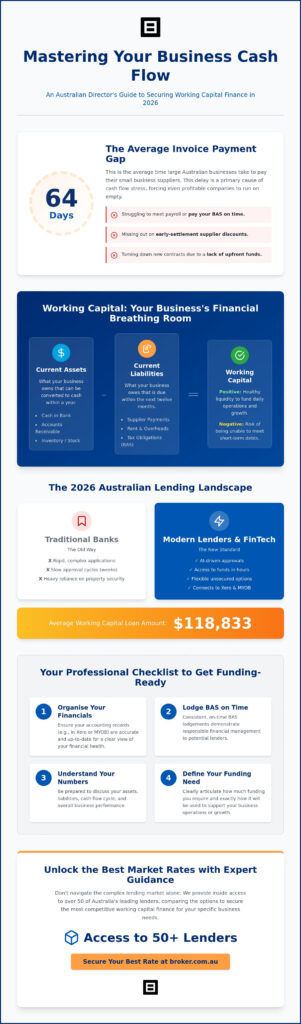
Did you know that the average time for large Australian businesses to settle small business invoices has stretched to 64 days? It’s a sobering figure that explains why so many directors feel the pinch of lumpy cash flow and liquidity stress. When your capital is tied up in unpaid invoices or seasonal stock, even the most successful enterprise can feel like it’s running on empty. Accessing working capital finance shouldn’t be a source of further anxiety, yet the complexity of traditional bank applications often makes it feel out of reach.
We understand that you need a steady, predictable cash position to seize new opportunities with confidence. You’ve worked hard to build your business, and you deserve a financial partner who treats your goals with professional care. This guide is designed to help you master your cash flow and secure the right funding to fuel your growth without the stress. We’ll explore the most flexible lines of credit available in 2026 and show you how to secure the best market rates with expert precision, ensuring you’re prepared for upcoming shifts like the July 2026 payday superannuation changes.
Key Takeaways
- Understand why maintaining positive working capital is the essential “breathing room” your business needs to meet payroll and supplier obligations.
- Explore the 2026 Australian lending landscape and learn how AI-driven approvals are providing faster access to funds for ABN holders.
- Compare the strategic advantages of secured and unsecured solutions to find the most efficient fit for your business risk profile.
- Discover practical steps to organise your financial records and BAS filings to ensure a seamless, professional funding application.
- Learn how to leverage inside access to over 50 lenders to secure the best possible market rates for your working capital finance.
Table of Contents
- Understanding Working Capital: The Lifeblood of Your Daily Operations
- Exploring Working Capital Finance Options in the Australian Market
- Comparing Secured vs Unsecured Working Capital Solutions
- How to Optimise Your Working Capital and Prepare for Funding
- Strategic Funding with Broker.com.au: Accessing Best-in-Class Rates
Understanding Working Capital: The Lifeblood of Your Daily Operations
Think of working capital as the oxygen in your business’s lungs. It isn’t just a static figure on a balance sheet; it’s the actual breathing room you have to keep your daily operations running without the constant weight of financial anxiety. While your profit and loss statement might show a healthy surplus, your bank account often tells a different story. This gap between “accounting” working capital and actual cash on hand is where many Australian directors find themselves stuck. You can be profitable on paper but still struggle to meet payroll or pay your BAS on time because your wealth is tied up in stock or unpaid invoices.
Recognising when your business needs a liquidity boost is a hallmark of a proactive leader. You might notice subtle signs before a crisis hits. Are you consistently missing out on early-settlement discounts from your suppliers? Are you relying on high-interest credit cards to cover the weekly wage run? Perhaps you’re turning down new contracts because you can’t afford the upfront materials. These are clear indicators that your internal cash cycle is stretched and that tailored working capital finance could provide the necessary relief to keep your momentum going.
The Working Capital Formula Simplified
Stripped of the jargon, the formula is simple: Current Assets minus Current Liabilities. For an Australian SME, your assets include the cash in your business account, the value of the stock in your warehouse, and your accounts receivable. Your liabilities are the debts due within the next twelve months, such as trade credit, rent, and upcoming tax obligations. Understanding Working Capital helps you realise that it represents the net funds available to fund day-to-day operations after short-term debts are settled. If this number is negative, you’re essentially borrowing from tomorrow to pay for today.
Why Cash Flow Timing is the Real Challenge
The real struggle for most businesses isn’t a lack of sales; it’s the timing of those sales. There is often a significant “gap” between the moment you pay for raw materials or labour and the moment your customer finally settles their invoice. In the Australian market, payment terms of 30, 60, or even 90 days are common, especially when dealing with larger corporate clients. This creates a liquidity vacuum that can suck the life out of a growing firm.
Surprisingly, rapid growth can be just as dangerous as a slump. This is the “success trap,” where winning a major new contract forces you to hire more staff and buy more inventory immediately, depleting your cash reserves long before the new revenue hits your account. Strategic working capital finance acts as a bridge during these periods, ensuring that your growth remains a blessing rather than a burden on your cash position.
Exploring Working Capital Finance Options in the Australian Market
The Australian lending landscape has undergone a seismic shift. In 2026, ABN holders are no longer tethered to the rigid, slow-moving approval cycles of traditional big-four banks. A new era of non-bank lenders and fintech innovators has emerged, offering a diverse array of working capital finance products designed for speed and flexibility. With the average working capital loan amount sitting at approximately $118,833, it’s clear that SMEs are increasingly using these tools to manage their daily liquidity. The most significant change is the integration of AI-driven credit assessment. By securely connecting to your accounting software like Xero or MYOB, lenders can now analyse your real-time cash flow and provide approvals in hours rather than weeks.
Choosing the right facility requires a deep understanding of your specific business cycle. A “once-off” unsecured business loan might be perfect for a specific stock purchase, but a revolving credit facility offers a permanent safety net. If you find yourself frequently comparing working capital finance options, it’s essential to match the debt structure to the underlying need. Accessing a tailored line of credit ensures you have funds ready the moment a seasonal shift or a late-paying client creates a gap in your cash flow.
Unsecured Business Loans and Lines of Credit
Unsecured funding has become the fastest-growing segment for Australian SMEs, particularly for service-based businesses that don’t hold significant physical assets like property or heavy machinery. These loans rely on the strength of your bank statements and trading history rather than collateral. A line of credit is particularly powerful; it acts as a flexible reserve that you only pay interest on when you actually draw down the funds. Eligibility typically requires at least six months of trading history and a consistent monthly turnover, making it an accessible option for established businesses looking for streamlined confidence.
Invoice Finance: Unlocking Your Accounts Receivable
For B2B wholesalers and service providers, your greatest asset is often sitting in your “Accounts Receivable” folder. Invoice finance allows you to advance up to 85% of an invoice’s value immediately, effectively bridging the 64-day average payment gap seen in the current market. You can choose between invoice factoring, where the lender manages the collection process, or invoice discounting, which remains confidential so your clients are unaware of the facility. With fees typically ranging from 1% to 4% of the invoice value, it’s a highly efficient way to keep your operations moving while you wait for clients to settle their accounts.
Comparing Secured vs Unsecured Working Capital Solutions
Choosing the right structure for your working capital finance often boils down to a trade-off between the security you’re willing to provide and the speed at which you need to move. While secured loans historically offered the lowest rates, the Australian SME market in 2026 has shifted dramatically toward unsecured options. This isn’t just about convenience. It’s about protecting your personal assets from the pitfalls of cross-collateralisation, a common fear for many local directors who don’t want their family home tied to their business debt. Even with unsecured loans, you’ll likely encounter the “Director Guarantee.” This is a standard signature in the local market that signals your personal commitment to the facility without requiring a mortgage over a specific property.
To truly Optimise Your Working Capital, you must look beyond the headline interest rate. The total cost of finance includes establishment fees, line fees, and the opportunity cost of waiting. If a secured loan takes six weeks to fund due to property valuations, and you miss a bulk-buy discount on stock in the meantime, the “cheaper” loan has actually cost you more. Research into SME profitability shows that the speed of capital injection often correlates more strongly with growth than the interest rate itself. You need to weigh up whether the lower rate of a secured loan justifies the potential delay in accessing those funds.
When to Choose Secured Finance
Secured finance remains the heavyweight champion for large-scale capital needs or major restructures. By leveraging commercial property or significant equipment, you can unlock longer repayment terms and significantly lower interest rates. This is ideal when you’re looking to acquire a competitor or overhaul your entire supply chain. It places a charge on your balance sheet, but the trade-off is a predictable, lower-cost repayment schedule that suits long-term planning. It’s a professional choice for businesses with substantial assets who want to drive down their cost of capital over several years.
The Speed and Flexibility of Unsecured Options
When an unexpected bill arrives or a sudden opportunity knocks, “fast” usually beats “cheap.” Unsecured solutions are the go-to for many ABN holders because they bypass the arduous process of property valuations and title searches. There’s no need to spend weeks waiting for a bank valuer to visit your premises. At Broker.com.au, we’ve refined this process to a fine art. We can often organise unsecured funding in as little as 24-48 hours, giving you the streamlined confidence to act while the iron is hot. It’s about moving from a state of uncertainty to total liquidity with minimal fuss, ensuring you’re always in good hands.
How to Optimise Your Working Capital and Prepare for Funding
Before you even look at external working capital finance, it’s vital to tighten the screws on your internal processes. Think of this as getting your house in order before a professional inspection. A healthy cash position starts with your Cash Conversion Cycle (CCC), which is the time it takes to turn your investment in stock and labour back into cash. In 2026, with the median CCC for Australian public companies sitting at 62 days, any reduction you can make here directly improves your bottom line. Negotiating even an extra seven days with your suppliers or ensuring your BAS filings are always current provides the immediate breathing room you’ve been looking for.
Technology is your best ally in this space. Real-time dashboards allow you to track your Days Sales Outstanding (DSO) and Days Inventory Outstanding (DIO) with precision. When you see these numbers creeping up, you can act immediately rather than waiting for the end of the quarter. Similarly, supplier relationships are a two-way street. If you’ve been a loyal partner, don’t be afraid to ask for extended terms during your peak growth phases. Stretching your current liabilities by even a few weeks can significantly reduce the pressure on your business bank account.
Inventory and Accounts Receivable Management
Dead stock is essentially cash gathering dust on a shelf. Identify items that haven’t moved in 90 days and consider a clearance sale to liquidate that capital and free up warehouse space. On the flip side, your accounts receivable requires a proactive, automated approach. Don’t wait for a bill to become overdue; use your accounting software to send friendly reminders three days before the due date. Offering a small early-payment discount can also significantly speed up your cash inflow, reducing your daily reliance on credit facilities.
The “Broker-Ready” Checklist
When you’re ready to apply for working capital finance, being prepared is the difference between a seamless experience and a stressful one. Lenders in 2026 want to see “clean” financial data. This means your tax obligations must be managed and your profit and loss statements should clearly reflect your business’s health. Having a clear “purpose of funds” statement shows you’re using debt as a strategic tool for growth rather than a desperate patch for poor management.
If you want to ensure your application is structured for long-term health, get started with a professional assessment today. Having an expert guide review your financials ensures you’re positioned to secure the best market rates without the guesswork, moving you from a state of uncertainty toward streamlined confidence.
Strategic Funding with Broker.com.au: Accessing Best-in-Class Rates
Securing working capital finance doesn’t have to be a battle with a faceless institution. While the big banks often rely on rigid, tick-box criteria, our approach combines sophisticated technology with human insight. We use proprietary AI to scan a network of over 50 Australian lenders, instantly matching your specific cash flow needs with the most competitive facilities on the market. This “inside access” gives you a distinct advantage that’s impossible to find when walking into a local branch. You aren’t just another file in a queue; you’re a business owner with a specific vision that deserves a tailored financial solution.
Our boutique advisory model is built on the belief that you should feel in good hands from the very first interaction. We move you away from the anxiety of lumpy cash flow and toward a state of streamlined confidence. By handling the heavy lifting of comparing terms and dissecting the fine print, we ensure you stay focused on running your business while we secure the best-in-class rates you deserve. It’s about more than just numbers; it’s about providing the professional guidance needed to navigate a complex lending environment without the usual stress.
Our Stress-Free Application Process
We understand that your time is your most valuable asset. That’s why dedicated experts like Matt and Kylie take the lead, managing the entire process on your behalf from start to finish. We don’t just find a loan; we structure a solution that supports your long-term health and protects your personal assets from unnecessary risk. Whether it’s an unsecured line of credit or a flexible invoice finance facility, we ensure the debt aligns perfectly with your operational rhythm. It’s a professional, seamless experience designed to take the weight off your shoulders and let you get back to what you do best.
Get Started with a Low-Pressure Conversation
We’ve ditched the aggressive, high-pressure application forms used by many of our competitors. Our award-winning service starts with a simple, low-pressure conversation. We prefer the phrase “I’m interested” because it signals the start of a partnership rather than a cold transaction. This human-led approach is why so many Australian SMEs trust us to unlock doors that remain closed at traditional banks. If you’re ready to explore how the right funding can transform your trajectory and fuel your growth, we’re here to help you navigate the options with ease and precision.
I’m interested in working capital finance
Secure Your Business Future with Streamlined Confidence
Mastering your cash flow is about more than just surviving the 64-day average payment gap; it’s about positioning your enterprise for long-term growth. By understanding the nuances of your cash conversion cycle and choosing a facility that aligns with your operational rhythm, you turn a potential stress point into a strategic advantage. Whether you opt for a flexible line of credit or choose to unlock your accounts receivable, the goal is to maintain that essential breathing room in your business bank account.
At Broker.com.au, we’ve refined the process of securing working capital finance into a seamless, professional experience. Our award-winning finance solutions utilise proprietary AI matching technology to give you inside access to over 50 lenders, ensuring you find the best market rates with ease. Backed by five-star client testimonials, our team handles the heavy lifting so you can focus on your “dream” with total peace of mind. You’ve built a business worth growing; we’re here to ensure you have the capital to make it happen.
I’m interested in working capital finance
Frequently Asked Questions
What is the best type of working capital finance for a small Australian business?
The ideal funding type depends on your specific industry and asset position. For B2B firms, invoice finance is often the most efficient way to bridge payment gaps. For retailers or tradies, an unsecured line of credit provides the flexible safety net needed for seasonal stock or emergency repairs. We recommend a tailored assessment to ensure your working capital finance aligns with your operational cycle.
Do I need to provide my home as security for a working capital loan?
You don’t necessarily need to provide your family home as security for a working capital facility. Many modern lenders offer unsecured business loans that rely on your trading history and cash flow rather than physical collateral. While you’ll likely need to sign a Director Guarantee, this protects your residential property from being directly tied to the loan through the risks of cross-collateralisation.
How much working capital does my business actually need?
Your required funding is determined by the gap in your cash conversion cycle. Calculate the total value of your current inventory and outstanding invoices, then subtract your current payables. This figure represents the breathing room you need to operate comfortably. It’s wise to include a small buffer to handle unexpected opportunities or late-paying clients without experiencing liquidity stress or daily anxiety.
Can I get working capital finance if I have a low doc or no doc situation?
Accessing finance is still possible even if your full financial records aren’t ready. Many non-bank lenders specialise in low doc options that primarily require bank statements or recent BAS filings to verify your turnover. This is a professional solution for busy directors who need to move quickly but haven’t yet finalised their most recent annual tax returns with their accountant.
What are the typical interest rates for working capital finance in Australia in 2026?
Interest rates vary significantly based on your business’s risk profile and whether the facility is secured or unsecured. In the 2026 Australian market, rates are influenced by the RBA cash rate and the specific lender’s criteria. Generally, secured facilities offer lower headline rates, while unsecured options carry a premium for their speed and lack of collateral. We provide inside access to compare these market rates across 50 lenders.
How quickly can I access funds through a working capital facility?
You can often access funds in as little as 24 to 48 hours when using fintech lenders or specialised brokers. The integration of AI-driven credit assessment means that once you connect your accounting software, approvals happen almost instantly. This streamlined process is designed to move you from uncertainty to liquidity without the weeks of waiting required by traditional, slow-moving bank applications.
Is working capital finance tax-deductible for Australian companies?
Interest payments on working capital finance are generally tax-deductible for Australian companies, provided the funds are used for business-related purposes. This includes activities like purchasing inventory, meeting payroll, or covering daily operating expenses. We always suggest consulting with your accountant to confirm how these deductions apply to your specific company structure and financial situation during the current tax year.
What is the difference between a business overdraft and a line of credit?
A business overdraft is directly linked to your everyday transaction account, allowing you to spend into a negative balance as needed. In contrast, a line of credit is a standalone facility with its own limit and repayment structure. While both offer revolving access to funds, a line of credit often provides higher limits and more flexible terms for strategic growth needs and large-scale opportunities.