
Most Australian business owners view a balloon payment as a ticking financial time bomb, but for the savvy operator, it’s actually one of the most powerful cash flow levers available. It’s understandable if you feel hesitant. With the Reserve Bank of Australia holding the official cash rate at 4.35% as of June 2026, protecting your monthly working capital has never been more critical. You likely want to upgrade your equipment or fleet without choking your daily operations with high repayments that restrict your growth.
We recognise the anxiety that comes with a looming lump sum and the uncertainty of how asset depreciation will stack up against your debt. Given that 68% of Australian companies utilised asset finance last year to invest in their growth, getting the structure right is essential. This guide will help you master the mechanics and risks of these structures so you can optimise your strategy with confidence. We will walk through how to achieve lower monthly overheads, leverage tax-effective acquisition, and establish a clear exit strategy for the end of your loan term.
Key Takeaways
- Understand how deferring a portion of your loan principal can significantly lower monthly overheads and free up vital working capital for daily operations.
- Learn to use a balloon payment as a strategic lever to increase your borrowing power and acquire higher-quality assets that drive productivity.
- Discover how to navigate the “interest trap” and manage the relationship between asset depreciation and your outstanding debt.
- Explore proactive exit strategies, including refinancing options and seamless transitions to your next asset upgrade.
- Find out how tailored finance structures can turn a potential lump-sum obligation into a streamlined opportunity for business expansion.
Table of Contents
- What is a Balloon Payment and How Does it Work in Australia?
- Strategic Advantages: Why SMEs Choose Balloon Payments
- The Risks and Myths: Addressing “The Sting in the Tail”
- Exit Strategies: What Happens at the End of the Term?
- How Broker.com.au Simplifies Asset Finance
What is a Balloon Payment and How Does it Work in Australia?
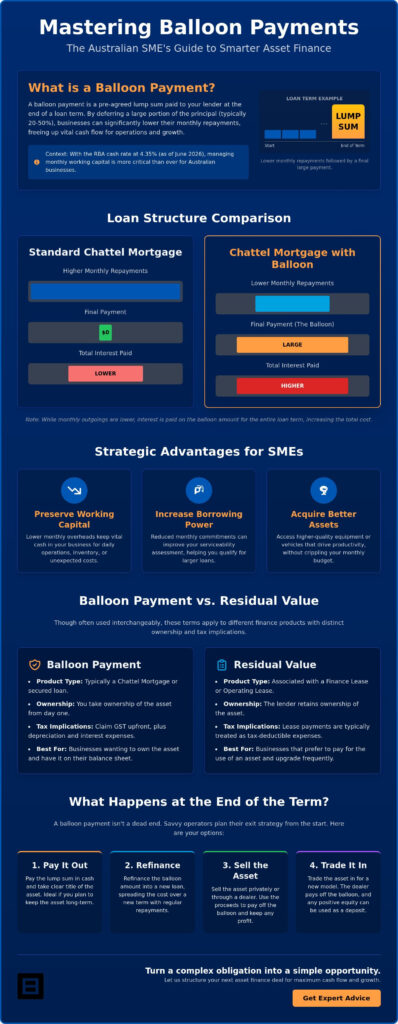
A balloon payment is a predetermined lump sum that you agree to pay your lender at the very end of your loan term. Think of it as a portion of the loan principal that is “set aside” rather than being paid off through your regular monthly instalments. By deferring this significant amount, you effectively reduce your monthly commitments. This structure is particularly popular among Australian SMEs because it allows them to keep more cash inside the business to cover operational costs or invest in growth opportunities. It’s a strategic way to align your debt repayments with your actual cash flow needs.
While the fundamental concept shares roots with a balloon payment mortgage, its application in the Australian commercial sector is most common in asset and vehicle finance. Typically, these payments range from 20% to 50% of the total loan amount. The specific percentage often depends on the type of asset, its expected lifespan, and how long you intend to keep it. With the Reserve Bank of Australia maintaining the cash rate at 4.35% as of June 2026, many businesses are using this structure to maintain liquidity while still accessing the latest technology and machinery required to stay competitive.
The Anatomy of a Balloon Loan
Understanding the cost of this flexibility is vital for sound financial modelling. One of the most misunderstood aspects of a balloon payment loan is how interest is calculated. You don’t just pay interest on the principal you are actively paying down; you also pay interest on the balloon amount for the entire duration of the loan. This means that while your monthly outgoings are lower, the total interest paid over the life of the loan will be higher than a fully amortised agreement. The length of your term also plays a major role. A three-year term allows for a larger balloon because the asset has less time to depreciate, whereas a five-year term usually requires a smaller balloon to ensure you don’t end up with negative equity. Residual value is the ATO-mandated minimum for certain leases.
Balloon Payments vs. Residual Values
The terms “balloon” and “residual” are often used interchangeably, but they serve different legal and tax functions. A balloon payment is typically attached to a Chattel Mortgage or a secured business loan. Under this structure, your business usually takes ownership of the asset immediately, allowing you to claim depreciation and interest as tax deductions. In contrast, a “residual value” is the standard term for finance leases or operating leases where the lender retains ownership and you pay for the use of the asset. Choosing between them depends on your specific tax profile for the current financial year. If you prefer to have the asset on your balance sheet from day one, a balloon structure is often the more efficient choice. However, if you want to swap equipment frequently without the risks of ownership, a lease with a residual value might better suit your needs.
Strategic Advantages: Why SMEs Choose Balloon Payments
Cash flow is the lifeblood of any growing enterprise. For many Australian SMEs, the primary draw of a balloon payment is the immediate relief it provides to the monthly bottom line. By shifting a significant portion of the loan principal to the end of the term, you effectively lower your committed overheads. This isn’t just about making ends meet; it’s a tactical move to ensure your business remains agile. Industry data shows that 68% of Australian companies utilised asset finance last year to invest in their operations, highlighting a clear trend toward preserving daily liquidity while still acquiring essential tools.
Lower monthly repayments also do wonders for your borrowing power. When lenders assess your serviceability, they look closely at your existing commitments. A smaller monthly debt obligation can improve your debt-service cover ratio, potentially helping you qualify for larger facilities or additional working capital finance. This structure is particularly effective for seasonal businesses, such as those in tourism or agriculture, where income fluctuates. It allows you to maintain a lower fixed cost base during the quiet months, protecting your cash reserves when you need them most.
Preserving Working Capital for Growth
Choosing a balloon structure allows you to reinvest “saved” monthly cash into areas that generate a higher return. While an unsecured business loan might offer speed, it often comes with higher rates and aggressive repayment schedules that can stifle growth. In contrast, asset finance with a balloon allows you to match the cost of the equipment to the revenue it generates. For example, a medical practice investing in high-value imaging equipment can use the preserved capital to hire more staff or expand their clinic. This strategy is equally powerful for high-value “yellow goods” like excavators or heavy machinery where the upfront cost is substantial but the long-term ROI is proven.
Tax and Accounting Benefits
The financial benefits of this structure extend to your tax obligations. When using a Chattel Mortgage with a balloon payment, you can typically claim the full GST amount on the asset’s purchase price in your next BAS. This provides a significant upfront cash injection. Additionally, you can continue to claim interest charges and depreciation throughout the loan term. While you should always consult your specialist, many businesses are currently leveraging these structures alongside the 2026 Instant Asset Write-Off provisions to accelerate their tax benefits. Since 87.6% of businesses report productivity gains of over 10% after upgrading their assets, the combination of tax efficiency and improved output creates a compelling case for expansion.
The Risks and Myths: Addressing “The Sting in the Tail”
While the cash flow benefits are clear, a balloon payment is often viewed with a sense of trepidation. Critics frequently refer to it as the “sting in the tail,” and without a proper strategy, that reputation can be earned. The most common pitfall is the interest trap. Because the balloon amount isn’t being paid down during the term, you are charged interest on that full lump sum for every single month of the loan. This results in a higher total interest cost compared to a standard principal and interest facility. However, for a business that can generate a 15% return on the capital they’ve kept in the bank, paying a few extra percent in interest is often a logical trade-off.
Refinance risk is another factor that causes “lump sum anxiety” for many Australian directors. If you plan to roll your debt over at the end of the term, you are at the mercy of the market conditions at that future date. With the Reserve Bank of Australia holding rates at 4.35% as of June 2026, there is always the possibility that the lending environment will be more expensive when your balloon falls due. This is why we focus on proactive planning rather than reactive scrambling. By understanding the mechanics now, you can build a buffer that ensures the final payment is a milestone, not a crisis.
Managing Depreciation vs. Debt
The danger of negative equity occurs when your asset’s market value drops faster than your loan balance. For a standard work ute or delivery truck, the ATO guidelines suggest a minimum residual value of 46.88% for a three-year term. If you set your balloon payment at 55% to keep monthly costs low, you’ll likely face a shortfall when it’s time to sell or trade in. Specialised machinery often holds its value better than passenger vehicles, but regular asset valuations are still essential. Keeping a pulse on the used equipment market ensures your debt levels remain safely aligned with the real-world resale value of your fleet.
The Cost of Deferring Principal
When you compare a standard loan to one with a balloon structure, the total interest expense will always be higher on the latter. You must decide if the “opportunity cost” of your capital justifies this expense. If that preserved cash allows you to take on a new contract or buy bulk inventory at a discount, the extra interest is simply the cost of doing business. Our proprietary AI-driven brokerage technology allows us to model these costs accurately against your projected revenue. This ensures you aren’t just delaying a headache, but rather making a calculated investment in your company’s immediate scalability.
Exit Strategies: What Happens at the End of the Term?
The final month of your finance agreement represents a significant crossroad for your business. While the thought of a large balloon payment can be daunting, having a clear exit strategy transforms this moment from a liability into a growth opportunity. You aren’t stuck with just one path. You can choose to pay the amount in full using your business cash reserves, taking full ownership and removing the asset from your debt schedule. Alternatively, many owners choose to sell the asset on the private market. This allows you to use the proceeds to clear the lender and pocket any surplus as capital for your next venture.
If you prefer to keep the asset but want to protect your liquidity, rolling the debt is a common choice. This involves moving the lump sum into a new, shorter-term loan facility. For those who want to stay at the cutting edge of their industry, trading the asset in is often the most seamless route. This effectively uses the equity you’ve built to kickstart a new finance agreement for a newer model. Each choice has different implications for your balance sheet and tax position, so selecting the right one requires a proactive approach.
The Art of the Refinance
Timing is everything. If you wait until the final week of your loan to address the lump sum, you lose your leverage. We recommend starting the conversation at least three months before the due date. Our team specialises in organising “balloon-only” refinancing to extend the working life of your equipment. Lenders typically look at the asset’s current condition and total age when approving these extensions. We can help you navigate these criteria and provide inside access to the best rates for your specific situation. This proactive step ensures your transition is stress-free and your cash flow remains uninterrupted.
Trading in for a New Asset
Calculating your equity is a simple but vital step in the trade-in process. Your equity is the difference between the current market value of the asset and your outstanding balloon payment. If your delivery truck is worth $60,000 and your balloon is $35,000, you have $25,000 in “hidden” capital to put toward your next upgrade. This approach allows you to streamline the transition to a more efficient, reliable model while managing the GST implications of the sale. By trading in, you avoid the hassle of a private sale and ensure your team always has the best tools available to drive productivity gains.
How Broker.com.au Simplifies Asset Finance
Finding the right finance structure shouldn’t feel like a second job. At Broker.com.au, we provide inside access to a diverse panel of over 30 lenders that specialise in commercial balloon payment structures. This isn’t just about finding a loan; it’s about matching your specific business profile with a residual structure that actually works for your cash flow. We use proprietary AI technology to scan the market, ensuring you aren’t just limited to the rigid products offered by the big four banks. This technology allows us to model different scenarios, helping you see exactly how a tailored balloon can preserve your working capital.
Our team, led by seasoned specialists like Matt and Kylie, understands that your business is more than just a credit score on a page. We look at the full picture of your industry, your equipment needs, and your growth potential. This human-led approach, backed by best-in-class technology, ensures the application process is seamless and entirely stress-free. We take pride in being a boutique partner that offers high-level expertise, ensuring you feel like you are in good hands from the initial enquiry to the final repayment.
Tailored Solutions for Business Owners
A one-size-fits-all bank balloon often fails to account for your unique tax structure or seasonal fluctuations. We don’t believe in high-pressure sales tactics or aggressive “apply now” buttons. Instead, we utilise an “I’m interested” approach. It is the start of a low-pressure conversation where we provide local insights and professional guidance tailored to your specific needs. Through our network, you gain access to rates and terms that aren’t available to the general public. This exclusive advantage allows you to secure the best possible deal for your vehicle or equipment finance without the usual corporate hurdles.
Beyond the Balloon: Holistic Financial Support
We see ourselves as your long-term partner and expert guide in the Australian lending landscape. Our expertise extends far beyond equipment; we can integrate your asset finance with broader needs like business acquisition funding or even your personal home loan. We don’t just set up the loan and walk away. We stay by your side to help manage the exit strategy, ensuring you’re ready for that trade-in or refinance well before the due date. This proactive support ensures your business remains agile and ready to capitalise on new opportunities as they arise.
Ready to lower your monthly costs? I’m interested in an asset finance quote
Secure Your Business Growth with Confidence
Mastering the balloon payment structure is about more than just lowering your monthly outgoings; it’s about maintaining the agility needed to scale in a competitive Australian market. By preserving your working capital today and planning your exit strategy well in advance, you can turn a significant lump sum from a source of anxiety into a calculated milestone for your next fleet or equipment upgrade. Success in asset finance comes down to proactive management and choosing a structure that aligns with your specific revenue cycles.
As an award-winning Australian brokerage, we provide the expert guidance and inside access to specialist commercial lenders you won’t find at a traditional bank. Our proprietary AI-matching technology ensures your finance is tailored to your unique business profile, taking the guesswork out of complex residual calculations. You are in good hands with a team that prioritises your long-term success and understands the nuances of local industry requirements.
I’m interested in a tailored finance solution
Your next phase of growth is within reach, and we’re here to ensure the process of securing it is seamless, transparent, and entirely stress-free.
Frequently Asked Questions
Is a balloon payment the same as a residual value?
No, these terms refer to different financial structures. A balloon payment is typically used with a Chattel Mortgage where your business owns the asset from day one. A residual value applies to finance leases where the lender retains ownership until the end of the term. While both serve to reduce monthly repayments, the tax treatment and ownership rights vary significantly between the two options.
Can I pay off my balloon payment early?
Yes, most Australian lenders allow you to settle the lump sum before the term ends. You should check your specific contract for any early termination fees or break costs that might apply. Paying the balloon payment early can reduce the total interest expense of the loan, as you stop accruing interest on that deferred principal amount once it’s settled.
What happens if I can’t afford the balloon payment at the end of the term?
You have several practical options if cash reserves are tight when the final payment falls due. You can refinance the amount into a new 2 to 3 year term, trade in the asset and use the equity to clear the debt, or sell the asset privately. Starting these conversations three months before the due date ensures a stress-free transition and protects your credit profile.
Are balloon payments tax-deductible for Australian businesses?
The lump sum payment itself isn’t a direct deduction; however, the interest you pay on that amount and the depreciation of the asset usually are. If you use a Chattel Mortgage, you can also typically claim the full GST on the purchase price in your next BAS. It’s best to consult your specialist to see how these rules apply to your specific tax profile this year.
Can I get a balloon payment on a used truck or piece of equipment?
Yes, many specialist lenders offer balloon structures for used assets, provided they meet certain age and condition criteria. Generally, lenders prefer that the total age of the asset at the end of the loan term doesn’t exceed 10 to 12 years. This allows you to access lower monthly repayments even when buying reliable second-hand machinery to grow your fleet or operations.
How much interest will I save by not having a balloon payment?
You will save a noticeable amount in total interest by opting for a standard principal and interest loan because you’re reducing the debt balance faster. With a balloon payment, you pay interest on that deferred lump sum for the entire duration of the loan. However, many owners find that the capital they keep in the business generates a higher return than the extra interest costs they incur.
Is it possible to refinance a balloon payment with a different lender?
Absolutely, and switching lenders can sometimes secure you a better rate or more flexible terms for the next stage of the asset’s life. We can help you compare the market to find a lender that specialises in “balloon-only” refinancing. This process involves a fresh assessment of your business’s current financials and a valuation to confirm the asset still holds sufficient market value.
Does a balloon payment affect my ability to get other business loans?
A balloon structure can actually improve your chances of securing other finance because it lowers your committed monthly overheads. Lenders look closely at your debt-service cover ratio when you apply for a line of credit or a commercial property loan. By keeping your monthly repayments low, you demonstrate better serviceability and higher daily liquidity for additional business facilities.