
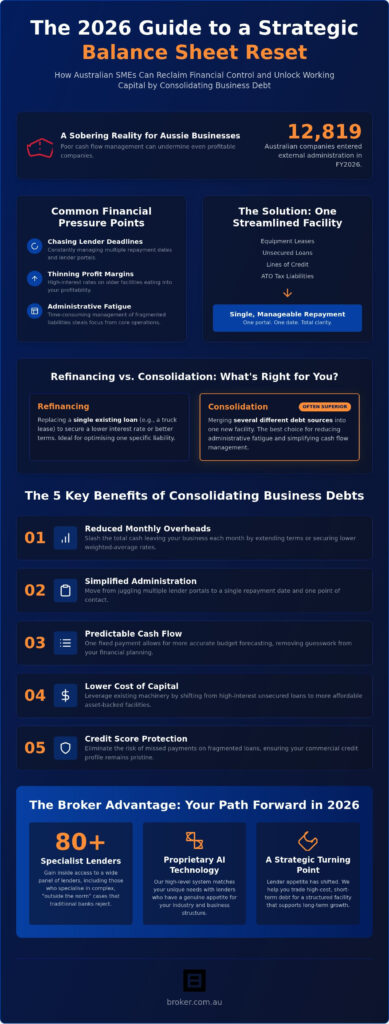
In the 2026 financial year, 12,819 Australian companies entered external administration; a sobering reminder that even profitable businesses can be brought down by poor cash flow management. If you feel like you’re constantly chasing lender deadlines or watching your margins thin out due to high interest rates on older facilities, you aren’t alone. Many SMEs are finding that refinancing asset finance Australia wide is no longer just an option but a necessity to maintain liquidity. Managing multiple portals and varying dates is an administrative burden that steals time from your core operations, especially with the added pressure of the “Payday Super” mandate and rising minimum wages.
This guide explains how to use a strategic “balance sheet reset” to reclaim control of your finances. You’ll learn how to restructure fragmented commercial liabilities to slash your monthly repayments and unlock the working capital you’ve been missing. We will preview the shift toward specialist lenders, the strategic benefit of clearing ATO debt, and how the expert team at Broker.com.au uses proprietary technology to find you a more efficient path forward. It’s time to move from administrative fatigue toward a state of streamlined confidence and relief.
Key Takeaways
- Discover how a strategic balance sheet reset can transition your business from managing high-rate volatility to achieving structured growth in the 2026 economic landscape.
- Learn how refinancing asset finance australia wide allows you to consolidate fragmented liabilities into a single facility, significantly reducing monthly overheads and administrative fatigue.
- Evaluate the critical differences between secured and unsecured consolidation structures to determine which path best protects your machinery while maximising liquid cash flow.
- Understand how to conduct a comprehensive debt audit to identify hidden exit costs, such as break fees and balloon payments, before committing to a restructure.
- Gain inside access to over 80 specialist lenders using proprietary AI technology designed to solve complex financial situations that traditional banks often reject.
Table of Contents
- What is Business Debt Consolidation in the 2026 Australian Market?
- The 5 Key Benefits of Consolidating Business Debts
- Comparing Consolidation Structures: Secured vs Unsecured
- How to Assess if Consolidation is Right for Your Business
- The Broker Advantage: Navigating 80+ Lenders in 2026
What is Business Debt Consolidation in the 2026 Australian Market?
In the current economic climate, many SMEs find themselves managing a patchwork of credit facilities that no longer serve their growth objectives. What is Business Debt Consolidation in a professional context? It’s the strategic process of merging multiple commercial liabilities into a single, streamlined facility. This approach is particularly relevant in 2026, as the Australian market transitions from a period of high-rate volatility toward a phase of structured growth. By consolidating, you replace fragmented, high-interest debt with a clear, singular path forward that provides immediate relief to your daily cash flow.
Most Australian businesses carry a variety of debt types that can be rolled into a more efficient structure. These typically include:
- Equipment leases and chattel mortgages for vehicles or specialised machinery.
- Unsecured business loans used for quick capital injections or inventory.
- Line of credit facilities that have become expensive over time.
- ATO tax liabilities, including BAS arrears or Superannuation Guarantee debts.
Managing these through separate lender portals is an unnecessary drain on your time and focus. When you explore refinancing asset finance australia wide through an expert broker, you gain inside access to a panel of over 80 lenders. This is vital for “outside the norm” cases where traditional banks might see complexity as a reason to reject an application. Our team acts as a high-level fixer, using proprietary AI technology to match your specific needs with lenders who have a genuine appetite for your industry and business structure.
The Difference Between Refinancing and Consolidation
While the terms are often used interchangeably, they serve different purposes in your business lifecycle. Refinancing involves replacing a single existing loan, such as a specific truck or excavator lease, to secure a lower interest rate or better terms. In contrast, consolidation merges several different debt sources into one manageable monthly repayment. Choosing the right path depends on your current cash flow needs. If you’re struggling with multiple due dates and high total repayments, consolidation is often the superior choice for reducing administrative fatigue and simplifying your business administration.
Why 2026 is a Strategic Turning Point for Debt Restructure
Lender appetite has shifted significantly this year. We are seeing a move toward more flexible commercial terms and a greater willingness to support debt restructure. AI-driven application processes are now standard, which drastically reduces the stress factor of complex financial assessments. When considering refinancing asset finance australia wide, it’s helpful to view it as a balance sheet reset. Strategic refinancing is a tool for unlocking trapped equity in business assets to fund future expansion. By acting now, you can trade high-cost, short-term debt for a structured facility that supports your long-term vision and provides the stability needed for growth.
The 5 Key Benefits of Consolidating Business Debts
Restructuring your commercial liabilities isn’t just a defensive move; it’s a proactive strategy to strengthen your foundation. When you commit to refinancing asset finance australia wide, you gain immediate advantages that ripple through every department. Here are the five primary benefits our clients experience:
- Reduced Monthly Overheads: By extending terms or securing lower weighted average rates, you can drastically cut the cash leaving your business each month.
- Simplified Administration: You move from juggling multiple lender portals to a single repayment date and one portal managed through your broker.
- Predictable Cash Flow: One fixed payment allows for more accurate 2026 budget forecasting, removing the guesswork from your weekly planning.
- Lower Cost of Capital: Shifting from high-interest unsecured loans to asset-backed facilities leverages your existing machinery to reduce total interest costs.
- Credit Score Protection: Eliminating the risk of missed fragmented payments ensures your commercial credit profile remains pristine for future needs.
A significant gap in most generic financial advice is the failure to address ATO tax debt. In 2026, lenders are increasingly receptive to including tax liabilities in a consolidation package. This settles your account with the tax office and stops the compounding interest charges that often stifle SME growth. Before proceeding, you should learn How to Assess if Consolidation is Right for Your Business to ensure your strategy aligns with your long-term goals.
Unlocking Working Capital for Growth Initiatives
The most immediate impact of a debt restructure is the sudden availability of liquid funds. This freed-up cash can be redirected into critical areas like business acquisition or upgrading to more efficient equipment. Beyond the numbers, there’s a profound psychological shift. Moving from a state of “debt stress” to “growth confidence” allows you to make decisions based on opportunity rather than obligation. A cleaner balance sheet also makes your business far more attractive to potential investors or partners. If you’re looking to fuel your next expansion, exploring Working Capital Finance can provide the necessary momentum.
Streamlining Your Financial Reporting and Compliance
Consolidation significantly reduces the admin fatigue associated with BAS preparation and end-of-financial-year (EOFY) reporting. Instead of reconciling a dozen different loan statements, your bookkeeper only deals with one. This efficiency leads to lower accounting costs and ensures you remain compliant without the last-minute scramble. Our team, including experts like Matt and Kylie, acts as your guide to ensure this transition is seamless. If you’re ready to simplify your operation, speaking with a specialist is the first step toward a more efficient future.
Comparing Consolidation Structures: Secured vs Unsecured
Choosing the right structure for your debt restructure is a pivotal decision. In 2026, the Australian lending market offers two primary paths: secured and unsecured consolidation. Secured consolidation involves using tangible assets like commercial property or heavy machinery as collateral. This path typically yields the lowest possible interest rates and longest terms, as the lender’s risk is mitigated by the physical asset. It’s an excellent choice for businesses looking for refinancing asset finance australia wide to lock in long-term stability.
Conversely, unsecured consolidation is built on the strength of your cash flow. Lenders prioritise your 2026 turnover and time in business over physical collateral. While the interest rates are generally higher than secured options, the speed of execution is unmatched. The trade-off is clear: you exchange a higher cost of capital for rapid access and the flexibility of not tying up specific assets. Navigating these requirements requires a nuanced understanding of current lender appetites, as many non-bank institutions have developed specialised niches for different industries.
Leveraging Asset Equity for Debt Restructuring
If your business owns machinery or vehicles outright, you are sitting on a powerful financial tool. A sale-and-leaseback arrangement allows you to sell your equipment to a lender and immediately lease it back. This provides a lump sum of capital to wipe out high-interest short-term debt while you retain full use of the machinery. Using the equity in your commercial vehicle fleet is another effective way to consolidate fragmented liabilities into a single, manageable facility. When considering your options for refinancing asset finance australia, our specialised Equipment Finance solutions can help you unlock this trapped capital efficiently.
The Speed Advantage of Unsecured Business Consolidation
There are moments when timing is more critical than the interest rate. Unsecured facilities can often be fast-tracked, with funding reaching your account in under 48 hours. This is particularly useful for SMEs facing sudden opportunities or urgent tax obligations. Approval criteria in 2026 focus heavily on consistent bank statements and a healthy Debt Service Cover Ratio (DSCR), often targeting the 1.25x gold standard. Unsecured consolidation can prevent “debt spirals” during seasonal cash flow dips. By moving quickly to consolidate smaller, high-pressure loans, you can restore your working capital and focus back on your core operations without the stress of daily repayment deadlines.
How to Assess if Consolidation is Right for Your Business
Before committing to a restructure, you must have a clear-eyed view of your current financial obligations. A successful debt reset begins with a comprehensive debt audit. You should list every outstanding balance, interest rate, and monthly repayment across your entire portfolio. This granular detail is essential when considering refinancing asset finance australia wide, as it allows you to identify exactly where your cash flow is being strangled. Don’t forget to include smaller, unsecured facilities that often carry the highest interest burdens.
Identifying “hidden” exit costs is the next critical step. Many commercial contracts include break fees, early termination charges, or significant balloon payments that can derail a consolidation plan if not accounted for early. You should also review your 2026 cash flow projections to find your “sweet spot”. This is the monthly repayment amount that balances debt reduction with the liquidity needed to meet new regulations like the “Payday Super” mandate. Finally, check your commercial credit file for errors; even a small inaccuracy can negatively impact the rate a new lender offers you.
Calculating the Real ROI of Debt Consolidation
When evaluating the return on investment, you must weigh the total interest paid over the life of the loan against the immediate monthly cash flow relief. While a longer term might mean paying more interest in total, the ability to unlock thousands in working capital each month is often the higher priority for growing SMEs. You also need to understand how origination fees are amortised into the new facility. For large-scale debt restructuring, professional corporate advisory is essential to ensure the new structure aligns with your long-term exit strategy or acquisition goals. You can start by using our Business Loan Calculator to model different scenarios.
The SME Documentation Checklist
Lenders in 2026 require high-quality, real-time data. You should prepare up-to-date P&L statements and balance sheets exported directly from Xero or MYOB. It’s also vital to export your ATO portal statements. Lenders want to see a clear history of tax compliance, or at the very least, a transparent view of any tax debt you intend to consolidate. Having these documents ready allows our team to move quickly, often securing approvals while others are still searching for paperwork. If you’re ready to see how refinancing asset finance australia could transform your cash flow, speak with an expert guide today.
The Broker Advantage: Navigating 80+ Lenders in 2026
Most business owners default to their primary bank when they consider refinancing asset finance australia wide. However, a single bank branch is limited by its own rigid credit policies and specific risk appetite. In the 2026 market, where interest rates have begun to stabilise but lender criteria remain tight, relying on one institution is a strategic risk. Our panel of 80+ specialist commercial lenders allows us to look beyond the standard “no” to find a structure that actually fits your business. We act as a high-level fixer, ensuring you aren’t held back by the limited perspective of a traditional lender.
We use proprietary AI technology to navigate this vast landscape with precision. It isn’t just about speed; it’s about matching “outside the norm” financial situations with the specific lenders most likely to offer an approval. This provides you with inside access to rates and terms that aren’t advertised to the general public. Instead of you chasing dozens of different banks, we bring the best options to you. This Expert Guide approach transforms a complex, high-stakes ordeal into a streamlined, stress-free process that moves you toward a state of relief.
Tailored Solutions for Complex SME Needs
Sometimes, your requirements are multifaceted. You might be looking to fund a business acquisition while simultaneously restructuring your existing debt to improve cash flow. We treat these as a single strategic move rather than separate headaches. Having a human partner like Matt or Kylie means there’s someone who understands the “why” behind your numbers. They provide the personal touch that a cold, digital portal or a large-scale bank simply can’t offer. Our “I’m interested” conversational approach is designed for busy directors who need high-level results without the high-pressure sales pitch.
Your National Partner in Commercial Finance
As an award-winning brokerage, our service is designed to scale with your business. Whether you’re a local firm looking to simplify administration or a national enterprise undertaking a major acquisition, we have the reach and expertise to support your journey. We pride ourselves on a proactive “can-do” attitude that solves the unique financial challenges of 2026. You aren’t just another file in a cabinet; you’re a partner whose success we are invested in. If you’re ready to trade administrative fatigue for structured growth, we are ready to help. I’m interested-let’s discuss your consolidation and refinancing options
Reset Your Balance Sheet for 2026 Growth
Transitioning from fragmented high-interest debt to a structured facility is a defining move for any ambitious SME. Throughout this guide, we’ve explored how a strategic debt audit and a clear understanding of secured versus unsecured structures can alleviate administrative fatigue. When you prioritise refinancing asset finance australia wide, you aren’t just cutting costs; you’re unlocking the working capital necessary to navigate the 2026 economic landscape with agility. By consolidating your liabilities, you trade uncertainty for a predictable, streamlined path forward.
As an award-winning commercial brokerage, Broker.com.au provides the expert guide you need to manage these complex transitions. Our team uses proprietary AI technology to give you inside access to over 80 Australian commercial lenders, ensuring we find a solution that fits your specific needs. Whether you’re clearing ATO debt or funding a national acquisition, we’re here to handle the heavy lifting. If you’re ready to move toward a state of streamlined confidence and relief, we’re ready to start the conversation. You’re in good hands with a team that goes above and beyond for your business.
I’m interested in consolidating my business debt
Frequently Asked Questions
Is it a good idea to consolidate business debt in 2026?
Yes, consolidating is highly strategic in 2026 as the Australian market shifts toward structured growth. By merging multiple facilities, you insulate your cash flow from the administrative burden of varying repayment dates. This is particularly vital for SMEs managing the 2026 “Payday Super” mandate. Refinancing asset finance australia wide allows you to trade high-cost, short-term debt for a single, manageable facility that supports long-term budget forecasting and stability.
Can I include ATO tax debt in a business debt consolidation loan?
You can certainly include ATO tax debt in a consolidation package, which is often a smarter move than a standard tax office payment plan. Settling BAS arrears or Superannuation Guarantee debts through a commercial loan stops compounding interest and improves your standing with other lenders. Lenders in 2026 view a cleared tax account more favourably than a lingering debt, making it easier to secure future growth capital when required.
How does asset refinancing work for equipment I already own?
Asset refinancing for equipment you own outright typically involves a sale-and-leaseback agreement. The lender purchases the equipment from you for a lump sum of capital, which you then lease back over a set term. This process allows you to unlock trapped equity to wipe out high-interest debts while maintaining full operational use of your machinery. It’s an efficient way to reset your balance sheet without sacrificing productivity.
Will consolidating my business loans hurt my commercial credit score?
Consolidation may cause a minor, temporary dip in your commercial credit score due to new enquiries, but it generally strengthens your profile long-term. By replacing fragmented repayments with a single facility, you eliminate the risk of missed payments that cause severe credit damage. A cleaner, well-managed debt structure is viewed positively by credit reporting bodies and future lenders, provided you maintain consistent, on-time repayments through your new portal.
What are the typical requirements for an unsecured consolidation loan in Australia?
For an unsecured consolidation loan in 2026, lenders primarily focus on your turnover and length of time in business rather than physical collateral. You’ll typically need to provide six months of bank statements, often exported directly from Xero or MYOB, to demonstrate consistent cash flow. Most specialist lenders look for a Debt Service Cover Ratio of at least 1.25x to ensure your business can comfortably manage the new repayment structure.
Are there early exit fees for paying off my existing asset finance early?
Most asset finance contracts in Australia do include early exit fees, often referred to as break costs or early termination charges. These can vary significantly depending on whether you have a chattel mortgage or a lease agreement. When refinancing asset finance australia wide, our team conducts a thorough audit to identify these hidden costs. We ensure the savings from your new, lower interest rate outweigh any penalties for paying off your existing facilities early.
How long does the business debt consolidation process take with a broker?
The timeframe varies depending on the complexity of your debt structure and whether the new facility is secured or unsecured. Unsecured consolidation can often be finalised in under 48 hours, provided your documentation is ready. Secured restructures involving property or heavy machinery typically take longer due to valuation requirements. Using our proprietary AI technology, we accelerate the matching process to ensure you reach a stress-free approval as quickly as possible.
What happens if my business has a default on its credit file?
Having a default on your credit file doesn’t automatically disqualify you from refinancing, though it may limit your options with traditional banks. Our role as a high-level fixer is to find non-bank lenders who specialise in “outside the norm” situations. We focus on the current health of your business and the reason for the default. By presenting a strong case through an expert guide, we can often secure competitive terms that help repair your credit.