
A bank won’t value your business on potential alone. If you’re asking how to value a business for a loan, the key is to show a lender more than an attractive sale price. You need to demonstrate reliable earnings, assets and cash flow that can support repayments, including if trading conditions tighten.
A conservative valuation can leave a buyer short of the funds needed to complete a purchase, particularly when goodwill, EBITDA and loan-to-value ratio (LVR) enter the discussion. A lender’s assessment may differ from the price a seller believes the business is worth. Understanding why can help you prepare a clearer case for business acquisition funding.
This 2026 Australian guide explains the income, market and asset-based methods lenders may consider, how goodwill is assessed, and which financial records can support a valuation. It also covers how valuation connects to acquisition finance, including equity contributions, loan servicing and cash-flow evidence. Broker.com.au specialises in business acquisition funding and can help you understand how to present your purchase to potential lenders.
Key Takeaways
- Learn how to value a business for a loan by considering the lender’s risk-focused assessment, not just the seller’s asking price.
- See how lenders may compare income, market and asset-based approaches to build a more balanced view of value.
- Find out which financial records and cash-flow evidence to organise before seeking acquisition finance.
- Explore practical ways to reduce perceived risk, such as showing that the business can operate without relying on you for every decision.
- Understand how Broker.com.au’s business acquisition funding service, proprietary AI technology and corporate advisory capability can support a complex purchase.
How to Value a Business for a Loan: Table of Contents
- Market Value vs Lending Value: Why Your Bank Sees Things Differently
- The 4 Core Valuation Methods Lenders Use in Australia
- Essential Documentation for a “Bank-Ready” Valuation
- How to Maximise Your Business Value Before Applying
- Navigating the Valuation Process with Broker.com.au
Market Value vs Lending Value: Why Your Bank Sees Things Differently
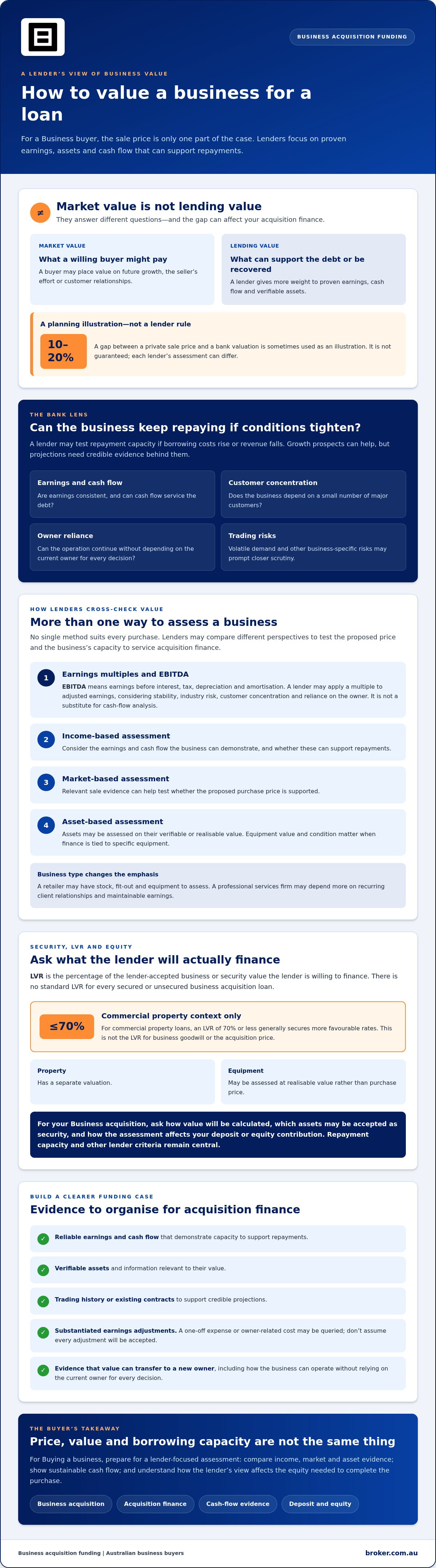
A seller’s price and a lender’s assessment answer different questions. Market value estimates what a willing buyer might pay in a sale. Lending value is a more conservative assessment of what the lender believes can support the debt or be recovered if repayments are not made. For a buyer arranging Business Acquisition Funding, that difference can affect the amount available to borrow and the equity contribution required.
A 10 to 20% gap between a private sale price and a bank valuation is sometimes used as a planning illustration, but it is not a fixed lender rule or a guaranteed reduction. The difference may reflect a buyer’s premium for future growth, while the lender gives more weight to proven earnings, cash flow and verifiable assets. A founder’s years of effort and customer relationships may represent valuable “sweat equity” to a buyer. A lender will look for evidence that this value can transfer to a new owner and help support the acquisition loan. These assessments draw on established business valuation principles, applied through a debt and recovery lens.
The “Bank Lens” on Business Worth
Lenders focus on whether the business can meet repayments under less favourable conditions, not only whether future growth looks promising. They may examine the consistency and quality of earnings, cash flow, customer concentration and the extent to which the operation depends on its current owner. Exposure to volatile demand, a small number of major customers or other business-specific risks can prompt closer scrutiny. There is no single risk rating that applies to every business in an industry.
Interest-rate changes and weaker trading conditions can affect the lender’s assessment of repayment capacity. For a Business Acquisition Funding application, a lender may test whether projected cash flow can still service debt if borrowing costs rise or revenue falls. Growth prospects can support the case, but projections need credible evidence behind them, such as trading history, existing contracts or a clear explanation of how the business will generate additional income.
Understanding Loan-to-Value Ratios (LVR)
LVR is the percentage of the lender-accepted business or security value that the lender is willing to finance. There is no standard LVR for every secured or unsecured business acquisition loan, so don’t assume a general figure applies to your purchase. Ask how the lender will calculate value, which assets it will accept as security, and how that assessment affects the deposit or equity contribution you need.
The type of security matters. Property has a separate valuation, while equipment may be assessed at its realisable value rather than its purchase price. For commercial property loans, an LVR of 70% or less generally secures more favourable rates. This benchmark should not be treated as the LVR for a business’s goodwill or its acquisition price. Unsecured lending may not use an asset-based LVR at all. Repayment capacity and the lender’s other criteria remain central.
The 4 Core Valuation Methods Lenders Use in Australia
No single valuation method suits every business purchase. A lender may compare earnings, assets and relevant sale evidence to test whether the proposed price is supported and whether the business can service acquisition finance. This cross-checking is sometimes called triangulation. Different methods offer different perspectives, but they do not guarantee that a lender will accept the seller’s asking price.
The business type affects which methods are most useful. A retailer may have stock, fit-out and equipment to assess, while a professional services firm may depend more on recurring client relationships and maintainable earnings. For an asset finance request tied to specific equipment, the lender may focus on that equipment’s value and condition rather than treating it as proof of the entire business’s worth.
Earnings Multiples and EBITDA
EBITDA means earnings before interest, tax, depreciation and amortisation. It is a common starting point for assessing operating performance, but it is not a universal measure of value or a substitute for cash-flow analysis. A lender may apply a multiple to adjusted earnings. The multiple can reflect factors such as earnings stability, industry risk, customer concentration and reliance on the owner.
Normalising earnings means identifying and substantiating adjustments that give a fairer picture of ongoing performance. For example, a buyer might ask whether a one-off expense or an owner-related cost should be treated differently. Don’t assume every adjustment will be accepted. Lenders may request supporting records and exclude items they consider unsupported or unlikely to recur.
Asset-Based and Capitalisation Methods
Four useful valuation lenses are earnings multiples, capitalisation of future maintainable earnings, discounted cash flow and asset-based valuation. Comparable sales provide a market cross-check. Capitalisation estimates value from sustainable earnings, while discounted cash flow assesses forecast cash flows over time. Both methods depend on assumptions, so projections need credible support rather than optimistic growth claims.
An asset-based valuation looks at the value of tangible holdings, such as equipment or stock, less liabilities. For a going concern, assets are considered as part of an operating business that continues trading. A liquidation valuation instead estimates what assets might realise if the business were wound down. It may not capture the value of an ongoing operation, its customer base or goodwill.
Comparable sales can help benchmark a purchase against similar Australian businesses. The comparison is useful only if differences in size, earnings, location, assets and sale conditions are considered. Public asking prices may not reflect completed sale prices.
For a buyer, the practical question is how to value a business for a loan in a way that supports both the purchase price and the repayment case. A clear valuation should explain its method, assumptions and evidence. If the acquisition is complex, consider discussing business acquisition funding options with a specialist familiar with the lender’s perspective.
Essential Documentation for a “Bank-Ready” Valuation
Well-organised records won’t automatically increase a business’s value, but they can make it easier to verify. For a buyer seeking Business Acquisition Funding, clear and consistent information helps a lender assess earnings, liabilities and the cash flow available to service an acquisition loan. A business profile adds context the accounts may not show on their own: what the business sells, who its customers are, how it operates and whether it depends heavily on the current owner.
Financial Statements and Tax Records
Prepare Profit and Loss statements for the last three financial years, along with an up-to-date Balance Sheet that discloses liabilities. Lenders may request a broader financial history, so check the requirements for your application. Include cash-flow information and explain material changes, unusual expenses or differences between reported earnings and bank activity.
Business Activity Statements (BAS) and relevant ATO records can help lenders compare reported turnover and tax information with the financial statements. Reconcile discrepancies rather than leaving them unexplained. Missing returns, inconsistent figures, undisclosed debts or unclear related-party transactions may prompt further questions, delay assessment or affect the lender’s view of risk.
Business Profile, Goodwill and Supporting Documents
Describe the business’s trading history, products or services, customer mix, staffing, key suppliers and the owner’s role. This profile helps explain the numbers and supports a buyer’s assessment of whether the business can continue operating after the sale.
Goodwill is harder to verify than physical assets. Lenders may look for evidence that customer relationships and earnings are likely to transfer to the new owner, such as repeat business, documented processes and a diverse customer base. Patents, trademarks and proprietary systems may support value when ownership, registration and commercial use are documented. Don’t assume an intangible asset will be accepted at the seller’s estimated value.
Review the lease and key supplier or customer contracts for terms that could affect continuity. Check expiry dates, transfer or assignment requirements, and any change-of-control conditions. A short lease or an agreement that may not continue after the sale can raise questions about future cash flow. Seek appropriate legal advice about contract terms before relying on them in your acquisition assessment.
Some lenders may request transaction data through Open Banking or another secure data-sharing process to review recent account activity. Treat this as a possible supplement, not a replacement for formal accounts, tax records or clear reconciliations. Confirm what information is requested and how it will be used.
To understand how to value a business for a loan, organise the evidence before making an application. Inconsistent accounts, missing tax documents, unexplained cash deposits or incomplete contract records are issues to address early, not details to leave for the lender to discover.
How to Maximise Your Business Value Before Applying
Before seeking Business Acquisition Funding, focus on making the business easier for a lender to understand and less risky to take over. Strong evidence of stable earnings and reliable operations can support your valuation and servicing case, but it won’t guarantee a higher lending figure. The aim is to show that the business can continue generating cash flow after ownership changes.
Reduce Owner-Dependency and Business Risk
If customers, suppliers or staff rely on the owner to make every decision, a lender may question how smoothly the business will operate after a sale. Document key processes, responsibilities and customer handovers so the business is not dependent on undocumented knowledge. A capable management team and clear operating procedures can help demonstrate continuity as a going concern.
Review customer concentration, too. If one client accounts for a large share of revenue, losing that relationship could affect the business’s ability to meet repayments. Where practical, build a broader customer base and keep evidence of repeat work and contract terms. Recurring revenue can make income more predictable and strengthen the valuation case, although it does not automatically secure a higher multiple. Lenders will still assess its stability, transferability and contribution to cash flow.
Clean Up the Financial Picture
Separate personal and business spending so reported results clearly reflect business operations. Add-backs are personal expenses paid by the business that are added back to profit to show true earning capacity. Each proposed adjustment needs supporting evidence. A lender may reject costs that are not clearly personal, properly recorded or unlikely to continue after the sale.
Work through the balance sheet before applying. Reconcile bank accounts, identify outstanding loans and other liabilities, and investigate old balances rather than leaving them unexplained. Review aged receivables and follow up overdue customer invoices. Check aged payables and agree a plan for amounts owed to suppliers. These steps help clarify working-capital needs and whether cash flow is being overstated by unpaid invoices or understated by overdue obligations.
- Remove or explain stale balances and duplicate entries.
- Confirm that debts, tax obligations and equipment finance are recorded accurately.
- Review stock for items that are obsolete, damaged or unlikely to sell.
- Keep evidence for any unusual transactions or earnings adjustments.
These changes take time to establish, so avoid last-minute adjustments that make the accounts harder to trust. A business buyer preparing for acquisition finance can work with an adviser to identify valuation issues and present the lender with a clearer picture. Explore business acquisition funding support to discuss your purchase and funding requirements.
Navigating the Valuation Process with Broker.com.au
A valuation is only one part of an acquisition finance decision. Lenders also consider the purchase structure, the buyer’s contribution and whether the business’s cash flow can support repayments. Broker.com.au specialises in Business Acquisition Funding and can help you understand how valuation evidence fits into the wider loan application, so you’re better prepared to discuss your purchase with potential lenders.
AI Technology and Business Acquisition Funding
Broker.com.au uses proprietary AI technology to facilitate quick and accurate loan applications. This can support the application process, but it does not replace a formal valuation or a lender’s own credit assessment. No technology can guarantee a particular valuation, predict approval or ensure a lender will accept the seller’s price.
Use an initial discussion to clarify what evidence may matter for your situation, including financial records, the proposed purchase price, business assets, cash-flow projections and your available equity. Ask how a lender may assess the business and what additional information could be required before you submit a formal application. This helps you prepare without assuming every lender will assess the industry or transaction in the same way.
For more information, explore Business Acquisition Funding and consider how the funding approach fits your purchase.
From Valuation to Funding
Complex acquisitions may need more than a straightforward review of the accounts. Broker.com.au’s corporate advisory capability can help address transaction complexity and consider how the valuation, funding requirement and purchase structure fit together. This can be useful when the proposed price includes goodwill, earnings need careful explanation, or the business’s operations are changing as part of the sale.
A specialist can also help you frame questions about lender criteria and consider whether secured or unsecured business loan options may suit your circumstances. The right structure depends on the transaction, available security, your equity contribution and evidence that expected cash flow can service the debt. The lender makes the final decision, so treat any early assessment as guidance rather than a confirmed offer.
Buying a business can feel demanding, especially when valuation terminology and lender requirements are unfamiliar. Start with a conversation about your goals and the evidence you have. If you’re ready to discuss your acquisition, get started with a business funding discussion.
Prepare Your Valuation with Confidence
Knowing how to value a business for a loan means looking beyond the asking price. Lenders assess whether earnings and cash flow can support repayments, while valuation methods, organised records and clear evidence of goodwill help build a credible case. For a buyer, reducing owner-dependency and resolving gaps in the financials can also make the purchase easier for a lender to assess.
Business Acquisition Funding involves more than a valuation figure. Your equity contribution, the proposed purchase structure and the business’s ability to service debt all matter. Preparing these details early can help you approach acquisition finance with greater clarity.
Broker.com.au is an award-winning Australian brokerage specialising in Business Acquisition Funding. Its proprietary AI technology supports loan applications, while its corporate advisory capability can help with complex deals. You don’t have to work through every lender requirement alone.
I’m interested in a business loan assessment. Take the next step with a clearer picture of your options and move towards your acquisition with confidence.
Frequently Asked Questions
Does the bank value goodwill when I apply for a business loan?
Yes, a lender may recognise goodwill, but it will usually want evidence that it is transferable and supported by earnings. For a business acquisition, goodwill might relate to an established customer base, repeat revenue or a recognised brand. The lender may take a cautious view if the business depends heavily on the seller or if the value is difficult to substantiate. Its assessment may differ from the seller’s estimate.
How much does a professional business valuation cost in Australia?
There is no single standard fee for a professional business valuation in Australia. The cost can depend on the business’s size and complexity, the valuation purpose, the information available and the scope of work required. Before proceeding, ask the valuer for a written quote that explains what is included and whether the report meets the lender’s requirements. Check with your lender first, as it may specify the type of valuation it will accept.
Can I use my own valuation, or does the lender appoint their own?
You can prepare your own estimate to understand the proposed purchase price, but don’t assume the lender will rely on it. A lender may require an independent valuation or assess the business using its own criteria and evidence. Before paying for a report, ask what format, scope and valuer credentials the lender requires. Your own analysis can still help explain the asking price and identify gaps to resolve.
What is a “Multiple of Earnings” and how is it calculated?
A multiple of earnings estimates a business’s value by multiplying an earnings measure by an appropriate multiple. For example, a valuer may assess maintainable EBITDA, which is earnings before interest, tax, depreciation and amortisation, then apply a multiple based on the business’s risk and characteristics. The earnings figure may be adjusted to reflect ongoing operations, but proposed adjustments need evidence. Lenders may scrutinise both the calculation and the assumptions behind it.
How does my industry affect the valuation multiple?
Industry can influence the multiple because it affects how a lender views the reliability and risk of future earnings. A business with predictable, recurring revenue may be assessed differently from one exposed to seasonal demand or a small number of major customers. Industry alone does not determine value. The business’s financial history, cash flow, customer concentration, owner-dependency and the quality of its records also matter to a lender.
What happens if the bank valuation comes in lower than the purchase price?
If the lender’s valuation is below the agreed price, the gap may affect how much it is prepared to lend. As the buyer, you could discuss a price adjustment with the seller, contribute more equity, or ask whether other acceptable security or a revised funding structure could address the shortfall. The lender must assess any revised proposal, so confirm your options before committing to a purchase or relying on additional borrowing.
How often should I revalue my business for financing purposes?
There is no universal revaluation timetable for business financing. Consider seeking an updated assessment when preparing for a loan application, buying or selling a business, or when material changes have affected earnings, assets or the business structure. Ask the lender what valuation date and report format it requires, as an older assessment may not reflect current trading or satisfy its assessment process.
Can I include my personal assets to boost the business valuation?
Personal assets don’t increase the value of the business itself, so keep the valuation separate from your personal financial position. However, a lender may consider your assets and liabilities when assessing your overall application, and may discuss whether acceptable security is available. This is different from proving the business’s earnings and ability to service acquisition finance. Ask how any proposed personal security would affect your borrowing and obligations.