Did you know that 61% of Australian business operators abandon traditional bank loan applications because the documentation is too cumbersome? When you’re securing business acquisition funding, the last thing you need is a complex process that results in a repayment schedule suffocating your profit margins. We understand that high interest rates, with the RBA cash rate currently at 4.35%, can make managing debt feel like a constant weight on your shoulders. It’s stressful when monthly outgoings eat into the cash flow you need to grow your new venture. This guide reveals proven strategies to lower business loan repayments by engineering a smarter debt structure from the start.
Whether you’re a first-time business buyer or a seasoned entrepreneur, we’ll show you how to move from uncertainty to streamlined confidence. We’ll explore how to leverage acquisition finance, utilise interest-only periods, and negotiate vendor finance to protect your bottom line. You’ll discover a clear path to buying a business with a repayment plan that actually supports your long-term goals. From understanding secured options to accessing unadvertised wholesale rates, we provide the expert insight you need to keep your business acquisition moving forward with ease.
Key Takeaways
- Master specific strategies to lower business loan repayments by engineering a bespoke debt structure tailored to your SME’s unique cash flow needs.
- Learn how to transition from high-interest unsecured facilities to secured funding to significantly reduce your interest burden and protect your profit margins.
- Discover how every business buyer can leverage acquisition finance to balance the purchase of goodwill and physical assets for maximum repayment efficiency.
- Explore advanced techniques like balloon payments and lines of credit to lower immediate monthly obligations and provide greater operational flexibility.
- Gain “inside access” to wholesale rates from over 100 lenders through specialist broker insights that aren’t available to the general public.
Table of Contents
- Understanding the Levers of Business Loan Repayments
- Strategic Refinancing and Debt Restructuring
- Strategies for the Business Buyer: Acquisition Finance
- Advanced Repayment Reduction Techniques
- The Broker Advantage: Accessing ‘Inside’ Rates
Understanding the Levers of Business Loan Repayments
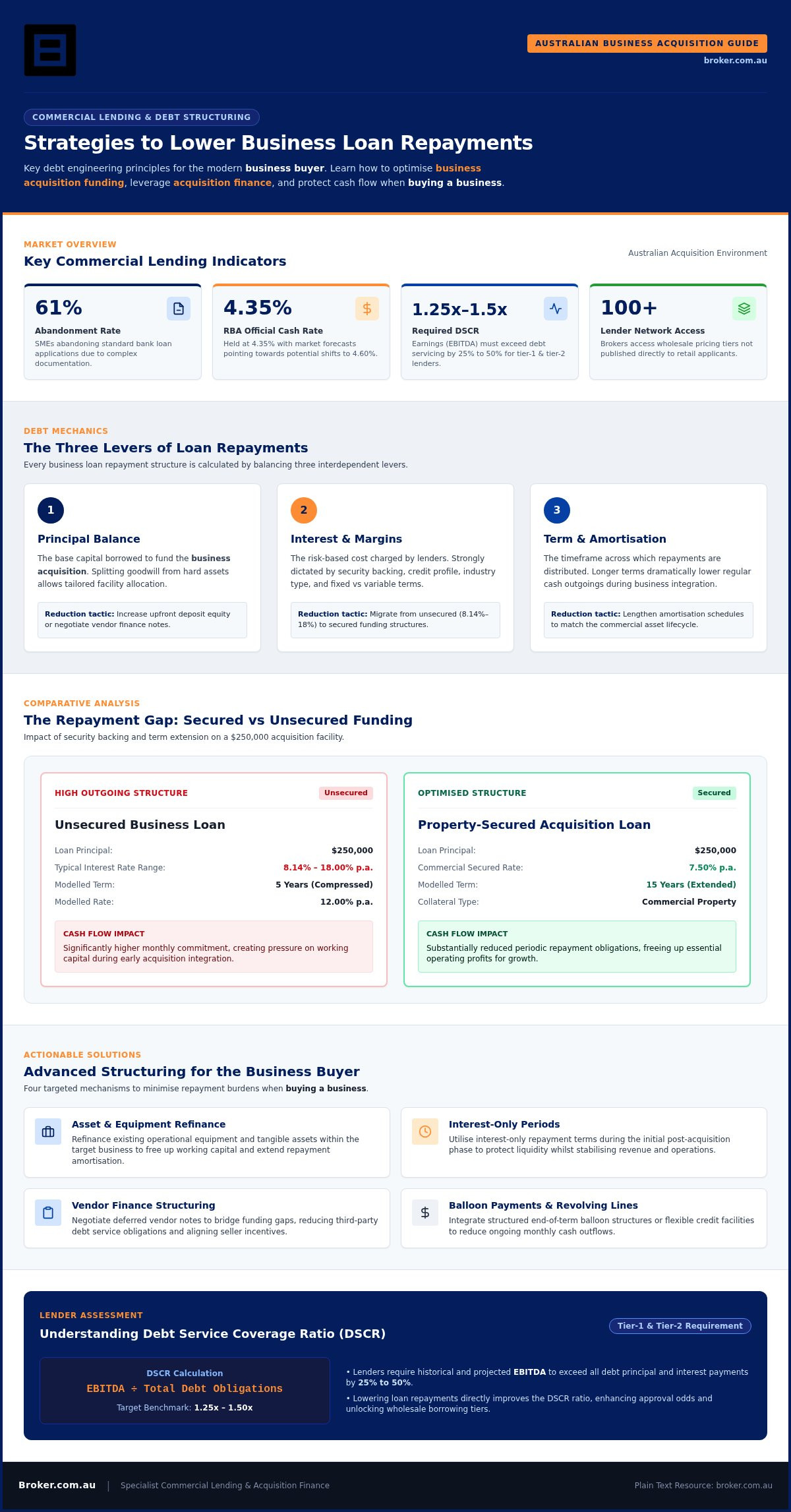
Lowering your monthly outgoings begins with understanding that every repayment is a calculated balance of three distinct levers: principal, interest, and term. For a business buyer, managing these components is essential to ensure that the debt doesn’t stifle the very growth you’re trying to achieve. The Reserve Bank of Australia (RBA) held the official cash rate at 4.35% in August 2026, though market analysts suggest a potential shift to 4.60% by the end of the year. This movement directly influences commercial lending margins, making it vital to implement effective strategies to lower business loan repayments before rates climb further.
Lenders assess your suitability through “servicing” requirements, focusing heavily on your Debt Service Coverage Ratio (DSCR). In the current Australian landscape, most tier-1 and tier-2 lenders demand a DSCR between 1.25x and 1.50x. This means your earnings before interest, tax, depreciation, and amortisation (EBITDA) must exceed your debt obligations by at least 25% to 50%. Choosing between a fixed or variable rate will also impact your cash flow volatility. While fixed rates provide repayment certainty, variable rates often offer the flexibility to make extra repayments without penalty, which can be a powerful tool for a proactive business buyer.
The Impact of Loan Terms and Amortisation
Extending your loan term is one of the most immediate strategies to lower business loan repayments. By spreading the principal over a longer period, you reduce the immediate pressure on your monthly cash flow, which is particularly useful during the integration phase of a business acquisition. However, there’s a clear trade-off; a longer term typically results in a higher total interest cost over the life of the loan. In Australian SME lending, amortisation refers to the structured reduction of a debt’s principal balance over a set timeframe through regular, calculated instalments.
Interest Rates vs. Total Cost of Finance
While a headline interest rate is important, it isn’t the only factor determining your repayment size. Lenders utilise risk-based pricing, where the interest rate offered is tailored to your credit profile, the industry, and the level of security provided. When applying debt refinancing principles to a new purchase, you can replace expensive short-term debt with a facility that matches the business’s natural cash cycle. We recommend using a business loan calculator to model how different deposit levels or acquisition finance structures affect your servicing capability. This ensures you’re not just looking for the lowest rate, but the most efficient overall funding solution for buying a business.
Strategic Refinancing and Debt Restructuring
Many Australian SMEs carry “lazy” debt that hasn’t been reviewed in over 24 months. This often includes multiple high-interest facilities that could be merged into a single, more efficient facility. For a business buyer, this consolidation is one of the most effective strategies to lower business loan repayments during a business acquisition. By aligning various debts under one lender, you can often negotiate better margins and reduce the administrative burden of managing multiple monthly outgoings. Asset finance also plays a vital role here, allowing you to refinance existing equipment to free up working capital for immediate growth needs.
Transitioning from unsecured business loans to secured funding is a game-changer for your bottom line. Unsecured rates in 2026 often sit between 8.14% and 18.00% p.a., whereas secured options can drop significantly lower. The Australian government highlights various ways to reduce your loan costs, emphasizing the importance of competitive non-bank lenders. If your business has built equity or you’re using property to back your acquisition finance, the savings are substantial. Moving debt to a secured structure doesn’t just lower the rate; it often allows for longer amortisation terms that further ease cash flow pressure.
Secured vs. Unsecured: The Repayment Gap
The difference in monthly outgoings between secured and unsecured debt is stark. Consider a $250,000 loan. An unsecured facility might require repayment over 5 years at 12% p.a., creating a heavy monthly burden. By contrast, securing that same $250,000 against commercial property with a 15-year term at 7.5% p.a. slashes the periodic commitment. While using residential equity can lower rates even further, you must be cautious of cross-collateralisation. This occurs when one security covers multiple loans, potentially limiting your future flexibility. We focus on helping you structure these facilities to maintain independence between your personal and business assets.
Timing the Market for a Loan Restructure
Knowing when to restructure is just as important as knowing how. Signs your business is ready include improved BAS statements, a consistent rise in EBITDA, or a stronger balance sheet after buying a business. These indicators suggest you’ve moved into a lower risk category, allowing you to access better pricing. Robust financial modelling is your best tool to impress new lenders and prove your servicing capability. If you feel your current debt structure is holding you back, starting a low-pressure conversation with an expert can help you identify the right time to pivot toward a more sustainable path.
Strategies for the Business Buyer: Acquisition Finance
A business acquisition is rarely a one-size-fits-all transaction. Unlike standard operational loans, acquisition finance must be engineered around the specific cash flow profile of the target entity. A savvy business buyer understands that balancing the purchase of intangible goodwill against physical assets isn’t just a tax consideration; it dictates your repayment capacity. While physical assets can be financed over longer terms using equipment or property security, goodwill often requires shorter, more aggressive amortisation. Aligning these tranches with the new business’s seasonal cycles ensures you aren’t caught short during quieter trading months.
Structuring business acquisition loans involves deep financial modelling to ensure the debt service doesn’t outpace the business’s natural rhythm. If you’re acquiring a seasonal enterprise, such as a tourism or retail business, your repayment schedule should reflect those peaks and troughs. This bespoke approach prevents cash flow volatility from becoming a threat to your integration plans. It’s about moving away from rigid bank products toward a facility that breathes with your business.
Structuring Acquisition Loans for Maximum Cash Flow
The first 12 months after buying a business are often the most precarious. Integrating new systems and staff while managing debt can strain even the healthiest margins. One of the primary strategies to lower business loan repayments during this phase is negotiating interest-only periods. Australian lenders frequently grant 1 to 3 years of interest-only terms for acquisitions, which suppresses immediate cash outflow while you stabilise operations. Additionally, incorporating Working Capital Finance into your initial structure provides a vital buffer. This ensures that your primary loan remains dedicated to the purchase price while your day-to-day liquidity stays protected.
Deposit and Equity Requirements for Business Buyers
In 2026, Australian lenders typically require a business buyer to provide an equity injection of 20% to 35% for standard deals. If the purchase is heavily weighted toward goodwill without property backing, this requirement can rise to 30% or even 50%. You can often meet these thresholds by leveraging existing business assets or property equity to secure the deal. A powerful way to reduce bank debt is through vendor finance, where the seller provides a loan for 10% to 30% of the purchase price. This seller note often carries deferred repayments or lower interest, directly substituting high-cost senior debt and significantly improving your overall serviceability.
Advanced Repayment Reduction Techniques
Beyond standard refinancing, sophisticated strategies to lower business loan repayments involve alternative facility types that offer greater precision. For an Australian business buyer, these tools are essential for managing the high-pressure integration phase after a business acquisition. One such method is Invoice Finance. Instead of taking on traditional debt with fixed monthly costs, you sell your outstanding invoices to a funder. This provides immediate liquidity without the recurring principal-and-interest burden of a standard loan. Additionally, business owners with residential mortgages can utilise debt recycling to convert non-deductible personal debt into tax-deductible business debt, effectively improving the net cash position of the enterprise.
Balloon Payments and Asset Finance
Balloon payments, or residuals, are highly effective strategies to lower business loan repayments on equipment and vehicles. By deferring a large portion of the principal, often 30% to 50%, to the end of the loan term, you drastically reduce your monthly outgoings. This is a common tactic when structuring acquisition finance for heavy-industry or transport businesses. A chattel mortgage assists with cash flow by allowing the business buyer to claim the full GST on the asset’s purchase price in their next BAS while keeping the loan repayments manageable. To avoid the “End of Term” trap, we recommend modelling the asset’s future market value to ensure you aren’t left with a residual payment higher than the asset’s worth.
Flexible Facilities: Line of Credit and Overdrafts
Switching from a high-repayment term loan to a flexible Line of Credit can be a strategic move after buying a business. Unlike a term loan, a Line of Credit allows you to draw down funds as needed, meaning you only pay interest on the utilised balance. This is perfect for smoothing out the cash flow volatility often seen in the first year of ownership. Managing day-to-day operations without increasing fixed debt gives you the breathing room to focus on integration. For those with property security, an interest-only period on commercial property loans can also suppress repayments for 1 to 5 years. This allows you to prioritise high-ROI activities during the critical early stages of your new venture.
Ready to see how these structures could work for your specific scenario? I’m interested in exploring these advanced debt structures.
The Broker Advantage: Accessing ‘Inside’ Rates
Accessing the most competitive margins requires more than a simple web search. A specialist broker acts as a high-level fixer, navigating the significant gap between the “Big 4” banks and over 100 non-bank lenders. For a business buyer, this means discovering strategies to lower business loan repayments that aren’t available to the general public. We utilise proprietary AI-driven financial modelling to stress-test your application against various lender criteria. This ensures you land with the most repayment-efficient provider while maintaining a seamless, professional experience from start to finish.
A business acquisition often falls “outside of the norm” for traditional branch managers. Whether you’re dealing with complex M&A structures or unique acquisition finance needs, a broker provides the inside access required to unlock discretionary pricing. This is particularly vital when buying a business with a mix of goodwill and physical assets; different lenders have vastly different appetites for these risks. We pride ourselves on finding solutions where others see roadblocks, ensuring your debt structure supports your long-term dreams.
Navigating Complex Lender Requirements
Brokers understand exactly how to “package” your application to reduce perceived risk and secure lower rates. This packaging can mean the difference between an “A-tier” bank rate and a more expensive “B-tier” alternative. A-tier lenders often provide the sharpest rates but maintain the most rigid credit policies. B-tier lenders offer the flexibility needed for complex scenarios that don’t fit a standard box. By addressing potential lender concerns regarding deposit requirements or servicing ratios upfront, we help secure award-winning finance solutions that remain stress-free.
Getting Started with a Debt Review
Starting the process is as simple as a low-pressure “I’m interested” conversation. To begin a quick, AI-assisted loan assessment, you’ll generally need your latest BAS statements, profit and loss reports, and historical financials for the target entity. Our technology quickly scans these documents for accuracy, matching your profile with lenders who have a high appetite for your specific industry. This review identifies exactly where you can trim monthly outgoings and streamline your debt facilities for better growth. It’s time to move from uncertainty to a feeling of streamlined confidence.
Organise a comprehensive debt review with our expert team today to see how we can optimise your cash flow and protect your profit margins.
Take Control of Your Business Cash Flow
Securing a sustainable future for your SME involves more than just accepting the first offer from a major bank. The most effective strategies to lower business loan repayments involve engineering a debt structure that aligns with your specific operational cycle. Whether you’re a business buyer navigating a complex business acquisition or an established owner looking to consolidate “lazy” debt, the right security profile and amortisation term make all the difference. By moving from high-interest unsecured facilities to tailored acquisition finance, you protect the profit margins you’ve worked so hard to build.
You don’t have to navigate the complexities of the 2026 lending landscape alone. Our award-winning finance brokers provide expert guidance for complex restructures and inside access to 100+ lenders, ensuring you get the best possible terms for your situation. We’re here to help you move from financial uncertainty toward streamlined confidence. Your next phase of growth is well within reach when you have the right partner by your side to unlock the best opportunities in the market.
I’m interested in lowering my repayments
Frequently Asked Questions
What is the fastest way to lower my monthly business loan repayments?
The fastest way to lower your monthly outgoings is often through debt restructuring or extending your loan term. By spreading the principal over a longer period, you immediately reduce the pressure on your cash flow. Another effective strategy is moving from high-interest unsecured debt to a secured facility. Implementing these strategies to lower business loan repayments allows you to reinvest those savings back into your core operations while maintaining a more sustainable financial position.
Can I refinance my business loan if I have an outstanding ATO debt?
Refinancing with an outstanding ATO debt is possible, though it typically requires a specialist broker to navigate non-bank lender requirements. Traditional banks often view tax debt as a red flag, but many boutique funders specialise in situations outside the norm. We can help you package a submission that includes a clear plan to clear the debt, often merging the ATO balance into a new, lower-rate facility to streamline your monthly commitments and reduce stress.
How much deposit do I need for a business acquisition in Australia?
A business buyer in Australia typically needs an equity injection of 20% to 35% for a standard business acquisition. If the deal is heavily weighted toward goodwill rather than physical assets, lenders may require a deposit of up to 50%. You can often meet these requirements by leveraging equity in existing commercial or residential property. Using experts ensures you structure the deal to satisfy lender servicing tests while keeping your upfront cash outlay manageable.
What is the difference between a secured and unsecured business loan rate?
The primary difference lies in the interest rate and the level of risk for the lender. Secured business loans are backed by collateral, such as property or equipment, and currently offer rates between 6.74% and 9.50% p.a. in the Australian market. Unsecured loans don’t require specific assets but carry higher rates, often ranging from 8.14% to over 18.00% p.a. Choosing a secured option is one of the most reliable strategies to lower business loan repayments.
Is it possible to switch to interest-only repayments on an existing loan?
Switching to interest-only repayments is possible on many existing facilities, either through a variation with your current lender or by refinancing to a new provider. This structure is particularly helpful for a business buyer during the first 1 to 3 years of ownership. While it doesn’t reduce the total debt, it significantly suppresses your immediate monthly outgoings. This creates a vital cash flow buffer while you focus on integrating a new business acquisition and driving revenue growth.
How does a balloon payment affect my monthly equipment finance costs?
A balloon payment lowers your monthly equipment finance costs by deferring a percentage of the principal, usually between 30% and 50%, to the end of the term. This means you only pay interest and a portion of the principal during the life of the loan. It’s an efficient way to keep repayments low for vehicles or machinery. However, you must plan for the final lump sum payment through refinancing or selling the asset before the term expires.
Will refinancing my business loan impact my credit score?
Refinancing will trigger a hard inquiry on your credit file, which may cause a minor, temporary dip in your score. However, the long-term impact is often positive. By securing a more manageable repayment structure and improving your business’s cash flow, you’re less likely to miss future payments. Lenders value a consistent repayment history over a single inquiry, especially when the restructure leads to a more robust and sustainable financial position for your enterprise.
How can a broker help me get a better rate than my current bank?
A broker provides inside access to over 100 lenders, including non-bank and private funders that don’t deal directly with the public. While your current bank only offers its own products, we use AI-driven modelling to compare the entire market and find the most repayment-efficient lender for your needs. We often secure discretionary pricing discounts that are unadvertised, giving you a competitive advantage that goes far beyond the standard retail rates found at a local branch.