Is your current debt structure a launchpad for growth, or is it the very thing holding you back from your next major acquisition? Many Australian business owners find themselves juggling multiple lenders, each with different interest rates and repayment cycles that drain both time and capital. It’s a common struggle that often leaves you feeling like you’re managing paperwork rather than a growing enterprise.
Understanding the strategic benefits of consolidating business debts is the first step toward reclaiming control of your cashflow. By streamlining your liabilities, you don’t just reduce monthly administrative headaches; you actively improve your borrowing power. This shift is essential for any serious business buyer looking to secure acquisition finance for their next venture. We’ll show you how a tailored approach to debt restructuring simplifies your repayments and prepares your enterprise for a successful business acquisition. You’ll discover how to transition from financial complexity to streamlined confidence, ensuring you’re in the best possible shape when buying a business.
Key Takeaways
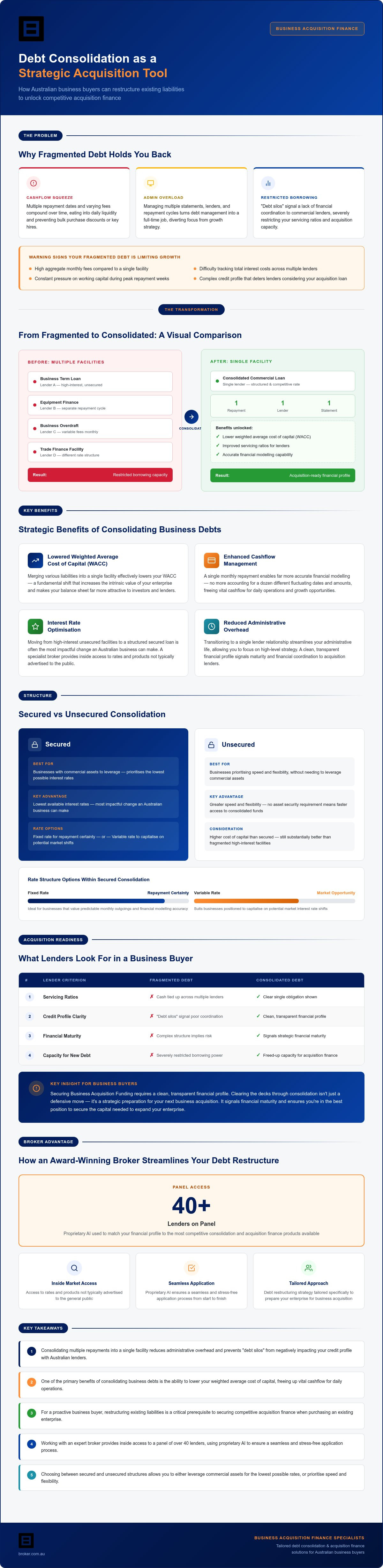
- Consolidating multiple repayments into a single facility reduces administrative overhead and prevents “debt silos” from negatively impacting your credit profile with Australian lenders.
- One of the primary benefits of consolidating business debts is the ability to lower your weighted average cost of capital, freeing up vital cashflow for daily operations.
- For a proactive business buyer, restructuring existing liabilities is a critical prerequisite to securing competitive acquisition finance when purchasing an existing enterprise.
- Working with an expert broker provides inside access to a panel of over 40 lenders, using proprietary AI to ensure a seamless and stress-free application process.
- Choosing between secured and unsecured structures allows you to either leverage commercial assets for the lowest possible rates or prioritise speed and flexibility.
Table of Contents
- Why Fragmented Debt Hinders Australian Business Growth
- The Strategic Benefits of Consolidating Business Debts
- Leveraging Consolidation for Future Business Acquisitions
- Secured vs Unsecured Consolidation: Choosing the Right Structure
- How an Award-Winning Broker Streamlines Your Debt Restructure
Why Fragmented Debt Hinders Australian Business Growth
Managing multiple debt facilities often feels like a full-time job that you never applied for. Between different repayment dates, varying interest rates, and a mountain of administrative overhead, the drag on your resources is significant. This isn’t just about the time spent on spreadsheets; it’s about the financial friction that slows your momentum. When your liabilities are scattered across different lenders, you’re likely paying more in aggregate fees and interest than necessary.
The Cashflow Squeeze of Multiple Repayments
Fragmented debt acts as a structural barrier that prevents a company from scaling operations or responding to market opportunities. Each separate loan comes with its own set of fees and service charges. Over time, these costs compound, eating into your day-to-day liquidity. This lack of operational flexibility means you might miss out on bulk purchase discounts or the ability to hire key staff when they become available. One of the core debt consolidation strategies involves bringing these disparate elements into a single, manageable facility. By focusing on the benefits of consolidating business debts, you can transform a chaotic balance sheet into a streamlined engine for growth. Common signs that fragmented debt is hindering your growth include:
- High aggregate monthly fees compared to a single facility.
- Difficulty tracking total interest costs across multiple lenders.
- Constant pressure on working capital during peak repayment weeks.
Impact on Borrowing Capacity
When you’re ready to take the next step, such as buying a business, Australian lenders will scrutinise your existing commitments. These “debt silos” often signal a lack of financial coordination to a commercial credit team. They look closely at your servicing ratios, which is your ability to meet all repayment obligations from your current cashflow. If your cash is tied up in inefficient, high-interest repayments across several different lenders, your borrowing power is severely restricted.
For a serious business buyer, this represents a major hurdle. Securing Business Acquisition Funding requires a clean, transparent financial profile. Lenders want to see that you have the capacity to take on new acquisition finance without overstretching your resources. If your current debt structure is complex, you’re essentially telling a lender that you might struggle with the added weight of a new purchase. Clearing the decks through consolidation isn’t just a defensive move; it’s a strategic preparation for your next business acquisition. It signals financial maturity and ensures you’re in the best position to secure the capital needed to expand your enterprise.
The Strategic Benefits of Consolidating Business Debts
Beyond merely surviving the month, the primary benefits of consolidating business debts lie in the strategic repositioning of your balance sheet. By merging various liabilities into a single facility, you can effectively lower your Weighted Average Cost of Capital (WACC). This isn’t just a technical win; it’s a fundamental shift that increases the intrinsic value of your enterprise. A cleaner balance sheet is far more attractive to potential investors or lenders when you eventually look at Business Acquisition Funding to scale your operations. Transitioning to a single lender relationship also streamlines your administrative life, allowing you to focus on high-level strategy rather than chasing multiple statements.
Interest Rate Optimisation
Moving from high-interest unsecured facilities to a structured secured loan is often the most impactful change an Australian business can make. In the current rate environment, the spread between unsecured short-term finance and a secured commercial loan can be substantial. Working with a specialist broker provides inside access to rates and products that aren’t typically advertised to the general public. Whether you opt for a fixed rate to ensure repayment certainty or a variable rate to capitalise on potential market shifts, the goal is to minimise interest margins. By leveraging the benefits of consolidating business debts, you can secure a more competitive position that protects your margins as the business grows.
Enhanced Cashflow Management
Streamlining your debts into one monthly repayment does more than just save time. It allows for far more accurate financial modelling, as you no longer have to account for a dozen different fluctuating dates and amounts. This predictability is vital when you’re looking to free up capital for reinvestment or considering additional asset finance for new equipment. By centralising your liabilities, you significantly reduce the risk of missed payments and the subsequent credit damage that can occur when managing a fragmented portfolio. This structured approach creates a stress-free environment where your capital works for you, rather than just servicing old obligations. For any proactive business buyer, this level of control is essential when preparing to secure acquisition finance for a new venture. Having your house in order makes the process of buying a business far more efficient, as lenders can clearly see your repayment capacity without the noise of multiple small debts.
Leveraging Consolidation for Future Business Acquisitions
For a savvy business buyer, the benefits of consolidating business debts extend far beyond simpler admin. It’s a strategic move designed to reposition your enterprise for aggressive growth. When you’re preparing to approach a lender for Business Acquisition Funding, your current balance sheet serves as your primary resume. A cluttered financial profile with multiple high-interest liabilities signals risk. Conversely, a consolidated debt structure demonstrates financial maturity and a sophisticated approach to capital management. By tidying up your existing obligations, you create the clear financial runway needed to secure the capital for your next purchase.
Preparing the Balance Sheet for Acquisition Finance
Lenders evaluate a business buyer based on their ability to service new debt while comfortably maintaining existing commitments. One of the most critical metrics they scrutinise is your debt-to-income ratio. If your cashflow is fragmented across several lenders, your servicing capacity appears restricted. This often leads to lower loan-to-value ratio (LVR) offers or higher interest rates on your new Acquisition finance. By consolidating your debts into a single facility with a longer term, you effectively lower your monthly outgoings. This improves your servicing profile, making you a much more attractive candidate for a new acquisition loan. You’ll need to show stable, predictable cashflow that can cover the repayments of both your restructured debt and the new funding required for buying a business.
Funding Options for the Business Buyer
Buying a business typically requires a substantial deposit, often ranging from 30% to 50% depending on the industry and the nature of the assets involved. Restructuring your current liabilities can often unlock equity in existing commercial property or equipment, which can then be used to satisfy these deposit requirements. This “clean slate” approach allows you to combine your old debts with your new Business Acquisition Funding into one cohesive structure. At Broker.com.au, we specialise in crafting these acquisition-focused debt structures. We use proprietary AI technology to scan the market, ensuring you get inside access to the best rates and lender terms. Our goal is to make the transition as seamless and stress-free as possible, providing you with the expert guidance needed to navigate complex lender requirements. Whether you’re looking at secured or unsecured options, having a professional advisor by your side ensures you’re in good hands throughout the entire process.
Secured vs Unsecured Consolidation: Choosing the Right Structure
Choosing the right architecture for your debt restructure is a pivotal decision for any growing enterprise. The path you take depends on your available assets, current cashflow, and immediate growth targets. While both paths offer the primary benefits of consolidating business debts, they serve different strategic purposes. A secured facility is often a long-term play for the lowest possible cost, whereas unsecured options prioritise speed and the preservation of equity for future opportunities. Understanding these nuances is essential for any business buyer who wants to maintain a lean and agile financial profile.
When to Choose a Secured Facility
If your business owns commercial real estate or has significant equity in heavy machinery, a secured loan is typically the most cost-effective route. By providing collateral, you signal lower risk to the lender, which translates directly into reduced interest margins. However, a sophisticated business buyer must be wary of cross-collateralisation. This occurs when a lender ties multiple assets together, potentially restricting your ability to sell or refinance individual properties later. Our expert advisors help you navigate these lender requirements to ensure your structure remains flexible. Secured loans provide extended repayment windows that ensure monthly commitments remain sustainable.
The Flexibility of Unsecured Consolidation
Not every business wants to tie up its property. If you have a strong, consistent cashflow, an unsecured consolidation loan offers a high degree of flexibility without the need for physical collateral. This is particularly useful for a business buyer who wants to keep their property equity “dry” for a future deposit on a new business purchase. This approach is one of the key benefits of consolidating business debts for those who value liquidity over the absolute lowest rate. The application process is often much faster. At Broker.com.au, our proprietary AI technology facilitates rapid unsecured applications, often moving from interest to approval in a fraction of the time required for traditional bank loans. This speed allows you to act quickly when buying a business, ensuring you don’t miss out on a prime opportunity due to slow funding. Eligibility generally requires a clean credit history and a proven track record of revenue, making it an elite choice for established SMEs looking to secure Acquisition finance.
To see which structure fits your next move, get started with a tailored assessment from our award-winning team.
How an Award-Winning Broker Streamlines Your Debt Restructure
Navigating the Australian lending landscape requires more than just a basic understanding of interest rates. It demands an expert guide who can untangle complex liabilities and present a clear path forward. While a single bank can only offer its own rigid products, an award-winning broker provides inside access to a panel of over 40 lenders. This competition is one of the key benefits of consolidating business debts, as it ensures your restructure is built on the most competitive terms available in the market today. We act as a high-level fixer, ensuring your finance is working for you rather than against you.
Beyond Traditional Banking
Big banks often struggle with situations that fall outside of their standard credit policies. If your business has a unique structure or you’re a business buyer looking for specialised Acquisition finance, a traditional branch manager might not have the tools to help. We pride ourselves on being seasoned partners who go above and beyond to find solutions where others see obstacles. By working with dedicated team members like Matt, Kylie, or Flavio, you receive a boutique level of personal attention that a large-scale bank simply can’t match. This tailored approach alleviates the anxiety of high-stakes financial decisions, moving you from uncertainty toward a state of streamlined confidence. We ensure your debt structure isn’t just fixed for today but is designed to evolve as you scale your enterprise.
Getting Started with Your Restructure
The process of buying a business is demanding enough without the added stress of managing a fragmented balance sheet. Our proprietary AI technology facilitates quick and accurate loan applications, ensuring that your documentation meets the strict requirements of Australian commercial lenders. This speed is a significant advantage for any business buyer who needs to move decisively when a prime opportunity arises. To begin, we perform a comprehensive evaluation of your current debt to identify immediate savings and cashflow improvements. We then guide you through the documentation phase, ensuring every detail is polished before submission. This seamless transition allows you to focus on the nuances of your business acquisition while we handle the heavy lifting of the finance restructure. If you’re ready to unlock your borrowing power and prepare for your next purchase, the first step is a low-pressure conversation about your goals.
I’m interested in consolidating my business debt
Unlocking Your Next Level of Growth
Success as a business buyer requires more than just identifying the right opportunity. It’s about ensuring your financial foundation is strong enough to support the purchase. The strategic benefits of consolidating business debts include a cleaner balance sheet, improved servicing ratios, and the ability to secure competitive acquisition finance. By restructuring your existing liabilities now, you position your enterprise as a mature, low-risk candidate in the eyes of major Australian lenders.
As an award-winning broker specialising in business acquisition funding, we use proprietary AI to ensure faster approvals and seamless applications. Our expert team is here to manage the complexity. This leaves you free to focus on buying a business with total confidence. You’re in good hands with a partner who understands the nuances of the Australian market and is committed to your long-term success.
Ready to realise your growth potential? I’m interested in consolidating my debt and discovering my true borrowing capacity.
Frequently Asked Questions
What are the main benefits of consolidating business debts in Australia?
The primary benefits of consolidating business debts include reduced aggregate interest costs and simplified cashflow management through a single monthly repayment. By merging multiple facilities, you can often secure a lower weighted average interest rate and remove the administrative burden of tracking several lenders. This process also eliminates “debt silos” that can restrict your borrowing power, creating a more transparent financial profile for future growth initiatives.
Can I consolidate my business debt if I don’t have property to use as security?
Yes, you can consolidate without property by using an Unsecured Business Loan, provided your business demonstrates strong and consistent cashflow. These facilities don’t require physical collateral like commercial real estate, making them an ideal choice for service based industries or those who wish to preserve their property equity. While rates may differ from secured options, the speed of funding and lack of asset risk are significant advantages for many.
How does debt consolidation affect my ability to get business acquisition funding?
Consolidating your debt significantly improves your chances of securing Business Acquisition Funding by lowering your monthly outgoings and enhancing your servicing capacity. Lenders scrutinise your debt to income ratio when you are buying a business. If your current liabilities are streamlined, you appear as a lower risk candidate. This proactive restructuring shows potential creditors that you have the financial maturity required to manage a successful business acquisition.
Are there any tax implications for restructuring my business loans?
Restructuring your business loans can impact how you deduct interest expenses, so it’s essential to discuss your specific situation with a qualified accountant. Generally, if the funds are used for income producing business purposes, the interest remains deductible. However, the way you organise the new facility may change your tax position regarding fees or early exit penalties from your previous loans, so professional advice is always recommended.
How much can I potentially save by consolidating multiple high-interest loans?
Savings vary based on the difference between your current rates and the new consolidated rate, but many businesses see a meaningful reduction in total interest paid. Beyond the interest margin, you can also save on the cumulative monthly account fees associated with multiple separate facilities. Even a small reduction in your weighted average cost of capital can free up thousands of dollars in working capital over the life of the loan.
What documents do I need to provide for a business debt consolidation application?
Most Australian lenders require recent financial statements, including profit and loss reports, balance sheets, and at least six months of business bank statements. You will also need to provide your most recent tax returns and identification for all directors. Having these documents organised ensures our proprietary AI technology can facilitate a faster application process, moving you from the initial interest phase to final settlement more efficiently.
How long does the process take when using a broker with AI technology?
Using a broker equipped with proprietary AI technology can reduce the initial application and approval timeframe to just a few business days. While final settlement depends on the complexity of the security and the specific lender’s requirements, the AI driven process ensures that your data is accurate and correctly formatted from the start. This efficiency is critical for a business buyer who needs to move quickly on a purchase.
Is it possible to consolidate personal debt and business debt together?
It is generally recommended to keep personal and business debts separate for tax and accounting purposes. However, as specialists in both home loans and business finance, we can help you restructure your entire portfolio to ensure your personal assets aren’t unnecessarily exposed to business risk. A tailored approach allows you to manage your personal mortgage and business liabilities in a way that naturally maximises your overall borrowing power.