
The “cheapest” interest rate from a Big Four bank might actually be the most expensive mistake you make if it causes you to miss a strategic acquisition. In 2026, with the RBA cash rate sitting at 4.35 per cent and APRA’s strict debt-to-income limits tightening the screws on traditional lending, many Australians find that the bank’s slow “yes” is just as damaging as a “no”. It’s incredibly frustrating to watch a prime commercial asset slip away while a credit department spends twelve weeks scrutinising your tax returns.
We understand that as a serious business buyer, you need certainty and speed to secure acquisition finance before the vendor moves on. This guide breaks down the choice between private lenders vs big four banks for commercial property, comparing real-world costs against the risk of lost opportunity. You’ll discover how to structure business acquisition funding that values the potential of the asset and your business cash flow, moving you from a state of uncertainty to a position of streamlined confidence. We’ll explore the 2026 lending landscape, showing you how to bypass rigid bank covenants and get your deal across the line in days, not months.
Key Takeaways
- Learn why the speed of private lenders often outweighs the lower rates of the Big Four when a business buyer needs to move quickly on a competitive commercial asset.
- Understand how the 2026 APRA debt-to-income limits impact your ability to secure acquisition finance through traditional banks and how private syndicates offer a flexible alternative.
- Evaluate the total cost of capital by comparing private lenders vs big four banks for commercial property to ensure you don’t lose a high-value opportunity to rigid bank approval times.
- Discover how asset-based lending allows you to leverage the value of the property and the business potential rather than relying solely on strict historical tax returns.
- Find out how proprietary AI technology can provide inside access to over 50 lenders to tailor a business acquisition strategy that fits your specific cash flow needs.
Table of Contents
- The 2026 Australian Commercial Lending Landscape
- The Big Four Banks: The Gold Standard for Cost of Capital
- Private Lenders: Speed, Flexibility, and Asset-Based Lending
- Side-by-Side Comparison: Banks vs Private Lenders
- Secure Your Next Acquisition with Broker.com.au
The 2026 Australian Commercial Lending Landscape
The Australian credit market in 2026 is defined by a sharp divergence between traditional institutional appetite and the needs of an agile business buyer. While the Reserve Bank of Australia held the official cash rate at 4.35 per cent in August 2026, the Big Four banks have already begun pricing in a forecasted rise to 4.60 per cent. This environment has triggered a significant tightening of lending criteria. For those buying a business, the challenge isn’t just the cost of money; it’s the accessibility of it. The primary debate between private lenders vs big four banks for commercial property now centres on whether you value the lowest possible headline rate or the certainty of actually closing the deal.
A major catalyst for this shift was the APRA regulation introduced on 1 February 2026. This rule limits new loans with a debt-to-income (DTI) ratio of six times or more to just 20 per cent of a bank’s total portfolio. Because acquisition finance often requires significant leverage against both the business and the commercial property, many buyers are finding themselves locked out of traditional bank funding. Private lending syndicates have stepped into this gap, offering opportunity-driven capital that prioritises the quality of the asset and the business’s future cash flow over rigid, historical income ratios.
Why Business Acquisition Finance is Changing
Traditional banks have become increasingly risk-averse regarding “goodwill” and intangible assets. In the 2026 market, they almost exclusively require commercial property to serve as the “anchor” for any business acquisition. However, their serviceability requirements remain stuck in a residential mindset. A business buyer needs a partner who understands that a commercial purchase is an investment in future productivity. Unlike a standard home loan, Business Acquisition Funding requires a nuanced understanding of industry-specific EBITDA and operational cycles, which the Big Four’s automated systems often struggle to process.
The Shift Toward Non-Bank Solutions
Private lenders now represent a mainstream pillar of the Australian landscape. They aren’t bound by APRA’s DTI caps, allowing them to structure acquisition finance that banks would rejected outright. Deal certainty is the new currency. In a competitive market where vendors won’t wait twelve weeks for a bank’s credit committee, the speed of a private syndicate is invaluable. Digital-first brokers are now using proprietary AI to match buyers with these exclusive funds, ensuring that buying a business remains a streamlined, professional experience rather than a bureaucratic marathon. When comparing private lenders vs big four banks for commercial property, the choice often comes down to whether you want a lender that acts as a gatekeeper or a strategic partner.
The Big Four Banks: The Gold Standard for Cost of Capital
The Big Four banks, ANZ, CBA, NAB, and Westpac, remain the benchmark for low-cost debt in the Australian market. For a business buyer with a fortress-like balance sheet and a long history of profitability, these institutions offer interest rates that private lenders simply cannot match. This long-term stability is attractive, yet the “cheap” headline rate often masks a significant administrative and operational burden. When weighing up private lenders vs big four banks for commercial property, you must decide if the interest savings justify the intense scrutiny and the very real risk of a lost deal.
The Rigid Criteria for Major Bank Approval
Banks typically demand two to three years of pristine, audited financial statements before they even consider acquisition finance. They focus heavily on Interest Coverage Ratios (ICR), ensuring your business can service debt even if the RBA moves rates higher than the current 4.35 per cent. This is where many people buying a business find their applications stalled. If the target entity has fluctuating cash flow or if the bank insists on cross-collateralising your family home, the “low cost” of the loan begins to feel very expensive. As highlighted by ASIC’s report on private credit in Australia, this rigid approach is a primary driver for borrowers seeking more flexible alternatives.
The Hidden Strings: Covenants and Reporting
Beyond the initial approval, major banks often impose restrictive covenants that can stifle a growing company. These might include annual reviews where a minor dip in turnover triggers a “technical default,” potentially giving the bank the right to call in the loan. They may also restrict your ability to pay dividends or draw down cash for further expansion. Most importantly, the 8-12 week approval timeframe is the biggest hurdle for a business acquisition. In a competitive 2026 market, vendors won’t wait months for a credit committee to make a decision. If you need a more responsive approach, you can discover how we structure acquisition finance to keep your deal on track.
Ultimately, the Big Four are designed for stability rather than speed. They excel at providing long-term, low-interest funding for established entities with simple structures. However, for a business buyer looking to pounce on a time-sensitive opportunity, the bureaucratic weight of a major bank can be the difference between a successful settlement and a collapsed contract.
Private Lenders: Speed, Flexibility, and Asset-Based Lending
In the 2026 credit market, viewing private lenders as merely “lenders of last resort” is an outdated mistake. They’ve evolved into sophisticated, strategic partners for the savvy business buyer. While the Big Four are bound by rigid internal policies and regulatory caps, private syndicates operate on an “Asset-Based” philosophy. This means they prioritise the intrinsic value of the commercial property and the future earning potential of the business acquisition over mountains of historical tax returns. When evaluating private lenders vs big four banks for commercial property, the most striking difference is the speed of execution. It’s now common for a private facility to settle within 48 to 72 hours, providing the agility required to secure a high-demand asset before a competitor can even finish their bank application.
The Reserve Bank of Australia’s analysis of commercial real estate highlights how non-bank lenders are increasingly filling the gaps left by traditional institutional caution. This flexibility extends to how the debt is structured. Private lenders often offer interest-only periods or even capitalised interest options. These features allow you to preserve vital working capital during the critical first six months of buying a business, ensuring the transition is seamless and well-funded.
When Speed is More Valuable Than Rate
Sometimes, a deal is too good to wait for a 12-week bank approval process. If you’re targeting a distressed sale or a highly competitive tender, the ability to provide a firm commitment in days is your greatest advantage. Private lenders also provide a vital safety net if a bank valuation comes in lower than expected. They can bridge the equity gap with “Low-Doc” solutions that keep the deal alive when the Big Four would simply walk away. For a business buyer, this deal certainty is often worth more than a few basis points in interest.
Tailored Acquisition Finance for the Business Buyer
Unlike a standard bank algorithm, a private lender looks at the “future state” of the company. They fund acquisition finance based on what the business will achieve under your management, not just what the previous owner did. They are also far more comfortable with specialised commercial assets like medical suites, cold storage, or industrial warehouses. They value your industry experience and your vision for the company’s growth. This human-led approach makes them a preferred choice for complex, high-stakes transactions that fall outside the norm.
Side-by-Side Comparison: Banks vs Private Lenders
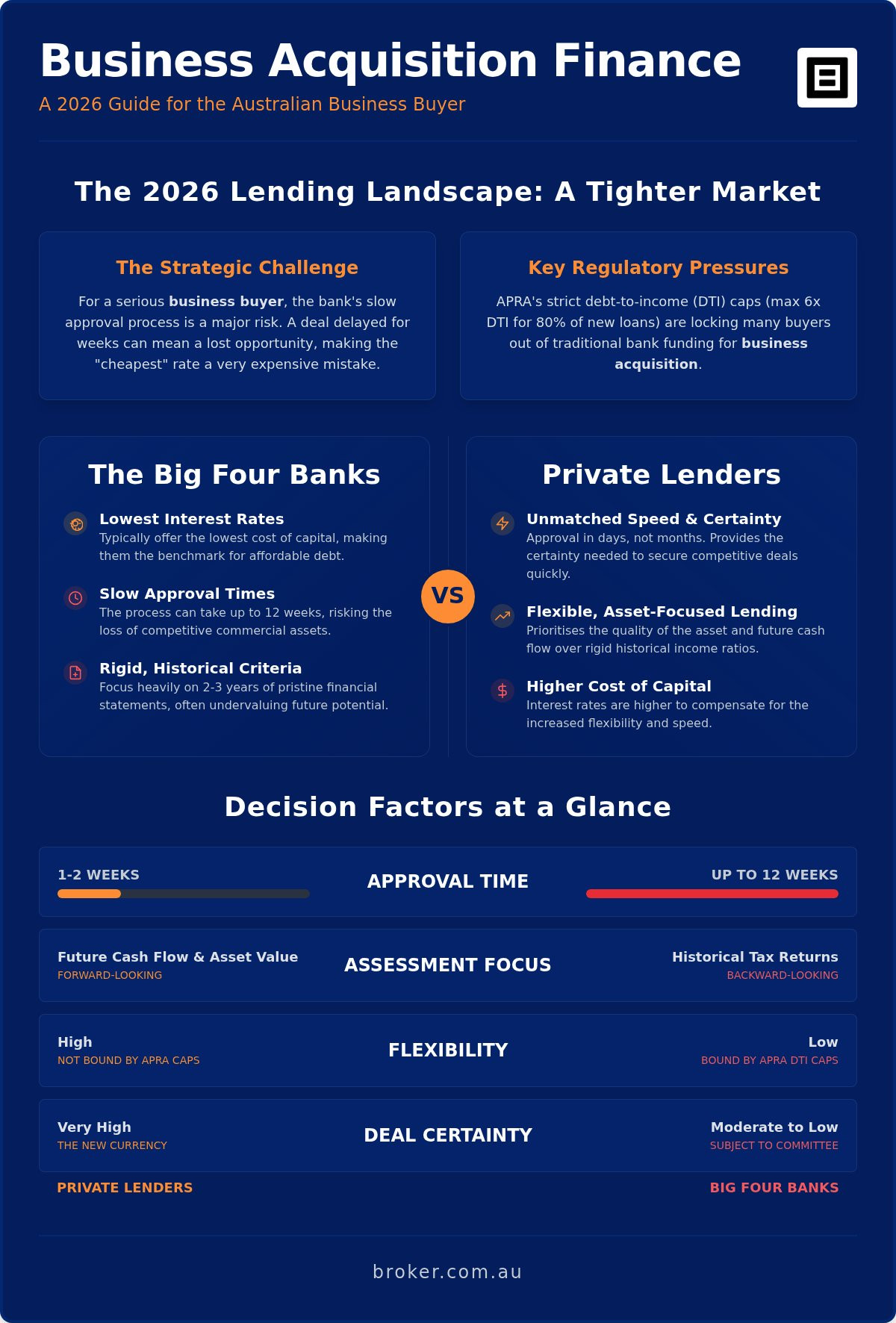
Choosing between private lenders vs big four banks for commercial property requires a clear-eyed look at the numbers. In the 2026 market, the “best” loan is the one that actually settles. While the Big Four offer lower headline rates, usually ranging between 7.91 per cent and 9.02 per cent for small business loans, they often cap Loan-to-Value Ratios (LVR) at 60 to 65 per cent for investment assets. Conversely, private lenders frequently offer LVRs up to 70 per cent for investments and 80 per cent for owner-occupied properties. This higher leverage can be the deciding factor for a business buyer who needs to preserve cash for operations.
The spread in interest rates is the most visible difference. Non-bank first mortgage rates currently sit between 9.50 per cent and 13.0 per cent; a 3 to 6 per cent premium over traditional banks. However, this cost buys you time. A major bank approval still takes an average of 8 to 12 weeks, whereas a private syndicate can move from initial enquiry to settlement in as little as 48 to 72 hours. For acquisition finance, this speed is often more valuable than the rate itself.
The Strategic ‘Bridge’ Framework
Sophisticated buyers often use private debt as a tactical bridge. You use the speed and flexibility of a private lender to win the business acquisition today, securing the asset before other bidders can mobilise. The objective is a 12 to 24 month plan to “bank” the debt once the business has stabilised under your management. This allows you to show the Big Four a track record of performance, making you a more attractive prospect for a later refinance. You must, however, account for establishment fees, which typically range from 1.5 per cent to 2.5 per cent, and ensure the valuation gap won’t prevent a future transition to a lower-rate lender.
Opportunity Cost Analysis for Business Buyers
Opportunity cost in Australian commercial real estate is the lost profit and capital growth resulting from a missed acquisition while waiting for a bank approval that never arrives. If a business acquisition offers a 20 per cent return on investment, paying 12 per cent interest to secure the deal is far more profitable than missing out entirely because you held out for a 7 per cent bank rate. When buying a business, consider this checklist:
- Urgency: Does the vendor require a settlement in under 30 days?
- Complexity: Does the deal involve significant goodwill or specialised assets?
- Leverage: Do you need an LVR higher than 65 per cent to keep working capital intact?
- Exit: Do you have a clear 2-year path to transition to traditional finance?
If you answered yes to most of these, a private solution is likely your strongest move. You can get started with our AI matching tool to see which private syndicates are currently active in your sector.
Secure Your Next Acquisition with Broker.com.au
Deciding between private lenders vs big four banks for commercial property is a high-stakes calculation that requires more than just a spreadsheet. It requires a partner who understands the nuances of the 2026 Australian credit market. At Broker.com.au, we act as your high-level fixer, using proprietary AI technology to scan over 50 lenders in seconds. This ensures you aren’t just getting a loan; you’re securing the specific acquisition finance structure that fits your business’s unique cash flow requirements. Our technology identifies the best-fit lender for your business acquisition, matching your goals with the lenders most likely to approve your deal quickly.
Many of the most flexible private syndicates don’t advertise to the general public. We provide you with inside access to these exclusive capital pools, giving you a competitive edge when buying a business. Our award-winning advisory team focuses on “outside the box” deals that traditional banks often reject, ensuring your acquisition isn’t derailed by rigid bureaucratic requirements. We’re committed to structuring loans that don’t just fund the purchase but actually protect your business’s future growth and operational stability.
The Broker.com.au Advantage
Our team, led by seasoned specialists like Matt and Kylie, brings years of expertise to complex commercial property loans. We understand that the process of buying a business can be inherently anxious. To alleviate this, we provide personalised guidance that moves you from a state of uncertainty toward a feeling of streamlined confidence. With a national network of over 50 lenders, including the Big Four and sophisticated private debt providers, we ensure you have every available option at your fingertips. We pride ourselves on being a boutique advisory that offers elite capabilities, avoiding the cold and impersonal feel of a traditional large-scale bank.
Your Next Steps to Buying a Business
Preparation is the key to a stress-free business acquisition. Before your first consultation, we recommend organising your last two years of financial statements, a clear business plan for the post-purchase phase, and details of any existing equity you intend to use. Having these documents ready allows our AI-driven technology to work even faster, providing you with the deal certainty required in a competitive 2026 market. We’ll help you understand the total cost of capital versus the risk of a lost opportunity, ensuring you find a lender that values the asset and your potential over strict tax returns.
Our “I’m interested” process is designed to be a low-pressure conversation rather than a cold, aggressive application. It’s the first step toward a tailored finance solution that meets your specific needs. If you’re a business buyer ready to secure your next asset with confidence, I’m interested in commercial property finance.
Secure Your Commercial Future with Confidence
The choice between private lenders vs big four banks for commercial property isn’t just about a decimal point on an interest rate. It’s a strategic decision about deal certainty and the speed required to win a competitive business acquisition. While the Big Four offer stability, private debt provides the agility a business buyer needs to pounce on high-value opportunities. We’ve seen how acquisition finance settled in days can prevent the devastating opportunity cost of a lost contract, ensuring you don’t miss out on prime assets while waiting for a bank committee.
As an award-winning Australian brokerage, we specialise in navigating these complexities for you. Our proprietary AI matching technology provides access to 50+ lenders, ensuring you find the perfect fit for buying a business without the traditional stress. Whether you need a low-rate bank loan or a flexible private bridge, you’re in good hands with our expert team. We’re here to help you move from uncertainty to streamlined confidence.
I’m interested in exploring my commercial finance options
Your dream acquisition is within reach; let’s find the right path to get you there together.
Frequently Asked Questions
Are private lenders for commercial property safe in Australia?
Private lenders are a safe, established pillar of the Australian financial system, regulated by ASIC and often funded by institutional capital or high-net-worth syndicates. While they operate with more flexibility than the Big Four, they are bound by rigorous legal contracts and Australian credit laws. For a business buyer, the safety comes from using a reputable intermediary to vet the lender’s track record and ensure the loan terms are transparent and fair.
How much deposit do I need for a commercial property acquisition in 2026?
In the 2026 market, deposit requirements depend heavily on your chosen path. The Big Four banks typically require a 30 to 35 per cent deposit for investment properties, reflecting a conservative 65 per cent LVR. Private lenders offer more leverage, often accepting a 20 to 30 per cent deposit for owner-occupied assets. When planning your business acquisition, you must ensure your remaining working capital is sufficient to handle the RBA’s forecasted 4.60 per cent cash rate.
Can I refinance from a private lender to a Big Four bank later?
Refinancing from a private facility to a major bank is a standard strategy for many Australian entrepreneurs. This “bridge to bank” approach involves using a private lender to secure the asset quickly and then transitioning to a Big Four bank once you have two years of stable financial statements. It’s an effective way to manage the debate of private lenders vs big four banks for commercial property by utilising the strengths of both at different stages.
What is the typical interest rate for a private commercial loan?
Indicative variable rates for private commercial loans in late 2026 generally range from 7.34 per cent to 10.38 per cent, though non-bank first mortgages can sit between 9.50 per cent and 13.0 per cent. These rates reflect the higher risk and speed of non-ADI lending. While higher than the 7.91 per cent small business rates offered by some major banks, they provide the flexibility required for complex acquisition finance that traditional institutions often reject.
Do private lenders require personal guarantees for business acquisitions?
Most private lenders in Australia require personal guarantees from company directors to secure acquisition finance. While the loan is primarily “asset-based,” meaning the property’s value is the main security, lenders still want to ensure the management team is fully committed to the business’s success. Some private syndicates may offer more flexible guarantee structures than the Big Four, particularly if the loan-to-value ratio is low or the property is high-quality.
How long does it take to get a commercial loan approved by a major bank?
Securing a commercial loan through a major bank typically takes between 8 and 12 weeks from the initial application to settlement. This timeframe includes rigorous credit committee reviews, property valuations, and extensive document verification. For a business buyer in a competitive 2026 market, this delay can be a significant hurdle. In contrast, private lenders can often provide approval and settlement within 48 to 72 hours, ensuring you don’t lose the deal.
What is a ‘Lease-Doc’ loan and do private lenders offer them?
A “Lease-Doc” loan is a specialised product where the lender assesses serviceability based on the property’s rental income rather than the borrower’s full tax returns. Private lenders are the primary providers of these loans in Australia. They are ideal if you are buying a business with a strong, long-term tenant already in place. This allows you to secure funding based on the asset’s performance, bypassing the rigid debt-to-income caps often found at major banks.
Why should I use a broker instead of going directly to my bank?
Using a specialist broker gives you inside access to over 50 lenders, including exclusive private syndicates that don’t deal directly with the public. Instead of being limited to one bank’s rigid criteria, you benefit from proprietary AI technology that matches your specific business acquisition needs with the right credit appetite. We act as your high-level fixer, structuring complex deals and reducing the inherent anxiety of high-stakes financial decisions to ensure a stress-free settlement.