
A strong development finance proposal explains what you plan to build, why the project is viable, how much funding you need and how you intend to repay it. Knowing how to prepare a proposal for development finance also means addressing lenders’ key concerns: project risks, your experience, available equity and the assets offered as security.
It’s natural to focus on plans, costs and expected sales. Lenders also assess the quality and resale value of proposed security, so explain which assets support the application and how they fit into the overall funding structure.
This guide covers how to present your business and development team, analyse demand, prepare realistic forecasts and clarify the amount, purpose and timing of funding. You’ll also learn how to set out your repayment strategy, disclose relevant financial details and support your case with evidence. A clear, well-organised proposal helps lenders assess the project and understand how you’ve planned for uncertainty.
Key Takeaways
- Present one clear development plan, supported by evidence of market demand, project feasibility and your team’s ability to deliver.
- Use realistic forecasts to show project costs, cash flow, funding contributions and how the loan will be repaid.
- Set out the amount, purpose and timing of the finance you need, linking each funding requirement to a project stage.
- Explain the proposed security clearly, including the assets available, their resale value and any guarantor support.
- Disclose relevant financial commitments and project risks, then show the practical steps you’ll take to manage them.
Table of Contents
- 1. Lender assessment of business plans and creditworthiness
- 2. Products, services and market analysis
- 3. Financial projections, cash flow forecasts and financial statements
- 4. Clarifying the amount, purpose and timing of financing
- 5. Loan security and asset resale value
- Broker.com.au: Secured Business Loans
1. Lender assessment of business plans and creditworthiness
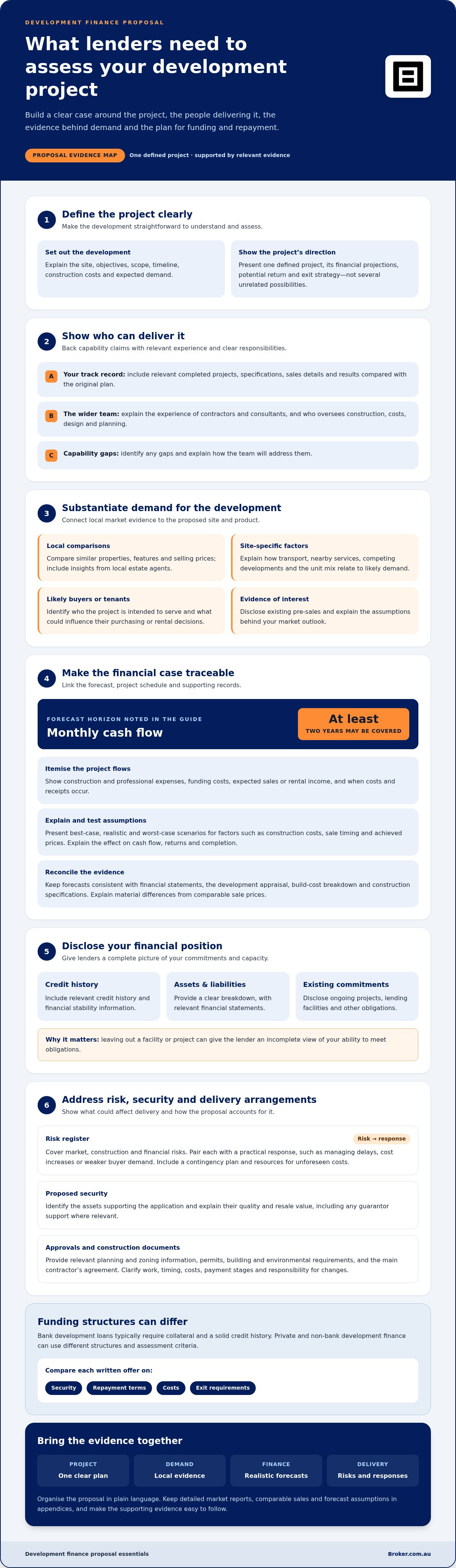
Lenders assess whether your development is feasible and whether you can deliver it. Present one clear project, its objectives, timeline, market case, financial projections and exit strategy. Explain the site, expected demand, construction costs and potential return. A proposal focused on one defined project is easier to assess than several unrelated possibilities.
Show who will manage the work. Describe your development experience and include relevant examples of completed projects, with specifications, sales details and results compared with the original plan. Set out your contractor’s and consultants’ experience, too. Identify who will oversee construction, manage costs and handle design or planning. Explain how the team addresses any capability gaps.
Lenders assess your creditworthiness alongside the project. They may consider your credit history, financial stability, debt-to-income position and record of successful developments. Disclose other ongoing projects, current lending facilities, and a clear breakdown of assets and liabilities. Include relevant financial statements and explain existing commitments. Leaving out a facility or project can give the lender an incomplete picture of your ability to meet obligations.
Bank development loans typically require collateral and a solid credit history. Private and non-bank development finance can use different structures and assessment criteria, so compare the security, repayment terms, costs and exit requirements in each written offer.
Include a risk register in your business case. Identify market, construction and financial risks, then pair each with a practical response. Explain, for example, how you would manage construction delays, cost increases or weaker buyer demand. Include a contingency plan and identify resources that could cover unforeseen costs. Lenders use their own assessment criteria, so make the evidence easy to follow and support key claims with relevant reports.
For planning approvals, permits and building contracts, provide the documents and status relevant to the site and development scope. Include applicable planning and zoning information, building and environmental requirements, and the main contractor’s agreement. The contract should clarify the work, timing, costs, payment stages and responsibility for changes. This helps lenders assess whether approvals and construction arrangements support the proposed timeline.
Organise the application into a clear document, using plain language and evidence rather than broad claims. Add a project timeline, feasibility material, financial information and supporting reports as appendices. Check the lender’s information requirements before submitting, and disclose concerns directly. A complete, consistent proposal gives the lender a clearer basis for assessing the project and your ability to deliver it.
2. Products, services and market analysis
Describe exactly what the development will deliver and who it serves. For a mixed-use project, separate residential and commercial space, then explain how each component meets demand. Show how the project’s layout fits the site, nearby amenities and transport links. If the development introduces a new product type, explain why it could attract buyers despite limited local comparisons.
Support demand assumptions with local evidence. Compare similar properties, their features and selling prices, and use insights from local estate agents. Explain the area’s strengths and constraints, such as transport access, nearby services and competing developments. Connect each observation to your project: for example, describe how the unit mix responds to buyer demand in that location. Disclose existing pre-sales, which can strengthen the proposal’s evidence of interest.
Economic conditions and location both influence demand, so state the assumptions behind your market outlook. Identify likely buyers or tenants, competing supply and factors that could change purchasing decisions. Keep the analysis specific to the site rather than relying on broad claims about the property market. If competition is strong, explain how the proposed design, product mix or location gives buyers a distinct reason to choose the development.
To prepare a feasibility study and cash flow forecast, itemise expected expenses, income and transaction timing, then connect each amount to the project schedule. Include construction costs, professional expenses, funding costs, expected sales or rental income, and the timing of receipts. Monthly cash flow forecasts may cover at least two years. Show the assumptions behind each forecast and align the figures with the build program.
Test whether the project remains viable if assumptions change. Present best-case, realistic and worst-case scenarios for variables such as construction costs, sale timing and achieved prices. Explain how each change affects cash flow, expected returns and your ability to complete the work. A delay in sales, for example, may postpone income while expenses continue, so show how the forecast accounts for that timing gap.
Ground your analysis in financial statements and project records. Present income, expenses and cash movements consistently, and reconcile forecast assumptions with the development appraisal and build-cost breakdown. State the construction specifications behind cost estimates, then explain any material difference between expected sale prices and comparable properties. This gives the lender a clear line from market evidence to projected income and project feasibility.
Keep the supporting document focused: put detailed comparable sales, market reports and forecast assumptions in appendices, then summarise their relevance in the main proposal. If the project’s cash flow depends on staged sales or leasing, make that sequence visible. A clearly supported feasibility case can help a lender assess whether development finance aligns with the project’s purpose and cash flow needs.
3. Financial projections, cash flow forecasts and financial statements
Build the financial model around the development schedule, not an isolated profit estimate. Start with a researched development appraisal, detailed build-cost breakdown, specification schedule and expected transaction dates. Match each cost and income item to when it occurs. This shows whether available capital and equity can cover outgoings before sales or refinancing generate funds.
Prepare linked income statements, cash flow forecasts and balance sheets. Monthly cash flow forecasts may cover at least two years, while an income and expense forecast may set out two years of assumptions. Show when construction payments fall due, when sales proceeds are expected and how loan interest affects available cash. Keep assumptions consistent across every statement.
Explain the method behind each forecast. For construction costs, identify the quantities, specifications and pricing assumptions used in the build-cost breakdown. For sales income, link expected prices and timing to comparable market evidence. Include professional expenses, project finance costs and operating costs where relevant. This allows lenders to trace how each assumption shapes the project’s financial position.
Include financial measures that explain project performance, such as return on investment and internal rate of return. Present them alongside the assumptions driving the result, not as stand-alone promises. Add a sensitivity analysis with best-case, realistic and worst-case scenarios. For example, show how delayed sales or higher construction costs affect cash flow, repayment capacity and expected returns.
Use previous projects to show how your forecasts compare with actual results. Provide specifications, sales particulars, photographs and achieved prices alongside the original plan. Explain any material differences, such as a changed construction schedule or lower sale proceeds. Case studies and performance data help show how previous experience informs this project’s assumptions and management decisions.
Make the development timeline measurable, with key stages such as acquisition, approvals, construction milestones, completion and sale or refinancing. Link each stage to its expected costs and receipts. If you’ll retain a completed property, explain how its income supports the exit plan, including any proposed long-term mortgage. State how and when the development loan will be repaid.
Finally, connect risks to forecast actions. If delays could increase holding costs, show where the schedule allows for disruption and what resources could cover additional expenses. Disclose the source of your cash contribution and any further funds available for unexpected costs. A clear contingency plan makes the financial analysis more useful than a single forecast based on ideal conditions.
4. Clarifying the amount, purpose and timing of financing
State the amount of finance required, what it will fund and when you need it. Break the request into project purposes, such as land acquisition, construction costs, professional expenses or other development outlays. Match each amount to the relevant budget line and project stage. This helps lenders understand the proposed investment and assess whether the funding request fits the project.
Explain the type of finance that suits each stage. Construction loans fund the building phase, while a long-term mortgage can finance a completed property. If you plan to sell completed dwellings, explain how sale proceeds support repayment. If you’ll retain the property, outline how refinancing or property income forms part of the exit strategy.
Give the lender a clear funding schedule. Show when you need funds, which milestone triggers each drawdown and what project cost it covers. For example, link construction funding to the relevant building stage rather than presenting one unexplained lump sum. Align the schedule with the construction contract, project timeline and cash flow forecast. Flag any timing gap between required payments and expected sales or other receipts.
Include the applicant’s contribution and its source, distinguishing it from the requested loan. Explain what resources remain available for unforeseen expenses or delays. If another funding source forms part of the structure, identify its purpose and timing. Lenders need to see how the complete funding plan supports the project, not just the requested facility in isolation.
Make a clear case for the funding requested. Summarise the project, funding purpose, amount, timing, repayment plan and supporting reports. Use concise sections in the main document, with detailed budgets, feasibility material and relevant evidence in appendices. Keep figures consistent across the proposal and attachments so the funding request can be followed without reconciling conflicting versions.
There’s no fixed proposal length for every development. A real estate loan proposal can range from a single page to over 100 pages, depending on the lender’s workload, the information required and the need for a clear, comprehensive application. Focus on completeness rather than page count. A smaller project may need a concise document, while a complex development may require more supporting analysis.
Plan the application well before the first funding date. This gives you time to assemble reports, contracts and financial documents, and resolve gaps before submission. State key transaction dates and explain dependencies, such as a purchase completing before construction begins. A precise schedule helps the lender assess whether the proposed finance can meet the project’s needs at the right stage.
5. Loan security and asset resale value
Lenders assess loan-to-cost ratio against eligible project costs and loan-to-value ratio against the property’s assessed value. They consider both alongside available equity, security quality and pre-sales, which can provide evidence of buyer demand and future repayment funds.
Make the security section specific. Identify each asset offered, its owner, location, existing finance and proposed role in the funding structure. For a development site, distinguish the land from completed property and explain how the project may change its value. A clear asset schedule helps the lender understand what could support repayment if the project encounters difficulty.
Resale value matters because lenders assess whether secured assets could be sold and how readily a sale might occur. Describe relevant features that affect marketability, such as property type, location, access and condition. For example, a site with a clear development purpose may appeal to a different buyer group than specialised commercial premises. Explain the likely buyer market using local comparable evidence.
Show the basis for each value in your proposal. Include available valuation material, comparable sales and details of the asset’s condition or development status. If the proposed value depends on planning progress, construction completion or another project milestone, distinguish current value from anticipated future value. This prevents projected outcomes from being confused with assets already available as security.
Disclose existing mortgages and other claims over assets, then explain how they affect the security offered. Include additional property only when it is genuinely available to support the project. If a guarantor is involved, outline their financial capacity and the assets they may contribute. Lenders need a clear account of the asset and any obligations that could affect its value.
Explain how pre-sales relate to repayment, rather than treating them as security. Provide the status and terms of relevant sales, and connect expected proceeds to the proposed loan repayment schedule. If sales are not the main exit, describe the alternative, such as refinancing a completed property. This helps the lender assess how security, project income and repayment plans work together.
Finish with a concise security summary that links each asset to its supporting evidence and explains any valuation assumptions. Where a proposed asset’s resale depends on completing construction, show the relevant stage and risk controls. If you’re assembling the security and funding case, discuss your development finance proposal with a finance specialist.
Broker.com.au: Secured Business Loans
Broker.com.au arranges secured business loans and can help you explore how one may fit your project’s funding structure. This can be relevant when property or other assets form part of your security, alongside a clear feasibility case, cash flow forecast and repayment plan.
Before speaking with a finance broker, organise your project budget, development timeline, details of available assets and supporting valuation evidence. These documents help explain how the funding request connects to the development and what security supports it. A broker can help you understand the information lenders need to assess the proposal and facilitate communication during the application process.
For a conversation about your development funding needs, contact Broker.com.au.
Take the next step with a lender-ready proposal
A development proposal can also serve as a working document for decisions throughout the project. Keep assumptions current as plans, market evidence or construction arrangements change, and record how each revision affects funding or repayment. This gives you a clear basis for discussing the proposal with a finance professional and responding to lender questions.
Understanding how to prepare a proposal for development finance means making the project’s case clear, not presenting it as risk-free. If you’re refining your funding approach, Broker.com.au offers secured business loans, Business Acquisition Finance & Advisory and unsecured business loans for different business finance needs. A conversation can help you consider which funding pathway fits your circumstances and project.
Contact Broker.com.au to discuss your funding needs and next steps. A clear proposal is a practical foundation for moving your development plans forward.
Frequently Asked Questions
How do I prepare an effective proposal?
To understand how to prepare a proposal for development finance, make the lender’s assessment clear and evidence-based. Start with the site, planned development, funding request and repayment route. Organise supporting documents so each key claim is easy to verify. Keep figures consistent across attachments, label forecast versions and explain material changes. Address weaknesses directly, showing how you’ll manage them instead of relying on broad claims.
What is a loan proposal?
A loan proposal is a document asking a lender to consider finance for a defined purpose. For a property development, it explains who is borrowing, what the project involves, how funding will be used and how repayment is planned. It presents the case for the application, supported by documents that let the lender assess the details. A clear proposal distinguishes project facts from assumptions and future plans.
What information should a development finance proposal include in Australia?
Include the information needed to understand the borrower, project and repayment plan. Set out the site and development outcome, project team, market evidence, costs, funding contribution, cash flow, timeline and exit strategy. If you’re working out how to prepare a proposal for development finance, separate residential and commercial assumptions in a mixed-use project. This makes each component’s expected income and role in the overall project easier to assess.
What documents do Australian development finance lenders require?
Document requirements vary with lender criteria and project details. Prepare a register covering the proposal, feasibility material, cost estimates, construction specifications, timeline, financial statements, cash flow forecasts and market reports. Add relevant planning, zoning, building and environmental information, along with contractor details and agreements. For an existing business, aged accounts receivable and payable listings for year-end and the latest interim period may help explain its financial position.
How do I calculate total project costs, contingency and required equity for a development finance application?
List each project expense once, including acquisition, construction, professional and finance costs. Link each item to an estimate or stated assumption, and match its payment timing to the project schedule. Show contingency separately and explain which risks it covers. To calculate the equity contribution, subtract proposed finance and other committed funding from total project costs, then identify the contribution’s source.
What are the main risks lenders look for in an Australian property development proposal?
Lenders assess market demand, construction delivery, financial viability and repayment risks. A project relying on one buyer group, for example, may be more exposed to changes in demand. Limited contractor experience can raise delivery concerns, while a tight schedule may leave little room for delays. Describe each relevant risk, its potential effect on cost or timing, and the practical response planned to manage it.
How can I strengthen a development finance application and improve approval chances?
Strengthen the application by supporting key claims with evidence and resolving inconsistencies before submission. Use a document register to track versions, dates and missing attachments, then reconcile totals across the proposal and financial models. Show relevant delivery experience, or explain how experienced team members address capability gaps. If a lender declines the application, establish the reasons and address those concerns before making another application.