
The fastest funding may cost more, while the lower-cost option may take longer to arrange. Choosing a bank loan vs private lender for your business often comes down to how quickly you need funds and what your business can offer as security. In Australia, private lending approvals typically take 1 to 3 days, compared with 1 to 3 weeks for bank lending, but private loans generally have higher interest rates and fees.
Speed matters when you’re buying a business, facing a payment deadline or managing a cash-flow gap. But faster approval does not automatically make a loan the better fit: the repayment schedule, total borrowing cost and consequences of default all affect whether the funding is workable. This comparison explains how bank and private lending differ in costs, terms, repayment flexibility and risk, and what each may mean for access to working capital or acquisition finance. You’ll also find a practical guide to matching the funding option to your timeframe, security and repayment plan.
Key Takeaways
- Match the funding route to your deadline: bank finance may suit a planned purchase, while private lending can be worth considering when timing is critical.
- Compare the full borrowing cost, including interest and establishment fees, rather than judging an offer by its rate alone.
- For business acquisition finance, consider how the lender will assess the business, your security, deposit or equity contribution, and ability to service repayments.
- Check the repayment schedule and exit plan carefully; a private loan can put secured assets at risk if refinancing or a planned sale falls through.
- For working capital, weigh speed against repayment pressure and choose a structure that fits the cash flow you expect to have available.
Table of Contents
- Private vs Bank Lending: Which One is Right for You?
- Comparison of interest costs and establishment fees
- Flexible loan terms and repayment schedules
- Private credit default risks and escalating rates
- Fast working capital for business owners
- Broker.com.au
Bank Loan vs Private Lender: Which One is Right for You?
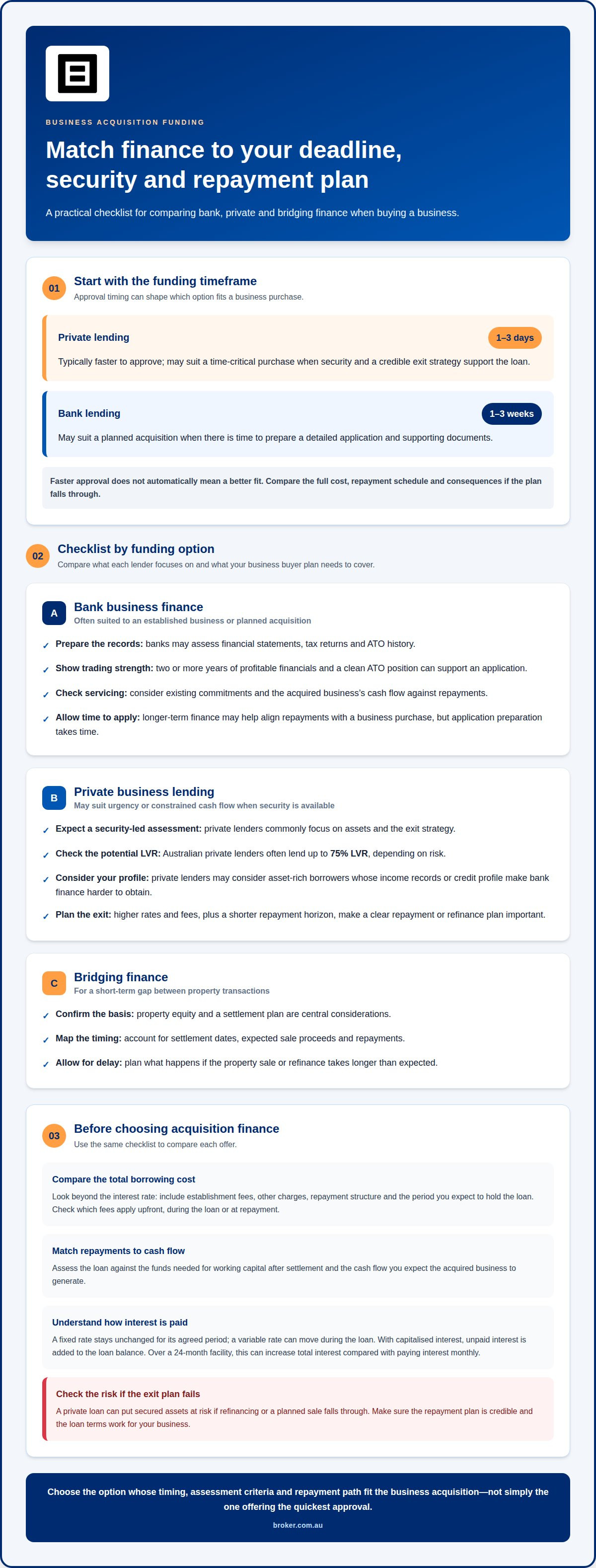
In Australia, bank and private finance differ in their funding sources, assessment focus and typical uses. Compare your business acquisition funding need, available security and repayment plan before choosing a route.
Traditional Bank Finance
Australian banks fund much of their lending from customer deposits and may assess a business acquisition application using financial statements, tax returns and ATO history. Two or more years of profitable financials and a clean ATO position can support an application. Bank acquisition finance may suit a business buyer with an established trading record and time to prepare a detailed application.
Banks can also offer longer-term finance than private lenders, which may help align repayments with a business purchase. A business buyer should assess servicing against existing commitments and the acquired business’s cash flow.
Private Lending
Private lending comes from private investors or specialist non-bank lenders, rather than traditional banks. It is commonly structured for businesses operating under an ABN, secured against assets and assessed with significant weight on security and the exit strategy. Private lenders may consider asset-rich borrowers whose income records or credit profile make bank finance harder to obtain.
Australian private lenders often lend up to 75% LVR, depending on risk. Private finance can support acquiring a business or bridging needs, but its shorter-term structure makes a clear repayment or refinance plan important.
Funding for Urgent or Financially Constrained Needs
Urgency can shift the comparison. A buyer facing a two-week deadline to acquire a competitor may have less time for a bank application than a buyer planning well ahead. Private finance can suit a time-critical business purchase when strong assets and a credible exit strategy support the loan. The trade-off is higher borrowing costs and greater pressure to repay on schedule.
Asset-rich, cash-poor owners may use property equity to bridge a temporary gap, including between property settlements. For example, bridging finance can help cover a business purchase before funds from an existing property sale become available. Treat this as short-term funding: map settlement dates, expected sale proceeds and repayments, then plan for what happens if the sale or refinance is delayed.
| Funding option | Typical assessment focus | Potential fit | Key consideration |
|---|---|---|---|
| Bank business finance | Financial records, tax returns and ATO history | Established business or planned acquisition | Application preparation and servicing |
| Private business lending | Security and exit strategy | Urgent need or constrained cash flow | Higher costs and shorter repayment horizon |
| Bridging finance | Property equity and settlement plan | Gap between property transactions | Repayment relies on a credible sale or refinance |
Choose the option whose assessment criteria, timing and repayment path fit the business acquisition, not simply the one offering the quickest approval.
Comparison of interest costs and establishment fees
The interest rate matters, but it does not show the full cost of business lending. Compare interest, establishment fees, repayment structure and other charges across offers with the same loan amount and term. For a business buyer, assess acquisition finance against expected business cash flow too, so repayments remain manageable after settlement.
Private loans commonly have higher interest rates and fees than bank loans. That difference may buy speed or flexibility, but it needs to serve a clear purpose. For example, a buyer facing a time-sensitive purchase might weigh the extra financing cost against the consequences of missing the transaction. If the purchase can wait, a lower-cost bank option may better suit the plan.
Establishment fees affect the amount borrowed or the funds available at settlement. Read the offer’s fee schedule and identify which charges apply upfront, during the loan or at repayment. Then compare the total cost over the period you expect to hold the loan. A lower interest rate may still be less suitable if fees or repayment conditions do not fit your acquisition timeline.
Capitalised interest changes when interest is paid, not whether it accrues. In some private lending structures, unpaid interest is added to the loan balance and settled at the term’s end. Over a 24-month facility, this can increase total interest compared with paying interest monthly. It can ease short-term cash-flow pressure, but the borrower needs a credible exit plan that covers the accumulated balance.
Fixed and variable interest rates affect how repayments may change during the loan. A fixed rate stays unchanged for its agreed period, helping a buyer plan repayments. A variable rate can move during the loan, so repayment costs may rise or fall. Compare the rate type with the business’s cash-flow capacity, especially if acquisition income may fluctuate after settlement.
Approval timing also affects the value of an offer. Bank lending can involve a longer application process, and complete documentation supports assessment and reduces avoidable delays. Private lending may move faster, but speed does not remove the need to understand fees, security and repayment terms. A broker can compare available finance options by structure, total cost and risk.
For a business purchase, assess borrowing costs alongside the funds needed for working capital after settlement. A loan that uses too much available cash for repayments may leave less for operating expenses. Compare offers using the same borrowing amount, repayment frequency and expected holding period, then choose a structure that fits both the purchase and its cash-flow demands.
Flexible loan terms and repayment schedules
Australian banks offer loan terms from 1 to 30 years, while private lending terms are often 3 to 36 months. Loan amounts vary with the purpose, security, servicing capacity and lender assessment, so a buyer should compare the proposed amount and repayment structure together.
A longer loan term spreads repayments over more time, which may ease pressure on a business’s regular cash flow. It can also keep the debt in place for longer. For a business acquisition, model repayments against the acquired business’s expected income and existing commitments. Allow for working capital needs after settlement too, rather than directing all available cash towards the purchase.
Private lenders may negotiate loan terms and repayment schedules around a borrower’s circumstances. A facility might use interest-only repayments during a short project, followed by repayment of the principal when a planned sale or refinance occurs. Some private lenders also structure short-term loans with capitalised interest. These structures can preserve cash during the loan term, but the full balance still needs a realistic exit strategy.
An exit strategy should identify how and when the debt will be repaid. For example, a business owner using a short-term loan before refinancing should map the refinance steps against the facility’s maturity date. If repayment relies on selling an asset, estimate the proceeds and allow for possible timing changes. Private lending is generally best suited to a short-term need backed by strong equity and a credible repayment pathway.
Investors and lenders need clear documentation to understand the proposed structure. For acquisition finance, prepare a picture of the purchase, the business’s cash flow, available security and the intended repayment source. Agree how much funding will be available at settlement and whether funds will be retained for working capital. The loan agreement should make the drawdown conditions, repayment dates and end-of-term obligations clear.
Compare repayment frequency as well as the loan term. Monthly repayments may suit a business with steady income, while seasonal trading may call for a different schedule. Test proposed repayments against quieter trading periods, not just the strongest months. If a business buyer expects income to build after acquiring a business, the initial schedule still needs to be manageable before that growth arrives.
- Term: Match the repayment period to the purpose and expected life of the funding need.
- Structure: Identify principal, interest, drawdowns and any final payment.
- Exit: Set out the repayment source and timing before accepting short-term finance.
- Documentation: Check that the contract reflects the agreed schedule and conditions.
Choose a structure that aligns the loan term, cash flow and exit plan, rather than relying on flexibility alone.
Private credit default risks and escalating rates
Compare offers using the same loan amount, term and repayment structure, then total the interest and establishment fees.
That comparison excludes other contract costs, so include applicable charges and consider when interest is paid. Capitalised interest is added to the loan balance, increasing the total interest cost compared with paying interest monthly. Also compare approval timing and credit appetite: a lower-cost offer may not suit an urgent purchase, while faster funding can cost more.
Private lenders may assess borrowers with weak credit where valuable assets or a credible exit strategy support the application. That flexibility doesn’t remove the repayment risk. If a planned refinance or asset sale falls through, extension fees, default interest or enforcement action may follow. A missed payment may also trigger an increased rate of 15-20% until the arrears are cleared. With a property-secured loan, default can put the secured asset at risk.
In Australia, private lenders are subject to protections including the ASIC Act’s prohibitions on misleading or deceptive and unconscionable conduct in providing credit. Responsible lending rules under the National Consumer Credit Protection Act generally don’t apply to credit used mainly for business purposes. Unfair contract term protections for standard-form small-business contracts have applied since November 2023, generally covering businesses with fewer than 100 employees or turnover under A$10 million, where the business loan is A$5 million or less. Eligible complaints about credit facilities of up to around A$5 million must be accepted by AFCA-member lenders.
Regulatory arrangements also differ by lender type. APRA sets capital requirements for banks, while non-bank lenders aren’t subject to those prudential rules; larger non-bank lenders must report lending to APRA. These distinctions don’t replace a close review of the contract, security and default clauses.
A business overdraft or line of credit can provide access to funds as cash-flow needs arise, rather than advancing a fixed lump sum for a set purchase. For example, a business buyer might use revolving finance for short-term operating expenses while keeping acquisition funding separate. Compare the limit, interest calculation, fees and repayment conditions with the business’s expected cash-flow cycle.
Before accepting an offer, calculate the full cost, identify what could trigger default interest and map a realistic repayment source. This helps you weigh the funding’s cost against its speed and fit for the business’s circumstances.
Fast working capital for business owners
Working capital finance addresses a timing gap between business costs and incoming cash. For example, a business may need to pay suppliers before customers settle invoices. The right facility depends on the purpose, how long the gap lasts and when cash flow is expected to recover. Separate this short-term need from acquisition finance, which funds the purchase and must be assessed against the acquired business’s ongoing commitments.
Invoice finance can link funding to approved unpaid invoices rather than relying only on a conventional business loan assessment. Australian businesses can typically access up to 85% of the value of approved unpaid invoices through invoice finance, and funds are usually received within 24 business hours. This can help bridge the wait for customer payment, but the amount available depends on eligible invoices and their value.
Private credit funds can often be accessed within days, while a bank refinance commonly takes up to three months or more. That timing difference can matter when a supplier deadline, stock order or payroll date arrives before expected receipts. Speed alone is not decisive: compare total cost, repayment timing and whether the facility’s purpose matches the cash-flow gap.
A property-backed facility may suit an asset-rich owner who needs working capital but wants to retain cash for daily operations. The lender considers available equity and security, while the business must still manage repayments from trading or a defined exit plan. Using a mortgage or other property security for a temporary cash-flow need links business obligations to that asset, so the repayment source and timeframe matter.
For a business buyer, working capital can also protect operating cash after settlement. For example, funds reserved for supplier payments or wages may prevent the purchase from using all available liquidity. Keep acquisition funding and working capital needs distinct in the funding plan. That separation clarifies how much capital supports the purchase and how much remains available for the first trading period.
- Invoice timing: Match invoice finance to eligible unpaid invoices and expected customer receipts.
- Short-term gap: Match the facility’s repayment date to the cash-flow recovery point.
- Property security: Weigh the available equity against the risk of securing business borrowing against property.
- Acquisition: Reserve enough operating capital for costs after purchasing the business.
Start by mapping the amount, purpose and expected repayment source for the cash-flow gap. Then compare speed and repayment demands against the business’s actual trading cycle. To explore a suitable working-capital funding approach, connect the facility structure to the timing of your business’s incoming cash.
Broker.com.au
Broker.com.au can help business buyers compare finance structures against the purchase, available security and repayment plan. If you’re acquiring a business, Business Acquisition Funding can address the purchase itself, while Working Capital Finance can help manage operating cash needs after settlement. Secured or Unsecured Business Loans may also suit different funding circumstances.
Bring the key details together: the purchase timeline, business financials, available equity, cash-flow needs and intended repayment source. This helps assess how bank and private finance options fit your acquisition, including their costs, terms and risks, without treating speed as the only deciding factor.
If you’d like to discuss your funding needs, contact Broker.com.au.
Choose a funding path that supports your next move
Before progressing, turn your preferred option into a clear funding brief: outline the purchase purpose, funds required, your contribution and how the business will manage repayments after settlement. This gives you a practical basis for weighing the trade-offs in choosing a bank loan vs a private lender for your business, without letting urgency alone set the direction.
Broker.com.au offers Business Acquisition Funding, Secured Business Loans and Unsecured Business Loans. These options can address different purchase and security circumstances, while the right structure depends on the transaction and your business’s needs. Bring your acquisition plans and funding priorities to the discussion so the available pathways can be considered against your next step.
For a considered discussion about your options, contact Broker.com.au. A clear funding plan can help you move towards buying a business with greater confidence.
Frequently Asked Questions
What is a Private Lender?
A private lender is a non-bank source of finance, such as a specialist lending business or private investor. In Australia, private business lending is commonly arranged for businesses operating under an ABN and may be secured against property or other assets. Unlike a bank, a non-bank lender does not take customer deposits to fund loans. Assessment and loan conditions depend on the facility’s purpose and security.
Borrowing power: how much can I borrow?
Your borrowing capacity depends on the loan purpose, available security, business cash flow, existing commitments and your contribution. For a business purchase, lenders also consider whether expected income can support repayments after settlement. Build a funding request around the purchase costs and the working capital needed to keep the business operating. Include your own funds and explain the repayment source, rather than relying on the purchase price alone.
Need Help Securing Funding for Your Business?
Broker.com.au helps businesses explore finance options for acquisitions and operating needs. Its offerings include Business Acquisition Funding, Secured Business Loans, Unsecured Business Loans and Working Capital Finance. The process is: “Complete one simple to use form → Get connected with an expert broker → Work directly with your broker → Financing secured.” For an acquisition, organise the transaction details, business financial information and funding purpose for the discussion.
What is Private Credit?
Private credit is business or commercial lending provided outside traditional banks, often through private investors, specialist lenders or private credit funds. The term describes a source of lending, rather than one specific loan structure. In Australia, private credit can fund business purposes and may use assets as security. Terms depend on the facility, the borrower’s circumstances and the lender’s assessment of repayment.
What are the differences between bank business loans and private lender loans in Australia?
The bank loan vs private lender for business decision depends on how each option fits your transaction, timeframe and repayment plan. Banks and private lenders differ in their funding sources, assessment approaches and loan structures. For a business purchase, separate the amount needed for settlement from cash required to keep trading afterwards. This helps you assess whether the proposed facility supports the whole acquisition plan, not just the purchase payment.
What interest rates and fees do Australian banks and private lenders charge for business loans?
Private loans commonly have higher interest rates and fees than bank loans, while the actual offer depends on its terms and security. For a bank loan vs private lender for business comparison, include the interest rate, establishment fees and other applicable charges. Also consider when interest is paid and how the balance changes. Check that the repayment structure matches the period you expect to use the funds.
What eligibility criteria do Australian banks require for a business loan?
Banks may assess financial statements, tax returns, ATO history, profitability, security and repayment capacity. For a business buyer, the application should also explain how the acquired business will contribute to loan servicing. Present the purchase purpose and forecast cash flow alongside the existing business’s records. This helps show how the requested finance relates to both the acquisition and the business’s ongoing obligations.
How do private lenders assess Australian business loan applications?
Private lenders may place strong emphasis on the assets offered as security and the proposed repayment or exit strategy. Credit history remains relevant, but valuable assets can help applicants whose credit profile is weaker. For example, explain whether repayment will come from business cash flow, a planned refinance or an asset sale. The application should connect that source to the loan term and show a clear route to repayment.