
Your tax return might tell one story, but your bank account tells another, and in 2026, the gap between those figures is often where self-employed home dreams stall. It’s incredibly frustrating when a lender treats your legitimate business deductions as a lack of serviceability or views your seasonal success as a risk. You’ve worked hard to build your enterprise, yet the rigid “tick-box” approach of major banks often makes the process of how to get a mortgage when self-employed Australia feel like an unnecessary struggle because you don’t have a standard payslip.
Being your own boss shouldn’t mean settling for higher interest rates or endless red tape. This guide reveals the exact strategy you need, providing a clear roadmap to secure “inside access” to the best market rates. You’ll discover how to manage the APRA debt-to-income caps implemented in February 2026 and which documents actually move the needle for a credit assessor. We’ll preview the specialist lending landscape, explain the shift toward non-bank lenders, and show you how to frame your business narrative to ensure a streamlined, stress-free approval.
Key Takeaways
- Understand why traditional banks often misinterpret business expenses and how to reframe your income to meet 2026 serviceability standards.
- Compare Full Doc and Low Doc pathways to determine which documentation strategy aligns with your current tax returns and business activity statements.
- Learn exactly how to get a mortgage when self-employed australia by using the “Add-Back” method to identify non-cash expenses that boost your total borrowing power.
- Access a tailored checklist for sole traders and company directors to organise your ABN history and financial records for a stress-free approval.
- Leverage specialist broker insights and proprietary AI matching technology to secure the same competitive interest rates typically reserved for PAYE earners.
Table of Contents
- Understanding the Self-Employed Mortgage Landscape in Australia
- Full Doc vs. Low Doc: Choosing Your Application Pathway
- Strategic Financial Prep: Maximising Your Borrowing Power
- Your Step-by-Step Checklist for a Successful Application
- Why Business Owners Benefit from a Specialist Mortgage Broker
Understanding the Self-Employed Mortgage Landscape in Australia
Securing a home remains a cornerstone of the Australian dream, even as home ownership trends in Australia evolve alongside a growing gig economy and entrepreneurial surge. For those running their own show, the path to approval often feels more like an obstacle course than a straight line. Lenders typically categorise anyone who isn’t a standard PAYG employee as self-employed, which includes sole traders, independent contractors, and company directors. A self-employed mortgage is simply a standard home loan that uses non-standard income verification methods to confirm you can afford the repayments.
Many traditional banks still view business owners as “higher risk” because of the perceived volatility of their income. This is often a myth; many businesses have stronger cash reserves and more consistent revenue than a typical employee, but their wealth is simply structured differently. While the old guard often insists on a strict two-year history of tax returns, the 2026 lending environment is far more nuanced. With the RBA cash rate sitting at 4.35% as of August 2026, lenders have had to modernise their approach to capture the growing market of successful entrepreneurs who don’t fit the standard box.
The Reality of Borrowing as a Business Owner
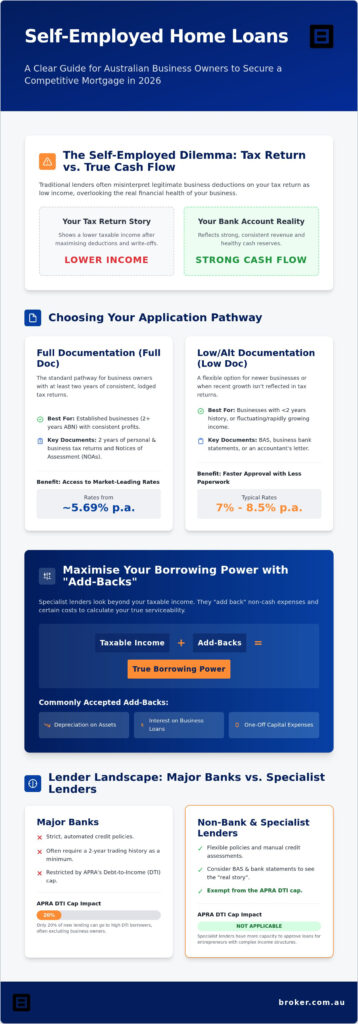
There’s a common misconception that high tax write-offs are the enemy of a home loan. While they reduce your taxable income, specialist lenders understand that these figures don’t always reflect your true cash flow. We look for “add-backs” such as depreciation, one-off capital expenses, or interest paid on business debts to reconstruct your actual borrowing power. Identifying these non-cash expenses is a critical step in learning how to get a mortgage when self-employed australia. This shift in perspective moves you from a state of uncertainty to a position of streamlined confidence.
Lender Appetites: Banks vs. Non-Bank Lenders
The “Big Four” banks are often restricted by rigid internal policies and the APRA debt-to-income (DTI) cap introduced in February 2026. This regulation limits their high DTI lending to just 20% of new mortgages, which can be a major hurdle for business owners with significant debt. Conversely, non-bank lenders are exempt from this specific cap, making them a vital resource for entrepreneurs. Our role is to provide inside access to these niche credit assessors who manually review your bank statements and BAS to see the success of your business, rather than just a computer-generated “no.” Knowing which doors to knock on is the secret to discovering how to get a mortgage when self-employed australia without the stress of a traditional bank decline.
Full Doc vs. Low Doc: Choosing Your Application Pathway
Choosing between Full Doc and Low Doc pathways is the most critical decision in your application journey. It’s the difference between a mountain of paperwork and a streamlined approval, but it also dictates the interest rate you’ll pay when figuring out how to get a mortgage when self-employed australia. While the terminology can feel like industry jargon, the choice usually comes down to how quickly you need the funds and how “clean” your tax records are for the last two financial years.
Full Doc loans remain the gold standard for those with a transparent, two-year paper trail. You’ll need to provide two years of personal and business tax returns, plus the corresponding Notices of Assessment (NOAs) from the ATO. If your business has recently scaled or your latest tax returns don’t reflect your current cash flow, Low Doc (often called Alt-Doc) options provide the necessary flexibility. These loans use Business Activity Statements (BAS), business bank statements, or accountant letters to verify your income instead of tax returns.
Is a Low Doc loan actually more expensive? Generally, yes. As of June 2026, Low Doc rates typically range between 7% and 8.5% p.a., which is a premium above the average variable rate of 5.90% p.a. found in Full Doc products. However, the “Alt-Doc” middle ground is gaining traction for business owners with only 12 months of trading history. It offers a bridge for newer enterprises that are profitable but haven’t yet hit the two-year mark required by the Big Four banks.
When is a Full Doc Loan the Best Choice?
If you’ve maintained consistent profits and an active ABN for over 24 months, a Full Doc loan is your best bet. The primary benefit is access to the sharpest interest rates on the market, often starting around 5.69% p.a. from competitive non-bank lenders. The main drawback is the intensity of the document hunt. Lenders will scrutinise every line of your tax returns, which can lead to longer lead times and more “back-and-forth” queries from credit assessors. It’s the right choice if your priority is the lowest possible interest rate over the life of the loan.
The Rise of the Modern Low Doc Loan
Modern Low Doc loans have evolved significantly in the 2026 market. Many specialist lenders now accept just six months of BAS to verify your turnover, which is a game-changer if you’re looking for expert tips for self-employed mortgages when traditional returns lag behind your current success. You’ll likely need a signed Accountant’s Declaration to confirm your solvency. Be mindful of Loan to Value Ratio (LVR) restrictions; most Low Doc lenders cap their lending at 60% to 80% of the property value to mitigate risk. If you’re unsure which path fits your current business cycle, let us help you compare the long-term costs versus immediate access.
Strategic Financial Prep: Maximising Your Borrowing Power
Borrowing power isn’t a fixed number; it’s a narrative built from your financial data. While an employee’s income is static, yours is dynamic, and how you present it can significantly swing a lender’s decision. Most banks treat the self-employed as a single group, but your specific business structure dictates how your income is assessed. This distinction is vital when researching how to get a mortgage when self-employed australia because it changes which “add-backs” a credit assessor will accept and how they view your personal liability.
Lenders understand that business expenses like depreciation or one-off equipment purchases don’t actually leave your pocket every month. We use an “add-back” strategy to identify these non-cash items, effectively boosting your servicing capacity. If your income is “lumpy” or seasonal, most lenders will average your profit over the last 24 months. Be aware that if your most recent year is significantly higher, many institutions will cap the usable income at a 20% increase over the previous year to protect against perceived volatility.
Organising Your Business Structure for Success
- Sole Traders: Your income is your net profit. It’s simple to verify, but because you and the business are the same legal entity, lenders view all business debts as your personal responsibility.
- Company Directors: You have more flexibility. Lenders can look at your salary, dividends, and sometimes the retained profits left within the company. This allows for a more sophisticated “income story” that can often lead to higher borrowing limits.
- Trusts and Partnerships: These are the most complex. Lenders will scrutinise the trust deed and the distribution of income to family members. Consistency is key here; frequent changes in distribution patterns can trigger closer scrutiny from credit teams.
Pre-Application Checklist: 6 Months Out
Six months before you apply, you need to “clean up” your financial conduct. Bank statements will be scrutinised for discretionary spending habits. High-frequency gambling, “buy now, pay later” services, or frequent overdraws are red flags. Your ATO portal must be spotless. Any outstanding tax debts or a history of late BAS filings can stall an application before it even reaches a credit assessor. Finally, consider the concept of debt recycling. By restructuring non-deductible personal debt into business-related debt, you may improve your tax position and your overall profile. This proactive approach ensures that when you’re ready to move, your application reflects streamlined confidence rather than financial chaos.
Your Step-by-Step Checklist for a Successful Application
Moving from the planning phase to an active application requires a clinical attention to detail. Lenders don’t just look at your profit; they look at the consistency of your business habits. Following a structured checklist is the most effective way to understand how to get a mortgage when self-employed australia without facing an immediate decline. This process ensures your business narrative is presented with the professional authority needed to satisfy even the most conservative credit assessor.
- Step 1: ABN and GST Verification. Most traditional lenders require your ABN to be active for at least 24 months. However, specialist lenders may consider applications with only 6 to 12 months of history if the industry experience is strong.
- Step 2: The Document Harvest. Collate your BAS, tax returns, and bank statements early. Discrepancies between your reported income and your actual bank deposits are a common cause of delay.
- Step 3: Serviceability Stress-Test. Use a lender-specific calculator that accounts for the current 3% serviceability buffer. This ensures you’re calculating your “real” borrowing power based on current 2026 regulatory standards.
- Step 4: Credit File Alignment. Use a service to check both your personal and business credit scores. Any defaults or late payments on a business utility bill can be just as damaging as a personal credit card slip-up.
- Step 5: The Business Narrative. Prepare a brief summary of your business’s history, its resilience during market shifts, and your future growth projections. An assessor is more likely to approve a loan when they understand the human story behind the numbers.
If you’re ready to see how your specific business profile stacks up against current lending criteria, get started with our proprietary AI matching tool to find your best fit instantly.
The Essential Document Pack
Your document requirements will shift based on the pathway you chose in section two. For a Full Doc application, you’ll need the last two years of personal and business tax returns, along with your most recent Notice of Assessment (NOA) from the ATO. If you’re opting for a Low Doc or Alt-Doc loan, focus on gathering the last 12 months of Business Activity Statements and six months of primary business bank statements to prove consistent turnover.
Polishing Your Personal Financial Conduct
In the six months leading up to your application, you must treat your bank statements like a public record. “Buy Now, Pay Later” accounts should be closed entirely; even with a zero balance, lenders often treat these as a significant liability that reduces your borrowing capacity. Similarly, credit card limits are assessed at their maximum potential, not your current balance. A $20,000 limit is a $20,000 debt in the eyes of a bank, regardless of whether you’ve spent a cent. Ultimately, bank statement “conduct” is the #1 deal-breaker because it provides an unfiltered view of your financial discipline.
Why Business Owners Benefit from a Specialist Mortgage Broker
Navigating the Australian lending market alone is like trying to find a needle in a haystack while the haystack is constantly moving. While a single bank can only offer you their specific products, a specialist broker provides inside access to more than 30 different lenders. This is particularly vital when you’re exploring how to get a mortgage when self-employed australia, as credit policies for business owners vary wildly between institutions. Instead of you adapting to a bank’s rigid rules, we find the lender whose appetite already matches your business profile.
At Broker.com.au, we utilise proprietary AI technology to scan the market and match you to the right credit policy instantly. This removes the guesswork and the anxiety of a potential decline. We act as your high-level fixer, capable of managing complex financial modelling, business acquisition funding, or asset finance alongside your home loan application. Our goal is to move you from uncertainty to streamlined confidence, handling the heavy lifting from your first enquiry through to settlement.
Moving Beyond the Big Four Banks
The Big Four banks often have the least flexibility for non-standard income because of their reliance on automated systems. By working with a specialist, you gain access to “broker-only” lenders who have built their entire business model around serving entrepreneurs. These lenders often offer interest rates that are more competitive than advertised because of our deep industry relationships. We recently assisted a sole trader with only 14 months of ABN history who had been declined by their long-term bank. By identifying a niche lender and presenting a professional business narrative, we secured an approval at a standard variable rate, proving that the right expertise can overcome traditional hurdles.
The Broker.com.au Difference
Our award-winning service is designed to prioritise your specific dream. We don’t just look at a single transaction; we specialise in loan restructuring and vehicle finance to ensure your whole wealth strategy is cohesive. Whether you need to fund a new fit-out or secure a commercial property, our team provides the professional authority you need to succeed. If you’re tired of the “tick-box” approach and want a partner who understands the nuances of how to get a mortgage when self-employed australia, we are ready to help.
Ready to see what is possible? I’m interested
Securing Your Future as a Business Owner
Building a successful enterprise is a significant achievement, and your home ownership goals shouldn’t be sidelined by the complexities of being your own boss. By choosing the right documentation pathway and strategically identifying add-backs, you can present a financial narrative that satisfies modern credit assessors. Whether you’re a sole trader or a company director, the key is proactive preparation and understanding which specific lending policies align with your business structure.
If you’re still uncertain about how to get a mortgage when self-employed australia, remember that you don’t have to navigate this landscape alone. As award-winning Australian finance specialists, we provide inside access to the best rates across more than 30 lenders. Our proprietary AI technology ensures accurate loan matching, moving you from a state of uncertainty toward a feeling of streamlined confidence. You’ve done the hard work of building your business; now let us handle the heavy lifting of securing your home.
I’m interested in a self-employed home loan
Frequently Asked Questions
Can I get a home loan if I have only been self-employed for 12 months?
Yes, but your options are usually limited to specialist or non-bank lenders. While the Big Four typically demand a 24-month history, many boutique lenders accept a 12-month ABN if you have previous experience in the same industry. You’ll likely need to provide BAS or bank statements to prove consistent turnover. This is a common path for those learning how to get a mortgage when self-employed australia without a long trading history.
What is the minimum deposit required for a self-employed home loan in Australia?
You can often secure a loan with a 5% to 10% deposit if you provide full documentation, though you’ll need to pay Lenders Mortgage Insurance (LMI). For low doc options, lenders generally require a higher equity stake, typically between 20% and 40% of the property value. This higher deposit helps mitigate the perceived risk of alternative income verification. Having a larger deposit also helps you access more competitive interest rates across our panel of 30+ lenders.
How do lenders calculate self-employed income if it fluctuates?
Lenders typically average your net profit over the last two financial years to account for seasonal peaks and troughs. If your most recent year shows a significant increase, most banks will cap the usable income at 20% above the previous year’s figure. Some specialist lenders are more flexible, potentially using your latest year or even a six-month BAS average if you can demonstrate that the growth is sustainable and not just a one-off spike.
Is the interest rate higher for a low doc mortgage?
Yes, low doc loans usually carry an interest rate premium of 0.5% to 1.5% above standard variable rates. As of June 2026, standard rates average around 5.90% p.a., while low doc rates often sit between 7% and 8.5% p.a. This extra cost covers the lender’s risk for not seeing full tax returns. However, many borrowers use this as a short-term strategy, refinancing to a cheaper “full doc” rate once they have two years of clean tax records.
Can I use my business equity to help buy a personal home?
You can potentially use the equity in a commercial property or the value of business assets to secure a personal home loan. This often involves a process called cross-collateralisation, though many experts suggest keeping business and personal debts separate to protect your assets. Our specialists can help you structure a loan that uses your business strength without putting your primary residence at unnecessary risk. It’s about finding a tailored balance for your specific needs.
What happens if I have an outstanding debt with the ATO?
An outstanding ATO debt is a major red flag for most mainstream banks and will likely result in an immediate decline. However, if you have a formal payment plan in place and a history of on-time instalments, some specialist lenders may still consider your application. You’ll need to be transparent about the debt and show that your business cash flow is strong enough to cover both the tax repayments and your new mortgage. This is where professional advocacy becomes essential.
Do I need an accountant’s letter to get a mortgage?
If you’re applying for a low doc or alt-doc loan, an accountant’s letter is often a mandatory requirement. This letter confirms that your accountant has reviewed your finances and believes you can afford the loan repayments without hardship. It’s not a guarantee of approval, but it provides a professional layer of assurance to the credit assessor. For full doc loans, your tax returns and Notices of Assessment usually provide enough evidence on their own without needing extra declarations.
How long does the approval process take for a self-employed borrower?
The approval timeline typically ranges from 5 to 10 business days, depending on the complexity of your business structure. Because a human credit assessor must manually review your BAS, tax returns, and add-backs, it takes longer than a standard PAYG application. Using our proprietary AI technology helps speed this up by matching you with the right lender first, ensuring your application doesn’t get stuck in a queue with a bank that was never going to say yes.