
The success of your next acquisition doesn’t actually hinge on the interest rate you secure; it depends on how you manage the gap between tangible assets and “blue sky” potential. In 2026, many Australian SMEs are finding that traditional banks are tightening the screws on goodwill financing for business purchase australia, leaving buyers feeling exposed and anxious about overpaying. It’s a high-stakes game where one wrong move in your funding structure can drain your post-settlement cash flow before you’ve even finished the handover.
We understand that the fear of risking your family home or being caught in a rigid repayment schedule is real. You want a transition that feels seamless, not a financial burden that keeps you awake at night. This guide is designed to help you avoid the costly pitfalls that derail business purchases and teach you how to structure acquisition funding for long-term success in the current Australian market. We’ll explore how to leverage tailored non-bank lending options, protect your personal assets, and ensure your loan structure perfectly matches the business’s actual cash flow.
Key Takeaways
- Understand how the 2026 RBA cash rate targets influence business valuations and why acquisition finance requires a more sophisticated approach than standard asset funding.
- Learn how to secure goodwill financing for business purchase australia without cross-collateralising your family home by targeting lenders who specialise in intangible asset value.
- Identify why the lowest interest rate isn’t always the best choice and how to prioritise flexible repayment terms that align with your new business’s actual cash flow.
- Master the “Big Three” documents required by Australian lenders and learn how a proper “add-back” analysis on a vendor’s P&L can prevent an immediate application rejection.
- Discover how inside access to over 40 bank and non-bank lenders provides the tailored funding solutions and agility that traditional local bank managers often cannot match.
Table of Contents
- Navigating Business Acquisition Finance in the 2026 Australian Market
- The Goodwill Gap: Financing Intangible Assets Without Risking Your Home
- Structural Errors: Choosing the Wrong Loan Type for Your Industry
- The Documentation Minefield: Avoiding Application Rejection
- Partnering for Success: How an Expert Broker Streamlines Your Purchase
Navigating Business Acquisition Finance in the 2026 Australian Market
Buying an existing business is a fundamentally different beast than simply upgrading your equipment or moving to a larger warehouse. When you seek goodwill financing for business purchase australia, you’re asking a lender to back your ability to maintain a legacy that someone else built. It’s a complex dance where the value of the deal often rests on intangible assets rather than just bricks and mortar. You aren’t just buying a list of equipment; you’re buying a reputation, a customer base, and a future stream of income.
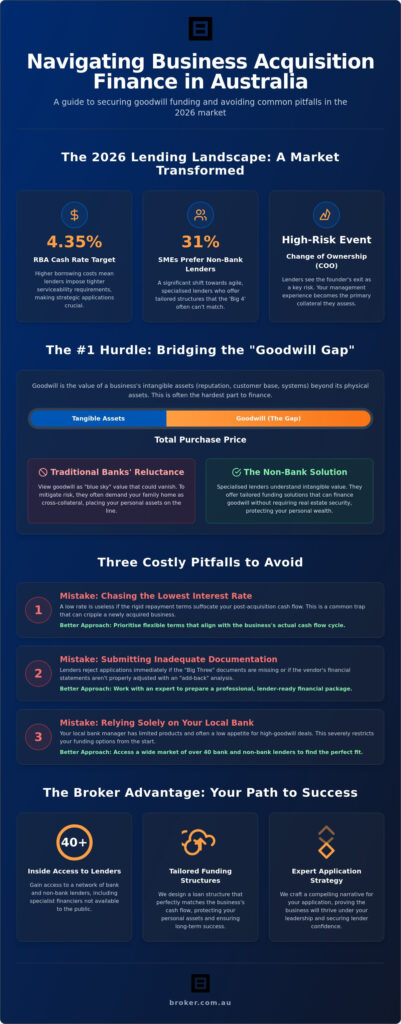
In the current 2026 market, the Reserve Bank of Australia has maintained a cash rate target of 4.35%, which directly influences how lenders calculate valuation multiples. Higher borrowing costs mean tighter serviceability requirements. This often creates a friction point between what a vendor thinks their “life’s work” is worth and what a bank is willing to fund. Bridging this divide requires more than just a standard application. It requires a strategic narrative that proves the business will thrive under your leadership, even as economic conditions fluctuate.
Acquisition vs. Expansion: Why Lenders Are Cautious
Lenders view a “Change of Ownership” (COO) as a significant risk event. When the original founder walks out the door, they take years of relationships, “secret sauce” knowledge, and cultural leadership with them. Unlike an expansion loan where you’re growing a known entity you already understand, an acquisition involves buying a “going concern” with inherent variables. The bank’s primary fear is that the revenue will dip during the handover period.
Your personal management experience becomes the primary collateral in these deals. Banks aren’t just looking at the vendor’s past performance; they’re scrutinising your CV to see if you have the grit to navigate the transition. They want to see that the Goodwill (accounting) you’re paying for is sustainable and won’t evaporate the moment the previous owner stops answering their phone. It’s about proving that the intangible value is backed by a tangible plan.
The 2026 Economic Pulse for Australian SMEs
The lending landscape has shifted dramatically this year. With 31% of SMEs now preferring non-bank lenders over the “Big 4,” the options for goodwill financing for business purchase australia have expanded but also become more nuanced. Traditional banks often have a low appetite for high-goodwill deals, preferring the safety of real estate security. They want to lean on your home, but we know that isn’t always the best path for your personal financial security.
This is where “inside access” becomes your greatest asset. Non-bank lenders in 2026 are increasingly agile, offering tailored structures that look beyond the family home for security. However, these options aren’t always visible on a standard search. Accessing these specialised pools of capital requires a partner who understands which lenders are currently “open for business” in your specific industry. We focus on moving you from a state of uncertainty toward a feeling of streamlined confidence, ensuring the funding matches your long-term vision without unnecessary personal risk.
The Goodwill Gap: Financing Intangible Assets Without Risking Your Home
The most daunting hurdle in any acquisition is the “Goodwill Gap.” This is the often substantial difference between the value of the physical equipment you can touch and the actual purchase price. When you’re seeking goodwill financing for business purchase australia, you’ll quickly find that traditional banks are often allergic to this gap. They view it as “blue sky” value that could vanish the moment the previous owner stops answering their phone. This skepticism often leads them to demand your family home as security, but that isn’t your only option.
Understanding Goodwill in an Australian Context
In 2026, goodwill represents the capitalised value of a business’s future economic benefits, specifically those arising from its reputation, brand loyalty, and established operational systems that generate consistent intangible cash flow. Properly valuing intangible assets is essential because industry benchmarks for EBIT (Earnings Before Interest and Taxes) multiples are shifting. If you over-leverage for “blue sky” potential without a data-backed valuation, you risk falling into the “Intangible Asset Trap.” This is where the debt repayments are so high that they choke the very growth you bought the business to achieve.
Alternative Security Structures for Acquisition
You don’t have to put your personal residential property on the line to close the deal. Sophisticated acquisition funding involves leveraging the target business’s existing assets, such as equipment, vehicles, or even commercial property, to secure a portion of the debt. For the remaining shortfall, we look toward cash-flow based lending or tailored unsecured business loans. These structures focus on the business’s ability to generate profit rather than what you own personally.
We specialise in identifying lenders who are comfortable with high-goodwill industries, such as professional services, health clinics, or digital agencies. These lenders understand that the value lies in the recurring contracts and systems. To satisfy their credit teams, we use proprietary AI-driven financial modelling to stress-test your acquisition against various 2026 economic scenarios. This proves your serviceability and moves the conversation from a place of risk to a place of streamlined confidence. If you’re unsure which structure fits your target business, you can start by looking at our business acquisition funding options to see what’s possible.
The goal is a seamless transition where the funding matches the business’s natural cash flow cycle. By using “inside access” to over 40 bank and non-bank lenders, we can often secure terms that protect your personal assets while providing the necessary agility to grow. It’s about finding a partner who sees the same value in the business that you do.
Structural Errors: Choosing the Wrong Loan Type for Your Industry
Many SMEs make the mistake of chasing the lowest possible interest rate while ignoring the restrictive covenants that come with it. In a high-stakes acquisition, flexibility is often more valuable than a few basis points. If your loan structure is too rigid, you won’t have the breathing room to handle the inevitable “hiccups” that occur during the first six months of new ownership. Securing goodwill financing for business purchase australia requires a structure that balances cost with agility, ensuring you don’t choke your cash flow before you’ve even found your feet.
A “Day One” cash flow shortage is the silent killer of Australian business acquisitions. It’s a common trap: you spend every cent of your capital on the purchase price and loan costs, only to realise the vendor has cleared out the bank accounts as part of the settlement. Without an integrated working capital finance facility or a pre-approved line of credit, you’ll struggle to meet your first payroll or supplier run. We always recommend layering your funding to include immediate liquidity from the moment you take the keys.
Secured vs. Unsecured Acquisition Funding
Choosing between secured and unsecured options isn’t just about interest rates; it’s about asset protection. While secured loans offer lower rates, they often require “all-paps” (all present and after-acquired property) charges or mortgages over your family home. Unsecured options, while carrying higher rates, provide the speed and agility needed to move quickly on a competitive deal. The following table outlines the typical landscape for Australian SMEs in 2026.
| Feature | Secured Acquisition Funding | Unsecured Acquisition Funding |
| Typical Rates (2026) | 6.8% to 9.5% p.a. | 9.5% to 18% p.a. |
| Approval Speed | 2 to 4 weeks | 24 to 72 hours |
| Security Required | Residential or Commercial Property | Director Guarantees / No Property |
| Best For | Long-term stability and low cost | Rapid settlement and asset protection |
Vendor Finance: The Strategic Layer for Complex Deals
Vendor finance is a powerful tool where the seller agrees to receive a portion of the sale price over time. This effectively makes the vendor a secondary lender. It’s a brilliant way to bridge the gap when goodwill financing for business purchase australia falls short of the total asking price. When a seller leaves “skin in the game,” it signals to your primary bank that the outgoing owner is confident in the business’s future performance. This often makes the bank more comfortable with the overall risk profile.
We often help clients structure a hybrid deal that combines a bank loan, a vendor finance portion, and an equipment finance carve-out. By separating the machinery or vehicle costs from the goodwill loan, you can often achieve a more efficient overall interest rate. This tailored approach ensures your transition is seamless and your personal assets remain protected from the start.
The Documentation Minefield: Avoiding Application Rejection
Lenders don’t just look at what a business made last year; they look at what it can make under your control. When applying for goodwill financing for business purchase australia, the quality of your documentation is the difference between a swift approval and a frustrating rejection. In 2026, the “Big Three” documents every Australian lender will scrutinise are your target business’s full financial statements for the last two years, the most recent 12 months of Business Activity Statements (BAS), and your detailed business plan for the transition.
One of the biggest mistakes is taking the vendor’s Profit & Loss statement at face value. A vendor’s P&L is only half the story. You need a rigorous “add-back” analysis to uncover the true underlying profit of the entity. This involves identifying discretionary expenses that won’t continue under your ownership, such as the vendor’s personal vehicle lease, one-off legal fees, or non-market salaries paid to family members. By “normalising” these accounts, you present a much stronger case for serviceability to a credit manager.
You also need to watch for the “ATO Red Flag.” With the Australian Taxation Office maintaining a strict stance on debt recovery and Director Penalty Notices (DPN) in 2026, lenders are terrified of hidden tax liabilities. We ensure your application package includes clear evidence that all employee entitlements, including superannuation and long-service leave, are fully accounted for. Our proprietary AI technology organises and verifies your financial data, ensuring your “lender-ready” pack meets the precise entry requirements of over 40 bank and non-bank lenders.
Step-by-Step: Preparing Your Application
- Step 1: Normalise the accounts. Strip away the vendor’s personal lifestyle expenses to show the business’s raw earning power.
- Step 2: Identify Add-backs. Document one-off costs like rebranding or equipment repairs that won’t recur in your first year of ownership.
- Step 3: Forecast your cash flow. Create a month-by-month 12-month forecast that accounts for the handover period and your planned growth strategies.
The Critical Nature of Due Diligence
Due diligence isn’t just a box-ticking exercise; it’s your primary shield against post-acquisition disaster. You must verify that the business is fully compliant with ASIC reporting standards and that there are no pending tax payment plans that could haunt the new entity. Our AI matching engine works behind the scenes to ensure your specific document set aligns perfectly with the unique credit policies of our niche lending partners. If you’re ready to see how your numbers stack up, get started with our secured business loans team today.
Partnering for Success: How an Expert Broker Streamlines Your Purchase
Navigating the final stages of a business purchase can often feel like walking a tightrope. While you’re busy coordinating with accountants, solicitors, and the vendor, the last thing you need is a rigid bank manager slowing down your momentum. Local bank managers are typically restricted by their own institution’s narrow risk appetite. If your deal doesn’t fit their specific “box,” they simply can’t help you. This is where the “Inside Access” advantage becomes your greatest asset in securing goodwill financing for business purchase australia.
At Broker.com.au, we act as your high-level fixer. Our proprietary AI technology doesn’t just look for a loan; it matches your specific acquisition profile with the most competitive rates across a panel of over 40 bank and non-bank lenders. We understand that every SME deal has its own unique “moving parts,” from earn-outs to complex tax structures. By managing the constant back-and-forth with credit teams, we ensure your path to settlement is stress-free, allowing you to stay focused on the actual business you’re about to run.
Tailored Solutions for Complex SME Acquisitions
Consider the challenge of a service-based business, such as a digital marketing agency or a consultancy firm. These businesses often have zero physical assets to offer as security, which usually causes traditional banks to walk away. We recently helped a client structure a deal for a high-growth SaaS provider where the entire value was tied up in recurring revenue and intellectual property. By identifying a lender that specialises in intangible asset cash flow, we secured the necessary goodwill financing for business purchase australia without the client needing to mortgage their family home.
Our approach is built on a low-pressure, “I’m interested” philosophy. We start with a conversation about your long-term goals rather than a mountain of paperwork. Whether you’re working with Matt, Kylie, or Flavio, you’re getting a seasoned partner who knows how to move a deal from conditional approval to funds in the bank with seamless efficiency. We go beyond just finding a loan; we provide the corporate advisory insight needed to ensure your funding structure supports your growth for years to come.
Your Next Steps to Acquisition
The most successful acquisitions begin long before the final contracts are signed. It’s vital to get a pre-assessment of your borrowing capacity before you commit to a Heads of Agreement. This gives you the confidence to negotiate from a position of strength, knowing exactly what your funding limits are. You can also use our online tools to test your post-purchase serviceability and see how different loan terms might affect your monthly cash flow.
If you’re ready to move from uncertainty toward a feeling of streamlined confidence, we’re here to help. Our team will guide you through every hurdle, ensuring your transition from the vendor is as professional as the business you’re acquiring. I’m interested in exploring acquisition funding options and taking the first step toward a successful handover.
Securing Your Legacy in the 2026 Market
Successful acquisitions in the current Australian landscape require more than just a signature; they demand a sophisticated approach to valuation and a loan structure that prioritises cash flow over rigid security. By rigorously normalising vendor accounts and layering your funding to include Day One working capital, you can protect your personal assets while ensuring your new venture has the breathing room it needs to thrive. The goal is to move beyond the anxiety of high-stakes debt toward a feeling of streamlined confidence in your new role as an owner.
Navigating the nuances of goodwill financing for business purchase australia is much simpler when you have the right expertise in your corner. As an award-winning Australian business loan broker, we use proprietary AI technology to accurately match your unique deal with the best available terms. Our team provides inside access to over 40 bank and non-bank lenders, ensuring you find a tailored solution that matches your specific industry needs without unnecessary stress.
If you’re ready to turn your acquisition goals into a reality, we’re here to guide you through every step of the process. I’m interested in exploring acquisition funding options and starting a low-pressure conversation about your future. You’re in good hands, and we’re excited to help you build your business dream.
Frequently Asked Questions
Can I get a business acquisition loan without using my home as security?
Yes, you can secure funding without risking your family home. Many non-bank lenders specialise in cash-flow based lending where the business’s revenue and profitability serve as the primary security. While traditional banks often insist on a residential mortgage, we provide inside access to alternative structures that protect your personal assets through director guarantees or charges over the business assets instead.
How much deposit do I typically need for a business purchase in Australia?
You typically need a deposit of 20% to 30% of the total purchase price. This requirement can vary depending on the industry and the strength of the business’s historical financials. In some cases, layering the deal with vendor finance can reduce the upfront cash contribution you need to provide from your own pocket, making the acquisition more accessible.
What is the difference between goodwill and asset-based lending?
Asset-based lending secures the loan against tangible items like machinery, vehicles, or property. In contrast, goodwill financing for business purchase australia covers the intangible value of the business, such as its brand reputation, intellectual property, and customer loyalty. Because goodwill has no physical form, lenders scrutinise your future cash flow projections more heavily to ensure the debt is serviceable under new ownership.
How long does the business loan application process usually take in 2026?
The timeline depends heavily on the lender you choose and the complexity of the deal. In 2026, non-bank lenders can often provide conditional approval within 24 to 72 hours. Traditional banks are generally slower; they typically take between two to four weeks to process a complex acquisition application. Having a “lender-ready” documentation pack from the start significantly speeds up this process.
Can I include working capital in my acquisition loan package?
Yes, and it’s highly recommended to avoid “Day One” cash flow shortages. We often structure acquisition packages that include a lump sum for the purchase price plus a separate line of credit or invoice finance facility. This ensures you have the necessary liquidity to cover payroll and supplier costs immediately after the handover from the vendor.
What happens if the business I am buying has existing ATO debt?
Existing ATO debt is a major red flag that must be addressed during your due diligence. Typically, any outstanding tax debt is cleared at the point of settlement using the vendor’s sale proceeds to ensure you start with a clean slate. If the debt isn’t managed correctly, it can lead to an immediate loan rejection because lenders in 2026 are extremely cautious about tax compliance risks.
Is it possible to get a loan for a franchise acquisition in Australia?
Yes, franchise acquisitions are often viewed favourably by Australian lenders because they come with a proven business model and established systems. Some lenders even maintain “accredited” franchise lists, which can lead to more competitive rates and higher loan-to-value ratios. We can help you identify which lenders have a specific appetite for the franchise brand you’re looking to purchase.
Why should I use a broker instead of going directly to my bank for an acquisition?
A broker provides access to over 40 bank and non-bank lenders, whereas a bank manager can only offer their own institution’s limited products. We use proprietary AI technology to match your specific acquisition profile with the lender most likely to approve your deal with flexible terms. This saves you the stress of multiple applications and ensures you get a structure that actually matches your business’s cash flow.