
A strong business acquisition loan application connects the purchase price, your contribution and the business’s cash flow. If you’re working out how to get a loan to buy a business in australia, that connection is central: lenders need to understand what the finance will cover and how repayments could be supported after settlement.
There’s no single deposit figure for every purchase. Lender requirements depend on the buyer, the business, the transaction and any proposed security. Before making an offer, consider how much equity you can contribute and whether the business’s financial performance supports the funding you’re seeking.
This guide covers acquisition finance for goodwill, business assets and working capital for the transition. It explains what lenders commonly assess, how to organise financial information and forecasts, and how to test affordability before committing to a purchase. Broker.com.au arranges tailored Business Acquisition Funding and facilitates applications across lending options, helping you approach buying a business with a clearer view of the funding required.
Key Takeaways
- Understand how to get a loan to buy a business in australia by linking the purchase terms, your contribution and the business’s ability to support repayments.
- Compare acquisition-focused funding with secured and unsecured loan pathways, considering the purpose of the funds and any proposed security.
- Estimate your available equity by reviewing your funds, assets and financial commitments. Deposit expectations depend on the lender and transaction.
- Prepare information about the target business, proposed purchase terms, your contribution and what the funding will cover.
- Assess whether projected cash flow can support repayments, including any funding needed for goodwill, assets and transition working capital.
Table of Contents
- How business acquisition loans work when buying an existing business
- Compare acquisition finance options for buying an Australian business
- How lenders assess your deposit, equity and repayment capacity
- Prepare your acquisition finance application before making an offer
- Move from business purchase plans to an acquisition funding pathway
How business acquisition loans work when buying an existing business
Acquisition finance helps a buyer purchase an existing business. Its structure depends on the deal, the buyer’s contribution and the business’s capacity to support repayments. Unlike finance for launching a new venture, it relates to an operating business changing ownership. It is also distinct from borrowing for ordinary expenses or later growth, even if the buyer needs separate funding for those purposes.
A lender’s assessment depends on the purchase and the people or entities involved. It may consider the business’s financial performance and cash flow, the buyer’s financial position, the proposed ownership and the available contribution. So, understanding how to get a loan to buy a business in Australia starts with defining what the purchase requires, not simply choosing a loan type. For a high-level introduction to loan terminology and types, see this overview of a business loan.
What can acquisition finance help fund?
Funding may be structured around different parts of the transaction. Goodwill is value attributed to aspects of a business beyond its identifiable assets, such as established customer relationships or reputation. A purchase may also include physical or other business assets, while working capital can support the handover and early transition under new ownership.
Separate these purchase and transition needs from ongoing operating expenses or a later expansion plan. A clear breakdown shows what the requested finance is intended to cover and helps align the funding request with the acquisition.
Who applies: the buyer, company or another entity?
The applicant may be an individual buying the business or an entity set up to acquire it. The suitable arrangement depends on the buyer’s circumstances and the transaction. Consider the applicant, proposed owner and purchaser named in the sale documents together when preparing the application.
Ownership and liabilities matter because a lender needs to understand who is responsible for the borrowing and what financial commitments affect repayment capacity. The application may also need to explain the buyer’s available assets, contribution and connection to the purchasing entity. Broker.com.au can help organise these details and facilitate an application across lending options, keeping the funding request tied to the proposed business acquisition.
Compare acquisition finance options for buying an Australian business
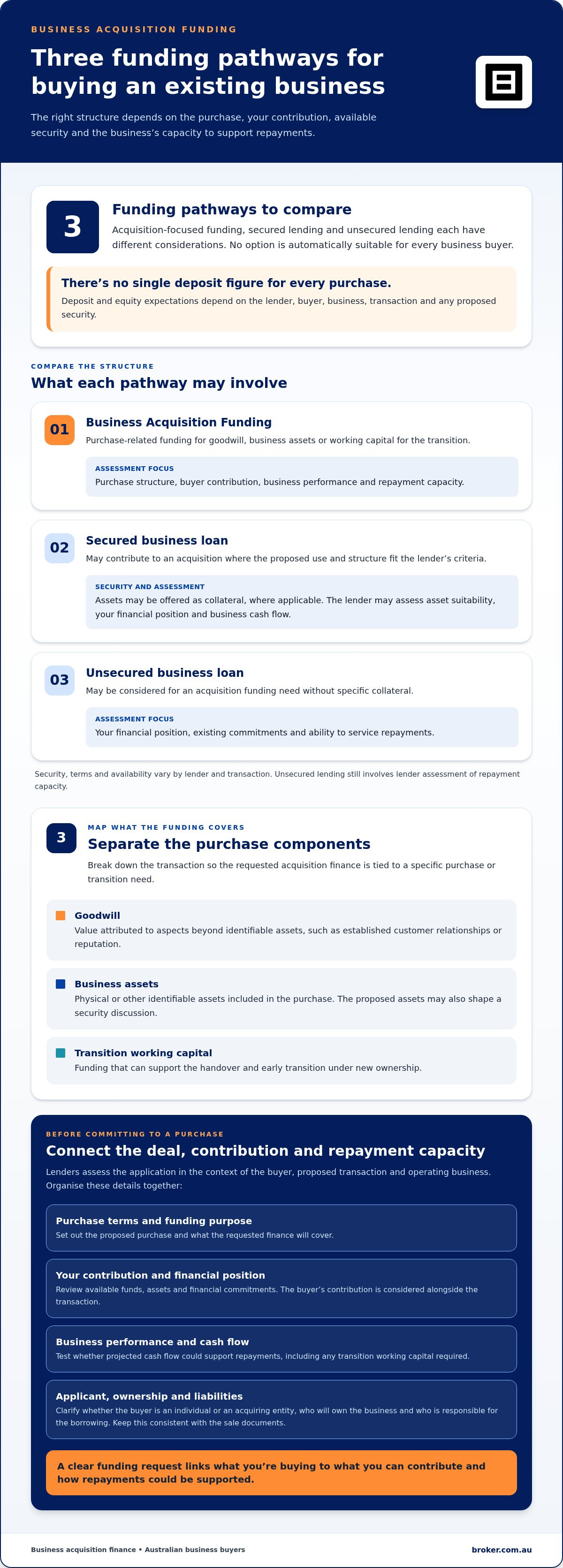
The funding structure should reflect what you’re buying, what assets may support the borrowing and how repayments could be made. Business Acquisition Funding focuses on purchasing an existing business. Secured and unsecured business loan pathways may also be considered, depending on the buyer and transaction. No option is automatically cheaper, simpler or suitable for every business buyer.
Use this comparison as a starting point for considering the funding request. Security, terms and availability vary by lender and transaction. The Reserve Bank of Australia’s bulletin provides broader context on small-business access to finance and How lenders assess your repayment capacity.
| Funding pathway | Potential purpose | Potential security basis | Key assessment considerations |
|---|---|---|---|
| Business Acquisition Funding | Purchase-related funding for goodwill, business assets or transition working capital | Depends on the lender and transaction | Purchase structure, buyer contribution, business performance and repayment capacity |
| Secured business loan | May contribute to the acquisition where the proposed use and structure fit the lender’s criteria | Assets offered as collateral, where applicable | Available assets, their suitability as security, the buyer’s financial position and business cash flow |
| Unsecured business loan | May be considered for an acquisition funding need without specific collateral | No specific collateral, subject to lender assessment | Buyer’s financial position, existing commitments and ability to service repayments |
When might secured or unsecured funding be considered?
With secured lending, an asset may be offered as collateral, giving the lender a potential source of recovery if the loan isn’t repaid. Unsecured lending doesn’t rely on specific collateral, but the lender still assesses the application and repayment capacity. For either pathway, consider the proposed loan in the context of the whole acquisition, including your contribution and the business’s expected cash flow.
How can a purchase be structured around its funding needs?
Break down the transaction before discussing a funding structure. Goodwill, identifiable assets and working capital for the handover may each raise different questions. For example, a deal with substantial business assets may prompt a different security discussion from one where more of the purchase value relates to goodwill. Whether a lender will fund each component depends on its criteria and the transaction details.
To assess how to get a loan to buy a business in australia, match each funding request to a specific purchase need, then consider it alongside available security and repayment capacity. Broker.com.au can help organise those details and facilitate an application across lending options. Explore Business Acquisition Funding as you assess a structure for the purchase.
How lenders assess your deposit, equity and repayment capacity
A lender looks beyond the sale price to understand how the purchase will be funded and repaid. The purchase price alone doesn’t establish borrowing capacity. A lender also needs to assess the buyer’s contribution, financial commitments and the business’s capacity to support repayments.
For a buyer working out how to get a loan to buy a business in australia, this means preparing a clear picture of both sides of the deal: the funds available to complete the purchase and the cash flow expected to service the loan. Deposit and equity expectations aren’t universal. They depend on the lender, the transaction, proposed security and the buyer’s financial position.
What deposit or equity could a business buyer need?
The required contribution varies, so don’t base your plans on a fixed percentage or assume one deposit figure applies to every acquisition. A lender may consider how much you’re contributing, what assets may be available as security and how the purchase is structured.
Prepare a realistic summary of your contribution and overall financial position. Include funds available for the purchase, relevant assets and existing liabilities or commitments. This gives the lender context to assess the proposed funding rather than viewing the deposit in isolation. A larger contribution may reduce the amount borrowed, but it doesn’t guarantee approval.
How do cash flow and servicing affect approval?
Servicing means assessing whether available income can meet proposed repayments alongside other financial commitments. For an acquisition, lenders may assess the target business’s cash flow and the buyer’s position together. The business’s past performance still needs to be considered against the debt requested and the new owner’s expected commitments.
Use the target’s financial information to build forecasts, and make the assumptions clear. Historical results show how the business has performed, but don’t automatically predict what will happen after ownership changes. Account for the proposed transition, including expected changes to trading or working capital needs. Explain the basis for each assumption and avoid relying on growth that isn’t supported by the business’s records or purchase plan.
Check that your affordability assessment includes both the business’s projected cash flow and your other financial obligations. Setting out your contribution, assets, liabilities and servicing case helps create a clearer acquisition finance application and can highlight gaps to address before you commit to the purchase.
Prepare your acquisition finance application before making an offer
A clear application starts with the deal you’re considering, not a generic borrowing request. Organising the purchase details and your financial position helps a lender understand what you want to acquire, how much funding you’re seeking and how repayments may be supported. This preparation isn’t a lending decision, so don’t treat it as a reason to proceed before you’re comfortable with the purchase terms.
Build a clear picture of the business purchase
Describe the target business and proposed transaction. Set out the proposed purchase terms and identify what the price relates to, such as goodwill or business assets. Then organise the available financial information on the business, including historical results and the assumptions behind your cash flow forecasts.
Keep transition working capital separate from the purchase amount. Explain what it is intended to support during the handover and how you estimated the need. This makes the funding purpose clearer and shows how the transition plan connects to projected cash flow.
Make the funding request easier to assess
Prepare a concise summary that brings together the key parts of the application:
- Purchase: the business, proposed terms and the assets or goodwill involved.
- Funding purpose: the amount sought for the acquisition and any separate transition working capital requirement.
- Buyer contribution: the funds you plan to contribute and any assets relevant to the proposed finance.
- Repayment picture: expected business cash flow, forecast assumptions and your other financial commitments.
Ground forecasts in the target’s available financial information. If you expect trading to change after the handover, explain why and show how that assumption affects servicing. A lender needs to assess the requested finance against both the business’s projected cash flow and the buyer’s wider financial position.
These steps can help you approach how to get a loan to buy a business in australia with a more coherent acquisition finance request. Preparing an application is separate from deciding whether the purchase is right for you; consider the transaction and its risks independently.
Broker.com.au arranges Business Acquisition Funding and uses proprietary AI technology to support quick and accurate loan applications. The team can help organise the information and facilitate an application across lending options. Explore Business Acquisition Funding as you prepare the purchase details and funding request.
Move from business purchase plans to an acquisition funding pathway
A workable acquisition funding pathway brings together the purchase structure, your contribution and the business’s capacity to support repayments. The discussion should relate to the existing business you plan to buy and distinguish funding for the purchase from any working capital needed for the transition.
What a tailored acquisition funding discussion should cover
Start with your goals as a business buyer and the proposed transaction. Clarify what the purchase price includes, such as goodwill and business assets, then outline any transition working capital needs. Set out the contribution you expect to make and the financial commitments that may affect your ability to service borrowing.
These details help frame whether secured or unsecured lending pathways could be considered. They don’t establish eligibility or guarantee approval. A lender’s assessment depends on the buyer, transaction and proposed funding structure. Forecasts should show how the business may meet repayments through the handover, using realistic cash flow assumptions.
Business Acquisition Funding can be tailored around purchase and transition requirements, including goodwill, assets and working capital. Broker.com.au arranges this funding as a broker and facilitates applications across lending options rather than lending directly. The company also offers corporate advisory services, and its proprietary AI technology supports quick and accurate loan applications. These capabilities support the application process but don’t promise a particular lending outcome.
Take the next step with confidence
Before a funding discussion, bring together the target business’s available financial information, proposed purchase terms, your contribution and a clear breakdown of what the funding would cover. Include your transition assumptions and other financial commitments so the discussion can focus on the purchase and how repayments may be supported.
If you’re considering how to get a loan to buy a business in australia, a broker can help organise the funding request and navigate relevant lending options around the transaction. You don’t need to have every detail resolved before beginning a conversation. Explain where you are in the purchase process and what you’re working towards.
Discuss acquisition funding for your business purchase.
Take the next step with a clearer funding plan
Buying an existing business is a major decision. A credible funding plan connects the purchase terms, your contribution and the business’s capacity to support repayments. Deposit and equity expectations depend on the lender and transaction, so focus on presenting a realistic picture of your finances and the target business’s cash flow.
If you’re considering how to get a loan to buy a business in australia, specialist Business Acquisition Funding can be structured around the purchase. Funding may address goodwill, business assets and working capital for the transition, subject to lender assessment. Broker.com.au arranges acquisition funding and facilitates applications across lending options. Its proprietary AI technology supports quick and accurate loan applications.
Organise the purchase details, buyer contribution and financial information, then discuss business acquisition funding with Broker.com.au.
Frequently asked questions
Can I get a loan to buy an existing business in Australia?
Yes, lenders may provide finance for buying an existing business, subject to assessment of the buyer, business and proposed transaction. Business Acquisition Funding is designed for this type of purchase and may be structured around goodwill, assets or transition working capital. Understanding how to get a loan to buy a business in Australia starts with setting out the purchase terms, your contribution and how repayments may be supported.
How much deposit do I need to buy a business?
There’s no single deposit amount for every business purchase. The contribution a lender expects depends on its assessment of the buyer, transaction and any proposed security. Be ready to explain how much you can contribute, what assets may be relevant and what financial commitments you already have. Treat any estimate as specific to the deal, rather than relying on a universal percentage or assuming a particular contribution guarantees approval.
What do lenders look at when assessing a business acquisition loan?
Lenders assess whether the proposed loan fits the purchase and appears serviceable. They may consider the target business’s financial information and cash flow, the buyer’s financial position, available contribution, assets and existing commitments, as well as the transaction and funding purpose. Prepare a clear account of what the loan would fund and how repayments could be met. The assessment depends on the lender and application details.
Can I borrow to buy a business that includes goodwill?
Potentially. Business Acquisition Funding may address goodwill, which is value attributed to a business beyond its identifiable assets. Whether a lender will fund goodwill, and on what terms, depends on its assessment of the buyer and transaction. Make the purchase breakdown clear by separating goodwill from identifiable business assets and transition working capital. This explains the funding request but doesn’t guarantee that every component will be included in a loan.
Can I use the business’s cash flow to repay an acquisition loan?
The business’s cash flow may form part of a lender’s assessment of repayment capacity, but it won’t necessarily be the only factor. Lenders may consider historical performance alongside forecasts, the buyer’s other commitments and the impact of the ownership transition. Base projections on available financial information and explain assumptions such as expected trading changes or working capital needs. This presents a grounded servicing case without treating future income as certain.
What documents do I need to apply for business acquisition finance?
Requirements vary by lender and transaction, but it’s useful to organise information about the target business, proposed purchase terms, your contribution and the intended use of funds. Lenders may also request the business’s financial records, cash flow forecasts and details of the buyer’s financial position and commitments. Keep transition working capital separate from the purchase amount, and make forecast assumptions clear. A broker can help organise and facilitate the application.
Is a secured or unsecured loan better for buying a business?
Neither is automatically better for every acquisition. A secured loan involves assets offered as collateral, where applicable. An unsecured loan doesn’t require specific collateral, but still depends on lender assessment. Compare the pathways against the purchase structure, available assets, buyer contribution and ability to service repayments. The business’s cash flow and funding purpose matter too. Terms, security requirements and availability vary, so the suitable option depends on the buyer and transaction.