
The approved facility usually isn’t paid out in one lump sum. Construction finance for commercial buildings commonly releases funds in stages as work is completed, with lending limits often measured against total development cost. In Australia, commercial construction loans typically lend 65% to 75% of total development cost, so the business usually needs to contribute equity towards the balance.
A staged structure can make cash flow easier to manage, but project funding depends on more than the build quote. Lenders assess the property’s value, project costs, business finances and ability to service the debt, as well as progress against agreed drawdown milestones.
This guide explains how drawdowns work, what lending limits and valuation measures mean, and how lenders assess a construction business’s financial position. You’ll see how these factors connect and what may shape the facility and the equity contribution your project needs.
Key Takeaways
- Commercial construction finance is assessed against the project’s costs, value, approvals and business capacity to service debt.
- Funds are generally released in stages as construction milestones are completed, with progress assessments helping support each drawdown.
- Loan limits depend on the lender’s valuation approach and may be measured against total development cost or the completed property’s value.
- Allow for an equity contribution and a clear plan for project cash flow, including costs that arise between drawdowns.
- Lenders assess more than the building proposal: budgets, cash flow, debt, revenue and financial risks all help shape the finance decision.
Table of Contents
- What is commercial construction financing?
- Progressive drawdowns and quantity surveyor certification
- Commercial construction loan facility sizes and lending limits
- Loan-to-value and total development cost lending limits
- Construction business finance assessment
- Broker.com.au: Secured Business Loans
What is commercial construction financing?
Construction finance for commercial buildings funds a business property project. Lenders assess approvals, costs, value and repayment capacity. Timing matters because planning delays can affect the loan application, construction start and completion date.
Pre-construction requirements and approvals
Pre-construction requirements include the planning, design and project documents needed before a commercial build can proceed. Unresolved approvals or unclear costs can delay work and weaken the funding plan.
Before applying, organise the development application, approved plans, construction budget and building contract. Lenders use these documents to assess the proposed build, its expected cost and whether it can be completed within the funding structure. A mortgage over the property may also form part of the security assessment.
Development application timing depends on the application type and state. In New South Wales, standard development applications have a stated assessment period of 40 days. In Queensland, code-assessable applications have a stated assessment period of 20 business days. These periods cover council assessment, not the time needed to prepare an application or resolve project changes.
Keep council approvals separate from the lender’s assessment timeline. If plans or costs change while the application is under review, the lender may need updated project information. Changes can affect the construction budget and project feasibility.
Application and approval timeframes
The application and approval process is the lender’s review of the borrower, project and security before formal funding approval. Timing matters because finance needs to align with the project schedule and any land settlement or construction commitments.
Prepare an application with business financial information, project costs, plans, approvals, construction details and the proposed funding structure. The lender assesses debt-servicing capacity, project viability and property value. Missing or changing documents may require further assessment and extend the timeline.
Commercial construction loan approval commonly takes around 4 to 8 weeks from application to formal approval. Major bank assessments may take 8 to 12 weeks or longer, while non-bank construction finance may take 4 to 6 weeks. Private construction finance may be approved and settled in 2 to 3 weeks in straightforward cases.
Timeframes vary by lending channel and application. Project complexity, documentation, valuation and approval status all influence how quickly the assessment progresses. Formal approval is also different from settlement: funding proceeds once the required lending and project conditions are met.
For construction finance for commercial buildings, allow time for council processes and lender assessment before setting a construction start date. This helps align approvals, funding conditions and the project schedule, rather than treating loan approval as the only step before work begins.
Progressive drawdowns and quantity surveyor certification
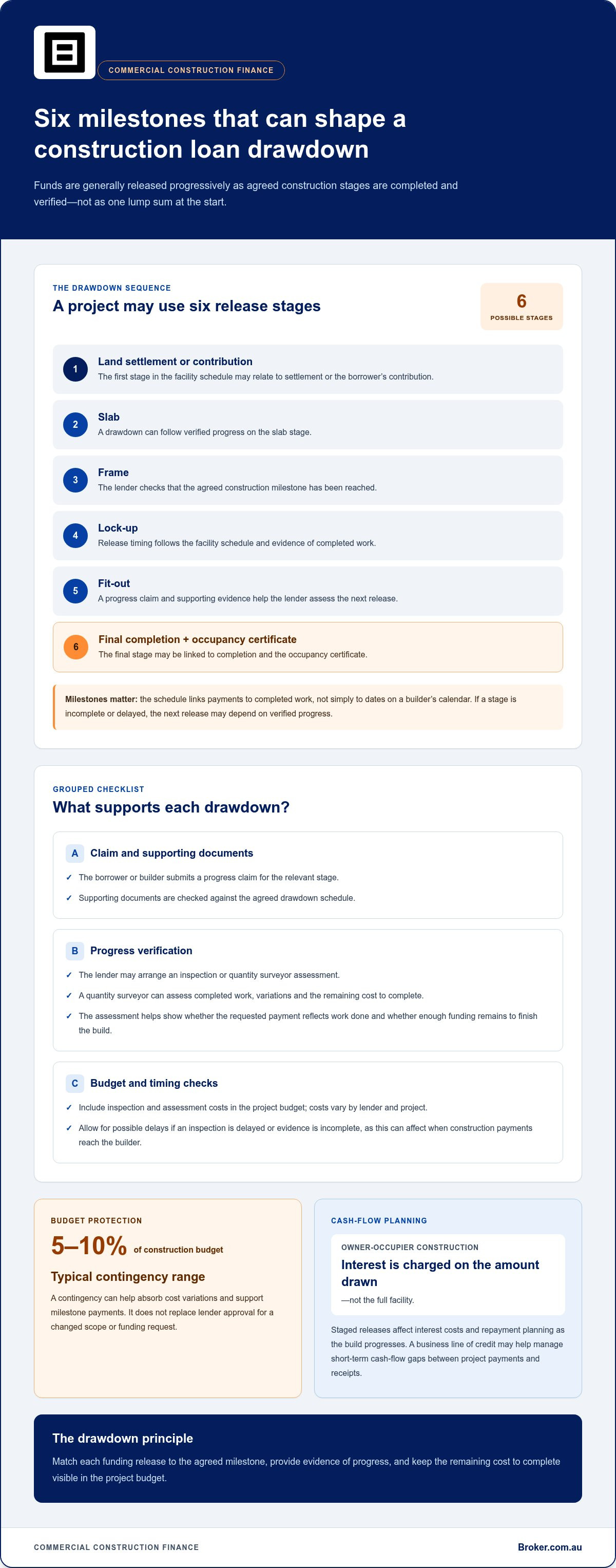
Commercial construction funding is usually released progressively, rather than as one payment at the start. Each drawdown follows a construction milestone, matching loan payments with work completed and the project’s cash-flow needs. In Australia, the facility schedule sets out the milestones and evidence required for each request.
A commercial project may use six drawdown stages: land settlement or contribution, slab, frame, lock-up, fit-out and final completion with an occupancy certificate. The lender’s schedule links payments to these milestones, not simply to dates on a builder’s calendar. If work runs behind or a stage is incomplete, the next release may depend on verified progress.
For each drawdown, the borrower or builder submits a progress claim and supporting documents. The lender reviews the claim against the agreed schedule and may arrange an inspection or quantity surveyor assessment. A quantity surveyor can assess completed work, variations and the remaining cost to complete. This helps establish whether the requested payment reflects work done and whether enough funding remains to finish the build.
Certification provides a project-level view, rather than just a snapshot of the latest invoice. For example, a quantity surveyor may compare the claimed slab work with site progress and the original budget. If a variation changes the remaining cost, the report can show its effect on the funding needed to complete the project. The lender uses this information to assess the next release against the credit facility and construction plan.
Inspection requirements and costs vary by lender and project. Include assessment costs in the project budget. A delayed inspection or incomplete evidence can also affect when construction payments reach the builder.
Build contingency into the funding plan before setting the drawdown schedule. Commercial construction contingency funds typically range from 5% to 10% of the construction budget. This reserve can help absorb cost variations without disrupting milestone payments, though it doesn’t replace lender approval for a changed scope or funding request.
For owner-occupier construction, interest is charged on the amount drawn, not the full facility. Staged releases therefore affect interest costs and repayment planning as the build progresses. A business line of credit may also help manage short-term cash-flow gaps between project payments and receipts. Explore business line of credit options as part of a broader funding plan.
Commercial construction loan facility sizes and lending limits
A commercial construction loan is sized around the project’s funding requirement, security and repayment plan. The approved limit is not the same as the amount released: funds are generally drawn as the project advances through agreed stages.
Construction terms commonly run for 12 to 24 months. During this period, interest-only repayments are common, and the principal is typically repaid when the project is complete or replaced with longer-term finance. A permanent commercial mortgage may suit a completed property that will be retained, while sale proceeds may repay debt on a development intended for sale. The exit plan is a key factor in assessing whether the facility fits the project.
Interest rates vary with the lender and the project’s risk profile. Major banks may offer development finance at 5.00% to 7.50% per annum; non-bank specialist construction finance may range from 8.00% to 11.95%. Private construction finance may carry rates of 10.75% to 16.00% per annum or higher. These market ranges show why the borrower’s equity, project preparation and ability to service debt matter alongside the headline rate.
A mid-build change can affect the facility. For example, a revised scope or higher build cost may alter the remaining funds required, valuation and expected completion date. Before agreeing to a change, the lender may reassess the updated budget, work completed, security and repayment plan. Don’t assume an existing approval automatically covers extra works or a different drawdown schedule.
Before changing the structure, map the effect on each remaining release and the final debt balance. Higher construction costs can reduce the funds available for later stages, even if earlier drawdowns proceeded as planned. The lender assesses the revised project as a whole, including whether the remaining funding and proposed exit still align.
Converting to a term loan means replacing short-term construction finance with longer-term debt after completion. The lender assesses the finished property, its value and the borrower’s capacity to meet ongoing repayments. If refinancing is the intended exit, plan the transition alongside the original application. Delayed completion can affect the conversion date and the construction loan’s repayment deadline.
Compare facilities on more than their maximum amount. Review the term, interest structure, drawdown conditions, treatment of project changes, and repayment or refinance plan. These factors show whether the construction loan can support the project from its first release through completion, rather than simply appearing large enough at approval.
Loan-to-value and total development cost lending limits
Commercial construction lenders assess projects using measures such as loan-to-value ratio (LVR), total development cost (TDC) and gross realisation value (GRV). LVR compares proposed debt with the assessed property value; TDC compares it with total project costs. The measure used affects the maximum facility and the equity the borrower needs to contribute.
Australian development finance limits vary by lender type and assessment method. Major bank facilities may be assessed against project costs or end value. Non-bank construction finance may reach 65% to 75% of TDC or 70% of GRV. Private construction finance may reach 75% to 85% of TDC or GRV. These ranges are not automatic entitlements. A lender may apply the lower measure when testing a project’s maximum debt.
For example, a townhouse project can be assessed against land, construction and associated costs, then against the expected value of completed homes. An apartment development may also rely on feasibility and projected sale proceeds. Commercial property projects use similar valuation measures, but an office, retail or industrial build has its own income and exit profile. The contract, project budget and valuation inform the lender’s assessment.
Mixed-use projects combine commercial and residential components, so lenders consider how each affects costs, income and completion risk. A development with shops below apartments, for instance, may need separate assumptions for leasing or sales. Construction finance generally funds the build through staged releases; development finance assesses the wider project, including land, approvals, construction and the planned exit. This distinction can shape the facility and equity required throughout the project.
State and territory costs also affect the total funding requirement. Stamp duty depends on the jurisdiction and transaction, while development contributions can add project expenses. Include applicable charges in the feasibility budget before calculating the equity gap. A construction contract alone may not capture every cost of completing a commercial development.
Equity is the portion of project costs not funded by the loan. Commercial construction borrowers in Australia commonly need around 30% of total project cost as a deposit or equity contribution. The actual gap depends on the lender’s valuation, TDC calculation and treatment of associated costs. A broker can help compare assessment methods and clarify how they affect the project’s funding position before a contract is committed.
Construction business finance assessment
A construction finance assessment examines both the proposed project and the business expected to deliver or own it. Lenders assess project feasibility, cash flow, existing debt, revenue and financial risks. A viable building concept alone doesn’t show whether the business can meet repayments while covering operating costs and construction commitments.
Start with a clear picture of the business’s financial position. Lenders review revenue streams, expenses, overheads, profit, debt obligations and available cash flow. They may also assess project costings and contingency planning. Present consistent figures across business accounts, the project budget and funding request so the lender can understand how the facility will be used.
Cash flow is central because construction expenses and business income don’t always arrive at the same time. Lenders consider how the business will cover wages, suppliers, overheads and loan commitments during the build. For example, a contractor with several active projects needs to show how progress payments, outstanding invoices and current costs affect available cash. Debt recovery and expense management also influence the business’s ability to keep projects moving.
For a property development, the lender also assesses feasibility and the plan for repaying or refinancing the debt. A feasibility study typically needs to demonstrate a minimum return on cost of 15% to 20%. Major banks commonly require presales covering 70% to 100% of a property development debt facility. Non-bank construction lenders may require 30% to 50% of units under contract, or sometimes no presales for certain project types. Presales can support projected revenue, but lenders still assess costs, timing and project risk.
Financial documentation helps show whether forecasts reflect the business’s actual trading position. Relevant records can include budgets, cash-flow forecasts, project costings, debt schedules, and revenue and expense information. Lenders also assess liquidity and finance ratios, alongside profit ratios and sales calculations. These measures help explain whether the business can manage its obligations, not simply whether the development may generate a return.
Review the figures together before submitting an application. If the project budget assumes progress payments will cover supplier invoices, the cash-flow forecast should show when those receipts and payments occur. If existing debt repayments reduce available funds, include them in the servicing picture. This joined-up view helps lenders assess both the business’s capacity and the development’s feasibility.
Prepare the business and project documentation as one coherent funding case, with clear budgets, cash-flow assumptions and repayment plans. Discuss development finance options for a commercial project with a funding structure that reflects both business capacity and project feasibility.
Broker.com.au: Secured Business Loans
Broker.com.au can help assess funding options when a commercial build needs finance structured around project costs, security and business cash flow. Its Secured Business Loans may suit businesses seeking finance supported by security, while the project’s feasibility, existing commitments and repayment plan remain central to the assessment.
Bring together the construction budget, project timeline, business financials and proposed facility details. This creates a clearer basis for discussing how funding could align with staged payments and the business’s capacity to service debt. If costs or cash flow change during planning, revisit the proposed structure before relying on it to fund the build.
For a considered conversation about finance for your commercial project, contact Broker.com.au or visit broker.com.au.
Plan your next move with confidence
A finance plan should remain useful after approval, not just help secure the initial facility. Keep the project budget, cash-flow forecast and completion plan aligned as work progresses. If the scope, timing or business conditions shift, review how the changes affect funding and the intended repayment strategy before they put pressure on operations.
For construction finance for commercial buildings, the next step is to match the project’s funding needs with the business’s capacity and property plans. Broker.com.au offers Secured Business Loans, Business Acquisition Funding and Unsecured Business Loans. The right option depends on what the finance needs to support and the wider business position.
Talk with Broker.com.au about your construction finance needs and take a considered next step for your project.
Frequently Asked Questions
How Much Can You Borrow?
The amount available depends on project costs, valuation, borrower equity and capacity to service debt. For example, a development with strong security but a weak repayment plan may support less borrowing than its asset value suggests. Compare the proposed facility limit with the full funding requirement, including land, construction and associated project expenses.
Planning a commercial build?
Start by matching the construction contract and project budget to a realistic funding timeline. A commercial build can involve land settlement, approvals, construction payments and a planned repayment or refinance at completion. For example, if the land purchase settles before construction funding starts, the project needs a clear plan for that gap. Make sure the business forecast also accounts for ordinary operating commitments alongside project spending.
What Costs Can the Facility Cover?
A commercial facility can be structured around eligible project costs, such as land, construction and associated development expenses. The lender assesses the proposed budget and how each cost contributes to the completed property. A fit-out, for example, may form part of a project’s construction scope, while business operating expenses require separate consideration. Present costs in a detailed feasibility budget so the funding request reflects the full project, not just the builder’s contract.
What Types of Commercial Projects Can Be Funded?
Projects can include offices, retail premises, industrial warehouses and mixed-use developments, subject to lender assessment. A business building an industrial facility for its own operations has a different income and exit profile from a developer constructing retail premises for lease or sale. Apartment and townhouse developments are also assessed as property projects, with feasibility, valuation and expected income or sale proceeds informing the funding decision.
What is commercial construction finance in Australia and how does it work?
Construction finance for commercial property funds the construction or development of a commercial property, with access to funds governed by the facility’s terms. A business can use it to fund an approved build, then draw funds as project requirements arise and lender conditions are met. For instance, a warehouse project needs a funding structure that accommodates both construction costs and the borrower’s intended plan to repay or refinance the debt after completion.
Which Australian lenders offer construction loans for commercial buildings?
Australian options include major banks, specialist non-bank lenders and private lenders. They assess commercial projects using different criteria, including the borrower’s financial position, project feasibility, valuation and repayment strategy. A developer with presales may present a different risk profile from an owner-occupier funding a building for its own business. Compare lender type with the project’s requirements, rather than assuming one category suits every commercial build.
What deposit and loan-to-value ratio do commercial construction lenders require in Australia?
Commercial borrowers commonly need to contribute around 30% of total project cost as equity, while loan limits depend on the lender’s chosen measure. Some assess the loan against total development cost; others also consider the completed property’s value. These calculations can produce different borrowing limits for the same project. Include land, construction and associated expenses when estimating the equity gap, rather than calculating a deposit from the build contract alone.
What interest rates, fees and costs apply to commercial construction finance in Australia?
Rates and costs depend on the lender, project risk, security and borrower assessment. Commercial construction loan establishment fees are commonly 0.5% to 1.5% of the loan. Include these expenses alongside construction costs when preparing the funding budget, as they affect the total cash requirement.