
Expansion doesn’t always mean opening another site. Buying an existing business can add customers, capabilities or capacity, but the right funding structure depends on how the purchase will be repaid. If you’re looking for funding for business expansion australia-wide, start with the growth opportunity and its expected cash flow, not just the amount you want to borrow.
Choosing a funding option can feel difficult when a lender may consider your contribution, available security and ability to service new debt. A promising opportunity alone may not be enough: your funding case needs to show how the purchase can support the business and meet repayments.
This guide explains how Business Acquisition Funding and other finance structures can support expansion through buying a business. It covers what lenders may assess, how deposit or equity and security can affect an application, and how to prepare financial projections and a repayment plan. With the right preparation, you can compare options and build a funding case around the business you plan to acquire.
Key Takeaways
- Match funding for business expansion australia to the growth goal and the cash flow expected to repay it.
- For buying an existing business, consider Business Acquisition Funding for purchase costs and transition needs.
- Compare finance options by their purpose, repayment source and fit with your expansion plan.
- Lenders may assess your deposit or equity contribution, security, financial position and capacity to service repayments.
- Prepare current financial records and realistic forecasts to support a clear funding case.
Table of Contents
- Funding for business expansion in Australia starts with the growth plan
- Compare Australian business expansion funding options by purpose
- What lenders may assess: deposit, equity, servicing and cash flow
- Prepare a stronger business expansion funding application
- Move from expansion plan to a tailored funding conversation
Funding for business expansion in Australia starts with the growth plan
Expansion funding is finance matched to a specific growth initiative and the cash flow expected to repay it. You might use it to purchase an established business, add equipment to increase capacity or fit out commercial premises. The funding structure should reflect what the money will pay for, when the benefits may flow through and how repayments could be met.
Before comparing finance, define the intended outcome. Are you acquiring customers and operations, increasing production capacity or managing a temporary cash-flow gap? The answer helps distinguish a one-off investment from ongoing working capital needs, and gives lenders context for assessing your request.
What counts as business expansion?
Growth can mean buying an established business, investing in equipment, expanding commercial premises or increasing capacity. Each plan has different funding needs. Equipment or a fit-out may involve a defined purchase, while working capital supports day-to-day cash flow. Set out the outcome you expect, then separate upfront investment from ongoing costs before comparing funding structures.
When buying a business is the expansion strategy
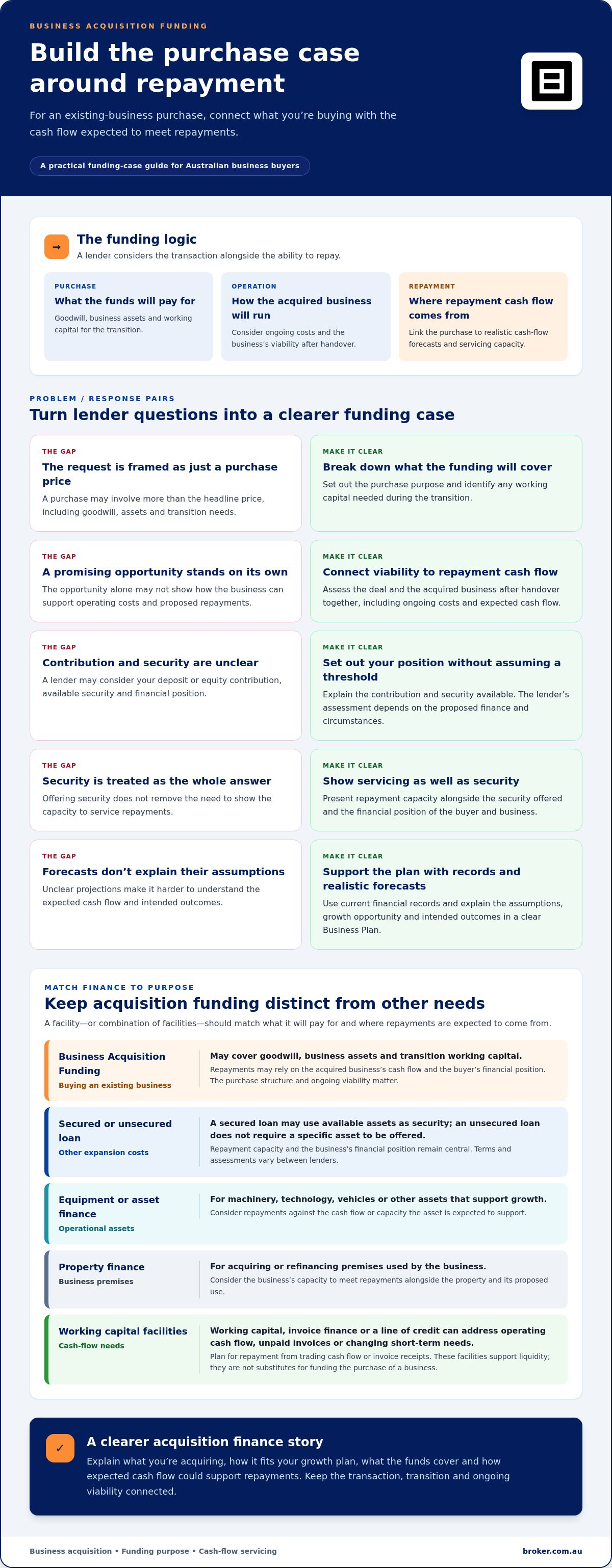
Buying a business can bring an established operation into your growth plan, but acquisition finance needs to account for more than the purchase price. Business Acquisition Funding can cover goodwill, business assets and working capital for the transition. As the business buyer, assess both the transaction and the acquired business’s ongoing viability, including whether its cash flow can support operating costs and proposed repayments.
Business acquisition funding is finance arranged to help buy an existing business, including relevant goodwill, assets and transition working capital.
Build your funding request around a credible plan. Explain what you’re acquiring, how it fits your strategy and where repayment cash flow is expected to come from. A clear Business Plan can set out the opportunity, assumptions and intended outcomes. Assess the deal and the business after handover together, so your case connects the purchase to ongoing operations and repayments.
There isn’t one structure for every expansion. The right fit depends on the purpose of the funds, expected cash flow, available assets and the lender’s assessment of the business and transaction. Once your growth outcome is clear, compare funding options against the specific need rather than starting with a loan type.
Compare Australian business expansion funding options by purpose
Once your growth goal is clear, compare finance by what it will pay for and where repayments are expected to come from. Funding for business expansion australia can involve one facility or a combination. Keep acquisition finance distinct from borrowing for equipment, premises or cash flow, so each part of the request has a clear purpose.
| Funding type | Potential purpose | Repayment source and key consideration |
|---|---|---|
| Business Acquisition Funding | Buying an existing business, including goodwill, business assets and transition working capital. | Repayments may rely on the acquired business’s cash flow and the buyer’s financial position. The purchase structure and ongoing viability matter. |
| Secured business loan | Expansion costs where assets may be available as security. | Assess repayment capacity alongside the security offered. Security can affect the structure, but doesn’t remove the need to show serviceability. |
| Unsecured business loan | Business funding without a specific asset offered as security. | Repayment capacity and the business’s financial position remain central. Terms and assessment vary between lenders. |
| Equipment or asset finance | Machinery, technology, vehicles or other operational assets that support growth. | Consider repayments against the cash flow or capacity the asset is expected to support. |
| Commercial property finance | Acquiring or refinancing premises used by the business. | Consider the business’s capacity to meet repayments alongside the property and proposed use. |
| Working capital, invoice finance or line of credit | Managing operating cash flow, unpaid invoices or changing short-term needs. | Plan for repayment from trading cash flow or invoice receipts. These facilities support liquidity; they aren’t substitutes for funding the purchase of a business. |
Acquisition finance for buying an existing business
Business Acquisition Funding can cover goodwill, assets and working capital needed during the transition. A lender may assess the target business as well as the business buyer’s financial position and the proposed purchase structure. Link your funding request to cash-flow forecasts that account for ongoing costs and show how repayments could be serviced.
Asset, property and working capital funding
Equipment finance can match funding to a specific asset, while commercial property finance relates to business premises. Working capital finance, invoice finance and a line of credit address cash-flow needs, not the acquisition itself. Secured and unsecured loans each have different considerations, so neither is automatically the better fit. Business acquisition funding options can help you explore finance for a planned purchase.
What lenders may assess: deposit, equity, servicing and cash flow
A lender’s assessment depends on the proposed finance, the business’s circumstances and the transaction details. For a business acquisition, the lender may consider both the buyer and the business being purchased. Deposit, equity and security are different parts of the picture, and none has a universal fixed requirement.
How deposit, equity and security fit the application
A deposit or buyer contribution is the amount the business buyer puts towards the purchase or project. Business equity is the owner’s financial stake in the business, while security refers to assets offered to support the loan. A lender may consider the amount and source of your contribution, the assets available and the overall transaction structure. Requirements can vary by lender and application, so don’t assume a standard deposit or security level applies.
For an acquisition, set out how the purchase will be funded, what contribution is available and whether you’re offering any assets as security. Be ready to explain the source of funds and how the proposed structure leaves the business able to meet operating needs after settlement. Clear, consistent information helps the lender understand the full request.
How servicing and cash flow inform a lender’s view
Serviceability is whether proposed repayments appear manageable against available cash flow. Lenders may review historical financial information alongside forecasts to understand trading patterns, costs and expected performance. For a purchase, they may consider the target business’s earnings alongside the buyer’s financial position, existing commitments and transition plans.
Allow for practical pressures in your projections. Existing debt repayments, handover changes and transition costs can affect the cash available to service new borrowing. Show the assumptions behind expected revenue and expenses rather than relying on an optimistic outcome without explanation.
Credible forecasts show how expected cash flow, existing obligations and proposed repayments fit together.
When seeking funding for business expansion australia, be ready to explain not only how much finance you need, but why the proposed repayments are realistic. Organise financial records and forecasts so the figures tell a consistent story. If you’re buying a business, connect the purchase details with the target’s performance and your plan for maintaining operations. Requirements depend on the lender, funding structure, business circumstances and transaction details, so make those specifics clear in your application.
Prepare a stronger business expansion funding application
A well-prepared application explains what the funding will support and how repayments may fit the business’s finances. Start with a clear purpose, then organise the information that supports the opportunity, your contribution and your repayment plan.
- Define the use of funds. Specify what you plan to buy or fund, whether that’s an existing business, equipment or a premises project. Separate one-off purchase costs from transition or ongoing cash-flow needs.
- Explain the expected benefit and timing. Describe how the investment supports your expansion objectives and when you expect it to contribute to the business. For an acquisition, connect the purchase to the customers, operations or capabilities you aim to add.
- Prepare current financial information. Gather available financial records and prepare a realistic cash-flow forecast. When buying a business, keep information about the target operation separate from your own financial position so the proposed purchase and buyer contribution are clear.
- Map out repayments. Show how forecast cash flow could cover proposed repayments alongside existing commitments. Account for transition costs or a ramp-up period, and make your revenue and expense assumptions easy to follow.
- Review the funding structure. Check that the finance request matches the intended use, expected repayment source, available contribution and any security offered. The structure should fit the full plan, not just the upfront funding need.
Build a clear expansion and repayment case
Make the case specific. For an acquisition, explain why the business fits your growth strategy and how you plan to support continuity after the purchase. For another investment, show the capacity or trading benefit you expect. In either case, align the timing of costs and expected cash flow with your repayment forecasts.
Organise information for acquisition finance
Bring together available financial information about the business for sale, relevant purchase details and forecasts. Then set out your own financial position, proposed contribution, existing liabilities and any available security. Keep the figures consistent and identify your assumptions. For another perspective on unsecured borrowing, see How Unsecured Funding Supports Australian Business Growth.
Preparation can turn a broad funding request into a clear, considered case. Explore business funding options with Broker.com.au, which arranges finance through lender options.
Move from expansion plan to a tailored funding conversation
A suitable funding pathway starts with three connected questions: what are you expanding, where will repayments come from, and what information will a lender need to assess? For buying a business, the request needs to reflect the purchase, the buyer’s position and the target business’s financial information. For other expansion plans, the structure should match the asset, property or cash-flow need.
For funding for business expansion australia, bring the growth purpose and repayment plan together, then compare options against the lender assessment they’re likely to involve. The right structure depends on the application details, so build a clear funding case rather than choosing a loan type by name alone.
What a broker can help clarify
Broker.com.au arranges Business Acquisition Funding and other business finance through lender options. A broker can help compare possible structures against your funding purpose and organise an application around the buyer, business and transaction information. For an acquisition, that means bringing purchase details together with forecasts and the buyer’s financial position. Proprietary AI technology supports the facilitation of quick and accurate loan applications, but each application remains subject to lender assessment and its details.
Choose the next step for your expansion plan
Before discussing finance, organise a practical summary of your plan:
- Growth objective: what you intend to acquire, purchase or fund, and the outcome you’re aiming for.
- Cash-flow picture: current financial information, expected cash flow and a realistic view of proposed repayments.
- Funding needs: the amount required, your planned contribution, existing liabilities and any available security.
If you’re weighing up borrowing with or without security, Unsecured vs Secured Business Loans: Which Fits Your Biz? outlines the differences. For an acquisition, keep the purchase information and your financial details organised separately, then show how the target business fits your expansion objectives and repayment plan.
A clear outline of your objective and available information gives a funding discussion a useful starting point. Discuss your business funding options with Broker.com.au.
Turn your growth plan into a clear next step
The right funding structure starts with the purpose of the investment and the cash flow expected to support repayments. For buying an existing business, Business Acquisition Funding can address needs such as goodwill, assets and transition working capital. Lenders may assess both the buyer’s financial position and the business’s ongoing viability.
A strong application brings those pieces together: a clear use of funds, realistic forecasts and a considered view of your contribution, existing obligations and repayment capacity. That’s a practical foundation for exploring funding for business expansion australia.
Broker.com.au is an award-winning business loan broker that arranges finance through lender options. Proprietary AI technology helps facilitate quick and accurate loan applications, while each application remains subject to lender assessment and its individual details.
Ready to discuss your growth plans? Explore funding for your business expansion with Broker.com.au.
Frequently Asked Questions
What types of funding can help a business expand in Australia?
Options include secured or unsecured business loans, Business Acquisition Funding for buying an existing business, equipment or asset finance for operational purchases, and commercial property loans for premises. Working capital finance, invoice finance and a line of credit can help manage cash-flow needs. When comparing funding for business expansion australia, match the structure to the purpose and expected repayment source. The lender’s assessment and your business circumstances also shape what may suit.
Can I get finance to buy an existing business?
Yes. Business Acquisition Funding can help eligible business buyers purchase an existing business. Depending on the transaction and lender assessment, funding needs may include goodwill, business assets and working capital for the transition. Prepare information about the target business as well as your own financial position. Lenders may consider the purchase structure, available contribution, cash-flow forecasts and capacity to service repayments. Approval and terms depend on the lender and application details.
How much deposit do I need to buy a business?
There isn’t one deposit amount that applies to every business purchase. The contribution a lender expects can depend on the lender, funding structure, buyer’s circumstances and transaction details. A lender may also consider the source of your contribution, available security and the purchase’s overall funding plan. Set out your available funds clearly and allow for transition and operating needs, rather than assuming all available cash should go towards the deposit.
What do lenders look at when assessing business acquisition finance?
Lenders may assess the target business’s financial information and cash-flow forecasts alongside the business buyer’s financial position. They may also consider the purchase structure, proposed contribution, available security, existing liabilities and whether projected cash flow appears sufficient to service repayments. Include realistic assumptions about operating costs and transition requirements. Each lender applies its own assessment, so a complete, consistent funding case helps explain how the acquisition and repayment plan fit together.
Can a business loan fund both an acquisition and working capital?
It may be possible to include purchase-related transition working capital in a Business Acquisition Funding request, depending on the transaction and lender assessment. Distinguish the amount needed to buy the business from funds intended to support operations after handover. Explain how each part will be used and how repayments could be met. A lender may assess the purchase, cash-flow forecast and buyer’s financial position as part of the overall request.
Is secured or unsecured finance better for business expansion?
Neither option is automatically better; suitability depends on the purpose, available assets, cash flow and lender assessment. Secured finance involves offering assets as security, while unsecured finance doesn’t require specific collateral. A lender still considers repayment capacity and the business’s financial position. For an acquisition, compare each structure against the purchase details, buyer contribution and expected cash flow. Terms and assessment can differ, so focus on how the structure fits your funding plan.
What information should I prepare before applying for expansion funding?
Prepare a clear description of the funding purpose, current business financial records and realistic cash-flow forecasts that account for proposed repayments and existing obligations. When buying a business, organise the target’s available financial information and relevant purchase details separately from your own financial position. Also outline your proposed contribution, liabilities and any available security. Keeping the figures consistent helps explain the transaction and gives a lender context to assess the application.