
What if the key to a successful business acquisition isn’t finding the perfect bank, but convincing the seller to become your lender? It’s a common frustration for many Australian entrepreneurs. You find the ideal company, but traditional lenders look at your lack of tangible assets and shut the door. High interest rates, currently reaching as high as 12.74% at ANZ or 9.02% for Westpac business development loans, only add to the serviceability pressure. You’re likely feeling the weight of protecting your family home while trying to ensure the previous owner doesn’t just hand over the keys and disappear.
Deciding on seller financing vs bank loan for business purchase doesn’t have to be a solo struggle. We’ll show you how to de-risk your deal and bridge valuation gaps using vendor finance or secured lending. This article explores the critical differences in costs, the reality of PPSR registrations, and the strategic advantages of each path. You’ll discover a clear roadmap to a funded acquisition that protects your equity and ensures a smooth transition into your new role as an owner.
Key Takeaways
- Understand why traditional banks often struggle to fund business goodwill and how a “clean break” bank loan can simplify your post-settlement operations.
- Discover how vendor finance effectively bridges the “valuation gap” by keeping the seller personally invested in a seamless transition and the business’s ongoing success.
- Learn how to weigh the critical differences of seller financing vs bank loan for business purchase, specifically comparing approval speed against long-term interest costs.
- Explore the strategic advantages of a hybrid funding model that combines bank security with seller flexibility to de-risk your acquisition and protect your equity.
- Identify how professional financial modelling and “inside access” to specialised lenders can help you secure funding for asset-light businesses that traditional banks might reject.
Table of Contents
- Understanding Business Acquisition Finance in the Australian Market
- The Case for Bank Loans: Stability and Clean Breaks
- The Case for Seller Financing: Flexibility and Skin in the Game
- Direct Comparison: Bank Loan vs Seller Financing
- The Strategic Hybrid: How Broker.com.au Architect Your Deal
Understanding Business Acquisition Finance in the Australian Market
Securing a business in 2026 requires more than just a solid business plan. The Australian lending environment has shifted. While interest rates have reached a new baseline, banks remain incredibly cautious about funding “goodwill.” This is the intangible value of a brand, its reputation, or its customer base. It makes the debate over seller financing vs bank loan for business purchase more relevant than ever. Your choice doesn’t just dictate how you pay for the company. It determines your monthly cash flow, your level of personal risk, and how much freedom you have to run the business without a former owner looking over your shoulder. We call this “Deal Architecture.” It’s the strategic art of matching specific funding types to the assets you’re actually buying.
What is a Traditional Bank Loan for Business?
Australian banks typically rely on the “Three Cs” when assessing an acquisition: Character, Capacity, and Collateral. Character refers to your industry experience. Capacity is the business’s ability to service debt from its existing cash flow. Collateral is the sticking point for many. Most major lenders will require a General Security Agreement (GSA). This gives them a registered interest over all the business’s assets via the Personal Property Securities Register (PPSR). For many buyers, this is a hurdle. They often lack the physical assets to back a large secured loan. Unsecured acquisition loans exist, but they often come with shorter terms and higher interest rates to compensate for the bank’s increased risk.
What is Seller Financing (Vendor Finance)?
In this arrangement, the seller becomes your lender. Instead of receiving the full purchase price upfront, they agree to be paid in instalments over time. You might wonder What is Seller Financing? at its core. It’s a method where the seller defers a portion of their exit proceeds to facilitate the sale. Australian sellers often use this to achieve a higher total valuation or to ensure a faster exit in a tight credit market. Common structures include:
- Promissory Notes: Straightforward debt agreements with fixed repayments and interest.
- Earn-outs: Payments that are contingent on the business hitting specific performance targets after you take over.
- Equity Retainers: The seller keeps a small percentage of ownership until you clear the debt.
This path provides the flexibility that rigid bank structures lack. It ensures the seller stays motivated to help you succeed during the handover period. However, it also means you’ll have an ongoing financial relationship with the person you just bought the business from.
The Case for Bank Loans: Stability and Clean Breaks
Opting for a traditional lender offers a level of operational autonomy that vendor finance simply cannot match. Many Australian buyers prioritise a “clean break” at settlement. This ensures that once the funds are transferred, the seller has no ongoing influence over your strategic decisions or daily operations. When you weigh up seller financing vs bank loan for business purchase, the bank route is often the preferred path for those who want to be the sole captain of their ship from day one. It removes the potential for friction that can arise when a former owner remains a significant creditor with a vested interest in your books.
Cost is another compelling factor. While vendor finance might seem convenient, bank senior debt is typically more affordable over the long term. In August 2026, Westpac small business loan rates are around 7.91% p.a., while other competitive commercial products start from similar levels. Contrast this with the typical terms of a seller note, which often carry interest rates between 6% and 12% p.a. to compensate the seller for their increased risk. By securing bank funding, you also establish a vital credit footprint. This history makes it significantly easier to access equipment finance or a commercial line of credit for future growth phases.
There is also a hidden layer of protection in the bank’s rigour. A bank’s “no” can often be a blessing in disguise, signalling that their credit team has identified risks in the business’s serviceability or valuation that you might have missed. If you want to see how your specific acquisition target stacks up against current lending criteria, you can get started with a preliminary assessment to gauge your borrowing capacity.
Secured vs Unsecured Bank Funding
The interest rate you pay depends heavily on your collateral. Using residential or commercial property as security can lower your rate significantly compared to an unsecured facility. However, unsecured funding remains a viable option for high-cash-flow businesses in sectors like professional services or medical clinics where tangible assets are minimal. Serviceability in Australian lending is the bank’s calculation of your business’s ability to cover all interest and principal repayments after operational expenses and personal drawings are deducted.
The Application Process: Speed and AI
Traditional bank applications have a reputation for being slow and rigid. At Broker.com.au, we use proprietary AI technology to streamline this process, cutting down the waiting period and reducing the anxiety that often comes with high-stakes finance. Our team provides the expert financial modelling required to present your case in the best possible light. We act as your expert guide, ensuring that your application doesn’t just sit on a desk but moves through the system with momentum and clarity.
The Case for Seller Financing: Flexibility and Skin in the Game
While bank funding offers a clean break, it often falls short when a seller’s price tag exceeds a lender’s conservative valuation. This “valuation gap” is a frequent deal-breaker in the Australian market. Seller financing serves as the essential bridge, allowing you to secure the business without needing to find extra cash upfront. When evaluating seller financing vs bank loan for business purchase, the most significant advantage is often the “skin in the game” it demands from the vendor. If a seller is willing to carry 20% or 30% of the purchase price as debt, they’re sending a powerful signal that the business’s future cash flow is genuine. They remain personally invested in your success during the handover period.
Flexibility is the other major drawcard. Unlike the rigid monthly schedules of major banks, vendor notes can be tailored to suit the specific pulse of your new enterprise. You might negotiate an interest-only period for the first six months to preserve working capital, or align repayments with seasonal revenue peaks. Speed is also a factor. While a traditional bank approval cycle typically drags on for four to eight weeks, a seller-financed deal can often be finalised much faster, providing a competitive edge in urgent acquisition scenarios.
Earn-outs and Performance Hurdles
One of the most effective ways to use vendor finance is through an earn-out structure. This involves tying a portion of the purchase price to future profit targets, which protects you against “revenue fluffing” or temporary spikes in performance just before the sale. It aligns your interests perfectly with the departing founder; they only get their full price if the business performs as promised. From a legal perspective, these arrangements must be handled with precision. It’s vital to ensure the seller’s security interest is correctly registered on the Personal Property Securities Register (PPSR) to avoid complications with other creditors or future refinancing efforts.
Negotiating the Vendor Note
Expect to pay a premium for this flexibility. Typical interest rates for vendor finance in Australia usually sit 2% to 4% above standard bank rates, reflecting the higher risk the seller is taking. However, this cost often comes with a “Right of Offset.” This clause allows you to deduct funds from your repayments if the seller is found to have breached warranties or misrepresented the business’s health post-settlement. A Letter of Intent must explicitly outline the financing terms early to prevent settlement delays or valuation disputes later in the transaction.
Direct Comparison: Bank Loan vs Seller Financing
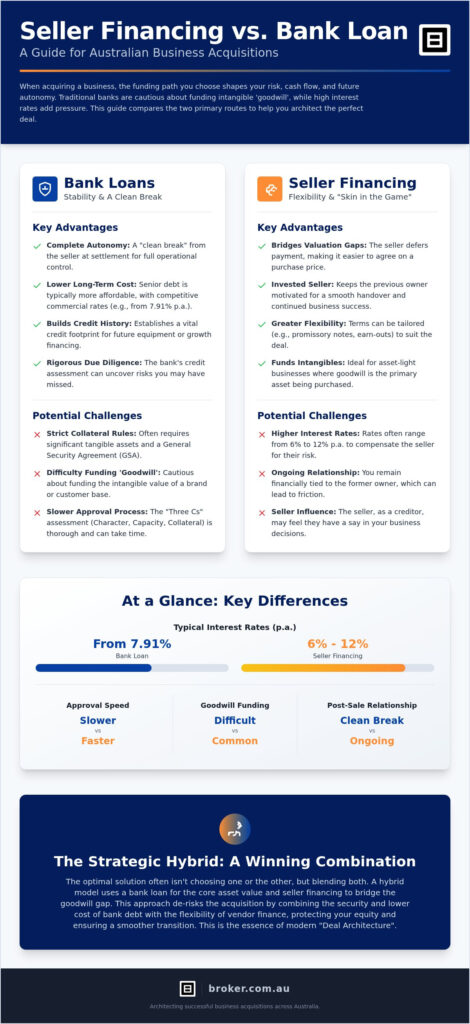
Choosing between a seller financing vs bank loan for business purchase requires a cold-eyed look at four variables: speed, cost, security, and relationship. Traditional banks are notoriously slow. They often take two months to process a complex acquisition while their credit committees pore over every detail. Sellers move much faster. They can sometimes close in days because they already understand the business’s inner workings. However, that speed comes at a price. While bank rates are market-linked and currently sit around 7.85% to 8%, seller notes are typically fixed at a higher premium to account for the vendor’s increased risk.
The security requirements and the nature of the relationship also differ. A bank is impersonal and transactional. They’ll almost certainly demand a General Security Agreement (GSA) over all company assets and potentially your personal property. A seller is often more collaborative. Their security might only be a specific interest on the PPSR for the business assets they sold you. If you’re unsure which path fits your specific acquisition, you should explore our business acquisition funding options to see what your business can actually afford.
Impact on Cash Flow and Serviceability
Your choice changes how you manage your monthly cash. Lenders use the Debt Service Cover Ratio (DSCR) to ensure the business generates enough profit to pay the debt. Bank covenants are often rigid. They might restrict how much you can spend on new equipment or marketing until the loan is significantly reduced. Vendor notes are usually more flexible. If you hit a rough patch, a seller is more likely to renegotiate terms to ensure the business survives. A bank default is a legal process; a seller default is a conversation about the business’s future.
The Hidden Risks of Cross-Collateralisation
Many Australian buyers fall into the trap of cross-collateralisation. This happens when a bank secures your business loan against your family home. It’s often more risk than you need to take. Our expert guides help you avoid putting the house on the line unnecessarily. We focus on deal structures that keep your personal and business assets separate. By using a mix of asset finance and unsecured facilities, we protect your equity and ensure your family’s future isn’t tied to the daily ups and downs of your new company. We help you organise your finance so that the business stands on its own two feet.
The Strategic Hybrid: How Broker.com.au Architect Your Deal
Most buyers view the choice of seller financing vs bank loan for business purchase as a binary decision. However, the most sophisticated acquisitions in the Australian market today are structured as hybrids. By using a bank loan for 50% to 70% of the purchase price and covering the remainder through vendor finance, you create a deal that satisfies all parties. Banks are far more likely to approve a loan when they see the seller has “skin in the game.” This commitment ensures the former owner remains motivated to facilitate a successful handover, significantly de-risking the lender’s position.
Our corporate advisory service goes beyond simply finding a lender. We architect a “best-in-class” structure that balances your post-settlement cash flow with the bank’s rigid security requirements. Our secret weapon is inside access to a national panel of specialised and non-bank lenders. These institutions often have a higher appetite for goodwill and asset-light businesses than the big four banks. This allows us to bridge valuation gaps that would otherwise stall a transaction in the current credit environment.
The 5-Step Process to a Funded Acquisition
- 1. Initial Discovery: We assess your current borrowing power and conduct a high-level review of the target business’s financial health.
- 2. Strategic Modelling: Our experts determine the ideal split between bank debt and vendor notes to ensure your serviceability remains comfortable.
- 3. Lender Selection: We tap into our national panel to identify the bank or non-bank lender that best understands your specific industry.
- 4. Negotiation Support: We assist you in “selling” the finance structure to the vendor, explaining how it secures their exit while protecting your interests.
- 5. Seamless Settlement: We use proprietary AI technology to manage the application and documentation, ensuring a stress-free close.
Why an Expert Broker is Your Best Asset
Moving from a state of uncertainty toward streamlined confidence requires a partner who understands the complexities of the Australian lending landscape. We handle the heavy lifting of bank negotiations and financial modelling while you focus on the operational transition. Our award-winning team ensures you aren’t just getting a loan; you’re securing a tailored strategy designed for long-term growth and equity protection. Ready to secure your next venture? I’m interested in a tailored finance strategy.
Securing Your Acquisition with Confidence
Navigating the complex choice between seller financing vs bank loan for business purchase doesn’t have to be a source of stress. You’ve seen that while traditional bank loans offer long-term stability and a clean break, vendor finance provides the flexibility and “skin in the game” needed to bridge difficult valuation gaps. The most successful Australian acquisitions in 2026 often utilise a strategic hybrid approach, leveraging the strengths of both paths to de-risk the transition and keep the departing owner motivated.
As award-winning business loan specialists, we act as your expert guide to move you from uncertainty toward streamlined confidence. We use proprietary AI technology to accelerate your approval and provide inside access to over 50+ Australian lenders, ensuring you get the best possible rates for your specific deal structure. Our team handles the heavy lifting of financial modelling and bank negotiations so you can focus on the operational handover. Your ideal business purchase is within reach when you have the right architecture behind your finance. I’m interested in exploring my finance options today. We’re here to ensure your transition is seamless and your family’s equity remains protected.
Frequently Asked Questions
Is seller financing legal in Australia for business purchases?
Yes, seller financing is completely legal in Australia and is a common tool used to facilitate business acquisitions. These private debt arrangements are typically documented through a formal Vendor Finance Agreement. It is essential to register the security interest on the Personal Property Securities Register (PPSR) to ensure the seller’s position is legally recognised. This structure provides a flexible alternative when comparing seller financing vs bank loan for business purchase options.
What interest rate should I expect for a business acquisition loan in 2026?
You should expect bank rates for secured business acquisition loans to range between 7.85% and 9.02% p.a. as of August 2026. Unsecured facilities or non-bank options often start from 12.74% p.a. depending on your specific credit profile. Seller financing rates are usually negotiated at a premium, often sitting 2% to 4% higher than traditional bank debt to compensate the vendor for their increased risk.
Can I combine a bank loan with seller financing in the same deal?
Combining a bank loan with seller financing is not only possible but often the most strategic way to fund a deal. This hybrid approach satisfies the bank’s requirement for buyer equity while ensuring the seller remains committed to a successful handover. Many lenders view the seller’s willingness to carry debt as a strong endorsement of the business’s future cash flow and operational stability.
What happens if I default on a seller finance agreement?
Defaulting on a seller finance agreement typically triggers the specific remedy clauses outlined in your private contract. Unlike a bank default which follows rigid institutional processes, a seller might have the right to reclaim specific business assets or even take back ownership of the company. These agreements are usually secured via the PPSR, making it vital to have a clear legal framework in place before settlement.
Do I need to put my house up as security for a business loan?
You don’t always need to use your family home as security for a business acquisition. While traditional bank loans often offer lower rates when secured by residential property, we specialise in unsecured business loans that rely on the company’s cash flow instead. This approach protects your personal assets and ensures that your family’s equity isn’t tied to the daily performance of your new venture.
How long does it take to get a business acquisition loan approved through a broker?
Our proprietary AI technology allows us to secure preliminary finance indications in just a few days. While a traditional bank might take eight weeks to process a complex file, our streamlined approach usually reaches full approval within two to four weeks. We manage the heavy lifting of the application process to ensure your acquisition moves forward without unnecessary delays or the typical administrative stress.
What is an earn-out and how does it protect me as a buyer?
An earn-out is a deal structure where a portion of the purchase price is paid only if the business hits specific financial targets after settlement. This protects you from overpaying for misrepresented revenue figures and ensures the departing owner stays motivated during the transition. It’s a powerful tool for de-risking an acquisition, especially when the final choice between seller financing vs bank loan for business purchase is still being decided.
Why would a seller agree to finance the person buying their business?
Sellers often agree to finance a buyer to achieve a higher total sale price or to facilitate a faster exit in a competitive market. It allows them to bridge the gap when a buyer’s bank valuation comes in lower than the asking price. In many cases, it is the most efficient way to finalise a sale for a business with high goodwill and few tangible assets.