Could the business you’re buying help fund its own purchase? Financing a business purchase with no money down can sound like a way to avoid a cash deposit, but it rarely means buying an existing business without any cash outlay. The key questions are how the purchase is structured, what the business can reliably repay and what risks a lender is prepared to take.
If you’re unsure how goodwill, assets and working capital fit into a funding request, you’re not alone. A deal that looks affordable on paper can become difficult if repayments outpace dependable cash flow, especially during the handover.
This guide explains what “no money down” can realistically mean for an Australian acquisition, and why it isn’t a promise of zero personal cash or guaranteed approval. You’ll learn how funding components may be combined, what lenders assess and how to prepare a proposal that accounts for repayments and transition cash flow. Use these points to assess the opportunity before committing to a purchase.
Key Takeaways
- Understand what “no money down” can mean in financing a business purchase with no money down, and why it doesn’t guarantee a zero-cash purchase.
- Compare secured acquisition lending, seller-supported finance and earn-outs, then consider how funding sources might be structured together.
- Assess whether the business’s trading performance, cash-flow quality and continuity can support proposed repayments.
- Prepare a stronger acquisition proposal by defining the purchase, gathering evidence and reviewing assets, liabilities and transition risks.
- See how Business Acquisition Funding can be structured around goodwill, assets and working capital for an existing-business purchase.
Table of Contents
- Can you finance a business purchase with no money down in Australia?
- Which acquisition finance structures could reduce the cash you contribute?
- What will lenders assess when financing a business purchase?
- How can a business buyer prepare a more financeable acquisition?
- How Broker.com.au supports business acquisition funding
Can you finance a business purchase with no money down in Australia?
Possibly, but “no money down” describes the buyer’s preferred cash contribution, not a lending outcome. A lender may consider a structure that reduces the cash needed upfront, but it will still assess whether the purchase is supportable and how its risks are managed. There’s no universal deposit rule for every acquisition.
Separate the cash deposit from the total funds needed to complete the purchase. A buyer might contribute little or no cash towards the agreed price while relying on other funding, seller support or acceptable security. The buyer may still need cash for due diligence, professional advice and the transition. A funding structure doesn’t remove these costs or the obligation to make repayments.
What does “no money down” mean when buying a business?
“No money down” means seeking to buy an existing business without contributing personal cash towards the purchase price. It doesn’t mean the acquisition needs no funding, has no costs or carries no repayment obligations. A lender may fund some components while another arrangement covers the rest, and the buyer may still need liquid funds outside the purchase price.
Cash, equity, security and seller support aren’t interchangeable. A cash deposit is money the buyer contributes towards the purchase. Equity is the buyer’s financial stake or contribution, while security is an asset a lender may consider to manage risk. An asset being part of the deal doesn’t automatically make it acceptable security.
Seller support can change when or how part of the price is paid. For example, the seller might agree to receive some of the price later, or a portion might depend on future business performance. These arrangements can reduce the amount required at settlement, but have their own negotiated terms and don’t guarantee lender support for the overall proposal.
Why a zero-cash contribution is not guaranteed
A lender assesses the buyer, the business being purchased and the transaction. It needs to understand whether expected cash flow can support repayments, whether trading performance is dependable and what could disrupt continuity after the handover.
Assets or seller support may form part of the proposal, but neither automatically secures approval. The lender’s criteria, the quality of the information and the deal details all matter. Don’t treat financing a business purchase with no money down as a deposit workaround or assume it will be possible before negotiations begin.
Map the full purchase funding requirement, identify what you can contribute and document how repayments could be met if trading conditions change. This gives the proposal a clearer foundation before you negotiate the structure.
Which acquisition finance structures could reduce the cash you contribute?
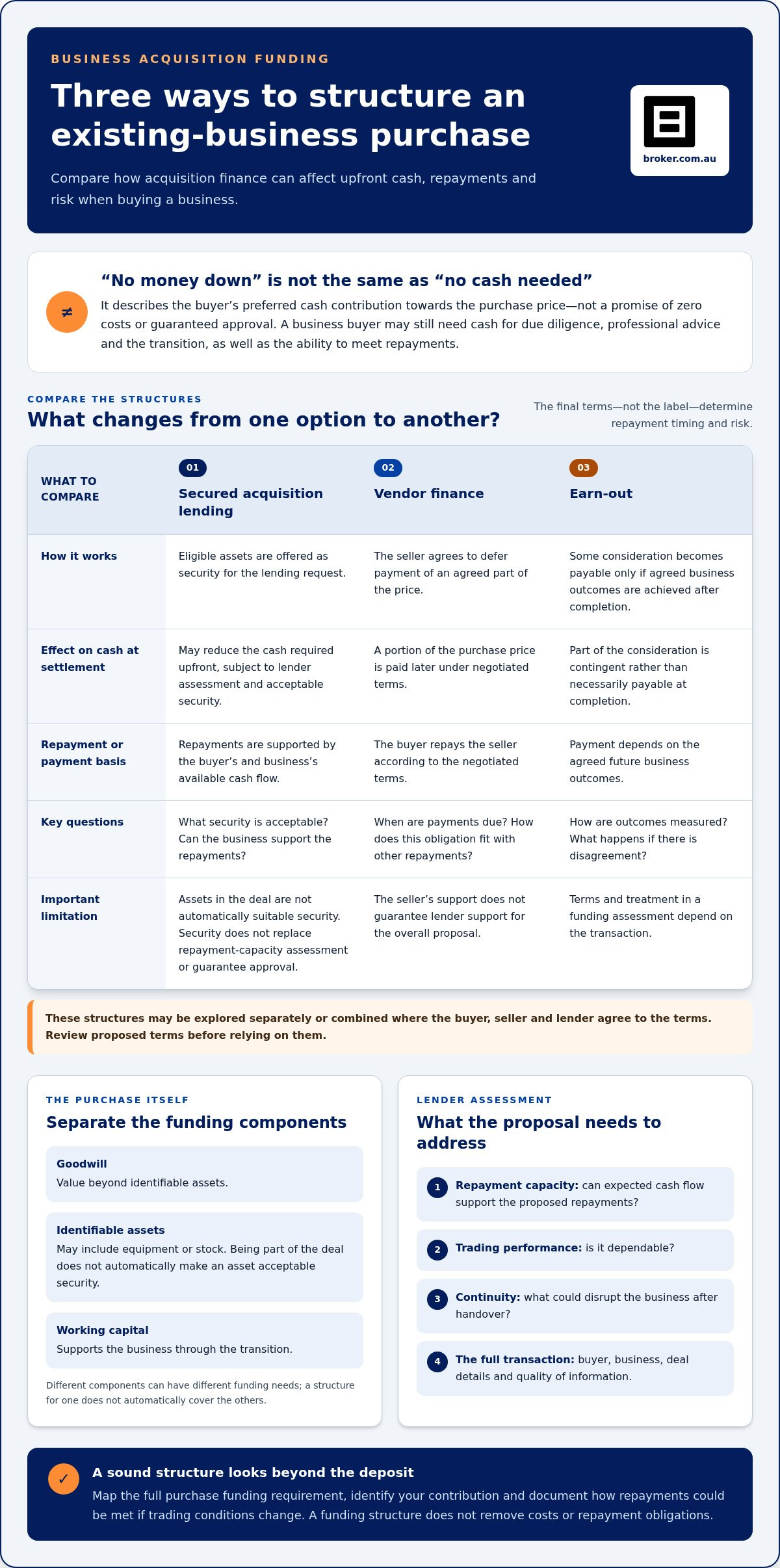
No single structure suits every purchase. A buyer may explore secured acquisition lending, seller-supported finance or an earn-out, sometimes combining components where the lender, seller and buyer agree to the terms. Each option shifts repayment timing and risk differently. Compare its effect on the whole transaction, not just the cash needed at settlement.
Separate the purchase into its components. Goodwill reflects value beyond identifiable assets, which may include equipment or stock. Working capital supports the business through the transition. These components can have different funding needs, and a structure for one doesn’t automatically cover the others.
How secured acquisition finance may support a purchase
Secured acquisition finance involves offering eligible assets as security, which may influence how a lender assesses risk. The assets being purchased aren’t automatically suitable security, and buyers may not have other assets to offer. The lender considers the asset, its ownership and its own criteria. Security can support a request, but it doesn’t replace an assessment of repayment capacity or guarantee approval.
How vendor finance and earn-outs change the deal
With vendor finance, the seller agrees to defer payment of an agreed part of the price, with repayment terms negotiated between the parties. An earn-out is different: some consideration becomes payable only if agreed business outcomes are achieved after completion. Both can affect the buyer’s cash needs, but their terms and treatment in a funding assessment depend on the transaction. Have proposed terms reviewed before relying on them.
The comparison below highlights what to examine. The repayment source and allocation of risk depend on the final arrangement, not just its label.
| Structure | Buyer contribution | Repayment source | Risk allocation and questions |
|---|---|---|---|
| Secured acquisition lending | May reduce cash required upfront, subject to lender assessment and security. | Repayments are supported by the buyer’s and business’s available cash flow. | What security is acceptable, and can the business support repayments? |
| Vendor finance | Seller defers an agreed portion of the price. | Buyer repays the seller under negotiated terms. | When are payments due, and how does this obligation fit with other repayments? |
| Earn-out | Part of the consideration is contingent, rather than necessarily payable at completion. | Payment depends on agreed future business outcomes. | How are outcomes measured, and what happens if there’s disagreement? |
Match each purchase component to its proposed funding source. Goodwill may be assessed differently from identifiable assets, while working capital needs to account for the business’s requirements during handover. A gap in any one area can affect the overall proposal. For buyers exploring financing a business purchase with no money down, assess a combined structure as one complete transaction, with all repayment commitments visible.
Business Acquisition Funding can be arranged around purchase components, including goodwill, assets and transition working capital. A clear funding request helps show how the proposed structure fits together.
What will lenders assess when financing a business purchase?
A lender looks beyond the sale price to assess whether the proposed acquisition can be repaid and whether the transaction makes sense as a whole. It may review the target business’s trading record, the buyer’s financial position and experience, the funding structure and any security offered. Each lender sets its own criteria and evidence requirements, so there isn’t one checklist or approval rule for every purchase.
Servicing means the buyer and acquired business can support the proposed repayments, based on the lender’s assessment. A profitable business can still raise questions if cash flow is uneven, a small number of customers account for a large share of sales or performance depends heavily on the current owner.
How business cash flow relates to loan servicing
Reported profit isn’t the same as cash available for repayments. An assessment may account for ordinary expenses, existing obligations, working capital needs and proposed loan repayments. Timing matters too: a business can record sales but have limited cash available when bills fall due.
Look for patterns that could make earnings less dependable. Does the business have seasonal peaks and quieter periods? Do a few customers account for much of its sales? Were recent results affected by a one-off contract, unusual costs or temporary trading conditions? These details help assess whether historical performance is likely to continue under new ownership.
Sustainable cash flow is central to showing how an acquired business may support its acquisition repayments. A realistic assessment should allow for the transition, rather than assume the business will perform exactly as it did under the seller.
What the buyer and transaction may need to demonstrate
The buyer’s capability matters alongside the target’s figures. Relevant management or industry experience can help show how you plan to operate the business. A transition plan can explain how you’ll maintain key staff, supplier and customer relationships, as well as business systems. Lenders may also consider your financial position, contribution, proposed role and capacity to manage the business.
Depending on the lender and transaction, evidence might include:
- Financial statements and trading records for the business being purchased.
- Cash-flow forecasts showing assumptions, expected repayments and transition needs.
- Information about the buyer’s experience, financial position and planned involvement.
- Details of the purchase price, assets, goodwill, proposed security and any seller-supported terms.
These are examples, not universal requirements. Confirm the evidence needed for the application and organise it so the figures and assumptions are clear and consistent.
Purchase price allocation matters because goodwill, identifiable assets and transition working capital may be treated differently in a funding request. A clear breakdown explains what the funds will cover and how the business will operate after settlement. For buyers considering financing a business purchase with no money down, the proposal depends on the full picture: reliable trading information, a capable buyer, a workable transition and repayments the cash flow can support.
How can a business buyer prepare a more financeable acquisition?
An organised proposal shows how the purchase, funding request and handover fit together. It won’t guarantee approval, but it can make the opportunity and its risks easier to assess. Work through these steps before relying on a particular funding structure.
Build the acquisition case before seeking funding
Summarise what the business does, why you want to buy it, the proposed terms and the role you’ll take on after completion. Organise the supporting information so the commercial case is clear and risks aren’t buried in a large bundle of documents.
- Define the transaction. Set out what’s being acquired, the proposed purchase terms and how the price is allocated across goodwill and identifiable assets. Note any seller-supported component separately.
- Explain your operating plan. Describe your relevant experience, day-to-day responsibilities and how you’ll maintain important customer, supplier and staff relationships during the handover.
- Review the business evidence. Examine trading information and cash-flow records, then investigate assets, liabilities and material changes in performance. Record assumptions and unresolved issues clearly.
- Map the funding request. Separate purchase consideration from working capital and transition requirements. State your proposed contribution and any security you may offer accurately. Don’t assume an asset will be accepted as security before it has been assessed.
- Test repayment resilience. Use actual trading patterns to consider realistic scenarios, such as softer sales, higher operating costs or a delayed handover. Check how each could affect cash available for repayments and explain what practical responses are possible.
Protect cash flow through the ownership transition
Keep working capital distinct from the amount paid to acquire the business. The business may need funds for ordinary operating commitments while ownership, systems or responsibilities change. Identify who will manage key tasks, which relationships need continuity and what depends on the seller’s knowledge or involvement. Include these needs in your funding plan rather than assuming they’ll be covered by the purchase price.
For buyers financing a business purchase with no money down, this preparation can clarify the real cash requirement and reveal pressure points before they become repayment problems. Check that the proposed structure accounts for both the acquisition and the period immediately after handover. Keep the supporting material consistent, with a clear link between purchase terms, business information and cash-flow assumptions.
Once your plan is organised, explore tailored business acquisition funding to structure a request around the purchase, buyer contribution, security and transition needs.
How Broker.com.au supports business acquisition funding
Buying an established business involves more than finding a loan for the sale price. The funding request may need to reflect what’s being acquired, how the business will trade under new ownership and the funds required for the handover. Broker.com.au arranges Business Acquisition Funding for existing-business purchases, helping organise the request around the transaction and its funding needs.
Every acquisition is different. The buyer’s contribution, available security, purchase structure and the business’s cash flow all inform how the funding request is presented. A tailored assessment brings these details together, while the lender makes its own decision under its criteria. No structure or approval is assured.
What the acquisition funding conversation can cover
A useful funding discussion connects the intended purchase with the buyer’s contribution and the case for repayment. It can consider how the requested funding relates to goodwill, assets and working capital for the transition. Separating these components clarifies what the funds are intended to cover, rather than treating the transaction as one undifferentiated amount.
For example, a buyer might need to account for goodwill, equipment being acquired and funds to support the business during the change of ownership. These needs can be set out alongside the proposed terms and expected cash flow. Whether a lender will fund a particular component, and on what terms, depends on its assessment of the buyer, business and transaction.
Broker.com.au can help organise the acquisition funding request and prepare application information for lender assessment. A clear, consistent account of the purchase and repayment case makes it easier to understand how the proposed structure fits together. It also distinguishes the buyer’s contribution from any seller-supported arrangement or security being considered.
A clear next step for Australian business buyers
Before discussing funding, gather the information you have about the proposed purchase: sale terms, trading information, a breakdown of goodwill and assets, your intended contribution and your plan for taking over operations. You don’t need to have every detail resolved to outline the opportunity, but clear information helps identify questions and organise the request.
Broker.com.au uses proprietary AI technology to support quick and accurate loan applications. This supports the application process; it doesn’t replace lender assessment or determine the outcome. The aim is to present relevant transaction information in a structured way, with the funding need and repayment case clearly connected.
If you’re considering financing a business purchase with no money down, focus on the complete acquisition, not just the deposit. Share your goals and the transaction details available, then explore how goodwill, assets and transition working capital may fit into a tailored funding request. Explore tailored business acquisition funding when you’re ready to discuss your proposed purchase.
Turn your acquisition plan into a clear next step
The goal isn’t simply to minimise cash at settlement. It’s to shape an acquisition that can withstand the realities of ownership, with a funding request grounded in the transaction and a repayment plan that leaves room for the business to operate.
If you’re exploring financing a business purchase with no money down, bring your purchase goals, available information and key assumptions into one clear picture. Broker.com.au’s Business Acquisition Funding can address goodwill, assets and working capital needed for the transition, with each component considered as part of the proposed purchase. Proprietary AI technology supports loan application preparation, while funding remains subject to lender assessment.
You don’t need every detail resolved before taking the next step. A conversation about the opportunity can help clarify what information will support the funding request and how to present your plans clearly.
I’m interested in business acquisition funding. Take the next step towards assessing your purchase with a considered, well-prepared plan.
Frequently Asked Questions
Can you buy an existing business with no deposit in Australia?
It may be possible to structure a purchase without a cash deposit, but there’s no guaranteed no-deposit option. The outcome depends on the buyer, the business, the proposed deal and the lender’s assessment. A seller agreeing to defer part of the price or acceptable security may form part of a proposal, but neither ensures approval. Also plan for cash needs beyond the purchase price, including advice and due diligence.
What does no money down mean when buying a business?
It usually means the buyer aims to contribute little or no personal cash towards the purchase price, not that the acquisition requires no funds or carries no financial obligations. For example, a buyer might negotiate to pay part of the price later while seeking funding for other components. They still need to understand every repayment commitment and keep the business viable after taking ownership.
Can vendor finance help you buy a business without a deposit?
Vendor finance can reduce the cash needed at completion if the seller agrees to receive part of the price later. It creates a repayment obligation to the seller, with timing and other terms negotiated between the parties. Account for this alongside any lender repayments and consider what happens if trading weakens. The lender’s treatment of seller finance depends on its assessment of the transaction.
How do lenders assess a business acquisition loan?
Lenders assess whether proposed repayments are supportable and review the buyer, target business and transaction. They may examine trading records, cash-flow forecasts, purchase terms, the buyer’s financial position and any proposed security. Be ready to explain forecast assumptions, such as whether existing staff will remain or an owner’s role must be replaced. Evidence requirements and criteria differ between lenders.
Can a business acquisition loan cover goodwill and working capital?
Business Acquisition Funding can address goodwill, assets and working capital required for a transition. Whether a particular request includes each component depends on the purchase, the buyer’s proposal and lender assessment. Set out what each amount is intended to support, distinguishing the value attributed to goodwill from funds needed to help the business operate through handover. This makes the purpose of the request clearer.
Does having business assets guarantee no-deposit acquisition finance?
No. Assets may be relevant to a funding proposal, but their presence doesn’t guarantee approval or mean they’ll be accepted as security. A lender assesses the transaction and its own criteria, including the proposed repayment case. Distinguish assets included in the business purchase from other assets being offered as security. Buyers considering financing a business purchase with no money down should avoid relying on asset value alone.