
What if the biggest obstacle to your entrepreneurial dream isn’t your bank balance, but simply your choice of lender? While many Australians believe that the Big Four banks are the only path to ownership, the reality of financing a business purchase with no money down in 2026 relies on a sophisticated “funding stack” rather than a single upfront deposit. It’s a strategic shift that moves the focus from your personal savings to the inherent value of the company you want to acquire.
We know how discouraging it feels to watch profitable opportunities slip away because you don’t have a massive cash reserve. It’s a common pain point for ambitious professionals who find themselves blocked by rigid lending criteria and complex financial jargon. This guide promises to provide a clear roadmap to 100% financing, showing you how to bypass traditional hurdles and step into a leadership role with confidence.
You’ll learn how to leverage target business assets and organise vendor finance to create a seamless acquisition. We’ll also examine the current lending landscape, where the average small business loan rate sat at 7.26% p.a. in May 2026, and show you how to find specialised lenders who look far beyond a simple balance sheet to help you realise your goals.
Key Takeaways
- Learn how to transition from traditional deposit-based thinking to a strategic “funding stack” that layers multiple financial solutions to reach 100% of the acquisition cost.
- Identify hidden capital within the target business by leveraging asset finance to refinance existing machinery, vehicles, or equipment.
- Explore the professional benefits of vendor finance and earn-out structures to reduce your initial cash outlay while ensuring a smooth transition of ownership.
- Gain inside access to specialised lenders who provide financing a business purchase with no money down by prioritising cash flow and business performance over personal collateral.
- Understand why a professional broker using proprietary AI is essential in 2026 to navigate complex deal structures and secure tailored outcomes that fall outside traditional bank norms.
Table of Contents
- The Reality of Financing a Business Purchase with No Money Down in Australia
- Strategic Deal Structuring: The ‘Funding Stack’ Approach
- Leveraging the Target Business’s Assets to Fund the Buyout
- The Seller’s Role: Navigating Vendor Finance and Earn-outs
- Navigating the 2026 Lending Landscape with a Specialist Broker
The Reality of Financing a Business Purchase with No Money Down in Australia
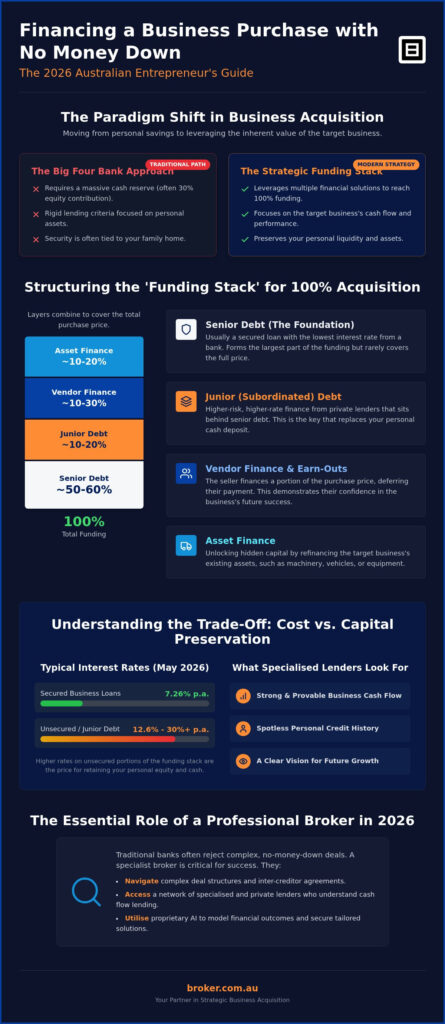
Many Australian entrepreneurs assume that “no money down” is a marketing gimmick or a relic of a bygone era. In the 2026 commercial market, it’s actually a sophisticated financial strategy used by savvy buyers to preserve their liquidity. While the Big Four banks typically demand a 30% equity contribution, specialised lenders focus on the target business’s performance rather than just your personal bank balance. This shift moves the security requirement away from your family home and onto the entity being purchased.
When you’re organising financing a business purchase with no money down, the ratio of tangible assets to goodwill is critical. Lenders view machinery, vehicles, and equipment as high-quality collateral that can be used for asset finance. If the target business is service-based with high goodwill, the application requires more detailed financial modelling to prove the cash flow can sustain the debt. It’s about finding a lender that looks beyond the balance sheet to see the true potential of the acquisition.
Is 100% Financing Actually Possible?
It is. However, you need to distinguish between zero-deposit and zero-equity deals. A zero-deposit deal means you aren’t dipping into your personal savings or selling your own assets to fund the buy-in. You might still provide equity through a second mortgage or by bringing in a silent partner. High-cashflow businesses are the primary targets for this. Lenders are more likely to approve unsecured acquisition funding when the EBITDA comfortably covers the debt service. In 2026, buyers with strategic advisory support are finding success because they can present a “funding stack” that mitigates lender risk.
Common Misconceptions About Zero-Deposit Buyouts
Skeptics often label these structures as too good to be true. However, these deals are fundamentally based on the concept of a Leveraged Buyout (LBO), which is a standard practice in corporate finance globally. The trade-off is straightforward. You retain 100% of your equity and cash, but you’ll likely face higher interest rates. For instance, while secured rates might sit near 7.26% p.a., unsecured loans in 2026 can range from 12.60% to over 30% p.a. depending on the risk profile. Your personal credit score remains vital; even if you aren’t providing a deposit, lenders use your credit history as a proxy for your character and management capability. Successful financing a business purchase with no money down requires a spotless repayment history and a clear vision for the company’s future growth.
Strategic Deal Structuring: The ‘Funding Stack’ Approach
Achieving financing a business purchase with no money down rarely involves a single bank loan. Instead, successful acquirers use a “funding stack.” This is a method of layering different financial products so they collectively cover 100% of the purchase price. While a traditional bank might only offer 50% to 60% of the value as senior debt, you can bridge the remaining gap using mezzanine finance, private lending, or seller equity. In this context, the specific deal structure is often more vital for your long-term ROI than the interest rate alone. A well-structured stack preserves your cash flow during the critical first year of ownership.
Layering Senior and Junior Debt
Senior debt is the foundation of most acquisitions. It’s usually a secured loan with the lowest interest rate, but banks are conservative and rarely fund the full price. To reach the total amount, you’ll need junior or “subordinated” debt. This sits behind the senior lender in priority. Because junior lenders take on more risk, they charge higher rates, but they provide the essential capital that replaces your personal deposit. Managing these layers requires inter-creditor agreements, which are legal frameworks that organise how different lenders interact if the business faces financial stress. You can find more details on these structures in the Australian Government’s guide to business funding.
The Role of Private Lenders and Boutique Firms
Private lenders act as high-level fixers for deals that don’t fit the rigid boxes of major institutions. They’re often more comfortable with financing a business purchase with no money down because they specialise in specific industries, such as healthcare, manufacturing, or tech. These boutique firms provide “inside access” to capital that isn’t advertised to the general public. At Broker.com.au, we utilise proprietary AI to scan the market and identify which private partners are most compatible with your specific deal’s risk profile. This technology allows us to assemble a bespoke stack in days rather than months.
Beyond the purchase price, you must also consider the first 90 days of operation. We often include a working capital facility, such as a line of credit or invoice finance, within the stack. This ensures you have the liquidity to manage payroll and inventory without needing an upfront cash reserve. If you’re ready to see how these layers could work for your acquisition, our team is here to help you model the structure. By focusing on the total funding mix, you can acquire a profitable asset while keeping your personal capital intact for future growth.
Leveraging the Target Business’s Assets to Fund the Buyout
The business you intend to buy often contains the very capital required to facilitate the acquisition. While traditional lenders focus on your personal assets, a strategic approach involves identifying “hidden” value within the target’s balance sheet. By using asset-backed solutions, you can unlock equity tied up in machinery, vehicles, or even unpaid invoices to cover the purchase price. This is a fundamental pillar of financing a business purchase with no money down, as it shifts the burden of security from the buyer to the business entity itself.
Refinancing Existing Equipment and Vehicles
Many established Australian businesses, particularly in transport, manufacturing, or construction, own their fleet or machinery outright. A “Sale and Leaseback” arrangement allows you to sell these assets to a specialised lender for their current market value and then lease them back over a set term. This provides an immediate cash injection that can be used to fund the goodwill component of the sale. If the premises require a refresh, fit-out finance can be structured into the deal to preserve your operational cash flow. This method is highly effective because it uses tangible collateral that non-bank lenders understand and value.
Invoice Finance: The Secret Weapon for Cash-Heavy Businesses
For businesses with significant trade receivables, invoice finance is a game-changer. You can often access up to 85% of the value of outstanding invoices on day one of ownership. This creates an immediate “deposit” from the business’s own operations. While you’re learning how seller financing works in Australia to manage the long-term debt, invoice finance provides the day-one liquidity needed to keep the wheels turning. You have two main options for this facility:
- Factoring: The lender manages your sales ledger and collections, which can be useful if you’re restructuring the back-office.
- Confidential Invoice Discounting: You maintain control over your collections, and your customers remain unaware of the finance arrangement.
Retail or wholesale acquisitions can also utilise stock and inventory finance. By leveraging the value of products sitting in the warehouse, you can secure additional working capital. When combined with a line of credit, these tools ensure that financing a business purchase with no money down doesn’t leave you “cash poor” during the transition. Our role as an award-winning broker is to help you identify these hidden levers and present them to the right lenders who look beyond the basic balance sheet.
The Seller’s Role: Navigating Vendor Finance and Earn-outs
The final piece of the acquisition puzzle often comes from the person sitting across the negotiating table. Vendor finance is a cornerstone of financing a business purchase with no money down, effectively turning the seller into a specialised lender. When a seller agrees to defer a portion of the purchase price, they aren’t just helping you bridge a funding gap; they’re providing a powerful signal of confidence to your other lenders. In the 2026 Australian market, where inter-generational wealth transfer is driving high volumes of SME sales, this structure has become a sophisticated tool for ensuring smooth transitions and protecting buyer capital.
Lenders view vendor finance as “skin in the game” from the outgoing owner. If the person who knows the business best is willing to wait for their final payment, it suggests the company’s cash flow is robust enough to handle the debt. This de-risks the deal for senior lenders, making them more likely to approve the remainder of your funding stack. To ensure the arrangement is secure, you need a “Best in class” vendor loan agreement that clearly outlines repayment schedules, interest rates, and default provisions, protecting both parties during the handover.
Pitching Vendor Finance to the Seller
Securing vendor finance requires a tailored pitch that focuses on the seller’s long-term benefits. You’re not just asking for a discount; you’re offering them a structured investment. For many retiring owners, receiving regular interest payments can be more tax-efficient than a single lump-sum payout, providing them with a steady income stream that often outperforms standard bank term deposits. In 2026, we’re seeing vendor loans structured with terms of two to five years, acting as a crucial buffer. This arrangement ensures the seller remains motivated to provide a thorough handover, as their final payout depends on the continued health of the business.
Earn-outs and Performance-Based Payments
Earn-outs are a strategic way to bridge the gap between a seller’s high asking price and a lender’s conservative valuation. By tying a portion of the payment to future EBITDA targets, you reduce your upfront capital requirement and protect yourself from hidden liabilities. If the business doesn’t meet the agreed performance benchmarks during the earn-out period, the final purchase price is adjusted downwards. This mechanism is particularly effective for financing a business purchase with no money down because it aligns the cost of the business with its actual demonstrated value post-acquisition.
Structuring these deals requires a deep understanding of both legal frameworks and financial modelling. If you’ve found a target business but aren’t sure how to approach the seller about these options, get in touch with our specialist team. We can help you draft a proposal that feels like a win for the seller while keeping your personal savings intact.
Navigating the 2026 Lending Landscape with a Specialist Broker
In 2026, the Australian lending market has moved beyond the simple checklists used in previous years. With 895 M&A deals completed in FY2026, lenders are becoming more selective, focusing heavily on the quality and sustainability of earnings. Attempting financing a business purchase with no money down requires a presentation that addresses increased regulatory scrutiny from bodies like the ACCC and ASIC. This is where a specialist broker acts as your expert guide, transforming a complex application into a streamlined path to approval.
Our proprietary AI technology at Broker.com.au speeds up the assessment of these intricate deals by matching your specific profile with a curated list of private and non-bank lenders. Instead of waiting weeks for a traditional bank to decline your 100% finance request, our system identifies compatible partners in days. We help you prepare a comprehensive “Corporate Advisory” pack that includes deep-dive financial modelling and a clear transition plan. This proactive approach ensures you’re in good hands from the moment you identify a target business.
The Power of Professional Presentation
Lenders don’t just want a business plan; they want a strategic roadmap that proves the acquisition is viable without a personal cash deposit. Your financial modelling must demonstrate exactly how the debt will be serviced through the target’s EBITDA while maintaining healthy working capital. This level of detail alleviates lender anxiety and builds immediate trust. A broker’s inside access to the best rates and niche lenders is the critical advantage that turns a theoretical zero-deposit deal into a funded reality.
Beyond the Loan: Long-Term Strategic Support
Our relationship doesn’t end when the contracts are signed. Once you’ve secured financing a business purchase with no money down, we help you restructure your debt post-acquisition to further improve cash flow. You can then scale your new enterprise by utilising asset finance or equipment finance to upgrade technology or expand your fleet. This bespoke attention ensures your boutique acquisition has the backing of a seasoned financial partner without the cold, impersonal feel of a large bank.
Ready to explore your options? Start a low-pressure conversation with our team today to see what’s possible. I’m interested in business acquisition funding
Secure Your Future with Strategic Acquisition Funding
The Australian commercial landscape in 2026 offers unprecedented opportunities for those who look beyond the rigid constraints of traditional banks. Successfully financing a business purchase with no money down is no longer a fringe strategy; it’s a sophisticated exercise in layering senior debt, vendor finance, and asset-backed solutions. By shifting the focus from your personal bank balance to the intrinsic value and cash flow of the target business, you can acquire a profitable asset while preserving your liquidity for operational growth.
As an award-winning Australian brokerage, we provide the expert guidance needed to navigate these complex structures. Our proprietary AI technology delivers faster, more accurate matches by giving you inside access to over 80 specialist lenders who understand the nuances of mid-market M&A. Whether you’re restructuring existing debt or embarking on your first buyout, our team is here to ensure the process is seamless and stress-free.
Ready to turn your leadership ambitions into a reality? I’m interested in exploring 100% business finance. You’re in good hands, and we’re excited to help you build your legacy.
Frequently Asked Questions
Can I really buy a business in Australia with zero dollars in my bank account?
Yes, it is possible by utilising a sophisticated “funding stack” that layers different financial products. This strategy involves combining senior debt with vendor finance and asset-backed lending to cover the full purchase price. While you don’t need a cash deposit, the target business must demonstrate strong cash flow or hold significant tangible assets to satisfy the criteria of specialised non-bank lenders.
What is the minimum credit score required for a no-money-down business loan?
Most specialised lenders look for a credit score of 650 or higher for 100% finance applications. Since you aren’t providing an upfront cash deposit, your personal credit history serves as a primary indicator of your financial character and management capability. A clean repayment history across previous facilities is essential to reassure lenders that you are a reliable partner for high-leverage acquisition funding.
Does ‘no money down’ mean I don’t have to provide a personal guarantee?
No, a personal guarantee is almost always a requirement for 100% debt-funded acquisitions. Lenders need to ensure that you are personally committed to the success of the venture, especially when they are providing the entirety of the capital. This guarantee provides the lender with legal recourse, serving as a substitute for the “skin in the game” usually provided by a traditional cash deposit.
What types of Australian businesses are easiest to finance with 100% debt?
Businesses with high tangible asset values or consistent, recurring revenue are the most suitable for this structure. Sectors such as manufacturing, transport, and established professional services like medical practices are prime targets. Lenders feel more comfortable providing financing a business purchase with no money down when they can secure the loan against machinery, vehicles, or a predictable “book” of loyal clients.
How do interest rates for no-deposit loans compare to traditional business loans?
Interest rates for zero-deposit structures are generally higher to reflect the increased risk profile. While a secured small business loan might average around 7.26% p.a. in 2026, the junior or unsecured layers of a funding stack can range from 12% to over 30% p.a. This higher cost of capital is the trade-off for retaining your personal equity and preserving your liquidity for future operations.
What is the difference between an unsecured business loan and vendor finance?
An unsecured loan is provided by a third-party lender without collateral, while vendor finance is an agreement where the seller defers part of their payment. Vendor finance is often more cost-effective and signals the seller’s confidence in the business. In contrast, unsecured loans are faster to access but carry significantly higher interest rates and stricter repayment terms than most seller-funded arrangements.
How long does the approval process take for a complex acquisition stack?
Finalising a complex funding stack typically takes between four to eight weeks from the initial application. While our proprietary AI can identify compatible lenders in just a few days, the due diligence and legal coordination between different parties require careful management. Having a professional “Corporate Advisory” pack ready at the start of the process is the most efficient way to reduce these timelines.
Can I use my home as security for a business purchase without a cash deposit?
Yes, leveraging residential equity is a common method for financing a business purchase with no money down. This is often the most affordable path to ownership, as it allows you to access lower interest rates reserved for secured lending. Even if you aren’t contributing cash from a savings account, the equity in your home provides the high-quality security that traditional and private lenders value.