
A credit score under 500 doesn’t automatically rule out getting a business loan with a past default. In Australia, an Equifax score below 500 is commonly considered bad credit, but lenders also weigh whether a default is paid, how recent it is, your trading history and your ability to repay. A secured business loan may be an option if you can offer an asset as security.
A past default can make getting a business loan feel less straightforward, especially if it is recent or unpaid. Before applying, understand how the default’s status and age may affect your options.
This guide explains how paid and unpaid defaults can affect eligibility, what to prepare if your credit score is low, and how bank and specialist non-bank lenders may assess applications differently. It also covers the factors that shape loan amounts, interest rates, approval and funding times, so you can compare potential costs and trade-offs.
Key Takeaways
- A credit score below 500 doesn’t automatically prevent approval; lenders also weigh a default’s age, amount, payment status and creditor type.
- Defaults generally remain on an Australian credit file for five years, so check your report and make sure resolved debts show the correct status.
- Compare bank and specialist non-bank lending criteria, processing times and total borrowing costs before choosing an application path.
- Prepare recent business bank statements and clear evidence of cash flow to help show how the business could manage repayments.
- If you can offer an asset as security, consider whether a secured loan suits your borrowing purpose and repayment capacity.
Table of Contents
- Can I get a business loan with a credit score under 500?
- How long do defaults stay on your credit file in Australia?
- Differences between bank and specialist non-bank lenders
- Indicative loan amounts, speeds and interest rates
- How paid and unpaid defaults affect Australian business loan eligibility
- Broker.com.au: Secured Business Loans
Can I get a business loan with a credit score under 500?
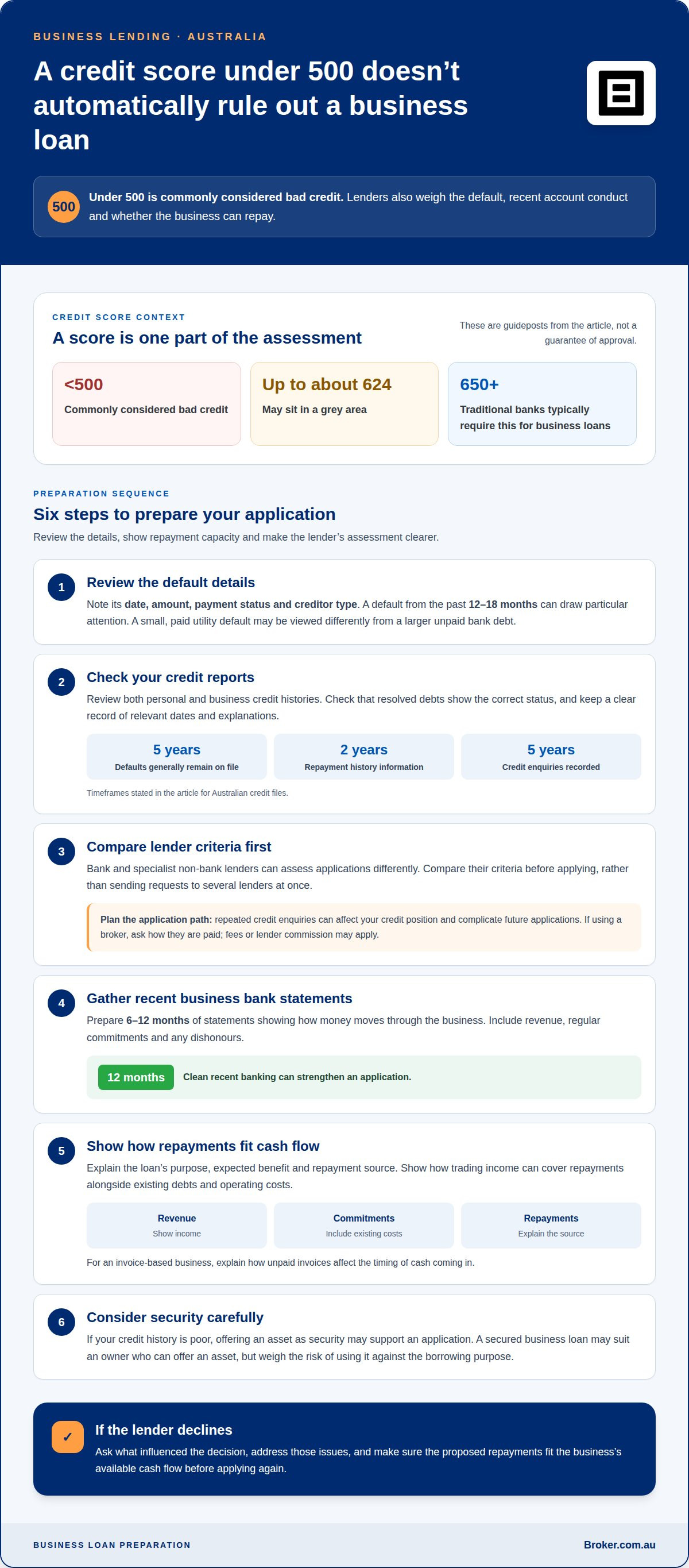
Yes, a score under 500 doesn’t automatically rule out a business loan in Australia. Getting a business loan with a past default can still be possible, depending on the lender’s assessment of your credit history, recent account conduct and capacity to repay.
- Review the Default DetailsCheck the default’s date, amount, payment status and creditor type before applying. A default listed within the past 12-18 months can draw particular attention, while a small, paid utility default may be viewed differently from a larger unpaid bank debt. Record whether the debt is settled and make sure your application explains its circumstances accurately.
- Choose a Lender Before ApplyingCompare lender criteria before submitting an application, rather than sending requests to several lenders at once. A score below 500 is commonly considered bad credit in Australia; scores up to about 624 may sit in a grey area, while traditional banks typically require 650+ for business loans. A broker can help match your circumstances to lender criteria and organise application materials. Ask how the broker is paid, since fees or lender commission may apply.
- Apply and Respond to the OutcomePrepare a complete application that explains the default and shows how the business can manage repayments. If a lender declines your application, ask what influenced the decision and address those issues before applying again. Avoid multiple applications without a clear plan: repeated credit enquiries can affect your credit position and complicate future applications.
- Gather 6 to 12 months of business bank statements to show how money moves through the business. Include clear records of revenue, regular commitments and any dishonours; twelve months of clean recent banking can strengthen an application. For an invoice-based business, explain how unpaid invoices affect the timing of cash coming in.
- Show how the loan fits the business’s cash flow, not just how much you want to borrow. Set out the purpose, expected benefit and repayment source in a business plan. This helps a lender assess whether trading income can cover repayments alongside existing debts and operating costs.
- If your credit history is poor, consider whether offering security could support your application. A secured business loan may suit an owner who can offer an asset, but weigh the risk of using that asset against the borrowing purpose. Before getting a business loan with a past default, check that the proposed repayments fit the business’s available cash flow.
How long do defaults stay on your credit file in Australia?
In Australia, a default generally stays on your credit file for five years from the date it was recorded. Check both your personal and business credit histories before a lender reviews your application.
- Review your personal credit reports from Equifax, Experian and Illion. A lender may consider a business owner’s personal credit history alongside the business’s file, particularly when a director or guarantor supports the application. Check each report for defaults, repayment history, enquiries and credit products. Note the date and status of each entry so you can explain relevant details consistently.
- Record the retention period for each credit event. Defaults remain on an Australian credit file for five years from the date recorded. According to the Office of the Australian Information Commissioner, repayment history information is kept on an Australian credit file for 2 years, while credit enquiries are recorded for 5 years. These entries have different timeframes, so don’t assume all negative-looking information disappears together.
- Account for bankruptcy separately from a default. According to the Office of the Australian Information Commissioner, bankruptcy information remains for the later of 5 years starting on the day you became bankrupt, or 2 years starting on the day you were no longer bankrupt. If either date is relevant to a director or guarantor, note both dates when reviewing the file and preparing an explanation for a lender.
- Review the business’s credit history as well as the director’s. Australian credit reporting includes positive repayment history alongside negative credit events, and files record the last 24 months of positive repayment history across credit accounts. A lender can weigh that recent record against older defaults, existing commitments and the business’s trading performance. For example, consistent repayments can provide useful context even when an earlier default remains listed.
- Australian banks may assess the complete credit file, not just the score. Traditional banks may treat defaults, court judgements or payment defaults from the past three years as indicators of bad credit. A lender may also consider whether a default has been paid, how recently it occurred and whether trading income can support repayments. A default can affect an application while it remains on file, but its age and the surrounding credit history also matter.
- Before applying, make a concise record of each director’s and guarantor’s credit events, including dates, status and any explanation. If a resolved debt still appears as unpaid, contact the credit reporting agency to correct its status. This helps ensure the lender sees an accurate history and lets you prepare clear answers about past credit issues.
Differences between bank and specialist non-bank lenders
Australian banks and specialist non-bank lenders assess applications from borrowers with past defaults, but their criteria can differ. High-cost finance can strain cash flow, and with secured borrowing, the asset offered as security is at risk if repayments are missed.
- Assess How Lenders Treat DefaultsCompare how each lender weighs a default’s age and repayment status. A default paid within the last 12 months may be treated as current or recent, while specialist non-bank lenders may consider a small, paid default that’s 3-4 years old. Don’t assume every lender assesses these events alike; the amount, creditor and surrounding credit history also shape the decision.
- Ask how the lender assesses trading performance alongside personal credit. Some revenue-based finance providers assess business bank account activity rather than relying on the applicant’s credit score. Consistent revenue during the most recent 6 to 12 months can help show current performance, but it doesn’t erase a default or guarantee approval. Compare this assessment with a bank’s focus on documented financials and repayment capacity.
- Compare Terms, Fees and RisksBefore accepting an offer, compare the interest rate, fees, repayment schedule and total amount payable. A shorter term may mean larger repayments, while a longer term can extend borrowing costs. High repayments can leave less cash for wages, stock and other operating expenses. With secured finance, missed repayments can also put the asset offered as security at risk.
- Ask for a written breakdown of each proposed loan and compare like with like. Check whether fees are charged upfront or included in repayments, whether early repayment changes the cost, and whether the term suits the business’s cash-flow cycle. For a business acquisition, test repayments against forecast trading income, not just the seller’s past figures. A lower headline interest rate does not necessarily mean a lower overall cost.
- Prepare identification, a business plan, financial reports, forecasts, lease agreements and personal financial information. These documents help lenders assess trading, commitments and repayment capacity. Keep details about directors, guarantors and the default consistent throughout the application. If a lender requests further statements or explanations, respond with relevant records rather than unsupported estimates.
- Allow for different approval processes when planning a purchase or refinance. Traditional lenders’ approval processes can take months, while specialist lenders may assess recent account activity and credit events differently. Before applying, compare the lender’s stated criteria with your credit file and intended use of funds. Do not choose solely for speed: match the loan structure and repayments to the business’s available cash flow.
Indicative loan amounts, speeds and interest rates
Bad-credit business finance can vary widely in amount, cost and timing. Before signing a loan agreement, compare the proposed repayments with the business’s cash flow.
- Review Rates and Loan TermsCompare indicative rates against the default’s status and age. Bad-credit business loans are listed with rates of 12-30% and terms of 6-36 months. For paid defaults older than 12 months, indicative rates are 12-22%, with terms of 6-36 months. Current defaults or ATO debt are associated with indicative rates of 18-30%+.These are different borrower profiles, not a single quote. Check whether the stated rate is annual, how often repayments are due and the total amount repayable under the agreement. A higher rate combined with a short term can put more pressure on working cash flow. Test repayments against trading income, not an optimistic sales forecast.
- Match the requested amount to the purpose of the finance and the evidence supporting your application. This highlights why the amount, security, repayment capacity and credit circumstances matter when assessing lending options.For equipment, compare the loan amount with the asset’s useful role in generating revenue. Equipment finance terms usually run from 12 to 84 months; heavy earthmoving equipment and trucks may have terms of five or seven years. Avoid borrowing for a longer period than the asset or business benefit can reasonably support.
- Consider Indicative Funding SpeedsAllow for separate approval and funding stages when planning a purchase. Low-doc bad-credit business finance may be available from the same day to 48 hours. Traditional banks may take 2-6 weeks to make an offer and 1-4 weeks to fund a business loan. These timelines describe different processes, so build a realistic buffer into the transaction.A fast indication is not a substitute for a complete loan application or final agreement. Incomplete statements, an unclear loan purpose or further assessment can affect timing. For equipment purchases, coordinate the funding timeline with the supplier’s invoice and delivery arrangements.
- Build a like-for-like comparison before choosing. Record each option’s amount, rate, term, repayment frequency, fees and estimated total repayment, using the same borrowing amount and term for each calculation. Then check whether the business can cover repayments after wages, supplier costs and existing commitments. If the finance is for buying a business, compare repayments with documented trading figures and forecast costs.
How paid and unpaid defaults affect Australian business loan eligibility
For Australian business owners, a default’s payment status shapes the story an application presents, but does not remove the entry. Build your finance approach around the default, recent repayment conduct and the business’s capacity to repay.
- Separate paid defaults from unpaid ones in your credit file. A recent default is one listed less than 12 months ago and unpaid, which can signal unresolved repayment difficulty. A settled default shows the debt has been resolved, but lenders still consider its age, amount and creditor. After resolution, ask the credit reporting body to update the listing to paid or settled.
- Put the default in context with evidence, not just an explanation. Note when it occurred, who the creditor was, whether you disputed the debt and how it was resolved. For example, documents showing that an account was paid, followed by on-time repayments, give a lender a clearer picture than an unexplained entry. Keep dates and status consistent across your application and supporting records.
- Show what has changed since the default. Lenders assess current business performance and repayment capacity alongside credit history. Provide recent statements that demonstrate regular income, controlled outgoings and fewer payment issues. If cash flow has improved because a customer contract began or trading stabilised, include supporting evidence rather than relying on projections alone.
- Manage new credit enquiries while rebuilding your position. Multiple applications can create several enquiries on your credit file and make recent credit-seeking visible to lenders. If several enquiries are already recorded, avoid new applications for 6-12 months before reapplying, while maintaining clean account conduct. A single well-prepared application is more useful than a string of applications with no changes to the underlying file.
- Use responsible repayments to build a stronger recent record. Many business owners can improve their credit position enough to access more competitive rates after 12 to 24 months of responsible repayments. Keep business and personal commitments current, and retain statements that show consistent conduct. The aim is to demonstrate a reliable pattern after the event, not simply wait for an older listing to lose prominence.
- Match the application to the reason for borrowing. For a business acquisition, link the requested finance to the purchase and show how the acquired business’s trading income can support repayments. For working capital, explain the cash-flow gap and how the funds will address it. A clear purpose and supporting evidence help a lender assess the proposal alongside a past default.
Prepare your credit-file history and borrowing purpose before discussing business finance options, so the application reflects your current position.
Broker.com.au: Secured Business Loans
Broker.com.au can help assess whether a secured business loan suits your borrowing purpose and circumstances. This may work for business owners with an asset to offer as security, provided the repayments also fit the business’s cash flow.
For a business purchase, Business Acquisition Funding can support your assessment of finance for the transaction. If you need to manage operating expenses instead, Working Capital Finance may be more relevant; an unsecured business loan is another option. The right structure depends on the purpose, available security, trading position and details of your credit history.
Share your borrowing goals and discuss the options with Broker.com.au. You’re welcome to get in touch for a conversation about your next step.
Plan your next finance step with confidence
Your next move is to turn your credit history into a clear borrowing plan. Before getting a business loan with a past default, define what the funds need to achieve and how repayments will fit alongside ordinary operating costs. A focused proposal keeps the decision centred on the business’s needs, rather than pressure to secure finance quickly.
If you’re buying a business, connect the acquisition finance to the practical realities of the purchase: the transition period, working capital needs and trading plan after settlement. Set out what needs to happen for the purchase to support repayments, and identify assumptions that need careful testing. This gives you a sounder basis for deciding whether to proceed, adjust the proposed funding or wait until the business position is stronger.
Choose a borrowing structure that supports your next business milestone without putting unnecessary pressure on cash flow. A conversation with Broker.com.au can help you consider the options in light of your circumstances and plans.
Contact Broker.com.au to discuss your options, and take the next step at a pace that feels right for your business.
Frequently Asked Questions
Looking for Support with Your Business Loan Application?
Broker.com.au can help you consider finance options and prepare a business loan application. Start by gathering your business’s financial reports, recent statements and a clear explanation of any default. If you’re buying a business, include details about the proposed purchase and how it will generate income. These materials help frame your circumstances for a lender and make it easier to discuss whether secured, unsecured or acquisition funding aligns with your plans.
What counts as bad credit for business loans?
Bad credit usually means a credit history contains events lenders consider signs of repayment risk, such as defaults or court judgements. In Australia, an Equifax score below 500 is commonly considered bad credit, but scores don’t tell the whole story. Lenders may also consider the default’s status, other credit enquiries and recent account conduct. A low score is one part of an assessment, not a complete summary of your business’s finances.
Can I dispute a default while also applying for business finance?
Yes, you can pursue a credit-file dispute while preparing a finance application, but explain that the entry is disputed. Gather relevant records, such as payment receipts or correspondence with the creditor, and submit the dispute to the credit reporting body. It has 30 days to investigate a dispute under the Privacy Act 1988. If the report changes during assessment, provide the lender with the updated information and supporting documents.
Can removing a default improve my business loan prospects?
Correcting an inaccurate default can improve the accuracy of your credit file, which may help a lender assess your application fairly. Removal is not automatic simply because you have paid the debt. A potential dispute ground is a default listed before the debt was 60 days overdue. Keep evidence of the listing and payment, then ask the credit reporting body to investigate. A correctly recorded default may remain visible for its applicable retention period.
Do Business Lenders Check Your Personal Credit File?
Yes. A business lender may review a director’s personal credit history as well as the company’s file, especially when a director or guarantor supports the borrowing. For example, a company with steady trading may still need to explain a director’s unpaid personal default. Review both files before applying and prepare a clear account of any difference between the company’s repayment record and an owner’s credit history.
Does a Default Automatically Stop You Getting a Business Loan?
No. A default does not automatically prevent business borrowing. Lenders assess its age, amount and payment status alongside trading performance, available security and repayment capacity. For example, a settled small utility account may present a different risk from a recent unpaid bank debt. Explain what happened and show how the business can meet repayments. Do not assume that one lender’s decision predicts how every lender will assess the application.
Can you get a business loan in Australia after a past default?
Yes. Australian businesses can seek finance after a past default, although lender criteria and potential costs depend on the full application. A borrower with a resolved default might provide recent trading records and show how repayments fit available cash flow. For a business purchase, explain the acquisition purpose and how the purchase can support repayments. Compare the loan structure with the business’s plans, rather than borrowing more than the purpose requires.
How do Australian business lenders assess defaults on personal and business credit reports?
Lenders consider personal and business credit reports alongside evidence of current trading and repayment capacity. They may compare the default’s date and status with recent statements, existing commitments and the proposed loan purpose. A director’s clean business history does not automatically offset a personal default, and a company listing does not necessarily describe a director’s conduct. Prepare separate explanations for each entry and ensure dates and payment details match the supporting records.