
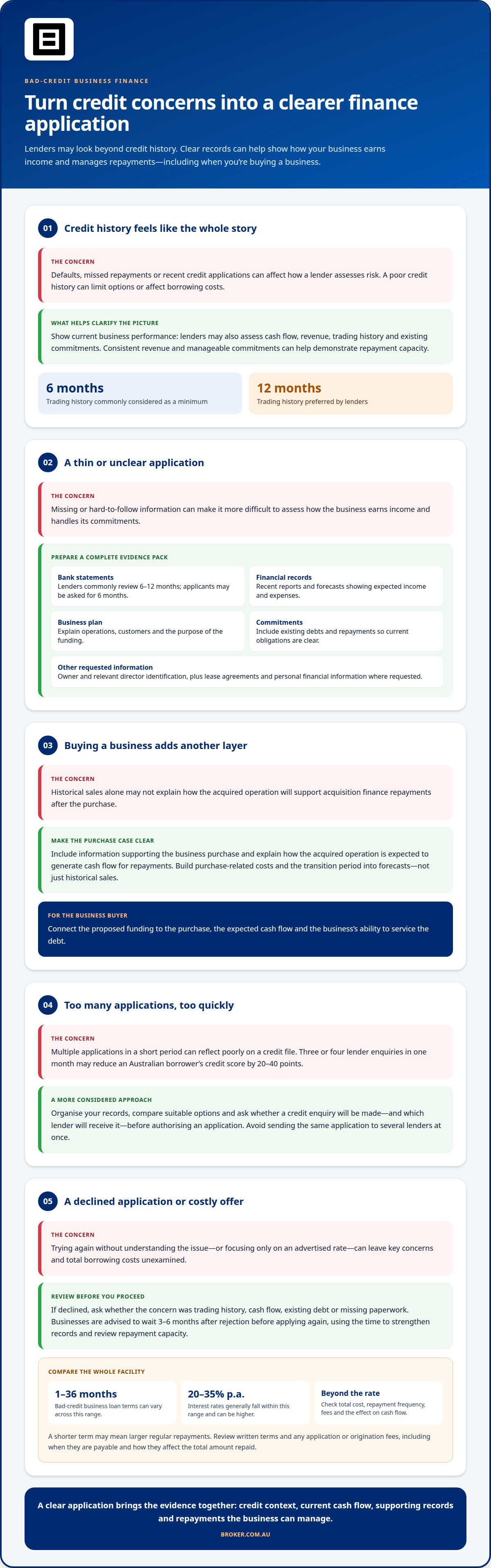
A poor credit history can narrow your borrowing choices, but it doesn’t automatically rule out a business loan. Bad-credit business finance options in Australia can include secured and unsecured lending, while lenders commonly assess both the owner’s personal credit history and the business’s record. They generally look for at least six months of trading history, with 12 months preferred.
It’s understandable to worry that a past default or missed payment will overshadow your business’s current position. Lenders may also assess cash flow, revenue, trading history and the strength of the application. Clear financial information helps present the full picture.
This guide explains how bad credit may affect an application, what eligibility criteria and documents lenders commonly consider, and which finance options Australian businesses can explore. It also covers what to weigh up when comparing facilities, including repayment terms, total borrowing costs and the effect of repayments on day-to-day cash flow.
Key Takeaways
- Bad credit can make borrowing harder, but lenders may weigh current cash flow and business performance alongside credit history.
- Prepare financial records and a clear business plan to help show how your business can manage repayments.
- Compare secured and unsecured finance carefully: using an asset as security may affect the terms, but it also puts that asset at risk if you can’t repay.
- For buying a business, assess acquisition finance against the purchase, your contribution and the business’s ability to service the debt.
- Match the facility to the need: short-term cash-flow pressure calls for a different approach from funding a major purchase.
Table of Contents
- Can bad credit get in the way of your business loan?
- Application documents
- Eligibility requirements
- Secured business loans
- Business finance options for businesses with bad credit
- Broker.com.au: Secured Business Loans
Can bad credit get in the way of your business loan?
Yes, a poor credit history can limit your business loan options or affect the cost, but it doesn’t automatically prevent approval. Lenders may consider the owner’s personal credit history alongside the business’s credit record, trading history and ability to manage repayments.
These are broad market ranges, not an entitlement: a lender may approve less than requested. For example, an application for A$50,000 might result in an approval of A$20,000, depending on the assessment.
Some specialist lenders may offer loans up to A$150,000 without a credit check. That doesn’t mean the lender skips assessment; it may place more weight on business revenue, cash flow or other eligibility criteria. A credit check may still apply to other products, so understand what the application involves before proceeding.
Credit history and approval
When a business has a limited trading history, lenders may look closely at the owner’s personal credit history as well as the business’s. Defaults, missed repayments and recent credit applications can affect how a lender assesses risk. Consistent revenue and manageable existing commitments can help demonstrate repayment capacity.
Before applying, review the requested amount against the business’s cash flow and likely repayments. Bad-credit business loan terms can range from 1 to 36 months, so a shorter term may mean larger regular repayments. Choose an amount the business can support, rather than borrowing the maximum offered.
Lender legitimacy and loan terms
Bad-credit loan rates vary by lender and borrower. Indicative rates can range from 15% to 35%, while bad-credit business loan interest rates generally range from 20% to 35% per annum and can be higher. Compare the total cost, repayment frequency, fees and term, not just the advertised rate.
Business-purpose credit is treated differently from consumer credit in Australia, so the National Credit Code does not apply in the same way to every business facility. ASIC regulation depends on the lender and product. Before sharing sensitive information or signing an agreement, check the finance company’s name or ABN on the Australian Securities and Investments Commission register.
Be cautious of an unsolicited call or email claiming you’re approved for a loan you never applied for. After approval, bad-credit business loan funds may arrive within 24 to 48 hours, but speed alone doesn’t prove an offer is legitimate. Read the written terms and confirm the repayment obligations before accepting.
Application documents
A complete application helps lenders assess how the business earns income and manages commitments. For a bad-credit application, prepare records that explain recent performance as well as past difficulties. Lenders commonly review six to 12 months of business bank statements; applicants may be asked for six months. Keep statements complete, with business income and regular expenses easy to identify.
Gather the core documents before submitting:
- Identification for the business owner and relevant directors.
- A business plan describing operations, customers and the purpose of the funding.
- Recent financial reports and forecasts showing expected income and expenses.
- Lease agreements and personal financial information, where requested.
- Details of existing debts and repayments, so lenders can assess current commitments.
For a business purchase, include information that supports the proposal and explains how the acquired operation is expected to generate cash flow for repayments. Forecasts should account for purchase-related costs and the transition period, not rely only on historical sales. Clear, consistent documents help lenders understand the application.
Before authorising an application, ask whether the lender will conduct a credit enquiry and which lender will receive it. A broker may submit an application after you agree to proceed, so clarify what information will be shared and whether a credit check is involved. Keep track of enquiries and avoid submitting the same application to several lenders at once.
Multiple applications in a short period can reflect poorly on a credit file. Three or four lender enquiries in one month may reduce an Australian borrower’s credit score by 20-40 points. Instead, organise your records, compare suitable options, and submit a considered application. Treat claims of guaranteed approval cautiously: lenders assess the application, supporting documents and repayment capacity.
If a lender declines the application, ask for specific feedback before trying again. Find out whether the concern was trading history, cash flow, existing debt or missing paperwork, then address that issue. Australian businesses applying for bad-credit finance are advised to wait 3 to 6 months after rejection before applying again. Use that time to strengthen records and review the business’s income, expenses and repayment capacity.
Check the written offer for any application or origination fees before accepting funding. Confirm whether a fee applies, when it is payable, whether it is added to the loan, and how it affects the total amount repaid. A broker may charge for its service or receive commission from the lender, so understand the arrangement before proceeding. For an acquisition, organise purchase and cash-flow documents before discussing finance for buying a business.
Eligibility requirements
Eligibility depends on more than a credit score. Lenders may also assess trading history, turnover and cash flow, including how revenue patterns affect the business’s ability to make repayments.
Business eligibility criteria
Requirements vary, but common criteria include GST registration, Australian trading history and sufficient revenue to support repayments. Other bad-credit lenders commonly look for monthly turnover between A$5,000 and A$12,000.
These are different lender benchmarks, not one national threshold. A lender may also assess the most recent six months of bank statements, existing debts and whether regular income covers expenses and repayments. Prepare a cash-flow summary that explains any unusual changes in revenue.
Turnover and location requirements
Eligibility criteria do not depend on a city-specific rule. Instead, lenders assess how the business’s location, industry and trading pattern affect income, costs and cash flow. For example, a seasonal business can use forecasts to show how it plans to meet expenses and repayments during quieter periods.
Explain any gaps between issuing an invoice and receiving payment. If customers have longer payment terms, show how the business pays wages and suppliers while waiting for revenue. This helps lenders understand how bank statements reflect the business’s actual cash-flow cycle.
Australian credit reports can include repayment history, credit applications, credit products, defaults, previous bankruptcies and past requests for reports. Comprehensive Credit Reporting began in 2018, and since June 2025, credit reporting has included Buy Now Pay Later repayment history. A default remains on a file for five years from when it was recorded; missed payments can remain for up to seven years.
A bad score is typically below 500 points, but Australian credit scales range from 0 to 1,000 or 1,200, depending on the bureau. Equifax lists 0-459 as its low score range. Lenders may also weigh current cash flow, turnover and recent statements, so a score alone doesn’t show whether the business can service new debt.
To review your credit file, request reports from Equifax, Experian and illion, then contact the relevant reporting body to correct errors. You can obtain a free credit check from a registered credit reporting agency. Credit reporting bodies may hold different information, so the Office of the Australian Information Commissioner (OAIC) advises that you may need to request a report from each one.
Before applying, review income, expenses, debts and cash flow together. For a business acquisition, also assess whether the acquired business’s revenue can support acquisition finance repayments alongside operating costs.
Secured business loans
Yes, Australian businesses may be able to borrow with a low credit score or defaults. Lenders can consider available security, the status of a default and the business’s capacity to make repayments.
Using an asset as security
A secured business loan uses an asset, such as property, as collateral. It may be an option when a poor credit history makes an unsecured application harder to support. The asset gives the lender recourse if the business doesn’t repay, so weigh the funding need against the consequences of default.
If repayments fall behind, a lender may take the secured asset to recover its losses. A director may also need to provide a personal guarantee. Before pledging property or another asset, check which asset secures the facility, what the guarantee covers and how repayments fit the business’s cash flow.
Defaults and credit scores
A paid default and a current default present different circumstances for assessment. Explain when the default occurred, whether it has been paid, and what has changed in the business since then. For borrowers with current defaults or ATO debt, indicative rates are 18-30% or more, so compare the full repayment obligation before accepting an offer.
A low score doesn’t tell the whole story. Lenders may also assess revenue, existing commitments and whether the proposed repayments are affordable. If the business has a current default, explain its cause, the business’s current cash position and the steps taken to prevent a repeat.
Bad-credit loan structures
Bad-credit business finance refers to funding options for applicants whose credit history may limit access to standard lending. Some options resemble unsecured, short-term business loans, but may come with higher interest rates and shorter terms. The amount and repayments depend on the lender’s assessment and the business’s financial position.
An unsecured loan doesn’t use a specific asset as collateral, but the application still comes with obligations. Lenders usually assess the business’s financial health, and may require a director’s personal guarantee. Read the agreement carefully to understand the repayment schedule and any guarantee.
Compare secured and unsecured offers on more than the headline interest rate. Consider the total amount repayable, loan term, payment frequency, security and any guarantee. A shorter term may mean higher repayments, while a secured facility puts the pledged asset at risk if the business defaults.
For a business acquisition, account for purchase funding and working capital separately in your cash-flow planning. The business’s trading performance and ability to service debt matter alongside the buyer’s credit file. Avoid borrowing against an asset unless the business can manage the repayments and the risk of losing that security.
Business finance options for businesses with bad credit
Bad credit doesn’t leave every Australian business with the same finance options. Match the facility to the need, whether that’s buying a business, managing unpaid invoices or covering a short-term cash-flow gap.
Available finance pathways
Some specialist lenders offer bad-credit loans similar to unsecured, short-term business loans. These may suit a defined expense, but compare the repayment schedule and total cost with the revenue available to meet them. A line of credit can suit fluctuating cash needs, while an overdraft may bridge a short-term gap, not fund a long-term purchase.
Invoice finance may help when customers haven’t paid issued invoices. It can provide cash against those invoices, with some facilities advancing up to 90% of their value. With invoice factoring, a business sells unpaid invoices at a discount and transfers responsibility for chasing payment to the buyer.
For a business purchase, assess acquisition finance separately from working capital. A purchase loan should fit the expected cash flow of the business being acquired; an overdraft is not a substitute for long-term purchase funding. Asset finance, such as hire purchase, is tied to an asset, which the business owns outright after making all repayments.
Lender and broker choices
Australian businesses can consider traditional banks, non-bank lenders and business finance brokers. Specialist lenders may assess revenue and cash flow alongside a credit score, while a broker can help match the funding need to a suitable facility and lender. No single lender fits every business with defaults or poor credit.
Before applying, identify whether the need is a purchase, a temporary cash shortfall or delayed invoice payments. Then compare the facility’s total cost, repayment structure and term. A line of credit may suit timing gaps better than a term loan when the business is profitable but waiting for customer payments.
For invoice finance, review which invoices qualify, how advances are calculated and what happens if a customer pays late. For unsecured finance, check repayments against current revenue and other debts. If defaults remain on the file, prepare a clear explanation and show how recent trading supports the proposed borrowing.
Multiple applications can affect a credit file, so narrow down the options before submitting. Prepare consistent, accurate figures for each assessment, including revenue, expenses and existing repayments. This makes comparisons clearer and helps avoid choosing an amount that strains cash flow.
If you’re weighing a business purchase against a working-capital need, explore business finance pathways that align with the purpose and repayment capacity.
Broker.com.au: Secured Business Loans
Broker.com.au can help assess finance options when a poor credit history complicates a business loan application. Secured Business Loans may suit businesses able to offer an asset as security, while Unsecured Business Loans and Working Capital Finance address different funding needs.
For a business buyer, Business Acquisition Funding can help structure finance around the purchase and the acquired business’s capacity to service repayments. Prepare current financial records, details of any defaults and a clear cash-flow picture, so the application reflects both the credit issue and the business’s current position. Broker.com.au uses proprietary AI technology to facilitate quick and accurate loan applications.
To discuss your funding needs, contact Broker.com.au or visit broker.com.au.
Make your next finance decision with clarity
A credit setback doesn’t have to define your business’s next move. Focus on the purpose of the funding and how the proposed repayments fit the business’s plans. If you’re buying a business, assess acquisition finance against both the purchase and the cash the business needs to operate after settlement. A well-prepared funding plan helps keep those decisions connected.
Broker.com.au offers Secured Business Loans, Unsecured Business Loans and Business Acquisition Funding. These options address different borrowing needs, from asset-backed finance to funding a business purchase. The next step is to discuss your circumstances, intended use of funds and the structure that may suit your plans.
Explore bad credit business finance options in Australia with a clear view of what you need the funding to achieve. Contact Broker.com.au about your options and take the next step with confidence.
Frequently Asked Questions
How much can you borrow with poor credit?
With poor credit, indicative borrowing amounts vary by credit-score band and lender assessment. A lender may offer less than requested after assessing revenue, existing commitments and repayment capacity. Treat these ranges as reference points, not a borrowing target, and choose an amount the business can service.
What documents do you need to apply?
Prepare identification, business bank statements, financial reports and a business plan. Lenders may also request forecasts, lease agreements and personal financial information. For a business acquisition, organise documents explaining the purchase, expected revenue and transition costs, so the funding request reflects the business’s operating needs. Check that names, dates and figures match across your records, and be ready to explain unusual transactions or periods of reduced income.
What can I use my business funding for?
Business finance can support different needs, depending on the facility and its terms. A buyer may seek acquisition finance to purchase an existing business, while working capital can help cover operating expenses. Equipment finance can fund machinery or technology, and invoice finance can release cash tied up in unpaid invoices. Match the facility to its purpose, then check that repayments fit the cash flow expected from that use.
What’s a bad credit score in Australia?
A score below 500 points is typically considered bad, but score ranges depend on the reporting bureau. Australian credit scales commonly run from 0 to 1,000 or 1,200 points, while Equifax lists 0-459 as its low range. A score is only one part of a lender’s assessment. Your credit report may also show repayment history, defaults and credit applications, which can give lenders context about past borrowing.
What bad credit business finance options are available in Australia?
Bad-credit business finance options in Australia can include secured or unsecured business loans, invoice finance and a line of credit. A secured loan may suit a business with an asset to offer as collateral; invoice finance may suit one waiting for customers to pay. A line of credit can help manage changing cash needs. For a business purchase, assess acquisition funding separately from short-term working capital.
What are the eligibility requirements for bad credit business loans in Australia?
Requirements vary, but lenders may assess Australian trading history, GST registration, monthly revenue, bank statements, existing debts and cash flow. These are different lender benchmarks. Recent statements should show that the business can meet operating costs and proposed repayments.
What interest rates, fees and loan amounts do bad credit business lenders offer in Australia?
Indicative rates vary with credit history, security and lender assessment. For scores from 400 to 499, rates are listed at 15-25% or more; for scores from 500 to 599, 12-20%; and for scores of 600 or more with minor issues, 8-15%. Check the offer’s fees, term and total repayment cost, not just its rate.
How do secured and unsecured business loans compare for borrowers with bad credit in Australia?
A secured loan is backed by an asset, which may support an application, but the asset is at risk if repayments aren’t made. An unsecured loan doesn’t use specific collateral, though lenders still assess business finances and may require a director’s personal guarantee. Compare the amount, repayment schedule, interest rate and total cost. The right structure depends on the business’s cash flow and willingness to put an asset at risk.