
Is your existing debt actually the biggest barrier to your next $1 million in revenue? While you might feel that your current finance is just a standard cost of doing business, restrictive loan covenants and high legacy interest rates can quickly become a cash flow choke point. In a market where 34% of SMEs are actively seeking funds for expansion, staying tied to outdated agreements often means missing out on vital opportunities. This is where strategic business loan restructuring for growth becomes a powerful tool for sophisticated Australian firms. By reorganising your liabilities, you can align your financial obligations with your 2026 scaling objectives rather than being held back by the decisions of the past.
We understand that managing multiple monthly repayments and navigating an RBA cash rate of 4.35% can feel overwhelming when you are trying to focus on operations. It’s frustrating to see your borrowing capacity limited by loans that no longer serve your needs. In this guide, you will learn how to simplify your financial structure to improve cash flow and unlock the capital required for your next 12 to 24 months of expansion. We will explore how to navigate current market rates, which start from 7.49% for secured loans, and how to position your balance sheet to move from a state of uncertainty to streamlined confidence.
Key Takeaways
- Discover how business loan restructuring for growth differs from insolvency measures, allowing you to unlock trapped capital without the stigma of financial distress.
- Explore the mechanics of consolidating multiple high-interest facilities into a single, efficient secured business loan to simplify your monthly obligations.
- Recognise the critical signs that your current debt structure is hindering your progress, including specific repayment-to-revenue benchmarks that signal a need for change.
- Follow a proven five-step roadmap to audit your current portfolio and prepare the professional financial modelling that lenders require to approve better terms.
- Understand how gaining inside access to over 40 specialist lenders and non-bank funds can help you secure more flexible terms tailored to your 24-month expansion plan.
Table of Contents
- What is Business Loan Restructuring for Growth?
- The Mechanics: How Restructuring Unlocks Capital
- Signs Your Business is Ready for a Debt Restructure
- The 5-Step Roadmap to a Successful Growth Restructure
- Why Broker.com.au is Your Strategic Growth Partner
What is Business Loan Restructuring for Growth?
For many Australian business owners, the term Debt restructuring often carries a heavy, negative weight, usually associated with insolvency or financial distress. However, in the context of a scaling enterprise, this perspective is fundamentally flawed. Business loan restructuring for growth is actually a sophisticated financial manoeuvre designed to reorganise existing liabilities to improve liquidity and enhance your total borrowing power. It isn’t about saving a sinking ship; it’s about upgrading the engine so the vessel can travel further and faster.
While “insolvency restructuring” is a reactive measure taken to avoid collapse, “growth restructuring” is a proactive choice made by healthy companies to remove financial friction. A specialist broker acts as a high-level fixer in this process. We look beyond the surface level interest rate to identify hidden inefficiencies in your current loan contracts, such as restrictive covenants that prevent you from accessing new capital or security arrangements that tie up too much equity. Business loan restructuring is a proactive strategy to align debt obligations with future revenue projections.
The Difference Between Refinancing and Restructuring
It’s easy to confuse these two terms, but the outcomes they deliver are quite different. Refinancing is often a simple transaction where you swap one loan for another to secure a slightly better interest rate. While useful, it rarely solves deep-seated cash flow issues. Restructuring involves changing the fundamental structure, terms, or security of your entire debt portfolio. Growth-focused firms usually need the latter to unlock significant capital. This might involve shifting from several high-interest unsecured facilities into a single, tailored secured business loan that offers more breathing room and lower monthly repayments.
Why 2026 is the Year to Reassess Your Debt
The Australian lending market in 2026 is vastly different from the environment of two or three years ago. With the RBA cash rate sitting at 4.35% as of June 2026, many legacy loans taken out during the low-interest era are now mismatched with current market valuations and cash flow requirements. These older contracts often contain rigid terms that don’t account for the current economic reality. Lender appetite has also shifted significantly; 31% of SMEs now prefer non-bank lenders over traditional banks due to their more flexible criteria. Reassessing your debt now ensures your business remains agile, providing the streamlined confidence needed to pivot quickly as market conditions fluctuate.
The Mechanics: How Restructuring Unlocks Capital
Understanding the technical levers of business loan restructuring for growth is essential for any director planning a major expansion in 2026. It’s about more than just finding a cheaper rate; it’s a strategic realignment of your balance sheet to ensure every dollar is working toward your next milestone. One of the primary mechanics involves consolidating multiple high-interest facilities into a single, lower-rate Secured Business Loan. This immediately simplifies your administration and reduces the total interest burden, turning what was once a complex web of repayments into a streamlined, manageable commitment.
Beyond simple consolidation, we focus on extending loan terms to reduce immediate cash flow pressure. While a shorter term might seem attractive for paying off debt faster, it often creates a cash flow “choke point” that prevents you from hiring staff or investing in new inventory. When considering what business owners should know about this process, the focus should be on how these changes support long-term goals. We often negotiate the removal of restrictive covenants, those “fine print” clauses that might prevent you from taking on further debt or require you to maintain specific liquidity ratios. Removing these barriers is often the key to unlocking the next phase of your growth plan.
Optimising Your Cash Flow Cover
Lowering your monthly repayments does more than just give you extra breathing room; it fundamentally changes how lenders view your business. By reducing your committed monthly outgoings, you increase your Debt Service Cover Ratio (DSCR). A healthier DSCR signals to the market that you have the capacity to take on more significant funding, such as Working Capital Finance, to fuel day-to-day scaling. Some sophisticated owners even use this opportunity for “debt recycling,” where they reorganise debt to make interest payments tax-deductible or to fund new, revenue-generating assets. If your current structure feels like a straitjacket, it might be time to explore more flexible options that align with your 2026 roadmap.
Releasing Security and Collateral
Many legacy loans are over-collateralised, meaning they use “lazy assets” that could be better utilised elsewhere. We look at strategies to release your family home from business loan security, a common pain point for Australian entrepreneurs. By switching certain facilities to Unsecured Business Loans or using Asset Finance to leverage equipment rather than real estate, you can free up property equity. This equity can then be redirected into commercial property investments or used as a clean slate for future borrowing. Moving away from a property-heavy security model provides the agility needed to scale without putting your personal assets at unnecessary risk.
Signs Your Business is Ready for a Debt Restructure
Identifying the right moment to initiate a business loan restructuring for growth is critical for maintaining momentum. Many directors find themselves in a position where their top-line revenue is soaring, yet their bank balance remains stubbornly low. This friction often stems from a debt structure that was designed for a smaller version of your current enterprise. If your monthly debt repayments exceed 30% of your gross revenue, you are likely operating in a danger zone where your capital is serving the bank rather than your own expansion. This benchmark is a clear signal that your current facilities are no longer efficient.
Fragmentation is another common red flag. If you are managing three or more separate lenders for different needs, such as equipment finance, a line of credit, and a commercial property loan, you are likely overpaying in fees and losing hours to administrative complexity. You might also find that your primary lender has “frozen” your limits despite your increased turnover. In the 2026 market, where major banks have tightened criteria for smaller loans, this stagnation can be fatal. If you are being forced to turn down lucrative new contracts because you lack the working capital to fulfil them, your finance is no longer a tool; it’s a bottleneck.
The “Growth Trap”: When Success Outpaces Your Finance
Rapid growth often leads to a paradoxical cash flow crunch. As you scale, your expenses for inventory and payroll precede the revenue from your new sales. This is the “Growth Trap.” Many owners try to bridge this gap with “Band-Aid” finance, such as high-interest credit cards or short-term unsecured loans. These are static solutions for a dynamic business. A strategic restructure replaces these expensive, temporary fixes with a cohesive plan that supports your 24-month roadmap, ensuring your success doesn’t outpace your liquidity.
Benchmarking Your Current Interest Rates
With the RBA cash rate at 4.35% as of June 2026, legacy loans from two years ago may be significantly out of step with the current market. Typical secured business loan rates now start from 7.49% p.a. If you haven’t performed a financial health check recently, you might be ignoring hidden costs like annual review fees or monthly service charges that have crept up over time. Comparing your legacy rates against 2026 commercial property loan rates is the first step in identifying where you can trim fat. We help you look past the base rate to see the total cost of capital, ensuring your structure remains professional, efficient, and tailored to your specific needs.
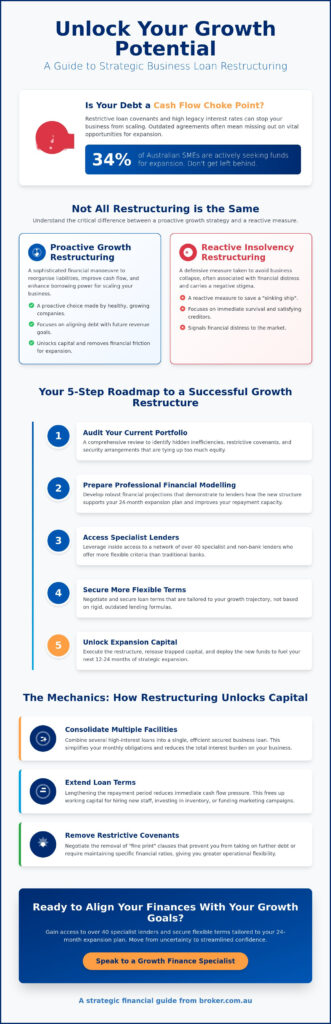
The 5-Step Roadmap to a Successful Growth Restructure
Moving from a restrictive debt environment to one that fuels expansion requires more than just a new application. It demands a methodical approach that addresses the specific bottlenecks identified in earlier sections of this guide. Executing a business loan restructuring for growth is a process of transitioning your balance sheet from a defensive posture to an offensive one. By following this roadmap, you ensure that every move is calculated to maximise your 2026 liquidity.
- Step 1: Audit your current debt portfolio. Review every existing facility to identify restrictive terms. Look for “all-asset” debentures or covenants that limit your ability to seek further funding.
- Step 2: Prepare updated financial modelling. Lenders in 2026 are focused on your future resilience. Create detailed projections that show how the restructured debt will directly lead to increased revenue.
- Step 3: Consult a specialist business loan broker. With 31% of SMEs now preferring non-bank lenders, you need a partner who can provide inside access to these specialist funds that major banks often overlook.
- Step 4: Negotiate a “Tailored Finance Solution.” Don’t settle for off-the-shelf products. Ensure your new structure aligns with your specific 2026 milestones, such as seasonal inventory peaks or planned capital expenditure.
- Step 5: Execute and monitor. Once the restructure is finalised, track your new cash flow position weekly. The goal is to see an immediate improvement in your Debt Service Cover Ratio.
Preparing Your “Growth Story” for Lenders
In the current economic climate, lenders are looking for more than just a high credit score. They want to see a “growth story” backed by data. If your plan involves expanding through a competitor purchase, integrating Business Acquisition Funding into your restructure can be a game-changer. Professional financial modelling is your best negotiation tool here; it demonstrates to the lender that you have a firm grip on your margins even with the RBA cash rate at 4.35%. We help you present your business as a high-performing asset that deserves premium terms.
Navigating Break Fees and Transition Costs
One of the biggest hesitations for directors is the cost of leaving their current bank. Calculating the “Break-Even Point” of a restructure is essential. This is the moment when the monthly savings from your new, more efficient structure outweigh the initial exit fees. We often negotiate with current lenders for a “clean exit” or find new lenders who are willing to “absorb” certain transition costs to win your business. If you are ready to see the numbers for yourself, I’m interested in a debt audit to determine your potential savings.
Why Broker.com.au is Your Strategic Growth Partner
Scaling a business is a high-stakes endeavour that requires a partner who understands the Australian lending landscape from the inside out. At Broker.com.au, we act as your expert guide, transforming the often anxious process of debt management into a source of streamlined confidence. We believe that business loan restructuring for growth should be a catalyst, not a chore. By leveraging our award-winning expertise, you can move away from the uncertainty of legacy debt and toward a financial structure that is purpose-built for your 2026 expansion goals.
Our competitive advantage lies in our sophisticated blend of technology and inside access. We provide you with a gateway to over 40+ lenders, including specialist non-bank and private funds that traditional institutions often cannot access. To ensure efficiency, we utilise proprietary AI technology that matches your business profile to the best available rates instantly. This isn’t just about speed; it’s about precision. Our technology ensures that the tailored finance solution we present is the most effective fit for your specific cash flow requirements and growth milestones.
Beyond the Big Four: Accessing Alternative Finance
The major banks often say “no” to complex restructures because their rigid, one-size-fits-all criteria aren’t designed for dynamic, fast-growing firms. If your situation is “outside of the norm,” you need a high-level fixer who can navigate alternative finance markets. Non-bank lenders often provide the flexibility required for complex scenarios like Business Acquisition Funding or releasing over-collateralised property equity. We leverage our “Best in Class” reputation to negotiate terms that the average consumer simply couldn’t obtain on their own, ensuring your business remains agile in a shifting economy.
Start Your Growth Journey Today
Taking a proactive, “can-do” approach to your finances is what separates industry leaders from the rest of the pack. While our digital tools are best in class, we remain a human-led advisory at heart. Our team members, like Matt or Flavio, provide the personal attention and local insights needed to ensure you feel “in good hands” throughout the entire process. We handle the technical complexities of your debt so you can stay focused on running your business and achieving your dreams. If you’re ready to unlock the capital trapped in your current loan structure, we’re ready to help. I’m interested in restructuring for growth.
Secure Your Competitive Edge for the Year Ahead
Your business deserves a financial foundation that supports your vision rather than one that restricts it. By auditing your current debt portfolio and identifying “lazy assets” or restrictive terms, you can transition from defensive management to proactive scaling. We’ve explored how business loan restructuring for growth allows you to consolidate multiple facilities, release personal security, and align your repayments with your 2026 revenue projections. This strategic realignment ensures that your capital is working just as hard as you are.
Navigating the complexities of the Australian lending landscape doesn’t have to be a source of stress. As an Award-Winning Business Loan Broker, we provide inside access to over 40 Australian lenders, ensuring you aren’t limited by the narrow criteria of the major banks. Our proprietary AI-driven loan matching technology instantly identifies the most efficient structures for your unique profile, saving you time and protecting your credit score. This combination of boutique service and elite technology keeps you in control.
Don’t let legacy contracts hold back your next phase of expansion. Our team is ready to help you move from uncertainty toward a state of streamlined confidence. I’m interested in a strategic debt restructure. You’re in good hands with a partner who prioritises your specific dreams and long-term success.
Frequently Asked Questions
Is business loan restructuring the same as debt consolidation?
No, business loan restructuring for growth is a more comprehensive financial strategy than simple debt consolidation. While consolidation focuses on merging multiple facilities into a single payment, restructuring involves fundamentally altering your debt’s terms, security arrangements, and covenants. This proactive approach ensures your entire financial structure is aligned with your 2026 scaling objectives rather than just simplifying your monthly administration.
Will restructuring my business loans impact my credit score?
Proactive restructuring typically protects or even improves your credit profile over the long term. By reducing your Debt Service Cover Ratio (DSCR) and ensuring repayments are manageable, you demonstrate financial stability to future lenders. We use proprietary technology to match you with appropriate lenders before formal applications are made, which helps minimise the number of hard enquiries on your credit file during the transition.
How much does it cost to restructure a business loan in Australia?
The total cost of a restructure depends on several variables, including break fees from your current lender, valuation fees for security assets, and potential legal costs for new documentation. It’s essential to calculate the break-even point where your monthly cash flow savings outweigh these initial transition expenses. We help you identify lenders who may be willing to absorb some of these upfront costs to secure your business.
Can I restructure my debt if I want to purchase another business?
Yes, you can certainly integrate a restructure with your plans for expansion. Many sophisticated owners use Business Acquisition Funding as the catalyst for a total debt overhaul. By reorganising your existing liabilities alongside the new acquisition debt, you can create a single, efficient financial structure that supports the combined entity’s cash flow requirements during the critical integration phase.
How long does the restructuring process typically take?
A standard business loan restructure typically takes between four and eight weeks from the initial audit to the final settlement. The specific timeline depends on the complexity of your current security arrangements and how quickly updated financial modelling can be prepared. Using an expert guide helps streamline this process, as we handle the heavy lifting with lenders while you stay focused on your day-to-day operations.
Do I need to provide property as security for a restructured loan?
You don’t always need to provide real estate as security for a restructure. While a Secured Business Loan backed by property often offers the lowest interest rates, we also facilitate Unsecured Business Loans or Asset Finance using equipment as collateral. Our goal is often to release “lazy equity” in your family home by shifting business debt toward more appropriate business-related security structures.
What financial documents do I need to prepare for a restructure?
You will generally need to provide the last two years of company tax returns, recent BAS statements, and up-to-date profit and loss reports. Because this is a business loan restructuring for growth, lenders also require detailed financial modelling and revenue projections for the next 12 to 24 months. Having these documents ready allows our team to present a professional growth story that secures the most competitive terms available.
Can I use debt restructuring to pay for a commercial property fit-out?
Yes, you can incorporate Fit-out Finance into your broader restructuring plan. By reorganising your existing debt to improve your cash flow position, you can more easily service the capital required for a major office or retail renovation. This approach ensures your new physical space is funded through a structure that matches the lifespan of the assets rather than relying on expensive, short-term working capital.