
A profitable business can still be difficult to finance if the numbers, buyer contribution or deal structure don’t stack up. Understanding what banks look for in a business acquisition loan means looking beyond the purchase price: lenders assess whether you can run the business and whether its cash flow can support repayments.
You may be unsure how much equity you’ll need, how a lender will assess goodwill or whether the target’s earnings are strong enough. Requirements vary between lenders, so there’s no single formula for acquisition finance approval. Preparing early can help you identify gaps and present a clearer case.
This guide explains how Australian lenders may assess you, the business and the transaction when you’re buying a business. It covers buyer experience, financial records, servicing, security, deposit and equity, and how goodwill or vendor finance could affect the structure. Whether you’re buying as an individual or through an entity, you’ll have a practical starting point for preparing an application for Business Acquisition Funding.
Key Takeaways
- Understand what banks look for in a business acquisition loan by considering the buyer, target business, transaction and repayment plan together.
- See how lenders may assess cash flow, financial history and forecasts to judge whether the business can support proposed repayments.
- Understand why buyer equity, security and goodwill are assessed differently, and why expectations vary between lenders and transactions.
- Use a practical sequence to organise sale details, the funding request and supporting records before applying.
- Compare secured and unsecured acquisition finance in light of your circumstances, available security and lender criteria.
Table of Contents
- What banks look for in a business acquisition loan
- How lenders assess cash flow and loan servicing for an acquisition
- How deposit, equity, security and goodwill shape the deal
- How to prepare a business acquisition loan application
- Choosing an acquisition finance pathway and taking the next step
What banks look for in a business acquisition loan
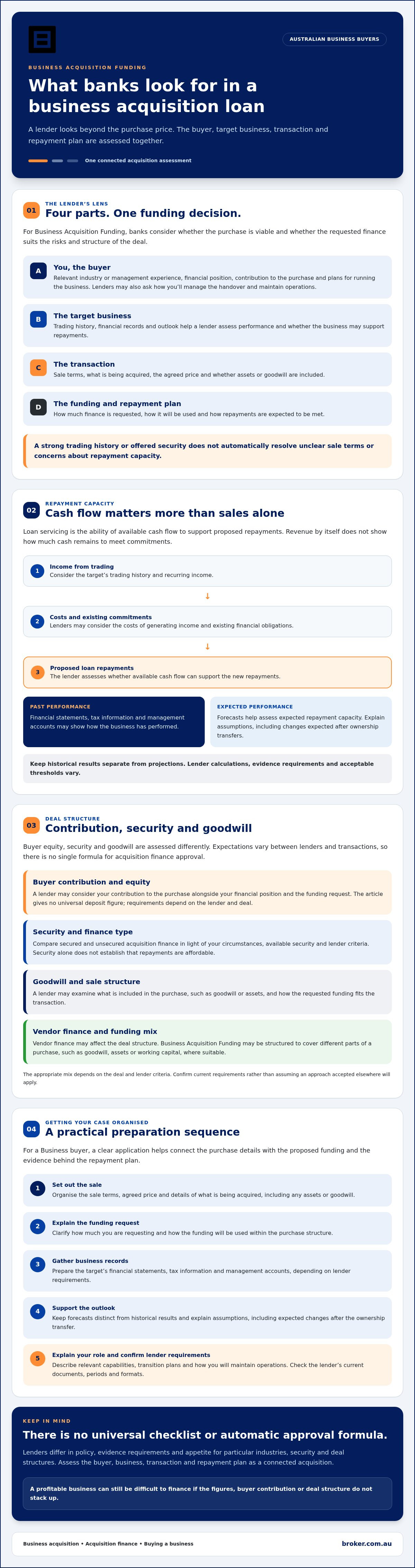
For a business acquisition loan, lenders assess the buyer, target business, transaction and proposed repayment plan together. They want to understand whether the purchase is viable and whether the requested finance suits the risks and structure of the deal.
This differs from seeking general funding for business operations. An acquisition loan is tied to a specific purchase, so a lender may examine the sale terms, what’s being acquired and how the funding will be used. Business Acquisition Funding may be structured to cover different parts of a purchase, such as goodwill, assets or working capital, where suitable. The appropriate mix depends on the deal and lender criteria.
There’s no universal checklist or automatic formula for approval. Lenders can differ in their policies, evidence requirements and appetite for particular industries, security or deal structures. Confirm current requirements with the lender rather than assuming that a document or funding approach accepted elsewhere will apply to your application.
Which parts of a business acquisition does a lender assess?
Consider the assessment in four connected parts: you as the buyer, the target’s performance, the purchase terms and the proposed funding structure. A lender may review the business’s financial records and outlook alongside the agreed price, what assets or goodwill are included, how much you’re requesting and how repayments are expected to be met.
A lender assesses the buyer, business, transaction and repayment plan as one connected acquisition, not as isolated boxes to tick. A strong trading history may support the case, but it won’t necessarily resolve unclear sale terms or a funding request that doesn’t fit the deal. Similarly, offering security doesn’t automatically address concerns about the business’s capacity to support repayments.
Some acquisitions use significant debt as part of the funding structure. The Leveraged buyout (LBO) overview explains this approach, but it doesn’t mean every business purchase follows an LBO structure or that a lender will accept a particular form of security.
Why does the lender assess the buyer as well as the business?
The buyer has a central role in making the acquisition work. Lenders may consider your relevant industry or management experience, financial position, contribution to the purchase and plans for running the business. They may also ask how you’ll manage the transition from the current owner and maintain operations.
These factors are considered in context. No particular experience level or personal asset guarantees approval, and requirements vary between lenders. Be ready to explain your role, relevant capabilities and approach to the handover. This helps the lender assess who will take responsibility for the acquired business, not just its past results.
How lenders assess cash flow and loan servicing for an acquisition
Loan servicing is the ability of available cash flow to support proposed repayments. For an acquisition, a lender needs to understand more than the target’s revenue. It may consider the costs of generating that income, existing financial obligations and the new loan repayments. Strong sales alone don’t show how much cash remains to meet those commitments.
This is central to what banks look for in a business acquisition loan. Lenders may compare the target’s trading history with forecasts and your assumptions about how the business will perform after the sale. Their calculations and acceptable evidence vary, so don’t rely on an assumed universal servicing ratio or threshold. The Australian Banking Association’s small business resources offer broader context on SME lending in Australia.
What financial information may banks examine?
Depending on the lender and transaction, supporting information may include the target’s financial statements, tax information and management accounts. These records show how the business has performed. A lender may also ask for forecasts to assess its expected capacity to repay acquisition finance.
Keep historical results separate from projections. Explain the assumptions behind forecasts, including any expected changes after ownership transfers. Check which financial periods, documents and formats the lender currently requires, as these may differ between lenders.
How can cash flow affect acquisition finance?
Recurring income matters, but so do operating costs, existing obligations and expenses related to the ownership transition. For example, if you plan to change staffing or invest in equipment after settlement, include the cost and timing in your forecast. Don’t treat all current cash flow as available for repayments.
Sustainable cash flow matters more than headline turnover because repayments must be met from money left after the business’s costs and obligations. Use the target’s trading history as a starting point, then explain where your assumptions differ and why. This helps the lender assess the repayment plan and lets you test whether the proposed funding remains workable under new ownership.
Preparing this information can make an application easier to assess, but it doesn’t guarantee an outcome. If you’d like help presenting the buyer, business and transaction to potential lenders, explore Business Acquisition Funding support.
How deposit, equity, security and goodwill shape the deal
Your contribution, available security and what the purchase price represents can all influence how an acquisition finance request is structured. There’s no standard deposit or equity amount for every Australian business purchase. A lender’s expectations may depend on the transaction, your position, the target business and the lender’s risk assessment.
Keep buyer contribution and security distinct. Your contribution is the money or equity you put towards the purchase. Security is an asset a lender may rely on if the loan isn’t repaid. Offering security doesn’t automatically replace a required contribution, and contributing more doesn’t guarantee that a lender will accept the deal or its repayment assumptions.
How much deposit or equity might a business buyer need?
There’s no reliable percentage to assume before a lender reviews the details. Ask what contribution it expects for your proposed transaction, and be ready to show the source and availability of your funds. Plan for more than the purchase price: settlement requirements and ownership transition costs may also need to be funded. Confirm each lender’s current requirements.
A larger deposit can reduce the amount you need to borrow, but it won’t necessarily resolve weak servicing or unclear assumptions. If the target’s cash flow doesn’t appear able to support the proposed repayments, extra equity alone may not address the lender’s concern. The contribution, security and repayment plan need to work together.
Can a bank finance goodwill when buying a business?
Goodwill is the value attributed to a business beyond its identifiable physical assets. It may reflect factors such as reputation, brand or customer relationships. Because goodwill isn’t the same as equipment or other tangible assets, lenders may assess it differently and may be cautious about lending against it.
Goodwill funding depends on lender appetite, the evidence supporting the value and the transaction. Don’t assume the price agreed with the seller will be the amount a lender is willing to fund. Check the lender’s current policy and any valuation evidence it requires.
Acquisition funding may cover different parts of a purchase. Depending on lender policy and suitability, the structure could address business value or goodwill, identifiable assets and working capital. For example, a buyer might identify equipment separately from goodwill rather than presenting the whole purchase price as one undifferentiated amount. Whether that approach works depends on the deal and lender criteria.
These are central factors in what banks look for in a business acquisition loan: not just how much equity you can contribute, but how the contribution, security, assets, goodwill and repayment case fit together. Clarifying each component before applying can help you identify funding gaps and discuss the transaction with lenders.
How to prepare a business acquisition loan application
A well-organised application helps a lender understand what you’re buying, how the purchase will be funded and what evidence supports your plan. Before submitting, check the sale details, buyer contribution, funding request and target business information for gaps or inconsistencies. Clear explanations are more credible than optimistic projections without supporting evidence.
Use this sequence to prepare:
- Step 1: Define the transaction. Review the sale agreement and clarify what’s included, such as business assets, goodwill and any working capital. Check that the purchase terms match the funding request.
- Step 2: Set out your contribution. Record the amount you expect to contribute and document its source and availability. Consider funds needed for completion and the transition, not only the purchase price.
- Step 3: Explain the funding request. Break down what you’re seeking to fund and how each part relates to the deal. Identify goodwill, assets or working capital clearly instead of combining them without explanation.
- Step 4: Organise the evidence. Gather available financial information about the target and relevant details about yourself as the buyer. Keep records consistent and easy to follow, and flag missing information rather than treating it as confirmed.
- Step 5: Check your assumptions. Compare your cash flow forecast with the business’s history. Explain material changes expected after settlement and identify assumptions that still need confirmation.
- Step 6: Confirm lender requirements. Ask the chosen lender or broker which evidence, financial periods and formats it currently requires. Requirements differ, so don’t rely on a checklist from another application.
What should you review before submitting an application?
Check that the sale terms, funding breakdown and supporting information tell the same story. List unanswered due diligence questions, including uncertainty about the assets or trading information you’re relying on, and raise them with the relevant professional advisers. Resolving discrepancies early can help you avoid building an acquisition finance case around incomplete or conflicting assumptions.
What documents could a lender request?
Examples may include buyer financial information, target business records, sale terms and cash flow forecasts. This is an indicative list, not a complete or universal checklist. The exact documents and formats depend on the lender and transaction, so confirm what’s needed with your chosen lender or broker before lodging an application.
Preparing these details can make it easier to present your business purchase clearly. For guidance on structuring an application, explore acquisition finance support.
Choosing an acquisition finance pathway and taking the next step
Once you’ve outlined the purchase and funding needs, compare options in the context of this specific acquisition. Secured and unsecured business loans may both be considered for buying an existing business, but neither is automatically available or suitable for every buyer. The right option depends on the transaction, your financial position, available security and lender criteria.
When might secured or unsecured acquisition funding be considered?
A secured loan involves offering an asset as security, subject to the lender’s approval and terms. The lender assesses the proposed security alongside the purchase and repayment case. Before relying on an asset in your funding plan, ask whether it may be considered and what obligations would apply.
An unsecured loan doesn’t require specific collateral, but that doesn’t mean the lender skips its assessment. It will still consider the buyer, target business, transaction and capacity to repay, and may apply different criteria from those for secured funding.
Consider what each pathway could mean for the whole deal. A purchase with few assets available as security may need a different funding approach from one that includes assets a lender is willing to consider. The lender’s appetite for the business, your contribution and the proposed repayment structure also matter. Don’t assume an unsecured option avoids all lender requirements or that offering security guarantees approval.
How can a broker support a business acquisition application?
A specialist broker can help turn the purchase details into a clear funding brief, organise relevant information about you and the target business, and present the proposed structure to potential lenders. This may help identify parts of the application that need clarification and explore possible lender options. It doesn’t guarantee approval or a particular lending outcome.
Broker.com.au arranges Business Acquisition Funding for people buying existing businesses, with funding for goodwill, assets and working capital where suitable. Its services also include secured and unsecured business loans, as well as corporate advisory. The focus is on helping present the acquisition and funding request in a way potential lenders can assess.
Understanding what banks look for in a business acquisition loan gives you a practical basis for a conversation, not a promise of finance. If you’re weighing up a purchase, take the next step at your own pace: I’m interested in discussing acquisition finance.
Prepare your next move with confidence
Buying an existing business is a significant commitment, but a clear finance plan can help you approach the process with greater confidence. The key takeaway from understanding what banks look for in a business acquisition loan is that lenders assess the buyer, target business, transaction and repayment case together.
Prepare by checking the sale details, organising the target’s financial information and making your cash flow assumptions clear. Confirm lender-specific expectations for your contribution, security and supporting evidence. A strong application is transparent about both the opportunity and any gaps that still need attention.
Broker.com.au specialises in Business Acquisition Funding and can help present your acquisition finance application to potential lenders. Funding solutions may address goodwill, assets and working capital, subject to lender policy. Proprietary AI technology supports loan application preparation, but doesn’t guarantee approval or a particular outcome.
If you’re considering a purchase, start a conversation about your options: I’m interested in discussing business acquisition funding. With preparation and guidance, you can take the next step as an informed business buyer.
Frequently Asked Questions
What do banks look for when approving a business acquisition loan?
Banks assess the buyer, target business, transaction and proposed repayment plan together. They may consider the business’s financial history and cash flow, purchase terms, your relevant experience, proposed contribution and available security. Criteria and evidence requirements vary, so there’s no universal checklist. A clear application should explain what’s being purchased, how the funding will be used and how repayments are expected to be supported.
How much deposit do I need to buy a business with a bank loan?
There’s no single deposit amount for every business purchase. Your required contribution can depend on the lender, transaction, your position and the overall risk assessment. Separate your contribution from any security you may offer, as one isn’t automatically a substitute for the other. Be ready to explain where your contribution is coming from and account for funds needed for completion and the ownership transition. Confirm current expectations with your chosen lender.
Can a bank loan cover goodwill when buying a business?
A lender may consider funding goodwill, depending on its current policy, the evidence supporting the value and the transaction. Goodwill is value associated with the business beyond identifiable physical assets, such as its reputation or customer relationships. Don’t assume the agreed sale price means the lender will fund the goodwill component. Broker.com.au arranges Business Acquisition Funding that may address goodwill, assets and working capital, subject to lender policy.
What documents might a bank ask for when I apply for acquisition finance?
A lender might request buyer financial information, target business records, sale terms and cash flow forecasts. Business records could include financial statements, tax information or management accounts, depending on the lender’s requirements and the transaction. These are examples, not a complete or universal checklist. Ask your chosen lender or broker which documents, financial periods and formats are currently needed. Keep historical results separate from forecasts and clearly explain their assumptions.
Does a business need strong cash flow to qualify for an acquisition loan?
Lenders generally need to assess whether the business’s available cash flow can support proposed repayments. Revenue alone won’t show this: operating costs, existing obligations and expected transition expenses affect the amount available. Historical performance provides context, while forecasts show how you expect the business to perform after the purchase. Lender calculations and acceptable evidence vary, so don’t rely on an assumed universal ratio or threshold when preparing your application.
Can I get a business acquisition loan without offering property as security?
It may be possible to explore an unsecured business loan for an acquisition, but availability depends on the lender, buyer, transaction and repayment case. Unsecured funding doesn’t require specific collateral, yet the lender still assesses the application and may have its own eligibility criteria. A secured option may involve other assets, subject to lender approval and terms. Discuss the available pathways with a lender or broker rather than assuming property is always required or that unsecured finance will suit the purchase.
Does my experience matter when applying for a business acquisition loan?
Yes. A lender may consider your relevant industry or management experience and the role you’ll take in operating the acquired business. It may also assess your financial position, contribution and plans for managing the transition from the seller. No single experience level guarantees approval, and requirements differ between lenders. Explain how your skills and operating plan relate to the business, and be clear about any areas where you’ll need support or further preparation.