
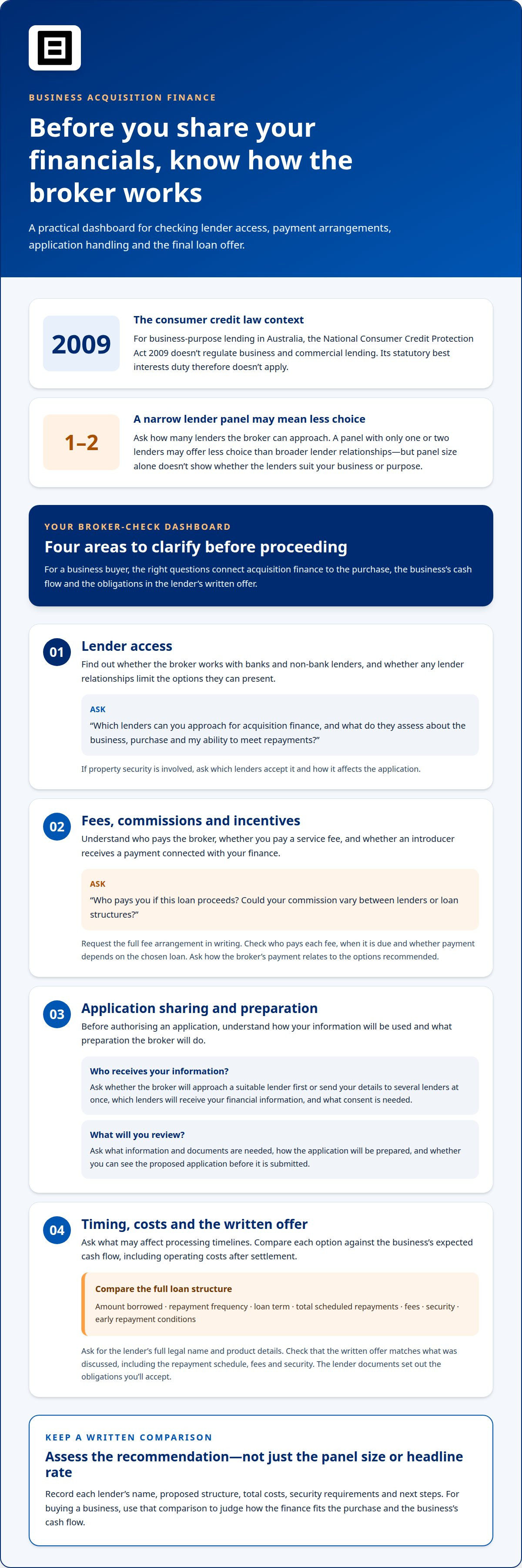
For business-purpose lending in Australia, the National Consumer Credit Protection Act 2009 doesn’t regulate business and commercial lending, so its statutory best interests duty doesn’t apply. That makes the questions to ask a business finance broker especially important: ask which lenders they can access, how they’re paid, how they match finance to your needs, and what they do to prepare your application. Ask what can affect the timeline, too.
It’s reasonable to want clear answers before sharing financial information or committing to a loan. If you’re buying a business, funding needs to suit both the purchase and the business’s cash flow and your broader plans. The most useful questions to ask a business finance broker will help you understand how the proposed funding fits those needs.
This guide covers questions to ask a business finance broker about lender access, fees and borrower interests, as well as loan matching, application preparation and timing. It also explains how brokers, accountants and lawyers bring different perspectives to a business acquisition, so you can approach the financing process with greater clarity.
Key Takeaways
- Ask which lenders a broker can access, whether they’re tied to a particular lender and how their panel could shape your options.
- Get a clear explanation of broker fees and commissions, including who pays them and how the arrangement may influence recommendations.
- Describe your priorities and ask how each proposed loan fits your business’s cash flow, funding needs and plans for buying a business.
- Find out what financial information and documents the broker needs, how they prepare an application and what can affect processing timelines.
- Use your broker, accountant and lawyer for distinct perspectives on funding, business finances and purchase terms when acquiring a business.
Table of Contents
- 1. 1 – How Wide is Your Panel of Lenders?
- 2. Does a business loan broker have to act in my best interests?
- 3. Loan-matching approach and borrower interests
- 4. Application preparation and processing timelines
- 5. Using business advisers such as brokers, lawyers and accountants
- Broker.com.au
1. 1 – How Wide is Your Panel of Lenders?
A broker’s lender panel shapes the finance options they can present. Ask how many lenders they can approach, whether they work with banks and non-bank lenders, and whether any lender relationships limit their recommendations. A broker with access to only one or two lenders may offer less choice than one with broader relationships. Panel size alone, however, doesn’t show whether those lenders suit your business or funding purpose.
Ask how the broker’s lender relationships have helped businesses with needs like yours. If you’re buying a business, ask whether the panel includes lenders that assess acquisition finance, and what information they consider about the business, purchase and your ability to meet repayments. For a loan secured against property, ask which lenders accept that security and how it affects the application. Experience matters when it helps the broker explain lender criteria and trade-offs clearly.
Find out how the broker plans to distribute your application. Will they recommend a suitable lender first, or send your details to several lenders at once? Ask which lenders will receive your financial information, what consent is needed, and whether you’ll see the proposed application before it’s submitted. Multiple submissions may create more options, but you should understand who will receive your information and why.
Discuss fees before proceeding. Ask whether the broker charges you, receives commission from a lender, or may be paid in both ways. Ask how any commission relates to the recommended loan, and request the fee arrangement in writing. A clear answer helps you understand the broker’s incentives alongside the lender’s costs, features and repayment structure.
Reviews and a track record can add context to a broker’s claims. Read client feedback for examples involving similar business sizes, industries or funding purposes, and ask about the broker’s experience with those cases. Treat testimonials as one part of your assessment: ask what the broker personally did, how they communicated, and how they handled an application that needed another lender or a different approach.
Before accepting an offer, ask for the lender’s full legal name and the product details. Check that the final documents match the lender and terms discussed, including the repayment schedule, fees, security and any property involved. Don’t rely on a verbal summary when the written offer sets out the actual obligations. The Australian Securities and Investments Commission’s Infoline can be reached on 1300 300 630.
Keep a written record of the answers. A useful comparison includes each lender’s name, proposed structure, total costs, security requirements and next steps. This makes it easier to assess whether the recommended option fits your cash flow and purpose, rather than choosing based on panel size or a headline rate alone.
2. Does a business finance broker have to act in my best interests?
For business-purpose lending in Australia, the National Consumer Credit Protection Act 2009 doesn’t regulate business and commercial lending, so its statutory best interests duty doesn’t apply. That makes clear conversations about a broker’s relationship with lenders, fees and commission especially useful. Ask how the broker balances your requirements against the way they’re paid, and how they’ll explain any potential conflict.
Start with direct questions: “Who pays you if this loan proceeds?” and “Could your commission vary between lenders or loan structures?” Ask whether you pay a service fee, whether an introducer receives a payment, and whether anything is payable if the loan doesn’t settle. These questions help you map the parties involved in the lending process and clarify whether a recommendation could affect the broker’s compensation.
Ask for the full fee arrangement in writing before authorising an application. It should identify who pays each fee, when payment is due, and whether the amount is fixed or depends on the chosen loan. If an accountant, business adviser or other introducer referred you, ask whether they receive a payment connected with your finance. A clear explanation lets you understand the commercial relationship without assuming commission alone makes a recommendation unsuitable.
Next, ask how the broker’s payment relates to the options they recommend. Does compensation differ by lender, loan term or product? Could ongoing commission apply? What happens if the loan changes or is refinanced? Ask the broker to explain how these arrangements affect their recommendation and distinguish their own fees from lender charges. If the answer is unclear, request a written breakdown before proceeding.
Compare the total repayable amount, not just the interest rate or broker’s fee. Review the proposed repayment schedule, interest, establishment and ongoing charges, and any other costs shown in the lender’s offer. A loan with a lower rate may still cost more overall if its fees or term differ. For an acquisition, assess repayments against the business’s expected cash flow, including the period after settlement when operating costs continue.
Use a consistent comparison for each option: amount borrowed, repayment frequency, loan term, total scheduled repayments, fees, security and early repayment conditions. Ask the broker to explain differences in plain language and show how each structure affects cash flow. Then compare the written lender documents with the summary. The lender documents set out the obligations you’ll accept.
If you’re considering acquisition finance, a discussion about business acquisition finance options can help connect fee disclosure with the wider cost and structure of funding a purchase.
3. Loan-matching approach and borrower interests
Ask how the broker turns your priorities into a shortlist. For a business acquisition, explain the purchase purpose, available contribution, repayment capacity and cash-flow needs. Then ask which criteria they use to find a suitable match, and why a particular lender fits better than other options. A recommendation should connect the loan structure, security and interest rate to your circumstances, not just the headline rate.
Ask whether the proposed interest rate is fixed or variable, and what each option means for repayments and flexibility. A fixed rate can make scheduled repayments more predictable during its fixed period, while a variable rate can change. Ask whether fees or conditions apply if you repay early, refinance or change the loan. Compare the total repayable amount and timing, not only the initial rate.
If a lender declines the application, ask why and which parts of it can be addressed. A broker can outline alternative lending solutions or a backup plan, such as changing the requested structure, providing further information or approaching another suitable lender. Ask how a new application would differ and whether it requires another credit enquiry before authorising it.
Discuss security separately. Ask whether the lender requires business assets, property or a personal guarantee, and what happens if the business can’t meet repayments. A director who gives a guarantee can become personally liable if the company cannot repay. If a home is proposed as security, establish exactly what property is exposed, who must consent, and how the lender’s security would be documented.
Australian business finance brokers don’t all have the same credentials. Ask whether the broker holds an Australian Credit Licence or is an authorised credit representative, and whether they belong to the Mortgage Finance Association of Australia or Finance Brokers Association of Australia. These details help distinguish licensing from professional association membership.
To verify a broker, search ASIC’s registers for licence or representative details and ask about the broker’s complaints process. The Australian Financial Complaints Authority can consider some small business credit disputes, subject to its rules and limits. Keep the broker’s written responses and relevant application records together.
Broker payment arrangements differ: a lender may pay commission, the borrower may pay a fee, or both may apply. Ask who pays, what triggers payment, and whether compensation differs between recommendations. Request the arrangement in writing.
Business finance brokers can arrange lending for purposes such as acquisition finance, working capital, equipment or property, depending on the lender and application. Ask which structure suits your purpose and how the repayment obligations fit projected cash flow.
An initial discussion with a broker doesn’t establish whether a lender will make a credit enquiry. Before an application is submitted, ask which business or personal credit file may be checked, who will make the enquiry, and what consent is required.
4. Application preparation and processing timelines
Business finance approval and settlement don’t follow one fixed timeline in Australia. Timing depends on the lender’s assessment, how quickly complete documents are supplied, any property valuation or other checks, and coordination between the parties handling settlement.
Ask the broker to map the process from initial review to funds being available. Request the expected stages, what must happen at each stage, who is responsible, and what could delay progress. For a business acquisition, work back from the proposed settlement date and identify when the lender needs the signed sale agreement, financial information and details of the business being purchased.
Before lodgement, ask for a document list tailored to the application. Depending on the lender and funding purpose, this may include business financial statements, recent management accounts, business and personal tax returns, bank statements, identification, details of existing debts, and information about proposed security. For an acquisition, the lender may also need purchase documents and evidence supporting the business’s revenue and cash flow.
Find out how the broker checks the application before submission. Ask who reviews figures for consistency, how gaps or unusual transactions are explained, and how changes are recorded. A difference between a bank statement and management accounts can prompt follow-up questions, so provide clear explanations with supporting records. Confirm how sensitive documents are sent and who can access them.
Clarify what “approval” means at each point. An initial indication, formal approval and settlement are distinct stages. Ask what conditions remain before funds can be released. If the loan involves property, ask whether a valuation is required, who organises it, and how its timing affects the lender’s decision. Also ask when signed loan documents must be returned and which settlement tasks remain outstanding.
If the lender declines the application, ask why and how that affects the next step. The broker can explain whether missing documents, servicing, security or the proposed structure contributed, then discuss whether further evidence, a revised application or another lender may be suitable. Before sending a new application, establish what will change and whether another credit enquiry is involved.
Keep a simple record of dates, document requests, submissions and outstanding conditions. For example, note when the broker lodged the application, when the lender requested updated accounts, and who is arranging any valuation. This helps you track progress without mistaking a document request for a final decision.
Ask how often the broker will provide progress updates, who will contact you about lender requests, and how quickly you should respond. Agreeing on a clear communication process helps prevent avoidable delays, particularly when a seller, solicitor, accountant and lender each need information before settlement.
Overall turnaround varies with the lender’s assessment, how promptly complete documents are supplied, any valuation or other checks, and coordination at settlement.
5. Using business advisers such as brokers, lawyers and accountants
Buying an existing business brings together funding, financial due diligence and contract terms. A finance broker, accountant and lawyer each examine a different part of the decision. Agree early on who handles each task, how information will be shared, and who will keep the acquisition moving towards settlement.
A business finance broker focuses on lender fit and application structure. Ask whether they’ve worked with businesses in your industry or with similar acquisition funding needs. Their experience can help explain how a lender may assess the purchase, cash flow, security and your contribution. Ask for relevant examples, then clarify what the broker will prepare and what information they need from you.
Your accountant can assess the financial records behind the seller’s claims. For example, ask them to compare profit and loss statements with tax records, bank activity and current liabilities. They can also help model whether projected cash flow can support loan repayments and operating costs after the purchase. Share the broker’s proposed repayment structure with your accountant so their analysis uses the same assumptions.
A lawyer reviews the sale agreement, conditions, warranties and settlement obligations. Ask them to identify clauses that could affect the transaction’s timing or funding, such as conditions that must be met before completion. If a mortgage or other security over property is involved, the lawyer can explain the documents and obligations attached to it. The broker assesses funding; the lawyer advises on legal terms.
Keep responsibilities clear. The broker can coordinate lender requirements, but shouldn’t replace your accountant’s financial analysis or your lawyer’s advice on the contract. Set up a shared timeline with key dates, document owners and outstanding decisions. For instance, record who supplies updated financials, who reviews the sale agreement, and who responds to lender questions. This reduces the risk of conflicting figures or missed conditions.
Ask each adviser how they protect confidential financial information and communicate with the other professionals. Give permission before financial documents are shared, and use one agreed version of key figures. If the accountant’s cash-flow forecast changes, tell the broker promptly, as revised projections can affect the funding structure and lender assessment.
Choose advisers whose experience matches the transaction, not just their job title. A mortgage specialist may understand property lending, while a business acquisition requires attention to trading performance, goodwill and the purchase agreement. Ask each adviser what they will deliver, what falls outside their role, and how their work supports your decision as a business buyer.
Bring your advisers together around the same purchase figures and proposed settlement date. To discuss how funding can fit into a business purchase, talk through acquisition finance options.
Broker.com.au
Broker.com.au can help you assess lender options, application requirements and how proposed repayments may fit your business cash flow. If you’re buying a business, Business Acquisition Funding can address the purchase funding need, while secured or unsecured business loans may suit other circumstances.
Bring your purchase details, financial information and questions about fees, lender choice, security and timing to the conversation. This gives the broker context to discuss suitable funding structures and the information lenders may need, while your accountant and lawyer advise on financial due diligence and sale terms.
If you’re weighing up a business loan or planning an acquisition, contact Broker.com.au to discuss your funding needs.
Take the next step with a clear funding brief
Before moving forward, write down the decision you need to make and the outcome that matters most. If you’re buying a business, note the purchase timetable, funding gap and cash reserves you want to retain after settlement. A concise brief keeps future discussions focused on the transaction, rather than a loan in isolation.
Use your questions to ask a business finance broker how funding could support your plans and which trade-offs deserve attention. Keep the questions focused on your priorities, such as how the proposed structure fits the purchase. You can then consider the options alongside advice from your accountant and lawyer.
When you’re ready to discuss your circumstances, contact Broker.com.au to discuss your options. A considered next step can help you move towards your business plans with greater confidence.
Frequently Asked Questions
How long has Broker.com.au been in business?
Broker.com.au was founded in 2018. Years of operation can provide context, but they don’t show by themselves whether a broker understands your industry or transaction. Ask who will manage your application, what similar funding situations they’ve handled, and how they’ll explain lender requirements. For a business purchase, experience with acquisition finance can be more relevant than general tenure alone.
How wide is the lender panel?
Broker.com.au’s AI-developed lender database covers 100+ lenders. The useful follow-up is whether lenders in that panel consider your particular purpose, such as buying an existing business or funding working capital. Ask how the broker narrows the options and whether your application will go to specific lenders with your consent. A broad database is useful only when it creates relevant choices for your circumstances.
How do you decide on your fee?
Broker.com.au earns commissions by facilitating business and property loan applications between clients and lenders. Before proceeding, ask whether you’ll also pay a separate broker fee, whether an introducer receives a payment, and what event triggers each payment. Request the arrangement in writing, including who pays and when. This gives you a clearer picture of the broker’s compensation alongside the lender’s loan costs.
Do you have experience in my industry?
Ask the broker to describe work with businesses similar to yours, including the industry, business size and funding purpose. For example, a buyer purchasing a hospitality business may need different lender evidence from a buyer acquiring a professional services firm. Ask what the broker learned from comparable applications and which features could affect a lender’s assessment. Relevant examples help show how their experience applies to your transaction.
Does a business loan broker have to act in my best interests?
For business and commercial lending used for a business purpose, the National Consumer Credit Protection Act 2009 doesn’t regulate the lending, so its statutory best interests duty doesn’t apply. Ask the broker what process they use to understand your priorities and explain recommendations. You can also ask how they disclose commission arrangements and how they handle a recommendation that pays differently from another suitable option.
How do I compare the true cost of a business loan?
Compare the total amount repayable over the proposed term, including interest and lender charges, rather than judging by the advertised interest rate alone. Check repayment frequency, loan duration, fees, security conditions and any costs triggered by changing or repaying the loan early. For a business acquisition, test proposed repayments against forecast cash flow after purchase, including ongoing operating costs.
How many lenders will see my application?
There isn’t a standard number of lenders that must receive an application. Ask which lenders the broker proposes to approach, why each fits, and whether your consent is needed before information is shared. You can also ask whether the broker plans staged submissions or simultaneous applications. This helps you understand who will receive sensitive business documents and whether each submission has a clear purpose.
Should I get the answers in writing?
Yes. Written answers create a useful record of the proposed lender, broker compensation, application distribution and any conditions discussed. Keep the broker’s summary with the lender’s formal offer, but rely on the final loan documents for the obligations you accept. If a written proposal changes, ask for an updated version so you can see what has changed before signing.