
With over 2.2 million self-employed Australians currently active in the economy, why does the traditional mortgage process still feel like it’s designed exclusively for PAYG earners? It’s a common frustration to find that while your business is thriving, your bank seems stuck on a tax return that doesn’t reflect your true borrowing power. If you’ve been asked for an accountant letter for home loan self-employed purposes, you’ve likely encountered the stress of a bank not understanding your cash flow or an accountant who’s wary of signing high-risk declarations. We believe you deserve a lending experience that recognises your hard work rather than penalising your complex income structure.
This 2026 guide is here to help you move forward with confidence and clarity. You’ll discover how to secure a letter that satisfies lender criteria while protecting your advisor’s professional standing. We promise to show you how to prove your income effectively and fast-track your application to get that approval. We’ll explore the vital differences between full-doc and alt-doc pathways, provide a clear list of letter requirements, and explain how our expert team can help you achieve a stress-free outcome without the usual bank hurdles.
Key Takeaways
- Understand exactly what an accountant letter for home loan self-employed entails and why it serves as a vital bridge between your business profits and personal borrowing goals.
- Learn the mandatory requirements for your documentation, including specific letterhead details and the minimum duration of your professional relationship with your accountant.
- Discover why many accountants are hesitant to sign standard bank declarations and how to navigate these liability concerns to secure the necessary verification.
- Explore flexible Alt-Doc and Low Doc loan alternatives that allow you to use Business Activity Statements (BAS) or bank statements if a letter isn’t the best fit.
- See how specialised AI technology and expert guidance can match you with a panel of lenders who offer tailored policies for complex self-employed income structures.
Table of Contents
- What is an Accountant’s Letter for a Self-Employed Home Loan?
- What Must an Accountant’s Letter Include?
- Why Accountants Are Often Hesitant to Sign
- Alternatives to Accountant Letters: Low Doc and Alt-Doc Loans
- How Broker.com.au Supports Self-Employed Borrowers
What is an Accountant’s Letter for a Self-Employed Home Loan?
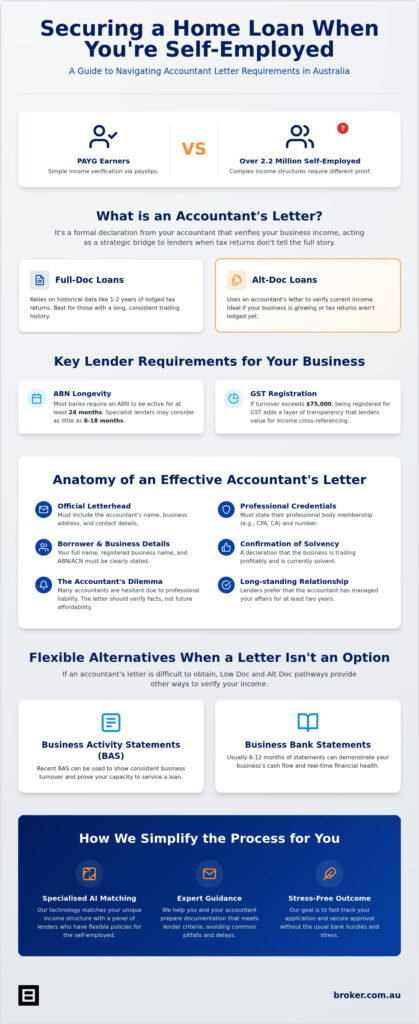
An accountant’s letter is a formal declaration where your qualified financial advisor verifies your income or business profitability to a prospective lender. Essentially, the document serves as a professional verification of a borrower’s ability to service a debt. While traditional “Full Doc” loans require years of historical tax returns, an accountant letter for home loan self-employed purposes is the primary tool for “Alt-Doc” (Alternative Documentation) applications. This is especially useful when your tax returns don’t reflect your business’s current performance or are yet to be finalised.
For many of the 2.2 million self-employed Australians, this letter acts as a strategic bridge. It allows lenders to look beyond the static figures of a previous financial year and consider the real-time health of your business. This process is a critical part of the broader Verification of Employment and income assessment, ensuring the lender has a factual basis for the credit contract without waiting for the next tax season.
When do you actually need one?
You might find this document essential if you haven’t lodged your most recent tax return with the ATO. For many business owners, the financial year ends but the paperwork takes months to process. If your business has seen significant growth since your last tax return, older figures might not justify the loan amount you need. SME owners often carry mortgage debt that is 50% higher than PAYG earners, making accurate income verification vital. Specialist self-employed loan products from non-major lenders often utilise these letters to get a clearer picture of your “real-time” earnings.
Lender requirements for your ABN and GST
The longevity of your business is a major factor in how lenders view an accountant’s letter. Most mainstream banks require an active ABN for at least 24 months, though some specialist lenders we work with can consider applications with as little as 6 to 18 months of registration. Your GST status also plays a role in the assessment. If your turnover exceeds the $75,000 threshold, being registered for GST adds a layer of transparency that lenders appreciate when cross-referencing your declared income.
The “start date” on your ABN is often just as important as the letter itself. It proves you aren’t running a “new” business, which reduces the perceived risk for the lender. Even if you’ve recently changed your business structure from a sole trader to a company, having a continuous ABN history can make the process much more seamless. We focus on matching you with lenders whose ABN requirements align with your specific business history, helping you avoid unnecessary rejections.
What Must an Accountant’s Letter Include?
An effective accountant letter for home loan self-employed applications isn’t just a simple note; it’s a technical declaration that needs to meet rigorous lender standards. To be accepted, the document must be presented on your accountant’s official letterhead, clearly displaying their professional credentials, membership details, and contact information. Lenders usually look for confirmation that your accountant has managed your financial affairs for at least two years. This longevity provides the bank with confidence that the income figures provided aren’t just a one-off peak but represent a sustainable business trajectory.
The letter serves as a bridge between your complex business structures and the bank’s simplified assessment criteria. It needs to provide a transparent view of your earnings, often including specific figures for gross income and net profit. Crucially, your accountant can highlight add-backs, such as depreciation or one-off capital expenses, which can significantly improve your borrowing capacity by showing cash that is actually available for loan repayments.
Essential details for the declaration
Precision is vital for a seamless approval. The declaration must state your full name, your registered business name, and your ABN or ACN. It should clearly define its purpose, specifically noting that it’s intended to support a home loan application. Most importantly, it needs to confirm that your business is trading profitably and is currently solvent. Because this involves professional liability, it’s helpful to understand CPA Australia’s position on accountant’s letters, which explains why your advisor might be meticulous about the exact wording used to describe your financial position.
The ‘Income Figure’ debate
Lenders and accountants often view income through different lenses. While your tax return might show a lower taxable income due to legitimate deductions, the accountant’s letter can focus on your net profit before tax. Lenders use this figure to calculate your serviceability, often applying the current 3% APRA buffer to ensure you can manage repayments if interest rates fluctuate. It’s essential that the figures in the letter align closely with your recent Business Activity Statements (BAS) or business bank statements. Any major discrepancies can lead to delays or requests for further documentation. If you’re unsure how to present your business’s financial strength to a lender, you can speak with our team to explore the best way to package your application.
Why Accountants Are Often Hesitant to Sign
Securing an accountant letter for home loan self-employed applications can sometimes feel like a tug-of-war between your broker’s needs and your accountant’s caution. This hesitation isn’t just bureaucracy; it’s a calculated move to manage professional indemnity risk. Under the 2025 Banking Code of Practice, banks are actually discouraged from asking third parties to certify that a client can repay a loan. Despite this, many lenders still push for these declarations, using templates that essentially ask the accountant to shoulder the bank’s credit risk. If the business fails or income drops, the accountant’s insurance could be on the line if they’ve signed an absolute guarantee.
There is also the natural conflict between tax-minimisation and borrowing power. Your accountant’s primary job is often to reduce your taxable income through legal deductions and structures. However, when it’s time to buy a home, you need that income to look as high as possible to meet the 3% serviceability buffer. We find the best results come from a three-way conversation between you, your broker, and your accountant. This helps find a middle ground that satisfies the lender’s assessment criteria without creating a legal nightmare for your advisor.
Managing the liability hurdle
Overcoming this hurdle often requires shifting the language from absolute guarantees to professional opinions. Accountants are far more comfortable stating that, based on management accounts and current trading data, the business appears solvent and profitable. Providing your accountant with up-to-date figures from your accounting software can boost their confidence in signing off. In some cases, your accountant might suggest an ‘Alt-Doc’ declaration that verifies factual past data rather than predicting future performance, which still meets the requirements of many specialist lenders.
Professional qualifications required
Lenders have strict rules about who can sign these documents. Generally, the signatory must be a member of a recognised professional body such as CPA Australia, Chartered Accountants Australia and New Zealand (CA ANZ), or the Institute of Public Accountants (IPA). A letter from a bookkeeper or an unregistered tax agent will almost certainly be rejected by a credit department. Before you begin the process, it’s wise to check your accountant’s professional standing to ensure their verification carries the weight required by the bank’s assessment team. This proactive check saves time and prevents the frustration of a rejected application late in the process.
Alternatives to Accountant Letters: Low Doc and Alt-Doc Loans
While an accountant letter for home loan self-employed purposes is a powerful tool, it’s not the only path to securing your dream home. If your advisor is hesitant to sign a specific declaration or your business structure is particularly complex, Low Doc and Alt-Doc loans offer a streamlined alternative. These products are designed for the 2.2 million self-employed Australians who have the cash flow to service a loan but lack the traditional paperwork required by major banks. While Alt-Doc loans often carry slightly higher interest rates, typically starting around 6.69% p.a. compared to standard variable rates of 5.69% p.a., the convenience of skipping the accountant’s signature is often worth the extra cost for busy business owners.
Some lenders also accept a ‘Self-Declaration’ form as part of the application. This is a document where you personally state your income and certify that your business can meet its financial obligations. It’s a low-pressure way to declare your earnings, though lenders will almost always cross-reference this with other data points like your bank statements to ensure the figures are realistic. If you’re ready to see which documentation path fits your business best, you can get started with our expert team for a tailored assessment.
BAS vs. Accountant Letter
In many cases, providing 6 to 12 months of Business Activity Statements (BAS) is more powerful than a single letter. Lenders will ‘annualise’ your BAS figures to determine a consistent income level. For example, if your last two quarters show steady growth, the bank can project that forward to assess your borrowing power. While bank statements offer real-time proof of cash flow, they can be more invasive as lenders scrutinise every transaction. BAS remains the gold standard for Alt-Doc verification because it’s a lodged government document that provides a high-level view of your turnover and expenses without the granular detail of daily bank records.
The ‘Clean Credit’ requirement
Because Alt-Doc loans involve less traditional verification, lenders offset their risk by requiring a higher level of credit health. You’ll also find that the Loan-to-Value Ratio (LVR) is typically capped at 85% for these products. This means you might need a larger deposit, often 20% or more, to avoid Lenders Mortgage Insurance or to meet the stricter criteria of non-bank lenders. Even with alternative documentation, lenders still apply the 3% serviceability buffer required by APRA. This ensures you can manage repayments even if interest rates rise, providing peace of mind for both you and the lender. If your credit history is pristine, these products offer a seamless path to approval without the need for complex historical tax returns.
How Broker.com.au Supports Self-Employed Borrowers
Broker.com.au acts as your dedicated advocate in a lending market that often feels rigged against business owners. We don’t just submit applications; we engineer them for success. By using proprietary AI-driven technology, we match your specific financial profile with lenders who maintain flexible policies regarding an accountant letter for home loan self-employed. This means you aren’t wasting time with major banks that often have rigid, “computer says no” criteria. We understand that your business is more than just a set of numbers on a tax return; it’s a living, breathing entity with unique cash flow cycles.
Our role is to bridge the gap between your accountant’s professional caution and the lender’s strict documentation requirements. We speak both “bank” and “accountant,” allowing us to negotiate the specific wording of declarations so that your advisor feels protected while the credit assessor gets the clarity they need. This award-winning approach transforms a high-stakes financial hurdle into a streamlined, stress-free process. We organise the complex paperwork and handle the back-and-forth negotiations, leaving you free to focus on what you do best: running your business and growing your enterprise.
Expert guidance for complex structures
Whether you operate as a sole trader, a company director, or through a complex family trust, we provide tailored solutions that reflect your actual borrowing power. We have inside access to a wide panel of non-conforming and specialist lenders who “get” business owners and are willing to look at the bigger picture. Our team helps you present your business in the best possible light, highlighting add-backs and one-off expenses that traditional banks often overlook. This expert positioning is often the difference between a flat rejection and a formal approval that secures your future home.
Get started with your self-employed home loan
Taking the first step toward your new home shouldn’t be a source of anxiety. We offer a simple, low-pressure initial consultation where we listen to your goals and assess your current situation. Using current 2026 data, including the latest APRA serviceability buffers and lender-specific DTI caps, we provide a no-obligation assessment of your borrowing capacity. This gives you a clear roadmap of what’s possible before you even approach your accountant. If you’re ready to experience a more efficient, professional way to borrow, we’re here to guide you through every step of the journey.
I’m interested in a self-employed home loan
Secure Your Property Goals with Confidence
Building a successful business is a significant achievement. Your personal property goals should reflect that success. While an accountant letter for home loan self-employed purposes is a powerful way to verify your income, it’s just one of several pathways available in the current 2026 lending market. By understanding the balance between tax-minimisation and borrowing power, you can position your application for a seamless approval. Whether you utilise a formal letter, Business Activity Statements, or a self-declaration, the right documentation strategy will bridge the gap between your business profits and your new home.
As an award-winning Australian brokerage, we specialise in business owner home loans and use proprietary AI matching technology to connect you with lenders who truly understand your cash flow. We’re here to manage the complex details. We provide the expert guidance you need to move forward without the usual bank-related stress. You’ve done the hard work of growing your enterprise; now it’s time to let us secure the finance that honours your ambition.
I’m interested in exploring self-employed home loan options
Frequently Asked Questions
Can I write my own accountant’s letter if I do my own taxes?
No, you cannot write your own letter even if you manage your own bookkeeping and tax lodgements. Lenders require an independent, qualified professional such as a CPA or CA to verify your financial standing to ensure the data is objective. If you handle your own taxes, you’ll likely need to provide alternative documentation like BAS or bank statements, or engage a qualified accountant to review your records and provide the necessary verification.
Do all Australian banks accept an accountant’s letter for a home loan?
Not all Australian banks accept an accountant’s letter as a standalone proof of income. While many specialist and non-bank lenders specialise in these “Alt-Doc” products, major traditional banks often insist on two years of finalised tax returns. It’s essential to match your application with a lender whose credit policy specifically allows for an accountant letter for home loan self-employed purposes to avoid an automatic rejection.
How much does an accountant usually charge to provide this letter?
Fees for these letters vary significantly depending on the complexity of your business structure and the depth of the review required. Most accountants charge a professional fee based on the time taken to verify your current management accounts and ensure the declaration meets their professional indemnity requirements. It’s best to ask for a quote upfront; this is a specialised professional service that involves significant legal responsibility for the advisor.
What happens if my accountant refuses to sign the lender’s template?
This is a common situation due to the professional indemnity risks that accountants face when certifying income. If your accountant is uncomfortable with a lender’s specific wording, we can often facilitate a conversation to find a mutually acceptable template. Alternatively, we can pivot your application toward a different Alt-Doc pathway, such as using your Business Activity Statements or business bank statements, which removes the need for an accountant’s signature entirely.
How old can the accountant’s letter be when I submit my application?
Most lenders require the letter to be dated within 30 to 90 days of your application submission. Because these documents are used to verify your “real-time” earnings rather than historical data, credit assessors want to see the most current view of your business’s performance. If your property search takes longer than expected, you may need to ask your accountant for an updated version before you reach the formal approval stage.
Is an accountant’s letter enough to get a 95% LVR home loan?
It’s very rare to secure a 95% LVR loan using only an accountant’s letter. Most Alt-Doc and Low Doc products are capped at an 80% or 85% LVR because the lender is taking on higher perceived risk by not viewing finalised tax returns. If you have a smaller deposit, you’ll generally need to provide full documentation, including two years of personal and business tax returns, to satisfy the stricter criteria.
Does the letter need to mention my business expenses or just income?
The letter typically focuses on your net profit after business expenses have been deducted. However, a well-crafted accountant letter for home loan self-employed applications will also highlight “add-backs” like depreciation, interest, or one-off capital purchases. These figures are added back to your profit to give the lender a more accurate picture of the actual cash flow you have available to service a mortgage comfortably.
What is the difference between a ‘declaration’ and a ‘certificate’ in lending?
In the lending world, a declaration is a statement of your current financial position based on available data, whereas a certificate can imply a more rigid guarantee of future performance. Accountants are almost always willing to sign a declaration but will strictly avoid anything labelled as a “certificate” of ability to repay. Understanding this distinction helps in choosing the right lender whose paperwork aligns with professional accounting standards in Australia.