
Cash flow isn’t the only factor in a business finance decision. If your business has valuable assets but uneven earnings, asset-based lending may be worth comparing with finance assessed mainly on cash flow. To understand the pros and cons of asset-based lending, start by checking which assets a lender may accept as security and how that affects the funds available.
Look beyond potential borrowing capacity. Pledging assets puts them at risk if repayments aren’t met, and the facility’s costs, reporting requirements and repayment terms matter too. When buying a business, these factors can help determine whether asset-backed acquisition finance suits the purchase and the business’s ongoing cash needs.
This guide explains how asset-based lending works, how it differs from cash flow finance, and which businesses it may suit. You’ll also learn what lenders consider when assessing collateral, how repayment arrangements can work, and what to weigh before using business assets to fund growth or an acquisition.
Key Takeaways
- Asset-based lending focuses on eligible business assets as security, while cash flow finance centres on the business’s ability to generate income to meet repayments.
- Eligible collateral and its liquidity affect how much a lender may advance; specialised or less marketable assets may offer limited borrowing support.
- Compare the facility’s costs, reporting obligations and repayment structure with the cash flow it will need to support.
- Using assets as security carries a real risk: if the business can’t meet its repayments, the lender may seize and sell pledged assets.
- For a business buyer, weigh acquisition finance against the assets available, the purchase’s impact on cash flow and the business’s ability to service the debt.
Table of Contents
- How does asset-based lending work?
- Asset-based or cash flow?
- Risk of losing pledged assets
- Repayment and what happens if the borrower cannot repay
- Businesses suited to asset-based lending
- Broker.com.au: Asset Finance
How does asset based lending work?
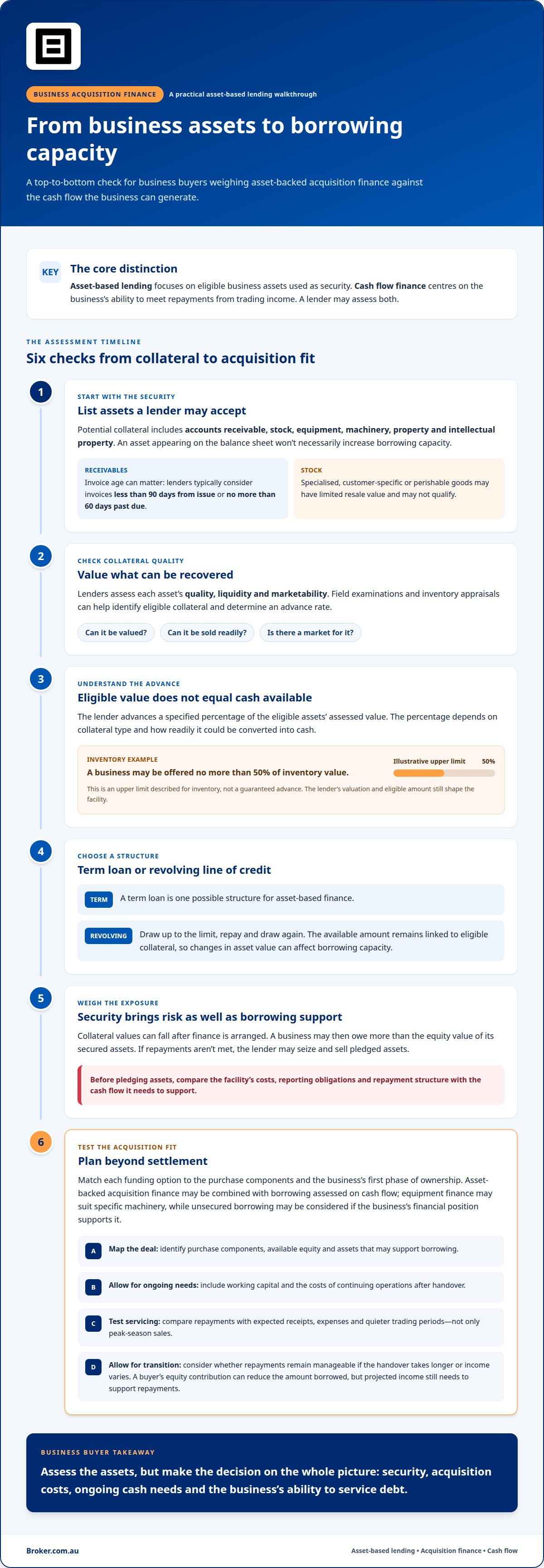
Asset-based lending uses eligible business assets as collateral for finance. The lender assesses their value and liquidity to set the borrowing limit, as not every asset is equally useful as security.
Eligible assets for collateral
Eligible collateral may include accounts receivable, stock, equipment, machinery, property and intellectual property. The lender’s advance is tied to what it can value and potentially recover.
Accounts receivable are generally assessed by invoice age: lenders typically consider invoices less than 90 days from issue or no more than 60 days past due. Stock can also support borrowing, but specialised goods made to a customer’s specifications or perishable products may have little resale value and may not qualify. A business should distinguish its broadly saleable inventory from items with a narrow market.
How lenders assess collateral
Lenders assess each asset’s quality, liquidity and marketability before deciding whether it can support finance. Field examinations and inventory appraisals can help identify eligible collateral and determine the advance rate.
The lender advances a specified percentage of the eligible assets’ assessed value. The percentage depends on the type of collateral and how readily it could be converted into cash. For example, reliable invoices and readily saleable stock are assessed differently from goods with limited resale options. An asset appearing on the balance sheet won’t necessarily increase borrowing capacity.
Collateral value and over-mortgaging
A fall in collateral value can leave a business owing more than the equity value of its assets. This matters because collateral values can fall after finance is arranged, leaving the business owing more than its security is worth.
A lender calculates loan-to-value by dividing the loan amount by the value of the secured asset. For inventory, a business may be offered no more than 50% of its value. This is an upper limit described for inventory, not a guaranteed advance; the lender’s valuation and eligible amount still shape the facility.
Consider a manufacturer offering machinery, stock and unpaid customer invoices as security. The lender assesses each category separately, then applies its valuation and advance rates to eligible collateral. Specialised stock with little resale value to another buyer may contribute little or nothing to the borrowing base, even if it is valuable to the manufacturer.
Asset-based finance may be structured as a term loan or a revolving line of credit. With a revolving line, the business can draw up to its limit, repay and draw again. The available amount remains linked to eligible collateral, so changes in asset value can affect borrowing capacity. Understanding these mechanics helps a business weigh the pros and cons before pledging assets.
Asset-based or cash flow?
For a business buyer, the key question is how the purchase debt will be supported after settlement. Asset-based lending focuses on eligible assets, while cash flow finance centres on the business’s capacity to meet repayments from trading income. A lender may assess both, alongside the purchase structure and buyer’s financial position. Compare the assessment basis with the business being acquired, rather than assuming its assets alone will fund the deal.
Acquisition finance may combine funding secured against business or property assets with borrowing assessed on cash flow. A buyer might also consider asset finance for specific equipment, or unsecured borrowing if the business’s financial position supports it. Each structure affects the equity contribution, security and ongoing repayment burden differently. The purchase price is only one part of the funding plan: allow for working capital and the costs of continuing operations after handover.
Trading patterns matter. A seasonal business may earn much of its income during particular periods, while wages, rent and supplier payments continue throughout the year. Test whether the proposed repayment schedule fits quieter months, not just peak-season sales forecasts. Asset-backed finance may help address timing gaps, but the business still needs sufficient cash flow to service debt.
Consider purchasing a manufacturer whose sale includes production equipment, stock and customer relationships. Equipment finance may suit a specific machinery purchase, while broader acquisition finance may need to cover goodwill, other assets and working capital. Cash flow projections should account for customer retention and the transition period. The buyer’s equity contribution can reduce the amount borrowed, but the lender also assesses whether projected income can support repayments.
Lenders may assess asset strength differently from those relying mainly on established earnings. This can matter when acquiring a business with valuable assets but uneven or difficult-to-forecast income. It doesn’t remove the need to show how debt will be serviced. Compare the facility’s repayment structure, security and reporting obligations with the business’s trading cycle and planned investment.
Before choosing a facility, map the acquisition funding to the deal and the first phase of ownership. Identify the purchase components, available equity, assets that may support borrowing, expected receipts and ongoing expenses. Then test whether repayments remain manageable if the transition takes longer or trading income varies. This links the finance decision to the buyer’s ability to operate the business, not just complete settlement.
A practical comparison for a business buyer involves these checks:
- Match each funding option to the purchase component it is intended to fund.
- Assess how the equity contribution affects borrowing needs and cash reserves.
- Compare repayment commitments with projected post-purchase income and expenses.
- Consider how security or facility conditions may affect future business decisions.
Risk of losing pledged assets
Pledging business assets means a missed repayment can become more than a cash flow problem. If the business fails to make payments, the lender may seize and sell assets pledged as security. This could affect equipment needed to fulfil orders, stock required for trading, or receivables expected to fund operating costs. The same risk applies to a business buyer if acquisition finance relies on assets needed to run the business.
The amount borrowed can also become out of step with the security. If collateral loses value, the business may owe more than the equity in its assets. For example, falling demand could reduce the resale value of machinery while the outstanding loan remains high. A business using inventory faces similar exposure if stock becomes harder to sell or less valuable.
Interest rates and fees affect the cash left for operations. Asset-based lending may cost more than traditional loans, so account for financing costs alongside supplier payments, wages and other commitments. A seasonal business might have strong receivables during its busy period but limited liquidity during a quieter stretch. Repayment pressure can increase if customers pay late.
Due diligence means assessing risks related to both the borrower and the collateral before relying on a facility. Review receivable quality, customer concentration, inventory marketability and equipment condition. These factors affect how dependable the borrowing base is. A large receivable from one customer may create concentration risk, while specialised stock may have limited value beyond its intended buyer.
Legal and regulatory matters also form part of asset-based finance risk assessment. Security documents, asset ownership and enforcement terms can affect what happens if payments stop. Applicable requirements depend on the transaction and its documents, so understanding those terms is important to assessing exposure. Clear records of which assets support the facility help the business track what is at risk.
Before committing, map each pledged asset to its business role and likely resale market. A manufacturer might rely on a particular machine to keep production running; losing it could reduce revenue and make other repayments harder. A retailer might pledge stock, but a change in demand could weaken its sale value. Assessing these scenarios helps show whether the collateral is essential to ongoing operations.
If a borrower cannot repay, the lender may sell the secured asset to clear the loan. Any surplus after the debt is cleared may be returned to the borrower. This does not remove the disruption of losing productive assets or the possibility that a sale won’t cover the outstanding balance. The central risk is twofold: reduced asset equity and reduced ability to keep trading.
Repayment and what happens if the borrower cannot repay
There is no single typical interest rate, fee or loan-to-value ratio for asset-based lending in Australia. These depend on the facility, eligible collateral, its assessed value and liquidity, and the lender’s terms. Asset-based lending may carry higher rates and fees than traditional loans, so compare the total repayment commitment with the cash flow available to meet it.
Eligibility and lending limits depend on which assets the lender accepts and the value it assigns them. Lenders assess collateral quality, liquidity and marketability, then apply an advance percentage. The resulting borrowing limit is tied to eligible assets, not simply the total assets recorded by the business. As the earlier inventory example showed, assessed value and the advance basis both matter.
Repayment arrangements vary by facility. A term loan may have fixed repayment terms, helping a business plan payments against expected income. A revolving line lets the borrower draw, repay and draw again within the limit. This flexibility can support working capital, but the business still needs enough cash to cover interest and scheduled repayments through seasonal fluctuations.
Borrowing-base reporting keeps the lender informed about the assets supporting the facility. Businesses may need to provide monthly or weekly reports detailing those assets, including changes in receivables or stock. If an invoice is paid, inventory is sold or collateral loses value, updated figures can affect the borrowing base and available capacity.
Assess the business’s ability to repay using realistic trading assumptions, not just its current collateral value. For example, a manufacturer might forecast customer receipts arriving later than expected while wages and supplier payments remain due. Mapping those dates against loan repayments can reveal a working-capital squeeze before it leads to a missed payment.
If a borrower cannot repay, the lender may seize and sell the asset pledged as security. Sale proceeds can be applied to the loan, and any surplus may be returned to the borrower. If the proceeds don’t cover the debt, the business may still owe the outstanding balance. Losing a productive asset can also weaken the business’s ability to earn income and meet other obligations.
Before accepting this type of finance, connect the security, reporting obligations and repayment schedule to the business’s cash flow. A business relying on equipment for production should consider how losing it could affect sales. A business with fluctuating receivables should assess how late customer payments affect its borrowing base and repayment capacity. These factors help show whether the facility remains workable as trading conditions change.
There is no single typical rate, fee or loan-to-value ratio. Terms depend on the facility, eligible collateral, and its assessed value and liquidity. Rates and fees may be higher than for traditional loans, while the borrowing limit depends on the lender’s advance percentage for eligible assets.
Businesses suited to asset-based lending
For a business buyer, suitability depends on whether the assets included in the acquisition can support borrowing and whether the business can service repayments after settlement. Asset-based lending may be relevant when the business has measurable assets, such as equipment, property, inventory or accounts receivable. Lenders will typically assess the assets’ value, ownership and condition, as well as the buyer’s experience and the business’s financial records. The pros and cons of asset based lending are especially important to assess before treating those assets as a substitute for equity or reliable post-settlement income.
Start with the purchase structure. Identify which assets are part of the sale and which are central to ongoing operations. A buyer acquiring a manufacturing business, for example, might assess production machinery, saleable inventory and customer invoices as separate parts of the funding picture. Their values and usefulness as collateral can differ, so the purchase price alone won’t show how much borrowing they may support.
Equity also shapes the acquisition finance plan. Lenders may require a deposit or equity contribution, with the amount depending on the assets available as security, the business’s financial performance and the buyer’s ability to service the loan. The buyer’s contribution affects how much funding is needed and how much cash remains for working capital after settlement. Using most available cash for the purchase can leave little for operating expenses or transition costs. Weighing the pros and cons of asset based lending means considering the full funding structure, not just the amount secured against business assets.
Repayment capacity after settlement is central. Lenders may review financial statements, tax returns and cash flow forecasts to assess whether projected trading income can support repayments while covering wages, suppliers and other ongoing expenses. If the acquired business relies on a few major customers, consider how changes in their payment timing could affect available cash. Assets may support borrowing, but they don’t replace a workable cash flow plan.
Asset-based lending may suit an acquisition when eligible assets provide a meaningful part of the funding basis and the business has a documented trading history. It may be less suitable when the sale mainly reflects goodwill, assets are difficult to value or resell, or the buyer needs to preserve security for another purpose. In those cases, combining different finance options may better reflect the purchase components and repayment capacity.
Before proceeding, bring the acquisition price, proposed equity contribution, asset details and post-sale cash flow forecast into one plan. This helps assess whether borrowing fits the transaction and the business’s ability to operate after ownership changes. The pros and cons of asset based lending depend on that fit: collateral can support funding, but repayment capacity and asset value remain central to the decision.
If you’re purchasing a business, explore acquisition funding options that reflect the assets included in the deal and the business’s post-settlement needs.
Broker.com.au: Asset Finance
Broker.com.au helps business owners explore financing options when asset value, cash flow and repayment capacity all matter. If you’re weighing asset-based lending against finance for a specific purchase, Asset Finance may be relevant for equipment or vehicles, while Secured Business Loans can support other business funding needs.
For a business buyer, the decision may involve more than the assets being acquired. Business Acquisition Funding can be considered alongside available equity, expected cash flow and the business’s ability to service repayments. Where a secured structure doesn’t suit the circumstances, Unsecured Business Loans may also be relevant.
Bring the funding purpose, asset details and cash flow outlook into the discussion to help assess which option aligns with the business’s needs. To explore your options, contact Broker.com.au.
Make your next funding decision with clarity
The next step is to match the finance structure to what the business needs to achieve. For an acquisition, consider how much capital should go towards the purchase, what cash needs to remain available for trading, and how repayments fit expected income. This gives you a clearer basis for weighing the pros and cons of asset-based lending against other finance options.
Broker.com.au offers Business Acquisition Funding, Secured Business Loans and Unsecured Business Loans. These options can help frame a discussion around the purchase, available security and funding needs. The right approach depends on the transaction and the business’s capacity to service borrowing, so focus on the full funding plan rather than the loan amount alone.
Take the next step at your own pace. Discuss your business finance needs with Broker.com.au and explore a funding approach that supports your plans.
Frequently Asked Questions
How do I choose an asset-based lender?
Choose a facility whose collateral rules and repayments fit your business, rather than focusing only on the headline borrowing limit. Compare how receivables, stock, equipment and property are valued, what reporting is required, and how changes in asset values affect available funds. Consider the repayment structure, fees, interest rates and what the security terms allow if payments are missed. For a business buyer, include the purchase and post-settlement cash flow in that assessment.
What are the potential benefits of asset-based finance?
Asset-based finance can provide working capital when a business has eligible assets but uneven or hard-to-predict earnings. A revolving facility may let the business draw funds, repay and draw again within its limit, supporting changing operational needs. For example, a wholesaler might use available funds to buy stock ahead of a busy period. The benefit depends on the borrowing base and facility costs, so assess whether the flexibility fits the business’s actual cash cycle.
What are the risks?
The main risk is putting business assets at stake: missed payments can lead to pledged collateral being seized and sold. A fall in collateral value can also leave the business owing more than the remaining equity in those assets. Other risks include higher interest rates or fees than traditional loans, borrowing capacity that changes as assets fluctuate, and ongoing reporting requirements. Consider how losing essential equipment or stock could affect the business’s ability to keep trading.
What if I can’t repay?
If repayments aren’t made, the lender may seize and sell the asset pledged as security, then apply the proceeds to the debt. Any surplus after the loan is cleared may be returned to the borrower. Losing the asset can disrupt operations, particularly if it is machinery needed for production or stock required to fulfil orders. Review the security and default terms before borrowing, and consider how the business would operate if the pledged asset were no longer available.
Why consider Asset Based Funding?
Consider asset-based finance when a business needs capital and has eligible assets that can support borrowing. It may help manage seasonal fluctuations or fund expansion, particularly when earnings alone don’t reflect the business’s capacity. Some facilities may allow funds to support acquisitions, subject to their terms. For a business acquisition, weigh this potential use against purchase funding needs, repayment capacity and the assets the business relies on to operate.
What is asset-based lending in Australia and how does it work?
Asset-based lending is business finance secured against eligible assets, with borrowing capacity linked to their assessed value. The lender evaluates the collateral and determines what portion can support the facility. It may be structured as a term loan or revolving line of credit. For example, a business with valuable equipment and customer invoices might use those assets to support working capital, while the lender’s assessment determines the eligible borrowing base.
What types of assets can secure asset-based loans in Australia?
Potential collateral includes accounts receivable, inventory, equipment, machinery, property and intellectual property. A manufacturer could offer machinery and saleable stock, while a service business may have suitable receivables. Asset type and marketability matter: specialised goods made for one customer or perishable stock may have little resale value and may not qualify. The lender assesses each asset, so a business’s total asset value doesn’t necessarily equal the amount it can borrow against.
What are the main benefits of asset-based lending for Australian businesses?
For Australian businesses, potential benefits include access to working capital based on eligible assets and a way to support growth or manage seasonal funding needs. A revolving facility can provide repeat access to funds as the business repays and redraws within its limit. Some facilities may support a business acquisition when their conditions are met. Compare this potential flexibility with the costs, reporting duties and risks of pledging assets.