A bank loan isn’t the only way to fund a business. Alternatives to traditional business loans include non-bank finance, invoice or asset-backed funding, and crowdfunding, with the structure shaping how you receive and repay funds. For a business buyer, the right option may also support purchasing an existing business, depending on the deal and the business’s ability to service the debt.
When funding is time-sensitive, access speed and eligibility are understandably top of mind. Alternative lenders may provide funds faster than traditional lenders, but rates and fees can be higher. Compare repayment terms and cash flow as carefully as approval prospects.
This guide explains how alternative business lending works, how banks and non-bank lenders differ, and what can affect eligibility and access speed. It also covers invoice finance, secured and unsecured borrowing, acquisition finance and crowdfunding, so you can weigh the trade-offs before choosing a funding path.
Key Takeaways
- Match the funding structure to your business’s income: repayments linked to card sales may suit a different cash-flow pattern than invoice funding.
- Understand how invoice factoring can turn unpaid invoices into earlier access to cash, and what that means for your receivables.
- Approval speed and eligibility depend on factors such as cash flow, available assets and the finance structure, not just the lender type.
- For buying a business, consider how acquisition finance repayments fit with the business’s ongoing cash flow and your equity contribution.
- Crowdfunding can help launch an innovative product, but its campaign model differs from borrowing and brings its own considerations.
Table of Contents
- What are traditional and alternative lenders?
- What is Alternative Business Lending?
- Alternative lending eligibility and speed of access
- Crowdfunding
- Differences between traditional, non-bank and alternative lenders
- Broker.com.au
What are traditional and alternative lenders?
Traditional lenders include Australia’s major banks, while alternative lenders offer non-bank funding structures. For a business buyer, the choice affects how the purchase is funded and how repayments fit the business’s post-purchase cash flow.
Traditional and alternative finance
Traditional and alternative lenders assess applications differently, including their appetite for risk and the evidence they prefer. Traditional lenders generally offer lower interest rates, while alternative lenders may charge more. For acquisition finance, weigh these differences against the buyer’s available equity and the acquired business’s ability to service repayments.
Separate the purchase funding from the cash needed to operate afterwards. A buyer may need to account for the acquisition price, their contribution and working capital for ongoing expenses. For example, forecast cash flow may need to cover loan repayments as well as supplier invoices after settlement.
Alternatives to traditional business loans include non-bank business lending, invoice finance, merchant cash advances and crowdfunding. Match each structure to its purpose: invoice-backed funds may help manage receivables, while purchase finance needs to cover the transaction and have a clear repayment source.
Government grants can support Australian small businesses undertaking research and development, expansion, innovation or exporting goods and services. They may be relevant when a proposed activity fits those purposes, but should not be treated as general funding for a business purchase or ongoing acquisition repayments.
Merchant cash advances
A merchant cash advance provides a lump sum in exchange for deductions from future sales. The lender takes an agreed percentage of daily credit card sales until the advance and premium are repaid.
This structure may suit an acquired business with frequent card transactions and predictable sales. It may be less suitable if the business mainly takes cash or invoices customers. Consider how deductions could affect the funds available for wages, suppliers and other operating costs after taking ownership.
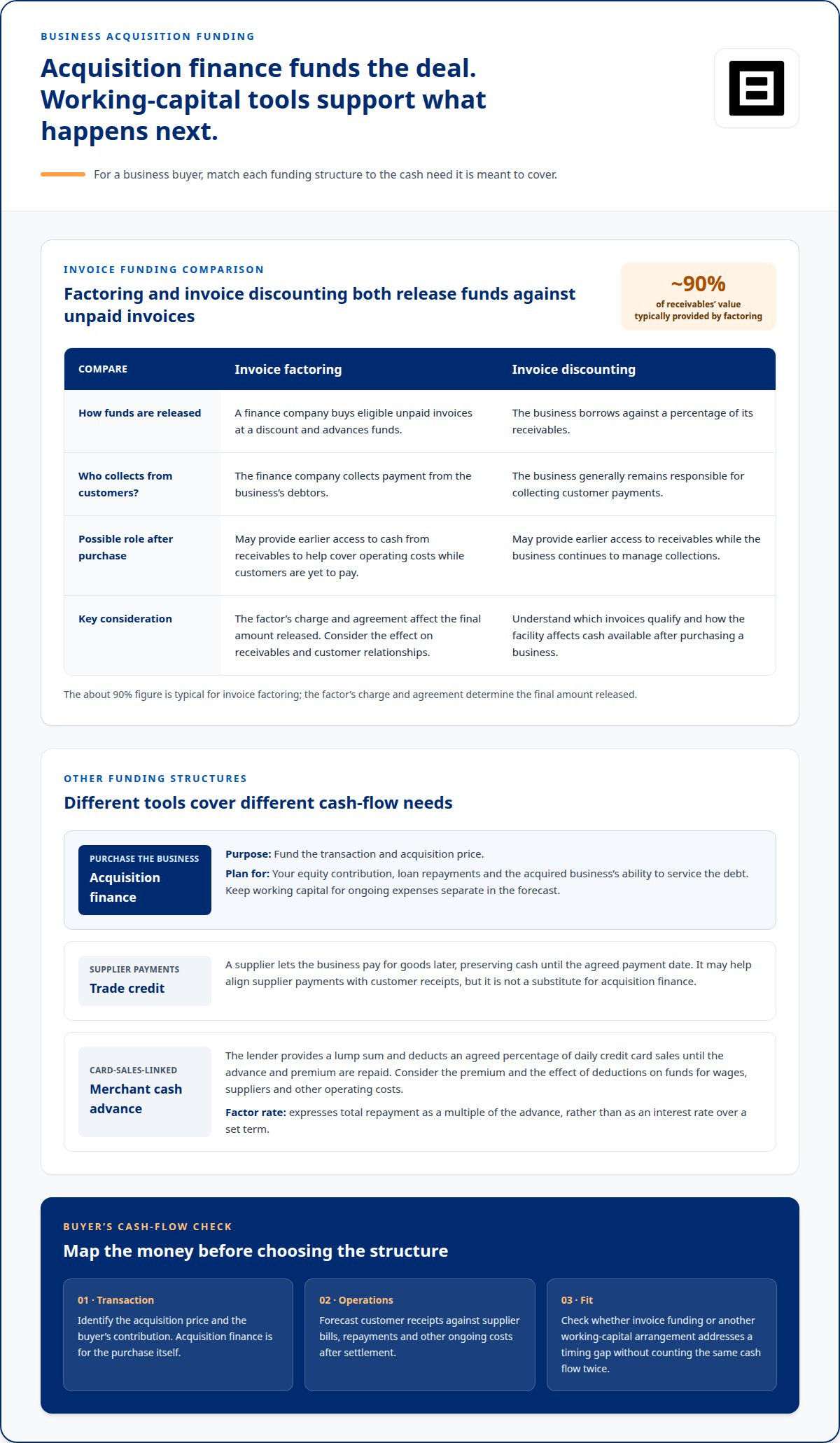
A factor rate expresses the total repayment as a multiple of the advance, rather than as an interest rate over a set term.
The benefit is a lump sum with repayments linked to card sales; the trade-off is the premium and deductions from revenue. Compare the total repayment, charges and effect on post-purchase cash flow with other funding options. Also consider whether projected sales can support repayments during quieter trading periods.
What is Alternative Business Lending?
Alternative business lending includes funding structures beyond standard bank loans, such as finance based on a business’s receivables. For a buyer, these facilities may support working capital after settlement, while separate acquisition finance funds the purchase itself.
Invoice factoring and upfront funding
Invoice factoring converts eligible unpaid invoices into earlier cash by selling them to a finance company at a discount. The factor advances funds and collects payment from the business’s debtors. This can help an acquired business cover operating costs while waiting for customers to pay, rather than relying on purchase finance for day-to-day expenses.
Invoice factoring typically provides cash valued at about 90% of accounts receivable. The factor’s charge and the agreement determine the final amount released. For a business buyer, the receivables available after settlement may help address a working-capital gap, but they don’t replace funding for the acquisition price.
Invoice finance can also let a business borrow against a percentage of its receivables. The structure matters: a buyer should understand which invoices qualify, how customer payments are handled and how the finance affects cash available after purchasing a business. Invoice finance can therefore relate to post-purchase liquidity rather than the purchase transaction.
Factoring, discounting and trade credit
Factoring and invoice discounting both release funds against unpaid invoices, but their collection arrangements differ. With factoring, the finance company buys invoices and collects from debtors. With invoice discounting, the business generally remains responsible for collecting customer payments. This distinction can affect customer relationships and accounts administration after an acquisition.
Trade credit works differently: a supplier lets the business pay for goods later, preserving cash until the agreed payment date. After a purchase, this may help align supplier payments with customer receipts, while invoice funding can provide earlier access to receivables. Neither is a substitute for acquisition finance.
For example, a buyer taking over a business with unpaid customer invoices and upcoming supplier bills can consider how receivables funding and trade credit fit its cash-flow cycle. Acquisition funding covers the transaction; these working-capital tools address the timing of operational receipts and payments. The forecast should account for both obligations without counting the same cash flow twice.
Before choosing a structure, map expected customer receipts against supplier bills and other operating costs after settlement. This can show whether invoice-based funding addresses a timing gap or whether the business needs a different working-capital arrangement alongside acquisition finance.
A buyer assessing this option can consider how the arrangement fits the business’s expected receipts and payments. Factor companies can provide business finance by buying outstanding invoices at a discount and collecting payment from debtors. This gives the business earlier access to funds, while the factor handles collection of those invoices. Before relying on this cash for operations, the buyer can consider which receivables are available and how the resulting funding fits the post-purchase cash-flow plan.
Alternative lending eligibility and speed of access
Alternative lending provides business funding through non-bank providers and structures outside standard bank loans. Applicants may receive approval and funds in as little as 24 hours. The speed can help address an urgent cash-flow gap, but it doesn’t show whether repayments will suit the business.
Bank lenders often assess documented business performance over a longer period. Traditional bank underwriters usually require two to three years of steady, documented cash flow and positive tax returns. Applications can take several weeks to reach funding, which may not suit a business facing an immediate payment deadline.
Alternative lenders may assess different information depending on the product and business. For example, a retailer seeking working capital may be assessed against sales activity, while a business with outstanding invoices may be assessed against its receivables. The relevant evidence depends on the funding structure.
Eligibility still depends on the lender’s assessment, not speed alone. Cash flow shows whether repayments can be met alongside wages, supplier payments and other commitments. Existing debt and the amount sought also affect affordability. A business seeking a larger commitment needs to show how repayments fit its operating income.
For a business buyer, the intended use of funds shapes the assessment. Acquisition finance must fit the purchase and the acquired business’s ability to service debt. The buyer’s available equity, business records and expected cash flow all inform the funding case. A short-term facility may address a timing gap, but may not suit long-term purchase costs.
Alternative funding can help when a bank’s timing or criteria do not match the business’s needs. A seasonal operator, for instance, may need funds before peak trading begins. A business awaiting payment for completed work may need working capital before customers settle outstanding invoices. In both cases, timing and expected receipts shape the borrowing requirement.
Speed comes with trade-offs. Alternative business loans generally provide funds faster than traditional financing, but often carry higher interest rates and fees. Set-up, administration or early repayment charges can affect profit margins. Compare total repayments and the payment schedule with the business’s cash-flow cycle, not just how soon funds arrive.
For an Australian business purchase, finance decisions should account for both the transaction and ongoing operations. Repayments that appear manageable against forecast revenue may strain cash flow if customer payments arrive later than expected. Mapping expected income against repayments, supplier credit and other commitments helps show whether the structure supports the acquisition.
Crowdfunding
Crowdfunding is usually better suited to raising support for a product or growth initiative than paying for an existing business. Separate the acquisition funding needed at settlement from any later capital raise for expansion, product development or customer engagement.
For example, a buyer purchasing a food manufacturer might need acquisition finance to complete the purchase, then consider a reward-based campaign for a new product line. Backers may contribute in exchange for the product, helping gauge demand. The campaign would support the product launch, not replace funding for the business purchase.
Crowdfunding, venture capital and loans
A loan creates a repayment obligation, while venture capital provides funds in exchange for part ownership. Crowdfunding can involve product rewards or, in an equity campaign, shares. These structures affect ownership and cash flow differently, so they are not interchangeable sources of acquisition funding.
Peer-to-peer lending is another borrowing option for Australian businesses, with investor funding arranged through a lending platform. Interest rates depend on the application and terms. A business buyer considering it should assess repayments against the acquired business’s cash flow and not treat loan proceeds as equity unless the lending structure supports that use.
Equity crowdfunding or angel investment may bring capital and investors into a business, but an adviser can help clarify the amount sought, ownership offered and intended use. For a buyer, that could mean separating funds for an acquisition from capital sought for post-purchase expansion. In Australia, the Australian Securities and Investments Commission has rules for raising money by selling shares, making the proposed structure relevant.
Finance for the acquired business
Equipment finance and leasing provide access to equipment, rather than funding the purchase of an entire business. Equipment finance can fund machinery needed after settlement, while leasing provides use of equipment under a separate arrangement. Distinguish these asset costs from acquisition finance and consider how each commitment affects operating cash flow.
A business credit card can cover eligible short-term purchases, but it doesn’t provide the same structure as acquisition lending. Its usual interest-free period is 55 days, so a buyer should consider whether upcoming receipts can clear the balance without squeezing cash needed for wages or suppliers.
Invoice factoring may help an acquired business access cash against receivables, but it depends on outstanding invoices and does not fund the acquisition itself. These facilities may support operations after settlement. Keep purchase costs, equipment needs and working capital distinct in the funding plan, so each source has a clear purpose and repayment path.
Differences between traditional, non-bank and alternative lenders
Traditional banks, non-bank lenders and alternative lenders differ in ownership, assessment methods and finance structures. The label alone does not show whether a business loan suits a company’s cash flow or a buyer’s acquisition plans.
Traditional banks are deposit-taking institutions, while non-bank lenders provide finance without operating as banks. Australian banks face oversight from the Australian Prudential Regulation Authority and must belong to the Australian Financial Complaints Authority. Traditional banks may decline some business loan applications, so owners may need to consider other funding sources.
Non-bank lenders can offer more flexible criteria than traditional banks, but may charge higher interest rates and fees. Their assessment may focus on a particular asset, invoices or sales, depending on the finance structure. For example, a business with valuable receivables may find invoice-backed funding more relevant than a loan assessed mainly against property security.
“Alternative lender” is a broad description, not a single type of provider. It can include non-bank lenders offering secured or unsecured business loans, as well as providers using sales-based repayments. Some short-term or interest-only facilities can create balloon payments or refinancing risk, so understand the full repayment structure before choosing.
A business loan broker has a different role from a lender: the broker helps assess funding needs and identify structures that may suit the business. For a buyer, this can mean considering acquisition finance alongside working capital. The purchase price, available equity, cash flow and repayment capacity all shape the funding case.
When comparing lenders, look beyond approval speed. Consider total repayments, fees, security, payment frequency and whether the business can still meet supplier invoices and operating costs. For example, a seasonal business may have uneven monthly receipts, making fixed repayments harder during quieter trading periods.
For a business acquisition, lender selection also affects how the transaction is assessed. A lender may consider the buyer’s contribution, the acquired business’s trading performance and the proposed repayment source. A broker can organise these details into a clear funding case, while the lender makes the credit decision.
Compare the structure against the business’s cash flow, not just the advertised rate. Explore business finance options to consider which funding approach fits your needs.
Timing and documentation can also distinguish funding options. Traditional small-business loan applications may take several weeks to reach funding. These loans require solid, comprehensive business plans, so account for the preparation involved when weighing this option. Traditional banks tend to favour tangible assets as collateral, which can disadvantage businesses without physical assets. Security matters alongside repayment capacity: the funding case may depend on available collateral as well as the business plan and cash flow.
Some alternative lenders offer short-term or interest-only loans that can lead to balloon payments or refinancing risks. Consider the later amount due and the ability to refinance, rather than judging a loan only by its early payments. Comparing the full repayment structure with cash flow can show whether the terms fit the business’s needs. Assess the application process, documentation, security and repayment obligations together.
Broker.com.au
Broker.com.au helps business owners assess lending options against their funding purpose, cash flow and repayment capacity. For a business buyer, that may mean considering Business Acquisition Funding alongside the working capital needed to support operations after the purchase. Secured and unsecured business loans can also suit different funding needs and security positions.
Turn to Broker.com.au for help comparing finance structures or preparing a funding case for lenders. The process starts with understanding your situation and identifying options that align with the business’s requirements, rather than assuming one type of finance suits every borrower.
Contact Broker.com.au to discuss your business funding needs.
Choose a funding path that supports your next move
Choosing among alternatives to traditional business loans starts with the outcome you need. If you are buying a business, consider how acquisition finance fits the purchase and the cash flow needed to keep operations running. For other business needs, choose a funding structure that aligns with how the business earns revenue and manages repayments.
Broker.com.au offers Business Acquisition Funding, Secured Business Loans and Unsecured Business Loans. These options address different funding needs and security positions. A clear view of the purpose, available equity and repayment capacity can frame a useful discussion about which direction fits your plans.
You don’t need to settle on a finance structure before seeking guidance. Discuss the business’s requirements and next steps with a specialist who can help you consider suitable lending options. Contact Broker.com.au about business lending and take the next step with confidence.
Frequently Asked Questions
What exactly is an alternative finance company?
An alternative finance company provides or arranges funding outside a traditional bank loan. Some companies lend directly, while brokers facilitate applications between businesses and lenders. The distinction matters when you want to know who assesses the application and provides the funds. Broker.com.au is a business loan broker, facilitating loan applications between clients and lenders rather than lending directly.
How does invoice finance work in Australia, and what are typical fees?
Invoice finance gives a business access to funds tied up in unpaid customer invoices, helping bridge a cash-flow gap while payment is outstanding. Fees vary by arrangement and can be affected by invoice values, how long customers take to pay and how the funding is used. Before accepting an offer, compare the total charges and repayment terms, including how they change if invoices are paid late.
How can Australian businesses raise funds through equity crowdfunding or angel investors?
Equity crowdfunding raises capital by selling shares in a business, giving investors part ownership. In Australia, share-raising is subject to ASIC rules.