
The purchase price is only part of the funding equation. The right mix depends on the target’s earnings, available security and the buyer’s capacity to meet repayments.
It’s understandable to focus first on whether a loan can cover the purchase. But lenders also assess the business’s cash flow, financial history and forecasts. A strong application presents this information clearly. Missing documents can delay assessment and make it harder to show how the acquisition will be funded.
This guide explains how debt, equity and vendor finance can work together, what lenders may assess and which documents can support an application. It also covers practical ways to plan for repayments and working capital after settlement, so you can assess the funding structure as part of the wider acquisition decision.
Key Takeaways
- Compare debt, equity and vendor finance against your funding needs, repayment capacity and ownership preferences.
- Build your finance case around the target business’s sustainable earnings, cash flow, security and your own financial position.
- Consider whether vendor finance can bridge a funding gap, while agreeing clear repayment terms with the seller.
- Plan for repayments and day-to-day operating costs together so the acquisition doesn’t leave the business short of working capital.
- Organise financial statements, forecasts, business plans and buyer information into a complete application package.
Table of Contents
- 1. Advantages and disadvantages of debt and equity
- 2. Lender assessment criteria
- 3. Vendor finance
- 4. Preserving cash flow after an acquisition
- 5. Finance application documents
- Broker.com.au: Business Acquisition Funding
1. Advantages and disadvantages of debt and equity
Australian buyers can fund an acquisition with debt or equity, often combining both. Debt includes term loans and revolving credit facilities; equity may come from the buyer or private investors. Vendor finance can also contribute, with the seller receiving part of the purchase price over time.
Tax and transaction costs also matter. Interest on business loans is generally tax-deductible in Australia, while stamp duty and regulatory considerations depend on the transaction and its location. Include these costs in your funding model before deciding how much capital to borrow or invest.
The Australian Government generally does not provide finance to start or buy a business. Build the purchase plan around available equity, commercial lending or agreed vendor finance rather than assuming a grant or guarantee will fund the acquisition. Treat any tax concession as a separate tax outcome, not purchase capital.
For acquisition due diligence, gather financial information that shows the business’s sustainable earnings. Scrutinise and verify EBITDA adjustments and add-backs, then use the resulting earnings picture to support the valuation and repayment case. Lenders assess whether the proposed debt fits the business’s capacity to repay.
Debt lets a buyer acquire a business without giving private investors an ownership share. It can also preserve more of the buyer’s cash for operating costs. The trade-off is an obligation to make repayments even if revenue falls. Align borrowing with the business’s ability to meet repayments under changing market conditions.
Borrowing can improve returns on invested capital when the acquired business earns more than the cost of borrowing. For example, a buyer contributing A$400,000 towards a A$1 million purchase would need to borrow A$600,000. If earnings cannot support repayments, that leverage can put pressure on cash flow instead.
Equity avoids scheduled loan repayments on the contributed amount, but private investors may expect an ownership share and a portion of future returns. Discuss decision-making rights and profit sharing before accepting investment. Investor capital can reduce the amount borrowed, but it changes the buyer’s control and ownership position.
Australian banks typically require a deposit of 20% to 30% of the purchase price. The buyer may need to disclose available equity and personal assets and liabilities. A self-managed superannuation fund may invest in a business through a limited recourse borrowing arrangement, subject to strict ATO rules and specialist advice.
2. Lender assessment criteria
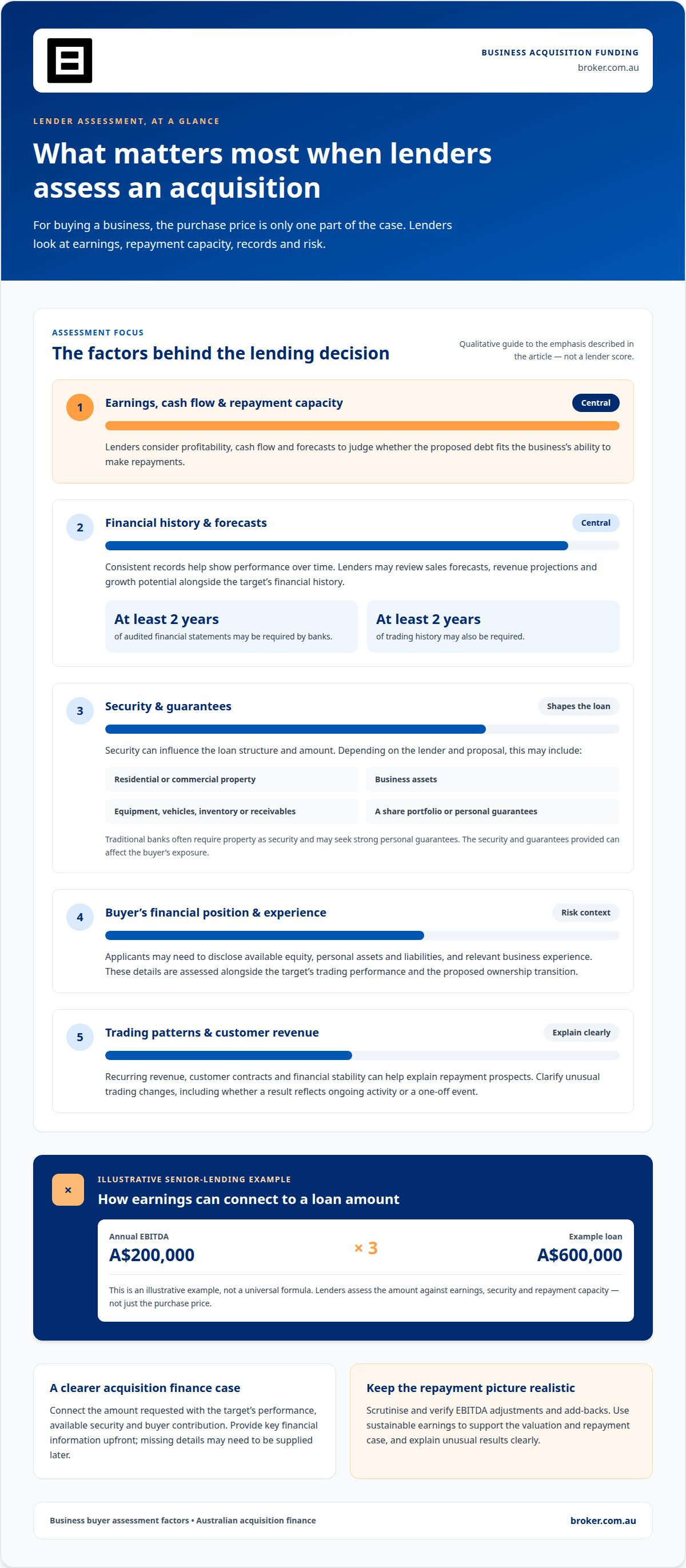
Lenders commonly review profitability, cash flow, sales forecasts and growth potential. A buyer’s personal financial position also matters. Applicants may need to disclose personal assets and liabilities, available equity and relevant business experience. These details help lenders assess risk alongside the target’s trading performance and proposed ownership transition.
Financial history is central to the assessment. Banks typically require at least two years of audited financial statements from the target and at least two years of trading history. Traditional banks often ask for several years of financial statements. According to the Australian Government’s business financing guide, lenders assess financial history, revenue projections and risk when evaluating business finance applications. Consistent records help explain the business’s performance over time.
Cash-flow-focused lenders may examine historical profitability, recurring revenue, customer contracts and financial stability. For example, a business with recurring contracts may present a different repayment profile from one relying on irregular project work. Lenders also need to understand unusual trading changes. Explain whether a result reflects ongoing activity or a one-off event to make the target’s sustainable earning capacity clearer.
Security can influence the loan structure and amount. Lenders may consider residential property, business assets or a share portfolio. Equipment, vehicles, inventory and receivables within the acquired business may also support lending instead of personal property. Traditional banks often require residential or commercial property as security and may seek strong personal guarantees. The security and guarantees provided can affect the buyer’s exposure.
The loan amount is assessed against earnings, security and repayment capacity, not just the purchase price. In one illustrative senior-lending example, a lender offers a loan equal to three times annual EBITDA. A business with annual EBITDA of A$200,000 would qualify for a A$600,000 loan under that example. It is not a universal formula.
A clear application connects the amount requested with the target’s performance, available security and buyer contribution. Provide key financial information upfront, because missing details may need to be supplied later. A broker can help organise the case for business acquisition finance, so lenders can assess consistent information across the purchase proposal and financial records. Business finance is available only to approved business customers and for business purposes, subject to eligibility, suitability and normal credit approval processes.
3. Vendor finance
Vendor finance lets a seller receive part of the purchase price through payments over time, rather than in full at settlement. In a vendor take-back arrangement, the buyer pays an agreed amount upfront and owes the deferred portion to the seller. This can bridge a funding gap when buying an established business, but it adds a repayment commitment alongside any lender debt.
A typical Australian vendor finance arrangement may defer 30% to 40% of the purchase price, with the balance paid over 12 to 36 months. The buyer may pay 60% to 70% at settlement. These are typical structures, not fixed terms. The actual arrangement depends on what the seller will accept and how the proposed payments fit the business’s expected cash flow.
For example, a blended acquisition funding structure may allocate 10% to 30% to vendor finance. This sits alongside buyer equity and lender funding, rather than replacing the need for either. The seller’s deferred amount can reduce the immediate borrowing requirement, while the lender still assesses the buyer’s contribution, the business’s earnings and capacity to meet all repayments.
Vendor finance can keep a transaction moving when the buyer and seller agree on value but can’t align on settlement funding. It may also show the seller’s willingness to remain financially connected to the business after the sale. However, deferred payments draw on cash that could otherwise support wages, suppliers or growth. Model the combined repayments before agreeing to the structure.
Set out the commercial terms clearly. The agreement should explain the deferred amount, payment schedule, interest arrangements, repayment triggers and what happens if payments are late. Define how the arrangement interacts with the senior lender’s facility and security, too. Clear terms reduce ambiguity during the handover, when the buyer is focused on operating the newly acquired business.
For instance, a buyer might use personal equity for part of the purchase, a senior loan for another portion and a vendor take-back for the remainder. The vendor payment schedule should match realistic cash-flow forecasts, not optimistic sales assumptions. If early trading is weaker than expected, fixed payments to both lender and seller can put pressure on working capital.
Vendor finance is particularly relevant to management buyouts, which may combine seller finance, cash-flow lending or staged equity transfers. Each structure changes who receives payments, when ownership transfers and how the buyer funds the transition. Compare the seller’s proposed terms with the lender’s criteria and the business’s sustainable earnings before settling on a funding mix.
4. Preserving cash flow after an acquisition
Australian business acquisition loans can be structured as term loans or revolving credit facilities, with security over property or business assets. A lender may also consider vehicles, equipment, inventory or receivables as collateral. The loan amount, repayment schedule and security depend on the facility and the business’s capacity to repay.
Preserve cash by separating purchase funding from the money needed to operate after settlement. A facility may cover acquisition and integration costs, while working capital supports wages, suppliers and other day-to-day commitments. If all available capital goes towards the upfront transaction, the business may have less flexibility to manage ordinary operating needs.
Prepare profit and loss and cash flow forecasts for the first two years. Show expected income, operating expenses, debt repayments and the timing of major cash movements. A profitable business can still face pressure if customer receipts arrive after supplier payments fall due. Forecast timing as well as totals.
Test the forecasts against different trading conditions. For example, model how a slower sales period or delayed customer payment affects cash available for repayments and operating costs. This helps show whether the proposed funding leaves enough capacity for operations, growth initiatives and unexpected expenses after the acquisition.
Cash-flow lending focuses on the target’s ability to generate reliable income. Lenders may assess historical profitability, recurring revenue, customer contracts and financial stability. A business with regular contract income, for example, can demonstrate a different repayment profile from one dependent on occasional large transactions. Present the evidence clearly in the financial statements and forecasts.
Match the repayment structure to the business’s expected cash generation. Fixed repayments can make budgeting clearer, while a revolving facility can provide access to funds as working capital needs arise. The facility terms should align with the acquisition’s purpose and the timing of the business’s receipts, rather than leaving the business reliant on unplanned borrowing.
Review the assets proposed as security alongside the funding request. Equipment, vehicles, stock and receivables may support a loan, and property may also be considered. Security can affect the lender’s assessment, but it does not replace the need to show that earnings can support repayments. Keep forecasts and the funding structure consistent with the evidence presented to the lender.
As a final check, map the settlement payment, integration spending and ongoing repayments against forecast cash flow. This makes any early funding gap visible before the transaction proceeds. For a buyer acquiring an established business, protecting operating capital is part of structuring the purchase, not a task to leave until after settlement.
5. Finance application documents
A well-organised application connects the purchase price, funding structure and repayment case. Lenders need to understand the target business, the buyer’s position and how the proposed loan will be used. Documents should tell one consistent story, from the acquisition proposal through to financial statements and forecasts.
Start with the target’s financial records. A lender may request its current balance sheet and a full business tax return less than two years old. These documents help show assets, liabilities and reported performance. Keep supporting schedules ready to explain material balances or changes, so the figures can be understood in context.
Include a business plan with three-year financial projections. Explain the assumptions behind expected sales, costs and earnings instead of presenting totals without context. For example, identify whether projected growth relies on existing customers, new contracts or operational changes after settlement. Align these assumptions with the acquisition strategy and proposed loan structure.
Forecasts should also show how the business expects to manage cash flow and repayments after completion. Use consistent assumptions across the profit and loss forecast, cash flow forecast and business plan. If the plan anticipates expansion, explain its expected effect on costs and revenue. Clear links between assumptions and projected results help lenders assess the application.
Prepare information about the buyer’s ability to run the business. A lender may ask for details of relevant qualifications. Include concise evidence of experience that relates directly to the target’s operations, such as managing its industry, staff or customers. This helps explain how the buyer intends to maintain performance after the ownership transition.
Present the transaction documents alongside the financial case. A summary of the agreed purchase terms, proposed settlement funding and any vendor-financed portion can clarify how the acquisition will proceed. Keep the requested loan amount consistent across the application, forecasts and transaction summary. If the funding structure changes, update each affected document before submission.
Consistency matters more than volume. Check that business names, reporting periods and figures match across tax returns, balance sheets and forecasts. Explain differences between accounting results and projected performance in a short supporting note. A broker can help organise the finance application documents into a consistent account of the transaction, making it easier for lenders to assess the credit request, interest and risk.
Broker.com.au: Business Acquisition Funding
Broker.com.au helps business buyers assess acquisition funding options when the purchase structure, lender criteria and post-settlement cash needs must work together. Its Business Acquisition Funding support can help compare debt, equity and vendor finance, organise application documents and present the target’s financial position to lenders.
Depending on the transaction, funding may involve Secured Business Loans or Unsecured Business Loans, with Working Capital Finance considered for ongoing operating needs. The right mix depends on the business’s earnings, available security, buyer contribution and ability to meet repayments while keeping cash available for operations.
If you’re preparing to buy an established business and want professional support with the funding structure and application, contact Broker.com.au to start a conversation.
Make your next move with a clear funding plan
Before committing to an acquisition, make funding part of the wider ownership plan. Consider how the proposed purchase fits your business goals, the responsibilities you’ll take on and the cash available to operate the business after settlement.
Broker.com.au offers Business Acquisition Funding, Secured Business Loans and Unsecured Business Loans. Its brokers can help assess funding options and organise the information lenders need to consider your application. Start with the target business, your purchase plans and the documents you’ve prepared.
Contact Broker.com.au to discuss your options and take the next step towards your acquisition with confidence.
Frequently Asked Questions
How much equity do buyers typically need for a multi-million-dollar business acquisition in Australia?
Australian banks typically require buyers to contribute a deposit of 20% to 30% of the purchase price. The amount of equity needed depends on the lender’s assessment of the business, available security and the buyer’s financial position. For example, a buyer’s funds may be combined with senior debt and vendor finance. The purchase price alone doesn’t determine the final funding mix.
What interest rates, fees and loan terms apply to Australian business acquisition finance?
Interest rates and fees depend on the lender, loan structure, security and assessment of the business and buyer. Australian business acquisition loans from major banks may have repayment terms of one to ten years. Compare the total cost and repayment schedule in each finance proposal, including applicable fees, rather than focusing on the interest rate alone. Repayments should fit the business’s projected cash flow.
Can Australian banks lend against the target business’s cash flow, assets or goodwill?
Yes. Lenders assess the target’s cash flow and may consider business assets as security, including equipment, vehicles, inventory and receivables. Goodwill is part of some acquisition valuations, and acquisition funding can include a goodwill component. However, goodwill isn’t the same as tangible collateral. The lender assesses the whole transaction, including how the business’s earnings support repayments.
What are the eligibility requirements for business acquisition loans from Australian banks and non-bank lenders?
Applicants need an eligible business purpose and must satisfy the lender’s credit approval process. Banks commonly assess the target’s trading record, financial statements, profitability and the buyer’s financial position. Cash-flow-focused lenders also examine recurring revenue, customer contracts and financial stability. Be ready to explain relevant management experience and how the proposed ownership transition supports continued trading.
How do vendor finance and earn-outs work in Australian business acquisitions?
Vendor finance defers part of the purchase payment, which the buyer repays to the seller under agreed terms. An earn-out instead ties a portion of the seller’s payment to the business meeting agreed post-sale performance measures. The agreement should define the metric, measurement period, access to financial records and how disputes are handled. These arrangements work differently, so don’t treat an earn-out as a vendor loan.
What are the risks of leveraged business acquisitions and how can buyers manage them?
Borrowing increases the impact of weaker earnings because repayments continue even when revenue or cash receipts fall. A buyer can manage this exposure by modelling downside trading scenarios, preserving working capital and checking that repayments remain serviceable under those conditions. Understand the effect of any personal guarantee or secured asset, too. A lower purchase price doesn’t remove the need to assess repayment risk.
What tax, stamp duty and regulatory rules affect financing a business acquisition in Australia?
Interest on business loans is generally tax-deductible in Australia. Stamp duty and regulatory considerations depend on the transaction and its location.
What Australian government grants, guarantees or tax concessions can help finance a business acquisition?
The Australian Government generally does not provide finance for buying a business, so don’t assume a grant or guarantee will fund the acquisition. Any tax concession is a separate tax outcome, not purchase capital.