
Understanding commercial loan covenants means knowing the conditions a business agrees to meet while a loan is outstanding. They can set financial tests, require regular reporting or restrict actions such as taking on more debt. Financial covenants are often reviewed every quarter, and breaching a condition can have consequences even if repayments are up to date.
When assessing finance, it’s easy to focus on the interest rate and repayment schedule. But covenants also affect how much flexibility your business has to manage cash flow, invest and respond to change. This is especially relevant when borrowing without property or other assets as security, as lenders may rely on reporting requirements and financial tests to monitor risk.
This guide explains how commercial loan covenants work in Australia, what borrowers and lenders gain, and the trade-offs to consider. You’ll learn how debt and negative covenants operate, what conditions may apply to unsecured business loans, and why it’s important to understand each obligation before agreeing to finance.
Key Takeaways
- Understand how affirmative, negative and financial covenants set different obligations and limits for a borrower.
- Weigh the potential benefit of more favourable borrowing terms against restrictions on cash flow, investment and business decisions.
- Learn why a covenant breach can have consequences even when repayments are up to date, and how early communication may help.
- See how negative covenants can affect taking on debt, selling assets, making distributions or changing business ownership.
- Explore the reporting and financial tests that may apply to unsecured loans, and how they can vary with the loan and borrower.
Table of Contents
- What is a loan covenant?
- Benefits and trade-offs for borrowers and lenders
- What are debt covenants?
- Negative covenants
- Covenants on unsecured loans
- Broker.com.au: Commercial Property Loans
What is a loan covenant?
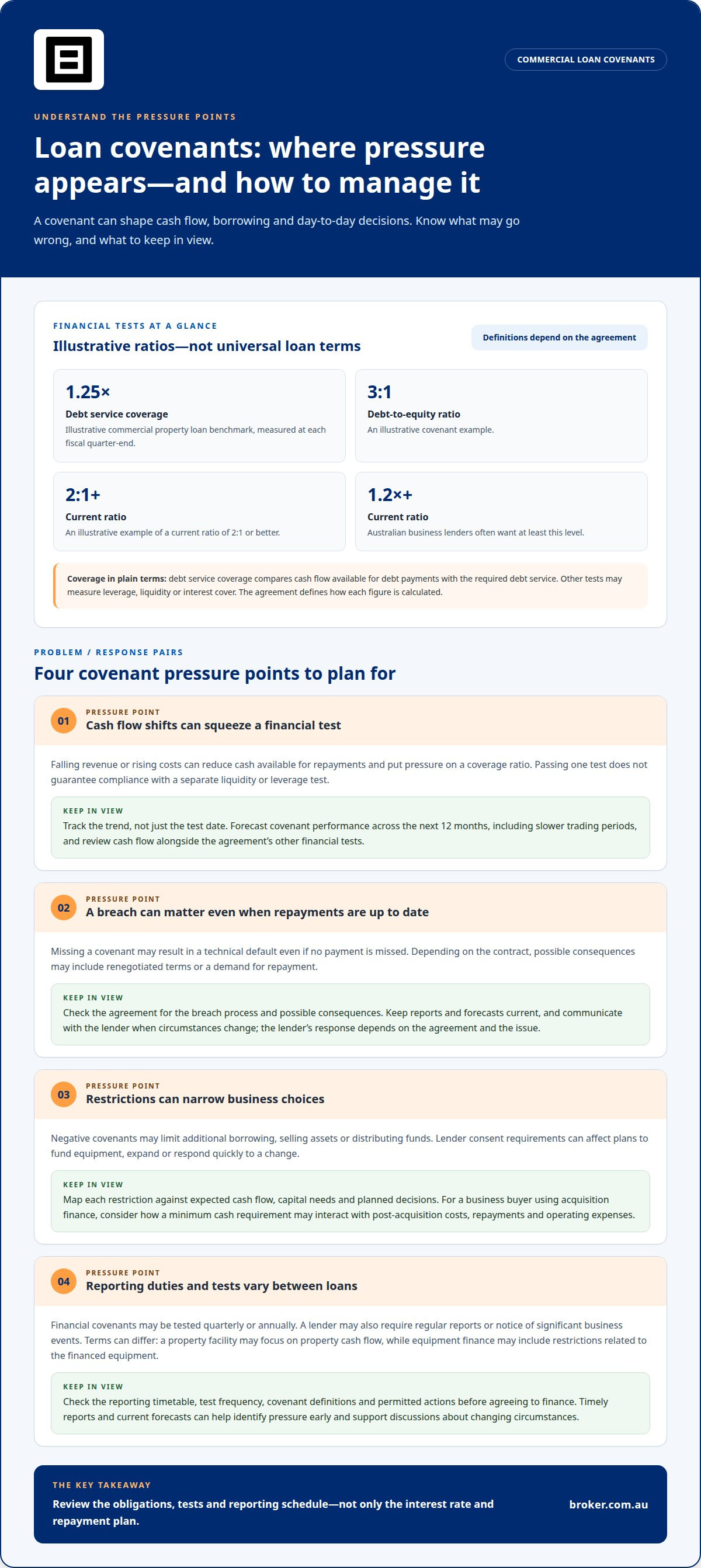
A commercial loan covenant is a condition in a loan contract that sets borrower obligations or limits. For Australian commercial property loans, a debt service coverage ratio of 1.25x is an illustrative benchmark, measured at each fiscal quarter-end.
Affirmative, Negative and Financial Covenants
Affirmative covenants require a borrower to take specified actions. Negative covenants restrict certain actions, while financial covenants set measurable financial tests. Together, they define what a business must do and which actions may require lender approval while the loan is in place.
For example, an affirmative covenant may require regular financial statements, adequate insurance or payment of taxes. A negative covenant may limit additional borrowing or the sale of an asset. Financial covenants can set minimum coverage ratios or liquidity thresholds, meaning a change in cash flow could affect compliance.
Performance Covenants and Financial Ratios
Performance covenants test whether a borrower’s financial results meet agreed thresholds, often using ratios calculated from financial statements. A debt service coverage ratio compares the cash flow available for debt payments with the required debt service. The lender may set a minimum threshold.
Other tests can measure leverage, liquidity or interest cover. Illustrative covenants may require a debt-to-equity ratio of 3:1, a current ratio of 2:1 or better, or a debt service coverage ratio of 1:1 or better. Australian business lenders often want a current ratio of at least 1.2x, while an illustrative property-loan test uses 1.25x coverage at each fiscal quarter-end. The agreement’s definitions determine how each figure is calculated.
Testing frequency and reporting obligations depend on the loan agreement. Financial covenants may be tested quarterly or annually, and a lender may require regular reports or notice of significant business events. A commercial property facility may focus on property cash flow and debt service coverage, while equipment finance may include restrictions related to the financed equipment. These terms can affect how freely a business sells assets, invests or arranges further lending.
Track the trend, not just the result on a test date. Falling revenue or rising costs can reduce the cash available for repayments and put pressure on a coverage ratio before a breach occurs. A stronger period may improve that measure, but the business could still miss a separate liquidity or leverage test. A breach may result in technical default even if no payment is missed. The contract sets out possible consequences, which may include renegotiated terms or a demand for repayment.
For a business buyer, covenants matter during acquisition finance and after settlement. Forecasting repayments alongside operating costs can show whether the proposed debt remains serviceable through a slower trading period. Review the covenant definitions, reporting timetable and permitted actions to understand how the loan could affect everyday decisions, from managing working capital to planning an investment.
Benefits and trade-offs for borrowers and lenders
Covenants give lenders a way to monitor repayment risk and borrowers a framework for managing finance. Their value depends on whether reporting duties, financial tests and restrictions fit the business’s cash flow and plans.
Borrower Benefits and Trade-offs
Agreeing to repayment conditions may support more favourable borrowing terms, but those conditions can reduce financial flexibility. For example, a covenant limiting additional debt could affect plans to fund equipment or expansion.
Before accepting terms, map each obligation against expected cash flow, capital needs and business decisions. A business buyer planning to retain cash for post-acquisition costs may need to understand how a minimum cash requirement interacts with repayments and operating expenses. Forecast covenant performance across the next 12 months, including slower trading periods, rather than relying only on current results.
Covenants can also affect decisions about equity and debt. If lender consent is required before taking on more debt or distributing funds, the business may have less room to act quickly. The benefit is a defined lending arrangement; the trade-off is committing to limits that remain in place throughout the loan.
Covenants as Lender Risk-management Tools
Covenants help lenders identify changes in a borrower’s financial position through agreed reporting and monitoring. For example, financial statements can reveal declining earnings or a rising debt burden before the next repayment becomes difficult.
A lender can use that information to assess risk and discuss options with the borrower. Reporting obligations also provide a structured view of business performance, while insurance or asset-maintenance conditions may help protect security. A lender’s response can depend on the agreement, the seriousness of the issue and how the borrower communicates.
A lender may review a company’s loan file annually after receiving year-end financial statements. Quarterly information provides a more frequent view when the agreement requires it. Keeping reports timely and forecasts current helps borrowers identify pressure early, explain changing circumstances and plan capital requirements with the lender.
Waivers and Lender Communication
A covenant waiver is a lender’s written agreement to waive or vary a requirement for a defined situation or period. It can provide breathing room after a breach, but does not automatically change other loan conditions.
For instance, a waiver may state that it supersedes the loan agreement for the next 90 days. Its scope and duration should be clear, and negotiated changes should be documented with agreement from all parties. A first-time or minor breach may be more manageable when the borrower contacts the lender early and shares relevant forecasts.
Useful communication is specific: explain the cause, show the effect on cash flow, and outline corrective action. If a quarterly forecast indicates a potential shortfall, raising it before the test date gives the lender time to assess the situation. For a temporary cash-flow gap, working capital finance may be relevant to the business’s funding needs, alongside the existing covenant obligations.
What are debt covenants?
Debt covenants set conditions a borrower must meet under a loan agreement. A breach can have consequences even when every scheduled payment has been made.
Technical Defaults and Cure Periods
A covenant breach can place a borrower in technical default without a missed repayment. The lender may have rights under the loan agreement before any payment falls overdue.
Some agreements allow a cure period, giving the borrower time to correct a breach. For a line-of-credit breach, a common cure period is around 30 days, but the agreement’s terms determine how it applies. A borrower should distinguish a reporting failure from a failed financial test, because the required corrective action may differ.
For example, a business that misses a financial reporting deadline may need to provide the overdue statements. If it falls below a coverage ratio, it may need to explain its cash-flow position and proposed remedy.
Monitoring for Potential Breaches
Covenant monitoring means tracking the financial measures and operational obligations set out in the loan agreement. Regular checks can reveal a potential breach before the formal testing date.
If a covenant is tested quarterly, checking the relevant figures monthly can provide earlier warning. Compare the latest accounts with the covenant definitions, then update the cash-flow forecast when trading conditions change.
Contact the lender promptly if forecasts indicate a likely breach. Explain the cause, the expected effect on repayment capacity and the steps being taken. For instance, a delayed customer payment may create a temporary cash shortfall, while falling sales may signal a longer-term issue. Clear information helps the lender assess the situation against the loan agreement’s actual tests.
Keep a record of each update, including the figures provided and any agreed actions. If the lender requests financial statements or a compliance certificate, meet the stated deadline to avoid a separate breach caused by late reporting.
Possible Breach Consequences
After a breach, the lender may impose penalties, terminate the agreement, accelerate repayment or renegotiate the loan terms. The available response depends on the agreement and the circumstances of the breach.
Any fees or costs arising from a breach or waiver depend on the loan agreement and the written waiver terms. Those documents determine whether charges apply and how they are calculated.
If a lender accelerates repayment, the borrower may have to repay the outstanding debt sooner than planned. This can put pressure on working capital and business assets, particularly when cash flow is already strained. A serious breach, or failure to take corrective action, may lead the lender to end its relationship with the business and call in the loan.
A waiver can provide temporary relief, but it does not automatically remove other obligations. Read its scope, duration and conditions carefully, and continue making required repayments unless the lender agrees otherwise in writing. Early communication and a clear corrective plan can help frame discussions, but the loan agreement determines the lender’s rights.
Negative covenants
A negative covenant restricts actions a borrower may take while a loan is outstanding. For example, a business may need lender approval before taking on additional debt or selling an asset used as security. These limits can affect routine decisions as well as major plans.
The purpose is to protect the lender’s position by limiting changes that could weaken repayment capacity or reduce the value of assets supporting the loan. For the borrower, the effect is less freedom to act independently. Depending on the agreement’s wording, a proposed acquisition, new borrowing arrangement or equipment purchase could require consent.
Common restrictions may cover actions such as:
- Taking on additional debt without the lender’s approval.
- Selling core business assets or property used as security.
- Merging with another company or changing ownership.
- Paying dividends, repaying shareholder loans or making distributions.
- Entering certain intercompany transactions or making capital expenditure.
- Changing business leadership or management arrangements.
Each restriction has practical consequences. If a manufacturer needs to replace equipment, a capital expenditure clause could affect the timing or approval process. If a company plans to sell a non-core asset, the agreement may require lender consent, even when the sale supports its plans. A strict clause can constrain decisions that might otherwise improve operations or cash flow.
Positive and negative covenants work in opposite directions. A positive, or affirmative, covenant requires an action, such as providing financial statements or maintaining insurance. A negative covenant restricts an action, such as selling specified assets. The distinction matters: missing a report and completing a restricted transaction can trigger different obligations and consequences under the same agreement.
Borrowers should review what each clause covers, which entities and assets it applies to, and what triggers a consent requirement. Consider a business buyer planning to acquire another company after settlement. A restriction on mergers, acquisitions or additional debt could affect that plan, even if the transaction supports growth. Clarify how the clause applies to ordinary business activity, proposed transactions and lender approval.
When reviewing or negotiating clauses, focus on precise definitions, the scope of restricted actions, consent requirements and permitted exceptions. For example, distinguish an ordinary-course asset sale from a sale of core assets, and clarify whether routine equipment replacement falls under a capital expenditure restriction. Ensure any negotiated changes are clearly recorded in the agreement and approved by all parties.
For a business purchase, covenant wording can shape both the acquisition structure and future decisions. Check whether the agreement restricts new borrowing, ownership changes, distributions or further acquisitions. Understanding these limits helps a buyer plan financing and operations without assuming every strategic decision remains unrestricted.
Covenants on unsecured loans
Unsecured business loans don’t rely on property or other specific assets as security. Lenders may use covenants to assess repayment capacity, cash flow and financial health. Understanding commercial loan covenants helps borrowers see how reporting duties and financial tests may shape day-to-day financial decisions.
A covenant package varies with the lender, loan size, industry and borrower profile. Financial tests may include a minimum debt service coverage ratio, comparing cash available for debt payments with the payments due. A lender may include a debt service coverage requirement in a loan covenant. The agreement’s definitions determine how earnings, expenses and debt obligations enter the calculation.
Reporting duties can be just as important as ratios. An agreement may require annual financial statements, usually due within 90-270 days of year end. Some non-standard commercial covenants also require accounts receivable lists or monthly compliance certificates. Building these tasks into accounting processes can help prevent missed deadlines and give the business an up-to-date view of its lending obligations.
- Financial tests: monitor coverage, cash flow or other agreed measures.
- Reporting duties: provide financial statements, receivables information or compliance certificates.
- Restrictions: obtain lender approval for specified actions, such as taking on more debt.
Testing may occur quarterly or semi-annually, particularly for larger unsecured loans exceeding A$2 million. A quarterly assessment can capture a weaker trading period that annual accounts alone might miss. Internal forecasts help identify pressure between formal reporting dates and show whether upcoming repayments remain manageable.
For a business buyer arranging acquisition finance, consider covenant tests alongside the funds contributed towards the purchase. The buyer’s equity contribution affects how much finance is needed, while retaining enough cash for operating costs can support post-settlement cash flow. Model proposed repayments, acquisition costs and ongoing expenses together, then consider how a quieter trading period could affect debt servicing.
Before signing, read each clause alongside its definitions, testing dates, reporting deadlines and breach consequences. Note how each ratio is calculated and which records support it. This helps you organise accounts and understand which business decisions could affect compliance.
If unsecured funding suits your plans, explore Unsecured Business Loans and consider how repayments and covenant obligations fit your cash flow.
Broker.com.au: Commercial Property Loans
Broker.com.au arranges Commercial Property Loans for purchasing or refinancing commercial property. Covenants are part of the overall borrowing picture, alongside repayment capacity, cash flow and the property supporting the loan. Understanding how the terms may affect future plans helps you consider finance options in context.
If you need finance for business assets or an acquisition rather than property, Secured Business Loans, Unsecured Business Loans and Business Acquisition Funding may be relevant. The right fit depends on the purpose of the borrowing, available security and the business’s financial position.
For a considered conversation about commercial property finance, contact Broker.com.au.
Make your next finance decision with clarity
Understanding commercial loan covenants is a useful starting point, but their practical impact depends on how they fit your business plans. Before committing to finance, consider the decisions you may need to make during the loan term, from managing cash reserves to purchasing assets or pursuing an acquisition. Your funding structure should support those plans while making the attached obligations clear.
Broker.com.au arranges Secured Business Loans, Unsecured Business Loans and Business Acquisition Funding. If you’re considering finance for business growth or a business purchase, talk with us about your funding needs and suitable options.
Contact Broker.com.au about commercial loans to discuss your plans and take the next step with greater clarity.
Frequently Asked Questions
Can I reset covenants if my business changes?
Yes, a lender-approved amendment or waiver can change covenant terms. A change in ownership, revenue model or operating structure may affect how existing tests fit the business. Explain what has changed, how it affects covenant performance and what revised terms would address the issue. Record any agreed variation in writing, including its scope and duration, so both the business and lender have a clear reference.
Do unsecured loans have covenants?
Yes, unsecured business loans can include financial tests, reporting duties and restrictions, even without property pledged as security. A lender may require accounts receivable information or compliance certificates, for example. Larger unsecured loans exceeding A$2 million may be reviewed quarterly or semi-annually. For a business buyer, allow for these reporting tasks in cash-flow planning, especially where acquisition activity changes revenue, costs or existing debt obligations.
How are covenants monitored?
Lenders monitor covenants by reviewing the records and calculations required under the loan agreement. A finance team can maintain a schedule of each test date, reporting deadline and source document, such as management accounts or receivables reports. Comparing current figures with forecasts can flag emerging pressure. For example, a fall in customer receipts may affect liquidity before annual statements show the full trading trend.
How do covenants work?
A covenant makes a borrower’s obligation or restriction part of the lending agreement. The clause defines what must be reported or maintained, how compliance is assessed and what may follow a breach. For instance, a lender may require financial statements and set a minimum cash balance. The borrower tracks that requirement alongside operating expenses, then supplies the agreed information by the stated reporting time.
How often are covenants tested?
Financial covenants are commonly tested quarterly or annually, as set out in the agreement. The testing period and measurement date matter: a ratio measured at financial year-end may differ from one assessed after a seasonal trading dip. Reviewing figures monthly between formal tests can reveal a likely shortfall sooner. Liquidity measures may need particularly frequent attention because available cash can change quickly.
What counts as EBITDA in covenant tests?
EBITDA means earnings before interest, tax, depreciation and amortisation, as defined in the loan agreement. Lenders may use it as a proxy for free cash flow, but the two measures can differ substantially. An interest coverage test, for example, may divide EBITDA by interest payments. Check which adjustments and reporting period the covenant permits, as these details affect the result.
What happens if a business breaches a covenant?
A breach can trigger technical default under the loan agreement, even if the business has made every scheduled payment. Depending on the contract, the lender may require corrective action, renegotiate terms, impose a penalty, accelerate repayment or terminate the agreement. Identify the breached clause, quantify its effect and communicate promptly with the lender. This gives both parties a clear basis for discussing next steps.
What is the timeline of a covenant?
A covenant applies from its effective date until the loan is repaid or the obligation is formally varied or removed. Some conditions apply continuously, while others are tested on set reporting dates or triggered by a particular action, such as taking on more debt. Loan documents set deadlines for statements, testing and any remedy after a breach, so map these dates against the business calendar.