
A bank decline doesn’t automatically shut the door on business finance. Non-bank lenders for bad credit business loans are lenders outside the banks that may assess an application by looking closely at business cash flow as well as credit history. Some pathways may consider businesses with 3+ months of trading, while many lenders look for at least six months.
Imperfect credit can make borrowing feel uncertain, especially when you need to protect cash flow or fund a business purchase. Lenders still need evidence that repayments are manageable, so they assess trading history, revenue, existing debts and recent bank conduct alongside your credit file.
This article explains who may qualify, what lenders assess and how secured finance, collateral and personal guarantees can affect an application. You’ll also learn what information to prepare and when a non-bank option may suit your circumstances, so you can approach the next step with a clearer picture of the trade-offs.
Key Takeaways
- Learn how trading history, turnover and cash flow can shape eligibility, even when your credit record is imperfect.
- Understand why a bank decline doesn’t automatically rule out business finance, and what non-bank options may be relevant.
- See how a broker can help match your circumstances and funding purpose with suitable lender criteria.
- Find out which financial records and forecasts can help demonstrate your ability to manage repayments.
- Weigh the trade-offs of offering security or a personal guarantee, including when funding an existing business purchase.
Table of Contents
- Who is eligible for a bad credit business loan?
- Non-bank lending for borrowers with bad credit or imperfect financials
- Broker assessments and lender approval
- Cash-flow-based assessment for applicants with bad credit
- Collateral and personal guarantees
- Broker.com.au: Secured Business Loans
Who is eligible for a bad credit business loan?
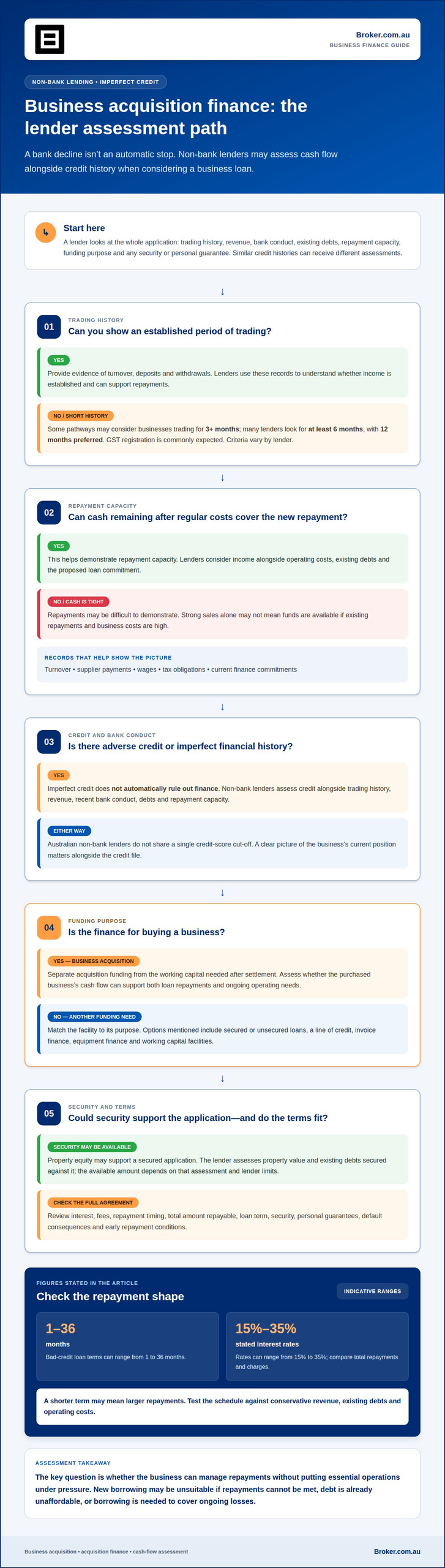
Eligibility depends on how the business trades, manages cash and supports repayments, alongside the applicant’s credit history. For non-bank lenders for bad credit business loans, trading-history expectations vary: a stated minimum may be 3+ months, while many lenders look for at least six months, with 12 months preferred.
Cash flow and trading history
Lenders review turnover, deposits and withdrawals to understand whether business income can support loan repayments.
Trading history helps show whether income is established or irregular. Some pathways start at 3+ months in business, while six months is a common benchmark and 12 months may be preferred. GST registration is also commonly expected. A single strong day of receipts, for example, doesn’t demonstrate consistent trading across the business’s history.
Repayment capacity and business finances
To assess repayment capacity, lenders consider income alongside business costs, existing debts and the proposed loan commitment. The key question is whether cash remaining after regular expenses can cover the new repayment without putting essential operations under pressure.
Prepare a clear summary of turnover, supplier payments, wages, tax obligations and current finance commitments. For example, a business with strong sales but high existing repayments may have less available cash than its turnover suggests. Lenders may also consider the business structure, industry, funding purpose and loan amount when assessing the overall position.
Property equity may support a secured application, but the lender assesses the property’s value and any existing debts secured against it. The amount available depends on that assessment and the lender’s limits, not simply the owner’s estimate of market value.
Credit history and lender criteria
Australian non-bank lenders don’t share a single credit-score cut-off for bad credit business loans. Applications for this finance are assessed using credit history alongside trading history, revenue, bank statement conduct, existing debts and repayment capacity.
A low score or adverse credit history doesn’t automatically rule out finance. Lenders may also assess the director’s profile, business structure, industry, loan purpose, requested amount, available documents and any security or personal guarantee. That helps explain why businesses with similar credit records can receive different assessments.
A bank decline doesn’t necessarily mean business finance is unavailable. Another lender may weigh cash flow and other factors differently. For example, clear evidence of stable trading can help explain the business’s current position despite earlier credit issues.
Non-bank lending for borrowers with bad credit or imperfect financials
In Australia, specialist non-bank lenders and finance companies may consider business applications with adverse credit or imperfect financials. Review the contract for interest, fees, repayment timing, loan term, security, default consequences and any early repayment conditions.
Finance access for small and medium-sized businesses
Non-bank finance can give small and medium-sized businesses another route to funding after a bank decline. Options may include secured or unsecured loans, a line of credit, invoice finance, equipment finance and working capital facilities.
Match the facility to the need. Invoice finance can release funds tied up in unpaid customer invoices, while equipment finance funds an asset purchase. If you’re buying a business, distinguish acquisition funding from the working capital needed after settlement. The purpose, business revenue and repayment plan all shape the application.
Benefits compared with bank finance
Non-bank lenders may use more streamlined approval processes than traditional banks and can assess cash flow alongside credit history. Their funding sources may also differ: banks generally rely heavily on deposits, while non-bank lenders often use more diverse sources.
That difference may make non-bank finance relevant when a business has imperfect financials or needs a facility suited to a specific purpose. It doesn’t mean every application is easier or less expensive. Compare total repayments, charges, term, security and conditions with the business’s available cash, not just the speed of a decision.
Lender options and contract warning signs
Australian bad-credit business finance is available from specialist non-bank lenders, including providers of secured and unsecured loans, invoice finance and lines of credit. No single lender or product suits every business. Funding purpose, revenue, existing commitments and security all affect which options may fit.
Review the contract’s interest rate, fees, repayment schedule, total amount repayable, term and default provisions. Bad-credit loan terms can range from 1 to 36 months, and stated interest rates can range from 15% to 35%. A short term may mean larger repayments, so test the schedule against actual cash flow.
Refinancing existing bank debt may help restructure repayments, while urgent commercial finance can address a defined timing gap. Neither is a fix for continuing losses. Business finance may be unsuitable if the business can’t meet repayments, already carries unaffordable debt or needs new borrowing to cover ongoing losses.
Before borrowing, calculate the repayments against conservative revenue, then account for existing debts and operating costs. Check whether the agreement requires property or other security, a personal guarantee, or fees triggered by late payment or default. For an acquisition, also assess whether the purchased business’s cash flow can support both the loan and ongoing operating needs. Funding for a business purchase should be considered alongside the wider settlement and cash-flow plan.
Broker assessments and lender approval
A broker can organise an application and identify loan options suited to its purpose. For Australian business finance, approval depends on the lender’s assessment, the business plan and the evidence supporting the request.
What a broker assessment covers
A broker starts by clarifying what the business needs funding for, how much capital it requires and how repayments could be managed. For a business buyer, that means distinguishing acquisition finance from working capital needed after settlement. A line of credit may suit changing cash needs, while a purchase requires funding aligned with the acquisition.
The broker can then consider the business’s financial position, credit history, existing debts, available security and proposed loan structure. This helps direct the application towards lending criteria that match the borrower’s situation, rather than relying on a generic approach. Brokers can recommend options and manage much of the paperwork.
Prepare a business plan that explains the funding purpose, expected cash flow and repayment approach. Lenders usually want to review a business plan before approving a loan. For an acquisition, explain how the business will operate under new ownership and how its revenue supports repayments.
Preparing the application
A complete application gives the lender a clearer basis for assessing the request. Gather identification, business records, financial reports and forecasts, plus details of existing debts and any proposed security. Depending on the application, a lender may also request lease agreements or personal financial information.
Keep the funding request consistent across your documents. If you’re seeking a loan to purchase equipment, for example, the plan, forecasts and supporting records should explain that purpose. A mismatch between the stated use and supporting information can prompt further questions and slow the assessment.
A broker may manage much of the paperwork, but the business owner still needs to provide accurate information and respond to requests. Some brokers charge for their services, while others receive commission from a lender. Understand how the broker is remunerated before proceeding.
Approval and funding timeframes
Non-bank lenders may offer more streamlined approval processes than traditional banks, but no single turnaround time applies to every business loan. Timing depends on the lender’s assessment, the application’s complexity and whether the required documents are complete.
Approval and funding are separate steps. A lender may need to complete its assessment, confirm the proposed terms and finalise security arrangements before releasing funds. For a business purchase, coordinate finance conditions with the transaction timetable so the funding steps align with settlement requirements.
To keep the process moving, respond promptly to requests and provide clear, consistent documents. If an application is declined, ask for feedback and identify what could be improved before applying again. A broker can help organise the next submission around the lender’s stated concerns.
Cash-flow-based assessment for applicants with bad credit
For Australian bad-credit applications, cash flow helps lenders assess whether a business can manage repayments despite credit issues. Show how money moves through the business and what remains after operating costs. Clear records can also explain whether weaker periods reflect ordinary trading patterns or continuing pressure on the business.
Showing the business’s cash position
A cash flow statement summarises money coming into and going out of the business. Lenders use it to understand income patterns, regular costs and funds available for repayments. They may look beyond total revenue to see whether cash arrives in time to cover wages, supplier bills and existing debt commitments.
Explain unusual account movements, such as seasonal changes, a large customer payment or a one-off expense. For example, a strong sales month may not demonstrate consistent repayment ability if customer invoices remain unpaid. Clear context connects the figures to the business’s day-to-day position.
Lenders may ask applicants to provide business bank statements. Make sure they cover the required period and that deposits and withdrawals can be understood alongside the business’s financial reports. A short explanation of a large transaction can clarify whether it was recurring income, a loan drawdown or an isolated event.
Documents that support the application
Prepare identification, a business plan, financial reports and forecasts, lease agreements and personal financial information where requested. Each item answers a different assessment question: identification establishes who is applying, while the plan explains the funding purpose and repayment approach.
Use forecasts to show how expected income and costs could affect repayments. A new business can prepare a cash flow forecast estimating future sales and expenses. For an established business, reconcile forecasts with actual account activity so the lender can see the basis for projected figures.
Keep documents consistent. If a forecast relies on a customer contract or a change in trading, explain that assumption in the business plan. For an acquisition, show how the purchase and ongoing operating costs fit into projected cash flow.
Credit checks and next steps
A bad credit history doesn’t remove the need for a full application assessment. Some lenders may conduct a formal credit check later in a no-credit-check business loan application, depending on their requirements. Read the consent wording carefully so you understand when credit information may be accessed.
If an application is unsuccessful, ask the lender for specific feedback. Identify whether the concern involved cash flow, existing commitments, documentation or credit conduct. Then address the issue before applying again, such as by updating a forecast or clarifying a recent account movement.
Submitting repeated applications without understanding the earlier decision can leave the same weaknesses unresolved. Use the lender’s feedback to refine the funding amount, repayment assumptions or supporting evidence, then present a revised application that clearly shows the business’s ability to repay.
Collateral and personal guarantees
Security can affect how a lender structures a business loan, particularly when an applicant has adverse credit. A secured loan is backed by collateral, and the lender can claim that security to cover losses if the borrower doesn’t repay. The asset and the agreement’s terms therefore matter as much as the proposed repayment.
Bad-credit business finance may be available without collateral, although offering security can support an application. A lender assesses the asset’s value alongside any existing debts secured against it. Property equity isn’t automatically available as cash: the lender’s valuation and lending limits affect how much it may support.
Before offering an asset, identify what the lender proposes to secure and what happens if payments fall behind. For example, a business owner considering property as collateral should understand which property is included, whether another lender already has a claim and how default could affect ownership. Read the security documents alongside the loan terms.
A personal guarantee is a director’s promise to meet the business’s loan obligations if the business fails to repay. Bad-credit business loans may require one, so a company structure alone doesn’t necessarily protect personal assets from a lender’s claim. Review who must guarantee the borrowing, which obligations the guarantee covers and when it ends.
Security and guarantees are different commitments. Collateral gives the lender rights over a specified asset, while a personal guarantee creates an obligation for the guarantor. A loan could involve either, both or neither. Check the agreement for each arrangement and consider how the business would operate if an asset used as security became unavailable.
A specialist broker can explain how collateral, guarantees and repayment terms fit together in a proposed facility. For example, a business seeking equipment finance should distinguish the equipment being financed from other business or personal assets. A flexible structure still needs repayments the business can support through cash flow.
Personalised service can help when an application has several moving parts, such as imperfect credit, existing secured debts and a director guarantee. A broker can organise the information and explain the lender’s requirements, while the borrower focuses on understanding the commitment. Before signing, make sure the asset, guarantee and repayment responsibilities are clear.
If secured borrowing fits your situation, explore secured business loan options and consider how the proposed security affects your business and personal position.
Broker.com.au: Secured Business Loans
Broker.com.au helps business owners explore funding options when credit history or financial circumstances make lending more complex. Its Secured Business Loans may suit businesses able to offer suitable collateral, while Unsecured Business Loans may be relevant when borrowing without asset security is preferred.
For business buyers, Business Acquisition Funding can support the purchase of an existing business. Working Capital Finance may help meet operating cash needs separately from acquisition costs. The appropriate option depends on the funding purpose, cash flow, repayment capacity and available security, so consider the full commitment before proceeding.
If you’re weighing up finance after a bank decline or planning a business purchase, contact Broker.com.au to discuss your situation.
Take the next step with a clear funding plan
Before moving ahead, decide what the funding needs to achieve and how it fits your business plans. A business buyer, for example, can separate acquisition costs from the working capital needed to keep operations running. That clarity makes a finance discussion more focused.
Choosing between non-bank lenders for bad credit business loans involves more than finding a lender willing to consider an application. The facility should suit the funding purpose and repayment capacity, and you should understand any security or personal guarantee before committing.
Broker.com.au offers Secured Business Loans, Unsecured Business Loans and Business Acquisition Funding. These options address different borrowing needs, from funding a purchase to seeking finance without asset security. The right fit depends on your circumstances.
Contact Broker.com.au about loan options and discuss a practical next step for your business. A considered funding plan can help you move forward with greater confidence.
Frequently Asked Questions
What is a Non-Bank Lender?
A non-bank lender provides finance without operating as a traditional bank. In Australia, these lenders offer business funding through different structures, including loans and invoice finance. Their assessment approaches and lending criteria vary, so the funding purpose and repayment capacity remain important. For example, a business seeking funds against unpaid invoices may need a different facility from one funding new equipment.
How do bad credit business loans work?
Bad credit business loans provide funds to businesses with credit-history issues, with repayments made under an agreed loan contract. Lenders assess factors such as business performance, cash flow, existing debts and security. Before accepting an offer, calculate the total repayment and consider whether the schedule fits quieter trading periods. Seasonal businesses should account for lower-income months, not just peak sales.
What types of non-bank business loans are available?
Non-bank business finance can include term loans, lines of credit, invoice finance, equipment finance and working capital facilities. Business buyers may also seek acquisition finance to purchase an existing enterprise. Match the product to its use: equipment finance relates to an asset purchase, while a line of credit can address changing cash needs. Review the repayment structure against the purpose and expected cash inflows.
What types of bad-credit business finance are available in Australia, including secured, unsecured and invoice finance?
Australian businesses may consider secured loans backed by collateral, unsecured loans without specific asset security, or invoice finance linked to unpaid customer invoices. With invoice factoring, a business sells invoices at a discount, receives funds upfront and the buyer collects the debt. Each structure affects cash flow differently. Consider whether repayments, security obligations or invoice collection arrangements suit your business.
What eligibility requirements do non-bank lenders set for Australian businesses with bad credit?
Eligibility criteria vary, but lenders commonly consider trading history, business revenue, bank account conduct, existing debts, industry and funding purpose. GST registration and the business’s legal structure may also be relevant. A credit score alone doesn’t capture the full application: lenders may weigh the reason for adverse credit against current trading and repayment capacity. Be ready to explain significant changes in your business’s circumstances or finances.
What documents are needed to apply for a bad-credit business loan in Australia?
Common application documents include director identification, business financial reports, bank statements, forecasts and a business plan. A lender may also request lease agreements or personal financial details. Low-documentation pathways may begin with around 12 months of business bank statements, alongside ABN or ACN details and basic director information. Organise records so deposits, expenses and existing loan payments can be matched to the business’s financial position.
How can an Australian business apply for a non-bank loan with bad credit, and how long does approval take?
Start by defining the funding purpose, amount required and repayment approach, then provide the requested business and director information. A broker can help identify options and manage much of the application paperwork. Broker.com.au’s process is: “Complete one simple to use form → Get connected with an expert broker → Work directly with your broker → Financing secured.” Approval timing depends on the assessment, application complexity and document completeness.
What collateral or personal guarantees may Australian non-bank lenders require for bad-credit business loans?
A lender may ask for business or personal assets as collateral, a director’s personal guarantee, both or neither. Collateral gives the lender rights over an identified asset if the borrower defaults; a guarantee makes the guarantor responsible under the agreement. Before signing, identify the assets covered, the guarantee’s scope and the conditions for release. Consider how a claim could affect business operations and the guarantor’s personal finances.