
A rejected business loan application doesn’t necessarily mean you should give up, but reapplying straight away may not help. If you’re asking, “What if my business loan application is rejected?”, first find out why; then address the issue before applying again. As a guide, wait until you have 2 to 3 months of improved financial statements to show a lender.
It’s understandable to want a quick answer, especially when finance is tied to buying a business, covering costs or keeping plans on track. But when to try again depends on what weakened the application, whether that was cash flow, credit history, time in business or the amount requested.
This article explains how to identify why your application was rejected, strengthen it and decide when to reapply in Australia. You’ll also learn how repayment capacity and lender requirements affect the decision, and when a different funding option may suit your business better.
Key Takeaways
- Use the lender’s specific reason for declining your application to guide what you improve before trying again.
- Keep clear, up-to-date financial statements and a cash flow forecast that shows how your business can manage repayments.
- Review your credit history, payment habits and existing debts, and correct any errors that could affect a future assessment.
- For a business purchase, show how the acquired business’s cash flow could support the acquisition loan alongside your existing commitments.
- A decline from one lender doesn’t automatically rule out finance elsewhere; lending criteria and suitable funding structures can differ.
Table of Contents
- 1. Funding options when traditional financing is unavailable
- 2. Cash flow and repayment capacity
- 3. Finding out why a lender rejected an application
- 4. Common reasons business loan applications are declined
- 5. Why Australian banks reject SME loan applications
- Broker.com.au: Secured Business Loans
1. Funding options when traditional financing is unavailable
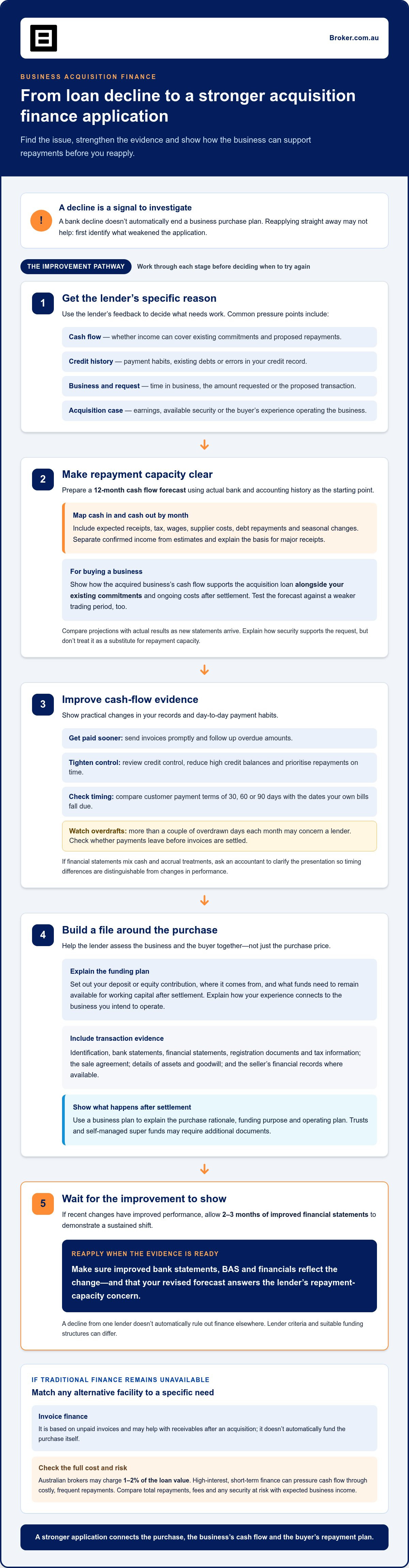
For a business buyer, a bank decline doesn’t automatically end the purchase plan. First identify whether the obstacle is the business’s earnings, the proposed transaction, available security or the buyer’s experience. Then consider whether the acquisition finance request can be structured around the actual purchase, rather than treating every business cost as one undifferentiated loan.
Your deposit or equity contribution is an important part of the picture. Set out how much you can contribute, where it comes from and what funds need to remain available after settlement. A larger contribution may reduce the amount borrowed, but using all available cash can leave too little to support the transition. Explain the balance between purchase equity and working capital in your acquisition plan.
Lenders assess the business’s financial position, repayment capacity, security and the applicant’s experience. If you’re buying a business, connect your experience to the operation you intend to acquire and explain how its earnings support the proposed debt. The purchase price alone doesn’t show whether the transaction can service finance. The lender needs a clear view of the business and buyer together.
Build an application file specific to the transaction. Alongside identification, bank statements, financial statements, registration documents and tax information, include the sale agreement, details of assets and goodwill, and the seller’s financial records where available. Your business plan should explain the purchase rationale, funding purpose and post-settlement operating plan. Trusts and self-managed super funds may require additional documents.
Check that the financial statements consistently reflect the business’s trading position. Accrual accounting records income when earned and expenses when incurred, while deferrals recognise certain income or costs in a later period. If the statements mix cash and accrual treatments, ask an accountant to clarify the presentation before a lender assesses them. Clear explanations help distinguish timing differences from genuine changes in performance.
If traditional finance remains unavailable, consider whether a different funding structure could address a specific need. Invoice finance is based on unpaid invoices, so it may help with receivables after an acquisition, but it doesn’t automatically fund the purchase itself. Combining facilities can separate acquisition costs from ongoing cash needs. Each facility should have a defined purpose and repayment source.
Using a finance broker can help with application preparation and lender matching, but Australian brokers may charge 1 to 2 percent of the loan value. High-interest, short-term finance can also put pressure on cash flow through costly, frequent repayments. Before accepting either route, compare the total repayment obligation, fees and any security at risk against the business’s expected income.
2. Cash flow and repayment capacity
A lender assesses whether regular income can cover existing commitments and proposed repayments. A strong sales history alone may not show whether cash arrives in time to meet bills. If you’re buying a business, include the acquired business’s cash flow alongside your personal and business commitments. Explain how any security supports the request, without treating it as a substitute for repayment capacity.
Prepare a cash flow forecast covering the next 12 months. Map expected receipts and payments by month, using actual bank and accounting history as your starting point. Include tax, wages, supplier costs, debt repayments and seasonal changes. If you’re purchasing a business, show how forecast income supports acquisition finance and the business’s ongoing costs after settlement.
Make your assumptions easy to follow. For each major receipt, record its expected timing and basis, such as a signed contract or repeat customer order. Separate confirmed income from estimates, and explain expected changes in costs or sales. Compare forecasts with actual results as new statements become available. This helps a lender assess whether the business is meeting its projections.
Watch for days when the bank account is overdrawn. More than a couple of these days each month may concern a lender. Review the dates against customer receipts, direct debits and loan payments. If payments leave the account before invoices are settled, adjust their timing where possible and show the change in subsequent statements.
Improve payment performance with practical steps. Send invoices promptly, follow up overdue amounts and tighten credit control. Australian businesses may offer customers payment terms of 30, 60 or 90 days, so compare those terms with the dates your own bills fall due. Consider delaying optional purchases, reducing high credit balances and prioritising repayments on time. These actions can help show better control of cash flow and existing debt.
For an acquisition, test the forecast against a weaker trading period as well as expected performance. Identify which costs remain fixed if sales fall, when major customer receipts arrive, and whether the business can still meet repayments. If recent changes have improved performance, wait until improved bank statements, BAS and financials reflect that change before reapplying. Allow 2 to 3 months of improved financial statements to demonstrate a sustained shift.
Australian small businesses facing financial difficulty can contact the Small Business Debt Helpline for free financial counselling. If your loan application was rejected, ask the lender what repayment-capacity concern affected its decision, then use that information to revise your forecast.
Once your figures show how income supports repayments, a tailored business finance assessment can help you consider funding options that fit the cash flow need.
3. Finding out why a lender rejected an application
Before applying again, identify the lender’s specific reasons for declining your application. Ask which aspects of your financial position, credit history, requested amount or supporting documents affected the decision. A clear explanation helps you choose a practical next step instead of submitting another application with the same gaps. If the response is broad, ask which issue had the greatest influence and what evidence could address it.
If the lender says credit information contributed to the decision, Australian lenders must tell applicants when a loan application is rejected for that reason. Review your credit reports from Equifax, Illion and Experian for errors, outdated details or debts you don’t recognise. According to the Office of the Australian Information Commissioner, you can request a copy of your credit report every three months. Keep copies of any dispute correspondence.
A rejected application doesn’t automatically mean your credit score has fallen by a set amount. Each new business loan application appears on your credit file, and multiple applications in a row can concern lenders. Focus on the credit enquiry and the underlying issue instead of making repeated applications. According to the Office of the Australian Information Commissioner, default listings expire five years after they’re added to a credit report.
Ask whether a different loan amount or structure could address the lender’s concern. If the requested amount exceeds demonstrated repayment capacity, a smaller facility may be considered. Where a credit score or monthly sales are weak but meet minimum requirements, a lender may offer a smaller loan, a higher interest rate or less flexible terms. Compare the repayments and conditions with your forecast before accepting a revised offer.
Time in business can also determine when to try again. Lenders often require six months to a year of trading history, so a business below a lender’s minimum may need to build that track record first. If the issue is a recent decline in sales, strengthen the evidence of stable income and repayment capacity. Update your financial statements, bank records and forecasts before resubmitting.
Another lender may assess the same business differently because lending criteria vary. That doesn’t make an unchanged application stronger: first address the original concern and check that the next lender’s requirements fit your circumstances. If you’re buying a business, explain the acquisition purpose, relevant experience and how the business’s forecast income supports repayments. Keep the funding request aligned with what the transaction actually requires.
One business reapplied eight weeks after its initial rejection and received approval for the requested amount. That example shows why timing should depend on the improvements made, not a universal waiting period. If you’ve corrected an error, reduced debt or improved trading evidence, document the change clearly. If the lender’s minimum trading-history requirement remains unmet, wait until your records show the required period before applying again.
4. Common reasons business loan applications are declined
Common reasons for rejection in Australia include a short trading history, poor cash flow, weak credit or deteriorating industry conditions. Lenders also assess the funding purpose and whether the business and owner can manage repayments.
A short track record can make it difficult to demonstrate consistent income. Some lenders also set a minimum gross-sales threshold, so a business with lower turnover may not meet their criteria. If you’re buying a business, explain your relevant management experience and how the acquired business will generate income to service acquisition finance.
Cash flow problems can point to repayment risk, even when sales look healthy. Late customer payments, rising costs or regular overdrafts may leave too little for loan repayments. Lenders consider existing commitments alongside the proposed facility. Your forecast should show how the business will cover both, including during a weaker trading period.
Credit history and debt levels can also affect approval. A score below 300 points is described as bad credit and may contribute to rejection. High credit utilisation can raise concerns too; most lenders prefer a debt utilisation rate below 30%. Review the credit file for errors, then address missed payments or reduce outstanding balances before applying again.
The amount and purpose of the funding matter. Applying for too much can leave lenders questioning whether repayments are affordable, while requesting too little may not cover the stated need. If you’re buying a business, show how the requested funding relates to the purchase and any essential working capital. Explain the expected benefit and the income available to support repayments.
Industry conditions and customer concentration can shape a lender’s view of future income. A business earning 80 percent of revenue from two clients may present concentration risk. Similarly, 60 percent of revenue from government contracts with similar end dates should be disclosed. Explain contract timing, renewal prospects and how the business could manage a gap in receipts.
Repeated applications can create another concern. Repeated applications may raise concerns for lenders, so it can help to understand the reason for a rejection before applying again. Avoid applying widely before understanding the reason for rejection. If the lender’s assessment indicates you can’t repay without hardship, Australian lenders must decline the application. Address the underlying affordability issue before seeking more credit.
5. Why Australian banks reject SME loan applications
Australian banks assess more than the amount requested. They look at whether the business can repay without hardship, what the funds will support, and how reliable its financial information appears. Around 20 to 25 percent of Australian SME loan applications were rejected in Q2 FY26. For an applicant, the useful takeaway is to identify the risk the bank sees, then strengthen the evidence addressing it.
Repayment ability is central to the assessment. A profitable result on an annual statement may not show whether cash arrives in time to cover loan payments. Banks compare existing commitments with proposed repayments and consider the business’s financial position. If your forecast relies on optimistic sales assumptions, explain the basis for those estimates and show how the business would manage a weaker period.
Financial information must tell a consistent story. Australian banks look for 12 to 24 months of historical financial statements when assessing SME loan applications. Keep monthly statements up to date if funding may be needed during the next 12 to 24 months. Reconcile accounting records with bank activity, and explain unusual changes in income, expenses or debt rather than leaving them unexplained.
A business plan can connect those figures to a clear purpose for the funding. Set out what the money will pay for, how it supports trading and what income will service repayments. If you’re seeking acquisition finance, explain how the purchase fits your experience and how the acquired business’s financial performance supports the borrowing. The lender needs a credible link between the transaction, future cash flow and repayment capacity.
Revenue concentration can create risk even when current sales are strong. If a business relies heavily on a small number of customers or contracts ending around the same time, a bank may question how reliably that income will continue. Disclose the concentration and show contract timing, renewal information and other revenue sources. This gives the lender context rather than leaving it to infer risk from the accounts.
Tax choices can also affect how a bank views the business. A business that prioritises minimising tax over demonstrating earnings may show weaker reported results for lending purposes. Financial statements supported by a business strategy can help explain longevity and earnings. Make sure the plan and accounts use the same assumptions, particularly for projected income and operating costs.
When an application is declined, treat the decision as a risk assessment, not just a verdict on the business. Ask which evidence or concern drove the outcome, then address it directly before another application. If the issue is repayment capacity, revise the funding request or improve the cash flow case. To explore finance options suited to your business position, discuss your business finance needs.
Broker.com.au: Secured Business Loans
Once you understand why a lender declined your application and have gathered the relevant financial information, Broker.com.au can help you consider finance options. If security is available, a Secured Business Loan may suit a business seeking funding for a clear purpose. For a business buyer, Business Acquisition Funding can help address the purchase separately from working capital needs.
The appropriate option depends on the business’s financial position, repayment capacity, available security and intended use of funds. If the original application fell short on affordability or documentation, strengthening those areas first can make the next funding discussion more focused. If you’re reassessing finance for a business purchase or ongoing costs, contact Broker.com.au or visit broker.com.au to discuss your situation.
Plan your next funding move
A loan rejection can prompt a useful reset: consider what the funding needs to achieve and how it supports your next business milestone. If you’re asking what to do if your business loan application is rejected, use the next conversation to explain your plans, purchase requirements and preferred repayment approach clearly.
If you’re buying a business, that might mean aligning acquisition finance with the purchase and the operating cash flow needed afterwards. Broker.com.au offers Business Acquisition Funding, Secured Business Loans and Unsecured Business Loans, with options to explore based on your funding purpose and financial position.
You don’t need to approach the next step with a perfect application in hand. A clear picture of your requirements can help make a discussion about suitable funding more focused. Talk with Broker.com.au about your business finance options and decide on a considered path forward.
Frequently Asked Questions
How long after a rejected application should I wait before reapplying?
Reapply when you can show that you’ve addressed the reason for rejection, rather than simply because time has passed. If the issue was missing information, provide the complete documents; if it was a lender’s minimum trading-history requirement, wait until your business meets it. If sales or repayment capacity were the concern, use updated records to demonstrate the improvement, not just a promise that conditions will change.
Do banks share information about why they rejected my application?
Banks don’t necessarily provide another lender with a detailed explanation of their decision. Ask the original lender for its reasons and keep the response for your records. If the decline involved information in your credit report, Australian lenders must tell you. Review your report for incorrect details, then provide relevant corrections or context with a later application rather than assuming another lender will know why you were declined.
How can you improve the likelihood of not being rejected?
Before applying, check that the requested funding matches a clearly explained business need and that the supporting documents agree. For example, if your business plan forecasts income from a new contract, make sure the financial forecast reflects when those payments are expected. Review your credit history and existing commitments, too. A well-prepared application gives a lender a coherent picture of the business, its plans and its ability to manage the proposed borrowing.
How can you improve your next finance application?
Build the next application around what has changed since the previous one. Include updated statements, corrected records or evidence that an issue has been resolved, and briefly explain why each change matters. For example, if a past application lacked context for a one-off expense, attach a clear explanation and show how current trading differs. Check that names, dates and figures match across the application, financial records and business plan before submitting.
How can I find out why my Australian business loan was rejected?
Ask the lender which part of the application drove its decision, then request clarification on any unfamiliar term. If you’re wondering what to do if your business loan application is rejected, separate the stated reason from assumptions about the outcome. If credit information was involved, obtain and review your credit report. Note any incorrect entries and gather documents that support a correction or explain the circumstances.
Can I appeal or ask a lender to reconsider a rejected business loan application in Australia?
You can ask the lender to review its decision, especially if you can provide new information or correct an error. Explain precisely what should be reconsidered and attach relevant evidence, such as an updated statement or corrected business record. Ask whether the lender will reassess the existing application or requires a fresh one. A review request doesn’t guarantee approval, so address the original concern directly.
How long should I wait before reapplying for a business loan after rejection?
There isn’t one waiting period that suits every rejection. The timing depends on what needs to change: correcting an administrative error may take less time than building a stronger trading record or demonstrating sustained improvement. Before submitting again, identify the lender’s minimum requirements and make sure your evidence meets them. A calendar delay alone won’t strengthen an application if its underlying position remains unchanged.
How can I improve my chances of business loan approval in Australia?
Make your application specific to the funding purpose and your business’s circumstances. If you’re buying a business, explain your relevant experience, the purchase structure and how the proposed acquisition fits your business plan. Keep the requested amount consistent with the documented need, and make the supporting records easy to follow. If your circumstances don’t fit one lender’s criteria, different lenders may assess applications differently, so avoid submitting multiple applications without a clear strategy.